Category: Uncategorized

  • Philadelphia’s ‘Blue Tag Program’ transforms sickle cell treatment

    By Alana Mauger

    A blue tag is placed on a bag of donated blood at a recent Philadelphia blood drive. Dave Skutnik/American Red Cross

    Philadelphia is home to many national firsts. The Library Company of Philadelphia, founded by Benjamin Franklin in 1731, was the nation’s first library. In 1740, the University of Pennsylvania became the first university in the U.S. and has the distinction of opening the nation’s first medical school (1765) and the world’s first college-level business school, Wharton (1881). And the Philadelphia Zoo, home to over 13,000 animals, was the nation’s first zoo.

    Philadelphia is also home to the Blue Tag Program, a lesser known but critically important first that began as a unique collaboration between the Children’s Hospital of Philadelphia (CHOP), the nation’s first pediatric hospital, and the American Red Cross. The program has saved countless lives of individuals living with sickle cell disease by providing blood transfusions that are more closely matched to their own.

    Sickle cell disease causes red blood cells to be hard and crescent-shaped – like a sickle – instead of soft and round, making it difficult for blood to flow smoothly and carry oxygen adequately to the rest of the body. Patients can experience complications like severe pain, anemia, infections, stroke and organ damage. It’s the most common inherited blood disorder in the U.S. and primarily impacts individuals who are Black or Latino/a. With no universal cure, patients with sickle cell disease rely on lifesaving blood transfusions as their main course of treatment.

    Finding the Right Unit of Blood

    Repeated blood transfusions over an individual’s lifetime can cause a patient to develop a life-threatening immune response against blood from donors that is not closely matched to their own.

    “The difference between the antigens and proteins that sit on the red cells between the donors and the recipients can cause a lot of problems,” explains Dr. Kim Smith-Whitley, a world-renowned hematologist and sickle cell disease thought leader. “One of those problems is antibody formation where your immune system recognizes those proteins as being unlike your own. And those antibodies can make it difficult for you to find the right unit of blood in the future, but it can also cause problems right then and there.”

    In fact, getting the wrong type of blood can be even more dangerous than the anemia itself. A patient’s blood count can fall even lower, and in that situation, it’s even more unsafe for them to receive a red cell transfusion.

    “It just builds up this vicious cycle, and unfortunately it can get to the point where it’s impossible to find a compatible unit of blood because you have so many antibodies.,” said Dr. Smith-Whitley.

    Thinking Outside the Box

    While completing her three-year pediatric hematology oncology fellowship training at CHOP in 1992, Dr. Smith-Whitely had a theory.

    “If the big antigens are A, B and D that everyone gets screened for, is there a way to screen for the ones that are most discrepant between European Americans and African Americans? And we found those were C, E and K,” she explained.

    After finding compelling data and research, she took the theory to one of her mentors, Dr. Catherine Manno, who took it to Sandy Nance, director of immunology and immunotherapy at Penn Jersey Blood Services Region of the American Red Cross. As a result, the Red Cross started screening for C and E in 1995 and added screening for K in 1997.

    Introducing the Blue Tag Program

    Unfortunately, despite matching programs across the country, antibody reactions were still occurring, largely because not enough African Americans were donating blood. In 1997, the Red Cross and CHOP started an education campaign and began holding blood drives in Black communities. The drives brought in about 50 units of blood per month. After a year, it became obvious more was needed.

    “It was raising awareness but not delivering blood in a way that is most beneficial,” Dr. Smith Whitley said. “The blood was available in spurts. You might have an adequate supply one week, and then nothing the next week. “

    Since blood often has a tie tag on it during processing, the idea for a sickle cell-specific tag was born. By 1999, blue tags were made available at all blood drives – not just sickle cell ones – and were also distributed within Black communities as an educational tool. After being processed, blue-tagged blood from donors who voluntarily identified themselves as Black started being held at CHOP for 21 days, designated specifically for children with sickle cell disease. Blood not used within 21 days was released into the general blood supply.

    “We started to bring in 100 to 250 units of blood per month, which was getting better. But we knew at CHOP that we needed about 600 units, and we thought for the general community, we needed about 750 to supply everyone who really needed it,” said Dr. Smith-Whitley.

    The missing piece turned out to be a community partner. The Delaware Valley Chapter of the National Sickle Cell Disease Association of America came on board. By 2005, the program was bringing in 1,000 units per month and was expanded to include all Philadelphia hospitals.

    “And we did that until the pandemic hit,” said Dr. Smith-Whitely, who by this point was serving as the clinical director of hematology and director of CHOP’s Comprehensive Sickle Cell Center.

    Looking Ahead

    CHOP continues to lead the way in sickle cell disease research. Dr. Stella Chou, CHOP’s Division of Transfusion Medicine chief, received a grant from the Doris Duke Foundation to genotype match blood transfusions for sickle cell patients, which may further decrease the likelihood of an immune response. Dr. Chou also led the American Society of Hematology’s (ASH) recommendations on blood transfusions, which calls for all individuals with sickle cell disease to be matched for C, E and K at minimum and to get extended matched blood if antibodies are present.

    “You can’t choose where individuals get sick,” said Dr. Smith-Whitely. “Sometimes, you would do all this work antigen matching at the hospital where the individual is primarily cared for, but then they would go to college or go on a business trip and get transfused at a hospital that didn’t follow the same rules and come back with antibodies. Patients should be able to have good care wherever they are. I’m really hoping that ASH recommendations will get some traction and that will protect individuals worldwide.”

    Drug therapies for sickle cell disease are also available for the first time. Dr. Smith-Whitely was an investigator for the drug Oxbryta® in its experimental stages. Now FDA approved, the medication reduces the need for blood transfusions in some sickle cell patients. In May 2021, Dr. Smith-Whitley was named executive vice president and head of research and development for Global Blood Therapeutics, Inc., a biopharmaceutical company based in California, which she says enables her to broaden her impact. She remains an attending physician in CHOP’s Division of Hematology.

  • National Blood Donor Month: Anna Snyder pays it forward, encourages mental health awareness

    By Alana Mauger

    Anna Sndyer with her dog Monte. Submitted photo

    Anna Snyder has two messages for the readers of this American Red Cross blog: give blood and take care of your mental health.

    Following in the steps of her mother and grandfather, Anna began donating blood in high school.

    “I grew up in a culture of ‘you should donate blood,’” she said.  “It’s a good thing to do.”

    After years of donating herself, Anna became a recipient of others’ generous blood donations several years ago. During a mental health crisis, Anna attempted to take her own life. The 8 transfusions she received in the hospital were a first step on her path to recovery.

    “I’m so grateful that I live somewhere with a healthcare infrastructure that had the resources I needed. Blood was an important part of that, she said.

    When traumas occur, it’s the blood already on a hospital’s shelf that helps save lives. Unfortunately, the current national blood shortage is posing a concerning risk to patient care and forcing doctors to make difficult decisions about who receives blood transfusions and who will need to wait until more products become available.

    In recent weeks, the Red Cross had less than a one-day supply of critical blood types and has had to limit blood product distributions to hospitals. At times, as much as one-quarter of hospital blood needs are not being met.

    Blood and platelet donations are critically needed to help prevent further delays in vital medical treatments, and donors of all blood types – especially type O − are urged to make an appointment now to give in the weeks ahead.

    Anna is paying it forward by continuing to donate blood and by encouraging others to do the same. Today, she’s also making progress through physical therapy and, most importantly, is taking care of her emotional wellbeing.

    “From a mental health perspective, I’m doing great!” she shared.

    At Anna’s request, below are some mental health resources. If you or someone you know is struggling with a mental health issue, help is available.

  • Winter is here! Stay safe at home and on the go

    By Maria Marabito and Alana Mauger

    Snow is on its way, which means icy roads, frigid temperatures and an increased risk of heating-related home fires. Stay safe with these important tips from the American Red Cross.

    On the Go

    • Cold weather can be unpredictable. Listen to local area radio, NOAA radio or TV stations for the latest information and updates so you can make responsible choices if going out into a storm.
    • Your car, just like your home, should have an emergency kit. The Red Cross has many online resources to guide you. Pack seasonal essentials like windshield scrapers, a small broom, sand, a flashlight, extra hats, socks and mittens (pro tip: mittens keep your hands warmer than gloves). Also, make sure you have an emergency blanket or sleeping bag in case your car breaks down in a snowstorm or deep-freeze situation. And if that happens, you’ll be glad that you packed extra food, like nuts and canned fruit, and bottles of water.
    • Use the buddy system. Be sure to bring your cell phone and make sure it’s fully charged. Let someone know your destination, your route, and when you expect to arrive. Plan to travel during daylight and, if possible, take another person with you.
    • Employ common-sense defensive driving practices. Don’t follow other vehicles too closely, as sudden stops are difficult on snowy roadways, and never use cruise control when driving in winter weather. Don’t pass snow plows, and remember that ramps, bridges and overpasses freeze before roadways.
    • If you get stranded, stay in your vehicle and wait for help; Don’t leave the vehicle to search for assistance unless help is visible within 100 yards, as you can quickly become disoriented and confused in blowing snow. Display a trouble sign, like a brightly colored cloth (preferably red) on the radio antenna.  To stay warm, run the engine for about 10 minutes each hour or five minutes every half hour. Running the engine for only short periods reduces the risk of carbon monoxide poisoning and conserves fuel. Remember to keep the exhaust pipe clear of snow and slightly open a downwind window for ventilation.

    At Home

    • Keep fire prevention in mind. If you’re keeping cozy with a space heater or fireplace, make sure that any combustible materials, such as furniture or curtains, are at least three feet away. In fact, any heat producer, such as a stove and radiator, should be three feet from anything that could catch on fire. Never leave your portable heaters and fireplaces unattended while on. Don’t forget to test your smoke detectors monthly (do it now; we’ll wait), and make sure everyone in your household knows your emergency escape plan.
    • In the case of a power outage, use flashlights instead of candles. Prepare for inclement weather by making an inventory of your flashlights, making sure that every room has one and every person knows where they are, and having an extra stash of batteries.
    • Don’t forget your pets! Bring your pets indoors with you during extremely cold weather. Make sure you have supplies to clean up after them, since the weather might prevent them from doing their business outside. Shelter animals like horses or livestock as best you can against wind, snow, rain and ice.
    • Protect yourself from the elements. If you must be outside, wear layered clothing, mittens or gloves and a hat, and cover your mouth to protect your lungs from severely cold air. Watch for signs of hypothermia and frostbite. Be kind to yourself if you must shovel snow. Stretch before you start and take frequent breaks to avoid overexertion. Remember to bend with your knees and lift with your legs to avoid a back injury.
    • Check on relatives, neighbors, and friends who are elderly or live alone.
  • Red Cross recovery operation continues after Bucks County, Northeast Philadelphia flooding

    By Alana Mauger

    Red Cross disaster workers prepare for the first day of the Multi-Agency Resource Center in Croydon, Bucks County.

    Eleven days after a severe storm dumped 10 inches of rain on parts of Lower Bucks County and Northeast Philadelphia, resulting in a 100-year flooding event, the American Red Cross remains focused on the recovery of residents impacted by water damage.

    To date, more than 80 trained Red Cross disaster workers assisted nearly 500 people – opening more than 180 cases, offering health and emotional services to more than 300 people, distributing over 1,000 relief supplies and serving more than 1,500 snacks.

    Trained Red Cross disaster workers assist Bucks County residents at the MARC on July 20.

    Many of those services were provided in person for the first time since the start of the COVID-19 pandemic.  After the storm, Red Cross disaster workers staffed an overnight evacuation center at Snyder Middle School in Bensalem on July 12, followed by a three-day community resource center July 13-15 at the Maltese Room behind Cornwells Fire Company in Bensalem. Volunteers also participated in an information and resource center operated by the Philadelphia Office of Emergency Management at the Chalfont Recreation Center on July 15 and 17.

    Red Cross volunteers participate in the information and resource center operated by the Philadelphia Office of Emergency Management on July 17.

    On July 16, Red Cross Regional CEO Guy Triano toured impacted communities in Bristol Township with Pennsylvania Governor Tom Wolf and Bucks County officials, leading to the opening of a Multi-Agency Resource Center (MARC) July 20-21 at Keystone Elementary School in Croydon. More than 20 government and community agencies, including the Red Cross, served approximately 400 families.  

    Red Cross Regional CEO Guy Triano talks with Pennsylvania Governor Tom Wolf as they tour flooded areas in Bristol Township July 16.

    Collaboration is key in helping communities recover from a disaster. Red Cross disaster mental health volunteer Merrie Eisenstadt made it a point to visit each agency on the first day of the MARC to learn about their services so that she could make better referrals to clients, especially since this was her first disaster deployment. That knowledge was put to good use. A licensed clinical professional counselor (LCPC), Merrie noticed a woman in the middle of the cafeteria who appeared “frozen.”

    “When I asked if I could help, she started crying,” Merrie shared.

    The woman spoke Mandarin, with little ability to communicate in English. Together with Ceena Jenkins from the Pennsylvania Department of Human Services, Merrie helped secure translation services by phone.

    “I learned that she had been living in her car because she can’t live in her home. As soon as I heard that, I had to help,” said Merrie. “I didn’t want her to feel like she was just a number.”

    Red Cross disaster mental health volunteer Merrie Eisenstadt speaks with residents at the MARC on July 21.

    Merrie spent close to two hours with the woman, walking her from table to table to fill out assistance applications with the help of the translation service.

    “That’s the advantage of a multi-agency center; each works in cooperation with the other,” she said.

    The woman Merrie assisted was just one of her 49 client interactions that day.

    “Greeting people waiting in line, listening to their stories, showing empathy – it’s the most important thing we can do in this situation,” she said.

    In addition to the agencies providing assistance at the MARC, the community at large also stepped up. Parx Casino, located in Bensalem, only a couple miles from where some of the most significant damage occurred, donated $75,000 to American Red Cross Disaster Relief. Because of this kind of support, the Red Cross can help communities prepare for, respond to and recover from disasters big and small.

    Parx Casino presents a $75,000 check to American Red Cross disaster relief.

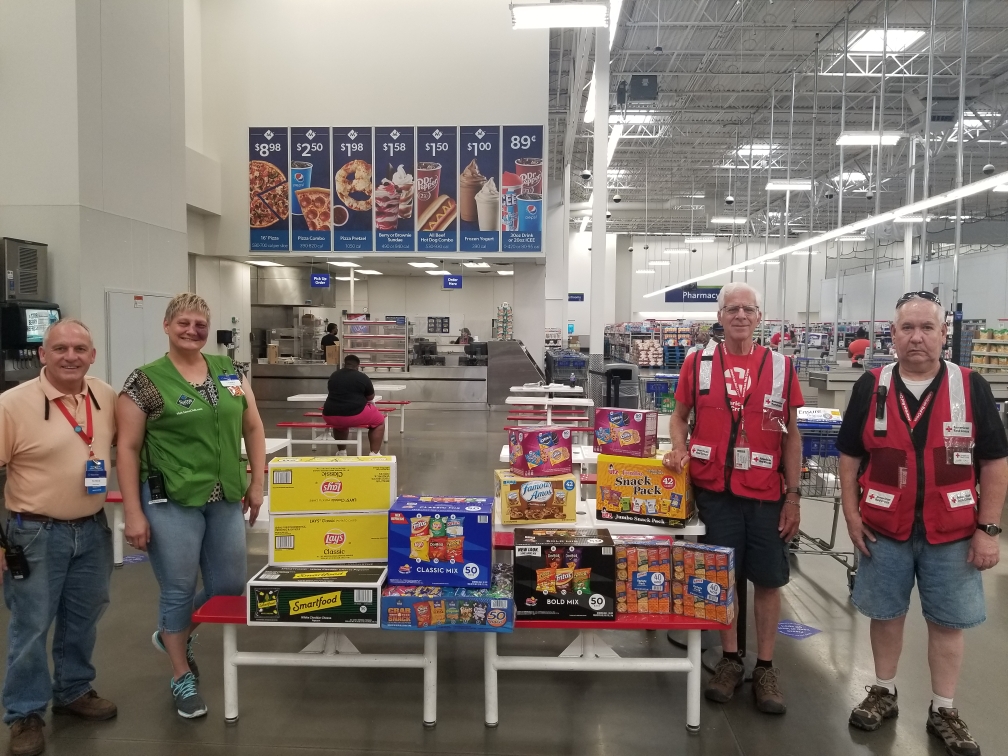
    And when Red Cross disaster volunteers Steve Thomas and Larry Daly went to pick up additional snacks at Sam’s Club in Willow Grove for clients on the second day of the MARC, store manager Patrick generously donated the $140 purchase.

    Sam’s Club in Willow Grove donates snacks to the Red Cross for residents at the MARC.

    Another example is the Salvation Army of Eastern Pennsylvania, which worked with the Red Cross since the third day of the response to provide impacted residents with meals and snacks, as well as additional clean-up kits and other services.

    As the Red Cross transitions from the response to the recovery phase for this disaster, recovery specialists will continue to work with impacted families to plan next steps and connect them with organizations that specialize in solving problems and meeting their specific needs.

    The vital work of the Red Cross is made possible by volunteers who contribute their unique backgrounds, talents and skills. To find a volunteer opportunity, visit redcross.org/volunteer.

    Red Cross disaster volunteers Steve Thomas and Larry Daly hand out clean-up kits at the MARC.
  • Flash Flooding 101

    By Alana Mauger

    Heat waves with high humidity. Thunderstorms with heavy rain. Flash flood warnings and watches. Rinse, repeat. It’s summer in Southeastern Pennsylvania, and the American Red Cross wants to help keep everyone safe from flash flooding.

    According to the National Weather Service, flash flooding is most often caused by heavy rainfall from thunderstorms and can occur anywhere – along neighborhood streams and creeks as well as on city streets and highway underpasses. Flash flooding is especially dangerous because of how quickly it occurs. People are often caught off guard and may become trapped on roadways and in buildings by fast moving or rising water.

    The Red Cross offers four common sense ways to make sure you’re prepared in the event of a flash flood:

    • Be Informed – Listen to local radio, NOAA radio or local television stations for the latest information and updates. Pay attention to weather conditions in your area and listen to the advice of local officials.
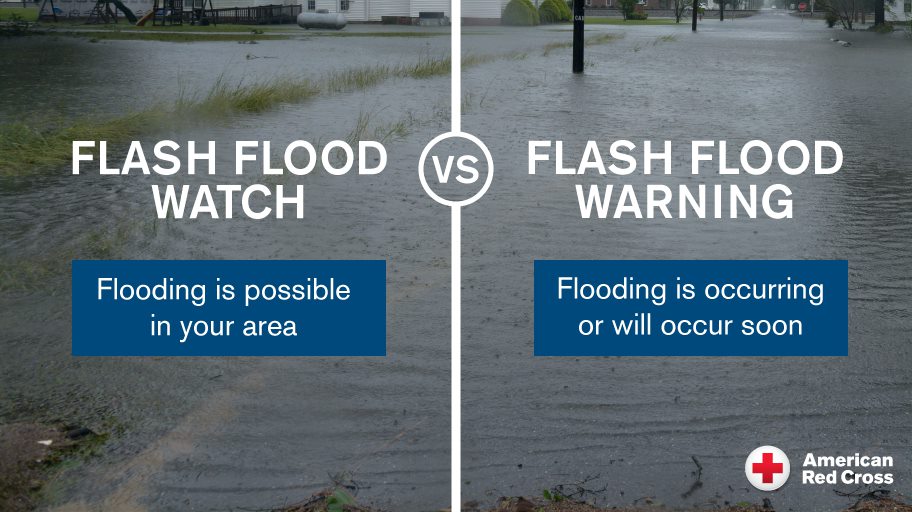
    • Be Educated – Know the difference between a flash flood watch and a flash flood warning. A flash flood watch means that a flood is possible in your area. A flash flood warning means flooding is already occurring or soon will be. If there’s a flash flood warning for your area, stay at or seek higher ground immediately and follow any evacuation orders.
    • Be Prepared – Check your emergency kit and replenish any missing items. Keep it nearby.
    • Be Safe – Turn around; don’t drown. NEVER drive through water. If you are caught on a flooded road and water is rising around you, get out of the car quickly and move to higher ground. Most cars can be swept away by less than two feet of moving water. Also, stay away from flood water if you’re walking. Never cross a flowing stream where water is above your ankles. And of course, keep children and pets out of the water.

    Visit the Flood Safety section of the Red Cross website to learn more or download the free Red Cross Emergency App from any app store.

  • Local heroes awarded Certificates of Merit for lifesaving efforts

    By Alana Mauger

    During a virtual ceremony on June 16, the American Red Cross awarded Certificates of Merit to Margaret Root and Dylan L’Heureux for extraordinary actions they took to save lives in emergency situations. The Certificate of Merit is the oldest and most prestigious Red Cross Lifesaving Award. It is signed by the President of the United States, who traditionally serves as the Honorary Chairman of the Red Cross.    

    “These individuals are true heroes and stewards of the Red Cross mission, and we commend them for their willingness to help others in distress,” said Jennifer Graham, executive director, Red Cross Delaware Valley Chapter.

    Margaret Root

    The first Certificate of Merit was presented to Margaret (Meg) Root who came to the aid of a co-worker suffering from cardiac arrest on Jan. 9, 2020. She assessed that the victim was pulseless, apneic and extremely cyanotic. While Meg went to retrieve an AED, another employee administered CPR until she returned to the scene. Meg was able to revive the victim until EMS arrived.

    Despite being a registered nurse and participating in CPR training for more than 30 years, Meg acknowledged this is the first time she had to use those skills in an emergency situation. 

    “As a nurse, I feel it’s my call of duty to help; it’s just what I was supposed to do,” she said. “I was really fortunate to have the Red Cross training.”

    As part of her employer’s first aid team, Meg and her colleagues received Red Cross Basic Life Support for Healthcare Providers training in 2019.

    “It was quite an event,” Meg continued. “This person was unresponsive, and 20 minutes later, he was alive and talking. For the AED to talk me through it and for him to respond, it was really remarkable.”

    Dylan L’Heureux

    The second Certificate of Merit was presented to Dylan L’Heureux, who saved a woman from choking on Sept. 8, 2020. As she was getting out of her car in a Target parking lot, Nancy Lewis began choking on a large calcium pill she was trying to swallow. She saw Dylan sitting in his car, tapped on his window and put her hands on her throat in the universal sign for choking.

    An experienced lifeguard, Dylan immediately sprang into action. He jumped out of his car and performed back blows and abdominal thrusts until Nancy could breathe again. He also stayed with her for 20-30 minutes until she was calm and able to breathe comfortably.

    “That was my first experience as far as saving anybody,” Dylan shared, noting that the pool for which he is a lifeguard stresses prevention, and he hasn’t had to “go above and beyond” in the water.

    “It was that realization that, wow, all the skills I’ve been training…this is what it was meant for. And just recognizing I know what I’m doing here was a very neat experience,” he said. “I’m so grateful to be put in that position where I could help someone else.”

    Dylan is certified in Red Cross Lifeguarding with CPR/AED for Professional Rescuers and First Aid, among other training.

    Lifesaving Awards program

    The Red Cross Lifesaving Awards program is comprised of four awards. In addition to the Certificate of Merit, the Lifesaving Award for Professional Responders and Healthcare Professionals is given to trained people who respond to emergencies as part of their work. The Certificate of Extraordinary Personal Action goes to people who lack Red Cross training but who step up during an emergency. Finally, the Lifesaving Instructor Award is given to instructors who teach the skills that help save or sustain lives.

    You can nominate and recognize a person or group who have used the skills and knowledge gained in Red Cross training courses to help save or sustain a life. Visit LifesavingAwards.org to get started. 

  • A Black History Moment at the American Red Cross

    Each February, the nation and the American Red Cross celebrate Black History Month. All this month here on the Red Cross Philly blog we honor our Black colleagues that are part of our local Red Cross team. We invited them to be guest bloggers to share their thoughts and stories as proud Red Crossers that make up our diverse team here in Southeastern Pennsylvania. Please note, the views expressed in this blog post are of the author and not necessarily those of the American Red Cross. To learn more about Diversity and Inclusion values at the Red Cross, please visit https://www.redcross.org/about-us/who-we-are/governance/corporate-diversity.html.

    Today’s blog is written by Andree Baylor-Lloyd, Director of Fixed Site Collections, American Red Cross

    As a Black Leader in my current role of Director of Fixed Sites of the Northeast division, I have learned through my interactions with co-workers, donors, and volunteers that each has a unique story. In those stories, you get to know so much beyond the person’s role. These stories, small and great, have shaped our workforce. It allows interaction between individuals that bring value into our culture and the opportunity to experience our uniqueness.  

    Black History Month’s importance resides in the greatness of the people who have made this history so rich through their achievements. Black History continues to develop in the lives as our ancestors’ stories and should not be forgotten.  There are so many areas of excellence, but what resonates with me is the culture of storytelling. From generation to generation, black people have been inspired through a message of hope, love, and perseverance. These stories allow the new generation to dream and be hopeful of a bright future.

    Black history reminds us of courageous folks like those of the Underground Railroad. The historic moments like the famous “I Have a Dream” speech by Dr. Martin Luther King Jr. and Kamala Harris, the first Black and Asian American Vice President of the United States.  But these are only a few of the significant and important events to know and remember.

    To honor this extensive and growing history, Black History Month was established by way of a weekly celebration in February known as “Negro History Week” by historian Carter G. Woodson. But just as Black History is more than a month, so are the numerous stories and figures often overlooked during it.

    The diverse history of Historically Black Colleges and universities

    While Jewish and African American communities have a tumultuous shared history when it comes to the pursuit of civil rights, there is a chapter that is often overlooked. In the 1930s, when Jewish academics from Germany and Austria were dismissed from their teaching positions, many came to the United States looking for jobs. Due to the Depression, xenophobia, and rising anti-Semitism, many found it difficult to find work, but more than 50 found positions at HBCUs (Historic Black Colleges and Universities) in the segregated South.

    Originally established to educate freed slaves to read and write, the first of the Historically Black Colleges and Universities was Cheyney University in Pennsylvania, established in 1837. By the time Jewish professors arrived, the number of HBCUs had grown to 78. At a time when both Jews and African Americans were persecuted, Jewish professors in the Black colleges found the environment comfortable and accepting, often creating special programs to provide opportunities to engage blacks and whites in meaningful conversation, often for the first time.

    In the years that followed, the interests of Jewish and African American communities increasingly diverged, but this once-shared experience of discrimination and interracial cooperation remains a key part of the Civil Rights Movement.

    Main image description: Photo of Andree Baylor-Lloyd

  • Cancer survivor received lifesaving blood as a child, last year he hosted 44 blood drives to pay it forward

    By: Sophie Kluthe 

    When you first walk through the doors of a blood drive at the Towamencin Mennonite Church in Harleysville, Montgomery County, you’ll come face to face with a Red Cross poster featuring a boy who survived cancer, in part, thanks to lifesaving blood. Walk a few feet down the hall and you’ll find that same boy, now a young man, hard at work to make this blood drive, and hundreds of others, a reality.  

    Peter Zucca was only 10 months old when he was diagnosed with cancer. Within a year, he received 51 units of blood during various operations, and those transfusions helped save his life. When he was 12, Peter called the Red Cross asking to host a blood drive so that he could help give back those 51 units. Now Peter is almost 18 and he hasn’t stopped giving back since.  

    “Growing up in the hospital environment you just know that everybody’s getting it,” he said referencing donated blood. “I have a great connection with the Red Cross now and it’s just my own will to help and to continue helping because I know that what I’m doing is making a big difference in people’s lives.” 

    Several years ago, Peter and his mother Dawn founded the Peter Powerhouse Foundation, which seeks to improve the lives of children who are currently fighting cancer by providing donations to pediatric cancer treatment facilities and financial support to childhood cancer survivors and their families. This foundation has become an important partner to the Red Cross, with Peter and Dawn hosting hundreds of blood drives and collecting thousands of units of blood at their church. When the pandemic hit in March of 2020, shutting down businesses, schools, and other blood drive locations, the Zuccas offered their church as an emergency blood drive site every day for two weeks. In the 52 weeks that made up 2020, the mother-son team organized 44 blood drives, collecting nearly 4,800 blood donations for patients in need.  

    “Dawn and Peter Zucca are the most extraordinary people I’ve met during my 38 years with the American Red Cross,” said Rosanne Marks, a donor services account manager with the American Red Cross. “The Peter Powerhouse Foundation blood drive has become the ‘go-to’ blood drive in Montgomery County. The donors are treated like gold and often fed and pampered so that they have a great experience giving blood and come back over and over.” 

    Look behind the scenes and you’ll notice that Peter and Dawn aren’t just the face of these drives, they do the leg work as well, including frequent communication and outreach to donors, enlisting support from their church to host blood drives, physically setting up and breaking down from blood drives, and more. Recently during a snowstorm, Dawn called and followed the township salt truck to make sure the route to the church parking lot was cleared to prevent delays at that day’s drive. She also personally shoveled all the church sidewalks to allow Red Cross staff to move equipment and start on time. For Dawn, that effort is fueled by painful memories.

     “It’s really easy for me and my husband to look back and to know that without blood, we wouldn’t have our son,” she said choking back tears. “I can shovel a lot of snow to open a church to know that somebody else’s child gets to live.” 

    Peter Zucca is now an accomplished high school senior who is also taking college courses. He’s a member of the Red Cross Delaware Valley Chapter’s board and is already an accomplished humanitarian. About 17 years ago his mother was grappling with a baby going through chemotherapy, surgeries and more. Now she’s a proud mom of a teenager, getting ready to send him off to college in the fall. She said Peter double checked to make sure they host blood drives on campus so he could take his work with him. While he’s paid his 51 units back many times over, it’s probably safe to say he’s not done paying it forward quite yet.  

  • COVID-19 during Flu Season: What You Need to Know to Stay Safe

    By Caitlin McLafferty

    In these challenging times, the American Red Cross is never far away. If you need information on emergency preparedness and coronavirus safety, you can find it at RedCross.org; just click on “Get Help.” And since winter is and the pandemic are both in high gear right now, avoiding the flu is paramount. Much of the advice on avoiding coronavirus also applies to keeping seasonal flu out of your house, so please refer to the Red Cross’s flu safety tips and Seasonal Flu Checklist. To protect yourself and your loved ones, here’s more info that bears repeating:

    Daily recommendations

    • Mask up: Cover your mouth and nose to avoid unwittingly infecting others. (Remember, people without symptoms can still carry the virus.) For information about masks, check the CDC guidelines here.
    • Keep your distance: When outside of your house, try to stay at least 6 feet away from others, and wear a mask. It’s safest to avoid crowded places and gatherings where it may be difficult to maintain that 6-foot buffer zone. These gatherings can infect many people in a short amount of time, so masks are especially important in those situations. For more, see the CDC’s social distancing guidelines.
    • Wash your hands: Use soap and water and lather up for at least 20 seconds. If soap and water are not available, use an FDA-approved hand sanitizer that contains 60% to 95% alcohol.
    • Know the symptoms: COVID-19 symptoms can appear two to 14 days after exposure. They include (but are not limited to) fever or chills, cough, shortness of breath or difficulty breathing, fatigue, muscle or body aches, headache, new loss of taste or smell, sore throat, congestion or runny nose, nausea or vomiting, and diarrhea.
    • Consider those at greatest risk: While anyone can become seriously ill with COVID-19, some populations are especially vulnerable. These include people over age 65, nursing home residents. and those with weakened immunity and chronic medical conditions (such as liver, kidney, and disease; lung conditions; diabetes; and cancer). If you’re around people deemed most at risk, take extra precautions.

    Travel

    Since the entire nation is currently experiencing a coronavirus surge, it’s important to limit your travel to necessary trips. This helps control the spread and keeps your loved ones and community safe. Even though you miss your out-of-town family and friends, you can stay in touch via phone and video calls, texts, and emails.

    • If you have been exposed to anyone who has symptoms or tested positive, do not travel.
    • If you believe you have symptoms yourself or have tested positive, quarantine! Do not travel.
    • If anyone at your travel destination has recently experienced symptoms or tested positive, do not travel.

    If you absolutely must travel, the CDC recommends getting tested one to three days before your trip. Make sure you have masks, hand sanitizer, and sanitizing wipes.

    After traveling: Quarantine and wear a mask around everyone, including others in your household who did not travel. Heed the daily recommendations above. The CDC also recommends getting tested three to five days after traveling to see if you were exposed during travel.

    Vaccinations

    Seasonal flu: Get yourself vaccinated against the flu. This lowers your risk of getting sick and infecting others. In a time when hospitals are trying to serve all patients—including those with needs unrelated to COVID-19—it’s important to prevent hospitalizations from seasonal illnesses such as flu.

    Coronavirus: When eligible, get the coronavirus vaccine. The vaccine has the ability to save countless lives. Currently, health care workers and nursing home residents have begun to receive the shot, per recommendations from the Advisory Committee on Immunization Practices. The next round of recipients will be front-line essential workers, such as educators and public transit employees, as well as people over the age of 75. Next up will be people ages 65 to 75, along with younger people (age 16 and up) who have underlying medical conditions. Eventually, everyone will be eligible; the distribution timeline is not finalized. In order for the vaccine to truly end the pandemic, people have to be willing to take the vaccine.

    Prior to receiving the vaccine, check in with your health care provider. If you have a history of allergic reactions, make sure to disclose it prior to receiving the vaccine. If you’re pregnant or breastfeeding, seek advice from your doctor, since data on the vaccine for pregnant women is limited.

    Everyone—with and without allergies—will be monitored for reactions. People with food or medication allergies or a family history of allergies can still receive the vaccine; they’ll be monitored for 30 minutes after getting the shot. Those without allergies or a history of reactions will be monitored for 15 minutes. Providers on site will be prepared to immediately react and treat anyone who shows signs of a reaction. If your known allergy requires that you carry an epinephrine auto-injector (EpiPen®), bring it with you; however, health care providers will have necessary resources to treat a reaction.

    Primary image description: A square design with two hands washing with soap on a teal-colored background. Above the hands are the words: Spread love. Not germs.

    Secondary image description: A horizontal design with an image on the right of a mug, a box of tissues, some loose tissues, and a pair of reading classes. A red block of text on the left reads: Flu Safety Tips | Handle your own belongings. | Wash your hands often with soap and water. | Carry hand sanitizer and anti-bacterial wipes with you.

  • For couple displaced by apartment fire, Red Cross “helped ease our hardship”

    By: Sophie Kluthe

    With less than 10 days to go before Christmas, Tyrel Whipple was not expecting to spend the cold morning of December 16th clearing what he could out of his apartment in Warminster, Bucks County. 

    Overnight, the fire department had rushed to the scene after one of the building’s units went up in flames. Because of the smoke, water and fire damage, all of the residents had to find somewhere else to stay. A Red Cross disaster response volunteer had arrived on scene early in the morning to figure out what kind of support residents like Whipple would need.  

    The hallway in Whipple’s apartment building a few hours after the fire was put out.

    Walking from the building to his car, holding a cardboard box filled with his possessions, Whipple said, “It’s going to cover me a place to stay until I can get everything figured out.” 

    He was among several residents from the building to work with the Red Cross, saying it made a huge difference in those crucial first days of recovery.  

    “All the help we received definitely helped ease our hardship.” Whipple said. 

    Whipple says the Red Cross had a hand in later steps of his recovery as well because of the referrals made to him by recovery specialists, connecting him with other organizations that could help fill a range of needs and replace various items lost in the process.  

    “We are really grateful for the help of your organization during our displacement,” Whipple said. “Another lady from your group has set me up with another group that can help us with resources for getting new furniture for when we can find another place to live.  The Red cross has been really amazing!” 

    The scene outside Whipple’s apartment building while residents were gathering their belongings.

    The apartment fire that displaced Whipple and his significant other was one of 521 home fires the Red Cross responded to last year in Southeastern Pennsylvania, providing emergency assistance to 2,734 displaced residents.  

    To learn more about what the Red Cross does in Southeastern Pennsylvania, visit: https://www.redcross.org/local/pennsylvania/southeastern-pennsylvania/about-us/our-work.html