Category: Uncategorized

  • A personal journey in honor of Black History Month

    In celebration of Black History Month, we invited colleagues to share their thoughts and stories as proud Red Crossers that make up our inclusive team in Southeastern Pennsylvania. Please note, the views expressed in this post are of the author and not necessarily those of the American Red Cross. Learn more about our culture of mission, impact and inclusion.

    By Samantha Munro

    Selfie of Samantha Munro
    Samantha Munro is a Technologist in the Immunohematology Reference Lab and is a Communications volunteer.

    We never think of ourselves as being part of history one day, let alone our journey. However, it is important to know that you are, and your story can make a difference in the lives of others. Since I’ll be writing from the standpoint of a Black American, no matter who you are or where you’re from, my hope is for you to gain insight and understanding that may help you through your own life’s journey. Being Black in America is ever-changing and stagnant at the same time, depending on where you are and who you are around. I’ve had a variety of experiences, some positive, some negative, and some funny. 

    I’ll start with a funny story. When I was volunteering on a Navajo Reservation in New Mexico while visiting a school, one of the children, maybe around 6 years ( but don’t quote me on that), came up to me and started to rub my forehead. She said, “It won’t come off!” I hurried into the restroom to see what was on my forehead, and there was nothing. I quickly realized what it was.

    Later that evening, our group met to talk about the day. I mentioned what happened — might I say that within my group, I was the only Black person there (the only minority). Our group leader understood, she said that I was probably the first Black person she (the little girl) had ever seen. In all fairness, it was also the first meeting of a different group of people of her ethnicity for me as well! I loved my visit, the people, and the culture. I’ve always wanted to go back, but I graduated as the volunteering was through the United Campus Ministries group in college and thus, I never got to go back.

    Like I’ve said, I have experienced the positive and the negative, but with everyone, no matter what they look like. What I have come to realize is that it’s less of a race issue and more of a soul issue. Some people will never like you and will look for something to use against you. Some people don’t even realize the hidden prejudices they have. 

    This is why I love volunteering. Yes, you are recognized for who you are, your experiences, and with that, you can give back to the community. Volunteering has even helped me in my working life. On the job, you face everyday challenges such as competition; yes, it can be healthy, but it can also be toxic. As anger and rage have been growing throughout the world due to many injustices, that anger can seep into the workplace and manifest in different ways. 

    Volunteering is my Soul Food — so ask yourself what is yours? Considering being a volunteer at the American Red Cross will not only bring joy to your life but also to the lives of others.  Sign up today.

  • National Blood Donor Month: Tracy Hampton champions the fight for sickle cell warriors

    By Terri Seydel

    Tracy Hampton doesn’t just donate blood—she champions it. As a self-described sickle cell fighter, she has turned her personal commitment into a movement, inspiring others to see blood donation not as a chore, but as a powerful act of solidarity. For Tracy, every pint of blood is a promise: a promise to ease someone’s suffering, to stand with sickle cell patients, and to fight for a healthier future.

    Tracy’s blood donor journey began when she was 18, inspired by her mother, who worked at the Children’s Hospital of Philadelphia and donated regularly. Her commitment followed her through college and military service with the U.S. Air Force, but gained a deeper meaning when the Red Cross alerted her that she is a Rare Donor Type with blood factors most beneficial to sickle cell patients.

    Now a Pharmacist at Temple University Hospital, she began learning more about the impact of sickle cell when a work colleague shared his own sickle cell patient journey.  His story and the red cross commitment to helping sickle cell patients, coupled with her unique ability to donate this specific blood type, made her own commitment grow deeper and even more meaningful.

    African American woman wearing a black shirt and tan pants stands with her hands on her hips in front of a lit backdrop that looks like an aquarium.
    Tracy Hampton champions blood donations for sickle cell warriors. Submitted photo

    Why Tracy’s Activism Matters

    Sickle cell disease is the most common inherited blood disorder in the U.S., affecting about 100,000 people, primarily of African descent. The disease causes red blood cells to become rigid and crescent-shaped, leading to painful blockages, anemia, and organ damage. Symptoms can begin as early as infancy, and for many patients, blood transfusions are the only way to manage these complications.

    The challenge is that sickle cell patients often need very closely matched blood, and those matches are most likely to come from donors of similar backgrounds. Because of this, the supply isn’t always as diverse as the need. Tracy’s activism helps bridge that gap. By donating herself and inspiring others to join in, she’s strengthening the blood supply and making it more inclusive for everyone who depends on it.

    The Red Cross Connection

    The American Red Cross has recognized the urgent need for specialized blood donations for sickle cell patients. Their initiatives include:

    • Targeted blood drives that encourage donors from communities most affected by sickle cell disease.
    • Sickle cell trait screening for donors offers valuable health insights while identifying the best matches for patients.
    • Awareness campaigns that highlight the importance of diverse blood donations and their lifesaving impact.

    A Personal Connection to the Cause

    For Tracy, donating blood is more than a routine; it’s deeply personal. Each time she gives, her blood is marked with a distinctive blue tag, ensuring it is set aside specifically for sickle cell patients who need closely matched transfusions. Through the Red Cross Blood Donor App, she follows the journey of her donation, seeing where it travels and knowing it has reached someone whose name she may never know but whose life she has touched. That connection fuels her commitment.

    Her dedication has already earned her 30 Red Cross donor badges, a milestone she wears with pride as a symbol of the impact one person can make on the larger community. But Tracy’s vision extends beyond her own contributions. She wants people to learn more about sickle cell disease and understand how profoundly it shapes the lives of patients and families. With greater awareness, she believes, comes greater compassion and a stronger collective commitment to help.

    At home, Tracy is raising two boys, ages 4 and 13, and hopes her example shows them that they are empowered to help others and give back to their community. For her, blood donation is not just about saving lives today; it’s about continuing a legacy of service and compassion passed down through generations of her family.

    Tracy’s story embodies the mission of these programs. She is living proof that one donor can spark change, and that activism can be as simple and as powerful as giving blood.

    Her activism reminds us that the fight against sickle cell disease isn’t fought in isolation. It’s fought in community, in compassion, and in the quiet courage of donors who choose to give. By following her lead, we can ensure that hope flows as surely as life itself.

    Join the Fight

    You can join Tracy’s mission to help improve and save lives by Learning more about Sickle Cell disease or scheduling an appointment to donate blood with the American Red Cross.

  • Protect yourself and your family from extreme winter cold

    By Cristina Turcato

    Illustration with a light blue background featuring a bright blue sweater and green hooded coat with the words: Red Cross graphic - Burrrr! Stay warm outside by changing wet clothing frequently to prevent body heat loss.
    Red Cross graphic – Burrrr! Stay warm outside by changing wet clothing frequently to prevent body heat loss.

    Every year, extreme cold weather affects millions of individuals and families across the U.S. Along with extreme temperatures, winter can bring frostbite, hypothermia and severe storms. During this season, it is important to take care of yourself and your family by following these safety tips, which cover winter shoveling and snowblower safety, as well as ways to stay warm in freezing temperatures.

    One way to stay safe in winter is to prevent hypothermia and frostbite. Hypothermia can occur at temperatures as high as 40°F, and a person can experience a dangerous drop in body heat when their temperature falls below 95°F. Frostbite can develop at temperatures below 32°F and affects exposed skin. Dressing in layers is one important prevention tip and is essential to staying warm. Avoid cotton clothing; instead, choose wool or polyester, which helps manage moisture and keep sweat away from the body. Additionally, wearing hats that cover the ears, along with scarves or face masks and mittens, can help protect against the cold.

    Another important prevention step is maintaining a safe home environment. Check the temperature in your home and make sure it stays at an optimal level of around 70°F. To prevent slips and falls, it is also important to salt driveways, garage entryways, sidewalks and roads. This helps prevent vehicle tires from sliding and reduces the risk of people slipping on black ice, which is often not noticeable at first glance.

    For snow shoveling and snowblower safety, there are important tips and precautions to keep in mind. When shoveling snow, individuals should wear waterproof gloves and consider using an ergonomic shovel for better grip and comfort. Proper technique is also important, such as slightly bending the knees, lifting with your legs instead of your back, and shoveling early and often. For snowblower safety, always read the safety manual before use and inspect the area for debris such as toys, rocks, or doormats. Never use your hands to clear a jam, even if the machine appears to be off. Instead, make sure the machine is completely powered off and use a tool such as a stick or broom to clear clogs.

    If someone is experiencing signs of hypothermia or frostbite, act immediately. Get out of the cold, remove any wet clothing, and seek help by using the Red Cross First Aid app. In general, it is important to listen to your body. If you feel lightheaded, overly fatigued, or unwell, stop what you are doing and seek help right away.

  • Resolve to Volunteer: Give the gift of time to help people in need

    By Alana Mauger

    Illustration of a multi-color beaded bracelet with square beads at the bottom that spell Volunteer.
    Red Cross graphic – Volunteer!

    As we start the new year, the American Red Cross is asking members of our community to help people in need by becoming a volunteer! Volunteers make up 90% of the Red Cross workforce and make the organization’s mission possible.

    You may be surprised to learn about the variety of volunteer opportunities the Red Cross has to offer. From supporting a family after a home fire, helping a member of the military during an emergency or ensuring that blood is available to those who need it, the Red Cross has something for everyone.

    Below are some of the most needed volunteer positions right now in Southeastern Pennsylvania:

    ⛑️ Disaster Action Team Specialist – Be a source of refuge and support when it’s needed most.Disaster Action Team responders provide 24-hour immediate support and assistance to individuals and families who have been impacted by home fires or other local disasters.

    📱 Disaster Action Team Duty Officer – Make a difference from the comfort of your own home! Duty Officers help families after home fires and other disasters by dispatching Disaster Action Team volunteers who provide essentials like shelter, food and clothing.

    🩺 Disaster Health Services Team Member – Put your professional credentials to work! We’re looking for licensed healthcare providers to deliver hands-on care and education to people impacted by disasters. 

    👩‍💻 Shelter Resident Transition Caseworker – Help families take the next step after a disaster. When large disasters strike, SRT volunteers work with shelter residents to identify resources, overcome roadblocks, and create personalized action plans that help families move toward a more sustainable living solution.

    🩸 Blood Transportation Specialist – Help deliver blood from our collection sites throughout Southeastern Pennsylvania and New Jersey to our lab in Philadelphia for testing and processing and/or to deliver blood products from our lab to hospitals. 

    🇺🇸 Service to the Armed Forces Reconnection Workshop Facilitator – Lead workshops that help service members and their loved ones strengthen emotional wellbeing. Must be a licensed mental health professional.

    🎖️ Veterans Affairs Voluntary Service Volunteer – Contribute to programs that improve veterans’ quality of life at VA health care facilities in Philadelphia and Coatesville.

    🗺️ Restoring Family Links Volunteer – Help identify and provide outreach to communities that might benefit from reconnection services for families separated by conflict, immigration, natural disaster, or other humanitarian crisis.

    To learn more about these roles and to fill out a volunteer application, visit redcross.org/volunteer.

  • Where recovery meets joy: Families return to the Red Cross House for a holiday celebration

    By Alana Mauger

    Hundreds of gifts were generously donated by Red Cross volunteers, staff and community partners for the annual Red Cross House Children’s Holiday Party. Photo by Dan Porter / American Red Cross

    When a fire broke out in the kitchen of their North Philadelphia apartment in April 2025, 8-year-old Saylon acted quickly, leading his father Anthony Crawley and twin sister Saylor to evacuate.

    “He saved me,” Saylor said, hugging her brother.

    For Anthony, a single parent raising two neurodivergent second graders, the aftermath was overwhelming, and he wasn’t sure where to turn. That’s when Disaster Action Team volunteers from the American Red Cross arrived.

    “The Red Cross came out and gave us direction because we didn’t know what to do,” he said.

    That guidance led the trio to the Red Cross House – a one-of-a-kind disaster recovery center in West Philadelphia where families can stay following a disaster. Here, families get a private room and key with a bathroom and three meals per day while they develop a recovery plan with a Red Cross caseworker.

    Anthony said the Red Cross House provided a clean and quiet place while he figured out their next steps.

    “The Red Cross helped a lot – with shelter, with funds and with clothing,” he said. “They helped tremendously for the situation I was in.”

    In a few weeks, Anthony was able to secure a new place for the family to live. When it came time to leave, he said Saylon and Saylor “didn’t want to go.” Saylor said she especially liked the outdoor playground, while Saylon’s favorite thing was the food.

    The twins and their father had the opportunity to revisit the Red Cross House last week for the annual children’s holiday party on December 17th, 2025. All families who stayed at the Red Cross House over the past year were invited back for the celebration.

    Anthony Crawley with 8-year-old twins Saylor and Saylon at the Red Cross House Children’s Holiday Party on Dec. 17, 2025. Photo by Dan Porter

    “Tonight is an opportunity for our volunteers and case workers to join up with the families that we have interacted with over the past year and celebrate the spirit of the season,” said Jennifer Graham, CEO, American Red Cross Southeastern Pennsylvania Region. “It’s our chance to see them on the next stop of their journey and celebrate how far they’ve come.”

    At the holiday party, families like Anthony’s enjoyed a kid-friendly meal – hot dogs, hamburgers, french fries and mac & cheese, cookie decorating, photos with Santa, Mrs. Claus and Red Cross mascot Fred Cross and a visit from the Philadelphia Fire Department complete with a real firetruck. The children received gifts thanks to the generosity of Red Cross volunteers, staff and community partners, like Lincoln Financial.

    “It’s amazing,” said Meghan Wright, executive director of Lincoln Financial Foundation, as she and her colleagues watched Santa and volunteers distribute hundreds of wrapped gifts.

    While they have supported the Red Cross House Holiday Party in the past, 2025 was the first time representatives from Lincoln Financial attended. Pictured: Alicia Smith, Meghan Wright, Chelsea Barrish and Hector Herrada. Photo by Alana Mauger / American Red Cross

    Like Anthony, Amie Wright and her children Shontell (13) and Massanic (9) also returned for the party. They stayed at the Red Cross House for 21 days after losing their home in an electrical fire in February 2025.

    That day, Amie’s husband was on his way out to run errands with the kids when a passerby pointed out smoke rising from their roof. The fire started at a bedroom outlet, where Amie had been asleep moments earlier. Thankfully, everyone escaped safely.

    When disaster volunteers came out and talked to them about the Red Cross House, Amie was hesitant at first, not wanting to stay in a shelter. But when the family arrived, she knew they made the right decision.

    “The food, the hospitality, the people – everyone was so welcoming,” she said.

    Being at the Red Cross House allowed Amie’s family to keep life moving. She drove the kids to school every morning, then used the quiet space and high-speed internet to work on her own college classes.

    She said everything was convenient, and the financial assistance helped her family start their recovery.

    “Just thank you, I thank the Red Cross so much for everything,” she said.

    Amie Wright with her children Massanic and Shontell at the Red Cross House Holiday Party on Dec. 17, 2025. The family of 4 stayed at the Red Cross House for 21 days in February. Photo by Dianne Heard / American Red Cross

    Between July 2024 and June 2025, the Red Cross House provided 175 families – 321 adults and 153 children – with disaster recovery services, including 3,204 overnight stays and 9,612 meals.

    Learn more about how the Red Cross House helps families rebuild after a disaster by visiting our website.

  • Heating safety matters: How to protect your home and family this winter

    By Vaishnavi Kalakota

    As temperatures drop, home heating becomes essential; however, it also becomes dangerous. After cooking, heating equipment is the second leading cause of home fires in the United States, with space heaters responsible for the majority of deaths and damage. Knowing a few simple precautions can protect your home, family, and community.

    Why Heating Safety Matters

    Not only is heating the second leading cause of home fires in the United States, but space heaters, in particular, account for the majority of heating-related fire deaths. Due to the dropping temperatures, winter months see a spike in heating-related emergencies. Many of these incidents are preventable through safe use and maintenance and by following the tips listed below.

    Graphic with the American Red Cross logo that reads: How to use a space heater: Place it on a nonflammable surface, not rugs. Ensure it has an auto shut-off feature if it tips over. Unplug the heater when you go to bed.
    How to use a space heater: Place it on a nonflammable surface, not rugs. Ensure it has an auto shut-off feature if it tips over. Unplug the heater when you go to bed.

    General Safe Heating Practices

    • Ensure that you keep anything that can burn at least 3 feet away from any heating equipment.
    • Never block vents, radiators, or heat registers.
    • Keep children and pets away from heat sources.
    • Install smoke alarms on every level of the home and test them monthly!
    • Install carbon monoxide (CO) alarms if using fuel-burning devices.
    • Create and practice a home fire escape plan.

    Space Heater Safety

    • Choose heaters with automatic shut-off if tipped over.
    • Plug space heaters directly into the wall and never use extension cords.
    • Turn heaters off before sleeping or leaving the room.
    • Place on a stable, flat surface.
    • Keep cords out of walkways.
    • Follow manufacturer instructions for spacing and wattage.

    Fireplace & Wood Stove Safety

    • Have chimneys and vents inspected and cleaned yearly.
    • Use a metal or heat-tempered glass screen to stop sparks.
    • Dispose of ashes in a metal container that you keep outside.
    • Burn only dry, seasoned wood.
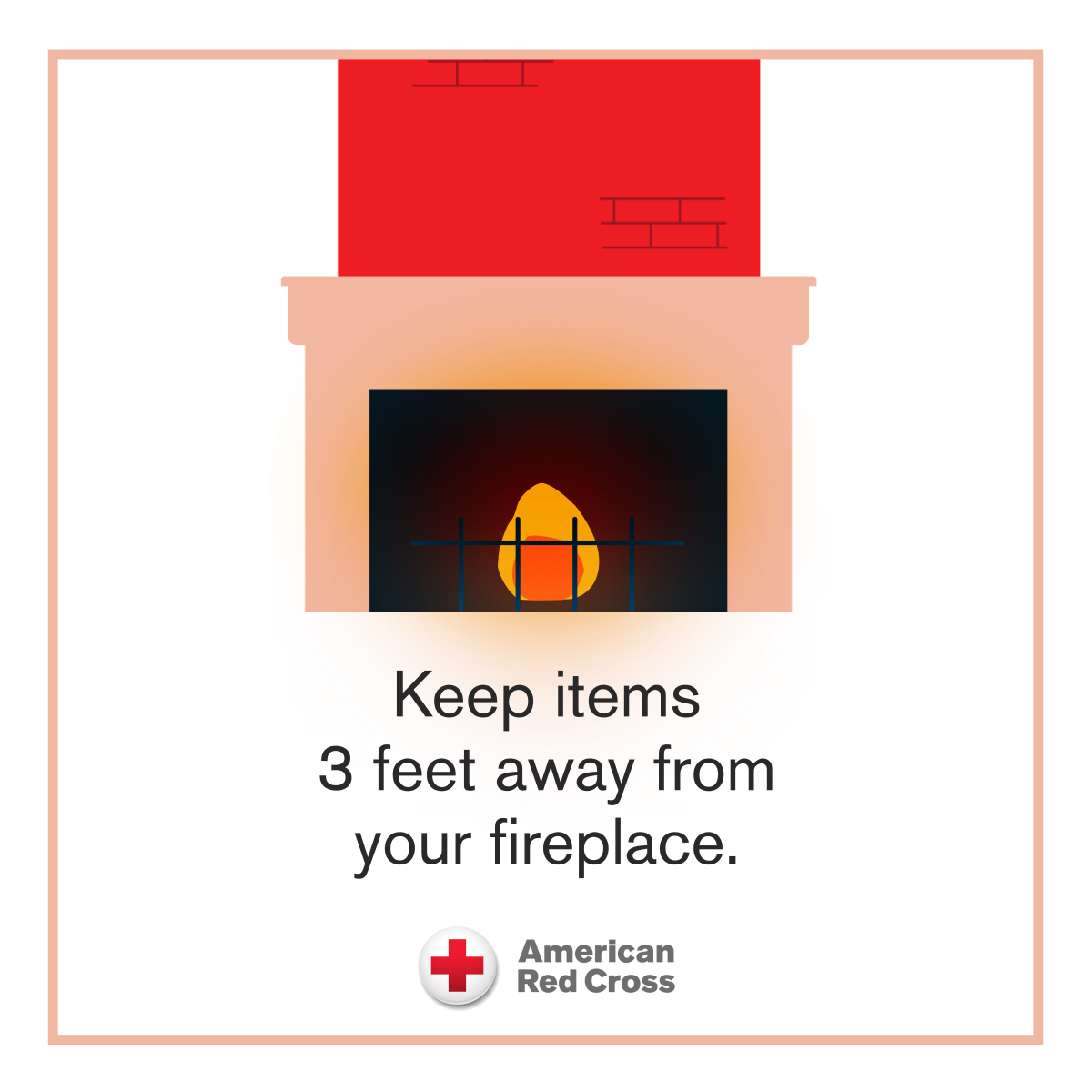
    • Keep flammable items away from fireplace openings.
    Graphic with American Red Cross logo and illustration of a fire place that reads: Keep items 3 feet away from your fireplace.
    Keep items 3 feet away from your fireplace.

    Furnace, Boiler & Central Heating Safety

    • Schedule annual professional inspections!
    • Replace filters regularly to prevent overheating.
    • Ensure furnace rooms have adequate ventilation.
    • Keep combustible materials away from the unit.

    Carbon Monoxide Prevention

    • CO is produced by all gas heaters, fireplaces, wood stoves, and generators.
    • Install CO alarms outside sleeping areas.
    • Never run ovens, grills, or generators for heating.
    • If the alarm sounds → move outdoors immediately and call 911.

    What to Do in an Emergency!

    • Call 911
    • Use a fire extinguisher only if the fire is small and contained.
    • Evacuate immediately if the fire spreads.
    • Never re-enter a burning home.

    Heating is necessary in winter, but it comes with risks that are easy to prevent. Simple steps, such as using heaters safely, maintaining equipment, and having working alarms, can significantly reduce the risk of a home fire. By following guidance from organizations such as the American Red Cross, National Fire Protection Association, and the U.S. Fire Administration, families can stay warm while keeping their homes safe.

  • Help kick cancer: Your platelet donation can save lives

    By Samantha Antenucci, Jenny Farley and Alana Mauger

    October is Breast Cancer Awareness Month — a time to raise awareness, honor survivors, support those in treatment and remember those we’ve lost. It’s a month filled with stories of courage and resilience and a reminder that the fight against cancer continues every day.

    While that fight can feel overwhelming, there’s one powerful way anyone can help: donating blood and platelets. Cancer patients often rely on transfusions during treatment, especially when chemotherapy affects their ability to produce healthy blood cells. Your donation can provide strength, hope and healing — and may even help save a life.

    Graphic with light yellow background featuring an illustrated heartbeat line with hands cupping a dark yellow heart and a dark yellow platelet drop hanging from it. Below it is text in burgundy and black: Platelets are lifesaving reinforcements in the battle against cancer.
    Red Cross graphic – Platelets are lifesaving reinforcements in the battle against cancer.

    Donating platelets

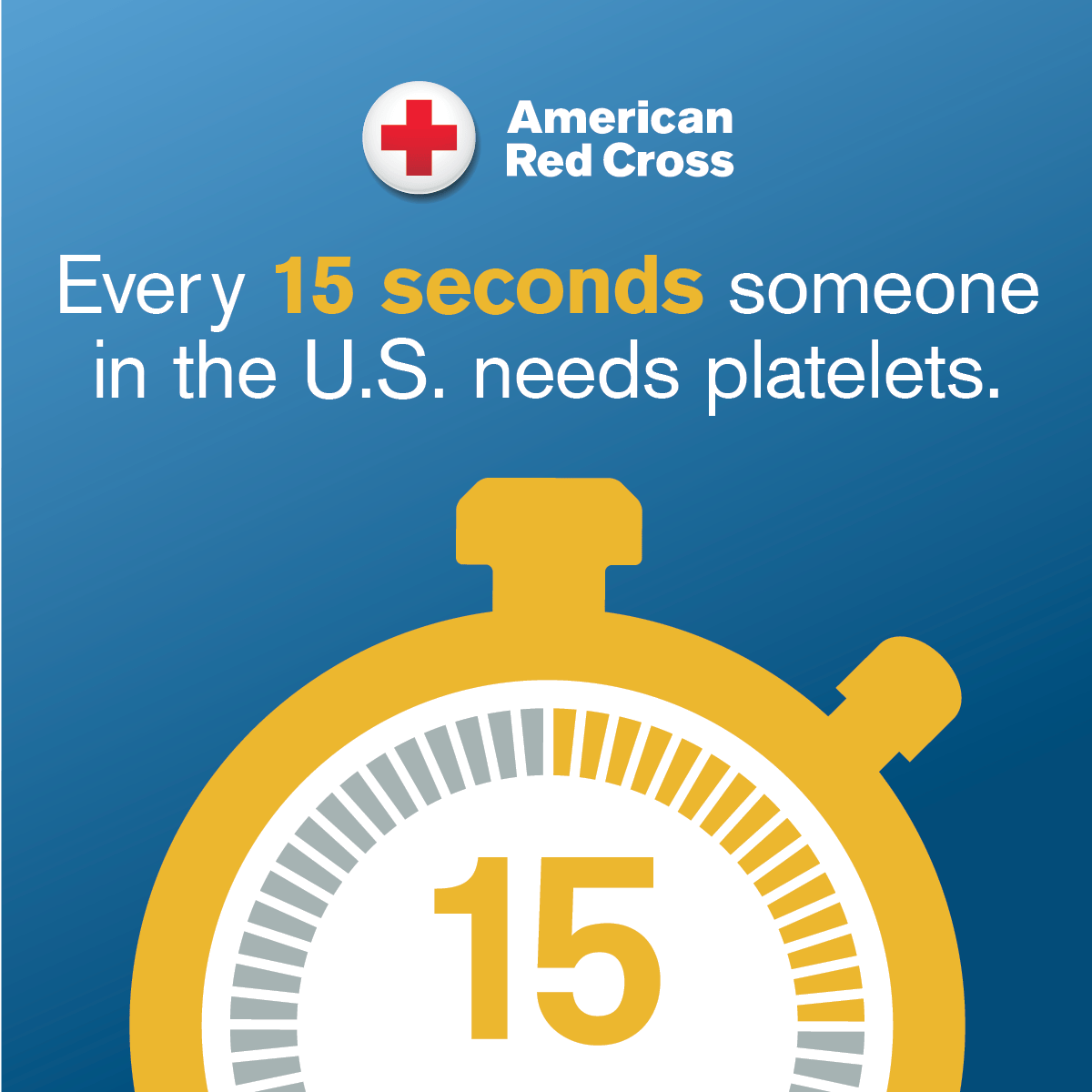
    Platelets are tiny cells in your blood that form clots and stop bleeding. For millions of Americans, they are essential to surviving and fighting cancer, chronic diseases and traumatic injuries. In fact, every 15 seconds someone in the U.S. needs platelets.

    Donating platelets is a bit different than donating whole blood. A typical blood donation takes about one hour, while a platelet donation takes 2-3 hours and must be done at a Blood Donation Center by appointment.

    During the process, blood is drawn from one arm and passed through an apheresis machine, which extracts the platelets. The remaining blood components are then returned to you through the other arm.

    Because platelets must be used within five days of donation, new donors are always needed. People with blood types A+, A−, B+, O+, AB+ and AB− are encouraged to donate. You can donate platelets up to 24 times per year.

    Red Cross video: Platelets Explained in Two Minutes. Watch it on You-Tube.

    Why blood and platelet donations matter

    You might not realize how vital a blood or platelet transfusion can be in cancer treatments. Nearly 50% of all donated platelets and 25% of all donated blood products go directly to cancer patients.

    Treatments like chemotherapy and radiation can severely reduce red and white blood cell counts and lead to complications like anemia, infection and difficulty clotting. Chemotherapy can also damage bone marrow, which is where platelets are produced. When platelet levels drop, the body’s ability to form clots is compromised — even small cuts or bruises can lead to dangerous bleeding.

    Patients with leukemia, lymphoma and other blood cancers often depend on frequent transfusions to survive. Those undergoing bone marrow transplants or major surgeries to remove tumors also require blood products to aid in recovery.

    Graphic with blue background featuring an illustrated yellow and white stopwatch with the number 15 in the center of it. Above the stopwatch are the words: Every 15 seconds, someone in the U.S. needs platelets.
    Red Cross graphic – Every 15 seconds someone in the U.S. needs platelets.

    Be a cancer kicker

    Because so many cancer patients rely on platelet donations, donors like Bucks County resident Gary LaSasso are often called Cancer Kickers.

    When Gary’s young cousin was diagnosed with Leukemia four years ago, he wanted to help in any way he could.

    “I knew that he was going to be in need of constant platelets during his treatments, and I thought I would do my part to help refill the platelet population – replenish the platelets,” he said.

    That desire to help turned into a personal mission. Gary now donates platelets 18 times a year.

    Initially, he planned to donate once a month – until a conversation in the donor canteen changed his mind.

    “I sat down in the canteen after one of my donations and another donor thanked me for my donation. I thought it was kind of strange, why is a donor thanking a donor?”

    Gary asked the donor why? Her answer stuck with him.

    “She said, ‘We just moved from Chicago. Our son is undergoing clinical trials at CHOP in Philadelphia and if he doesn’t get platelets every week he’s going to die. It’s people like you who donate that save his life.’ So, at that point I was like I can’t give once a month. I have to give more.”

    Gary doesn’t just donate; he inspires others to join him.

    “My 18 is one thing but if I can get two or three other people to give 10 times, that’s many more than I’m giving, so I like to use social media to spread the word and hopefully get more people.”

    Thinking about giving it a try? Gary has some advice.

    “Do it once. Join the Facebook group of platelet donors of the Red Cross, and when you’re around a community and you understand the impact that you’re making, you won’t just do it once. You’ll give a lot more.”

    Photograph of a man sitting on a platelet donation chair with needles in both arms wearing a T-shirt that reads "Platelet donor for life."
    Gary LaSasso donates platelets at the Red Cross Blood Donation Center in Langhorne. Photo by Jenny Farley / American Red Cross.

    Ready to donate?

    To schedule an appointment, visit RedCrossBlood.org, use the Red Cross Blood Donor app or call 1-800-RED CROSS (1-800-733-2767).

  • Ready to ShakeOut? Join the global earthquake preparedness drill Thursday

    By Vaishnavi Kalakota

    Blue and white graphic that reads: Join us in the world's largest earthquake drill. October, 16, 2025. Register: ShakeOut.org.
    ShakeOut graphic – Join us in the world’s largest earthquake drill. October, 16, 2025. Register: ShakeOut.org.

    Every year on the third Thursday of October, millions of people across the world take part in the Great ShakeOut, a global earthquake drill that teaches everyone how to stay safe when the ground starts shaking. The key steps are simple but lifesaving: Drop, Cover, and Hold On.

    1. Drop to your hands and knees before the earthquake knocks you down.
    2. Cover your head and neck under a sturdy desk or table. If there’s no shelter nearby, cover your head with your arms and crouch near an interior wall.
    3. Hold On to your shelter until the shaking stops.

    This year’s drill officially takes place on October 16th, but you can do your own drill at any time. To make the experience real, my family, friends, and I joined in the ShakeOut drill this week. We practiced in our living room, timing how long it took for everyone to get to safety. “It felt weird pretending there was an earthquake,” said my brother, “but now I know what to do if one happens.” 

    After the drill, we discussed creating an emergency kit and planning safe meeting spots. The drill lasted just a few minutes, but it made a big difference; we’re all a little more prepared now. 

    Photos of two people sitting under tables with their hand covering their heads illustrating what to do during an earthquake.
    Red Cross volunteer Vaishnavi Kalakota photographed members of her family participating in their ShakeOut drill earlier this week.

    To participate, go to ShakeOut.org/register and pledge your family, school, business, or organization’s participation in the drill. Registered participants will receive information on how to plan their drill and involve others. At the minimum practice one of the recommended protective actions listed at ShakeOut.org/dropcoverholdon. It is only a one-minute commitment for something that can save your life. 

  • August is National Make-A-Will Month

    By Colleen Becht-Foltz, American Red Cross Gift Planning Officer

    Photo of an iPad propped up on a table outside showing the Red Cross webpage with resources to create a will.
    The American Red Cross has a free resource to help you create your will. Visit Redcrosslegacy.org/workbook to get started. Photo by Alana Mauger/American Red Cross

    Being prepared is a key principle of the American Red Cross. So, throughout the month of August, we are encouraging folks to plan ahead and organize their financial affairs.

    Have you been putting off preparing or updating your will because, like so many of us, you found the process complicated? You can complete a will in 3 steps or less. 

    Step 1:   
    Download our free “Touching the Future,” guide and workbook now to help make this process simpler at Redcrosslegacy.org/workbook. This booklet provides a convenient place to gather all your important information concerning your assets, documents and wishes. This informative, easy-to-use resource is also a powerful tool for creating a will that reflects your values, looks after the well-being of family and friends, and honors the causes that have been important in your life.

    Step 2:   
    Once you are ready to take the next step in being prepared, the Red Cross has partnered with FreeWill to provide a free, secure, online tool that takes you step-by-step through the planning process. When visiting  FreeWill.com/Redcross, you will be asked questions that will help you decide how you would like to be remembered. If complex situations arise, FreeWill will indicate when additional legal council should be consulted.   

    Step 3:   
    If you have a simple estate, you can print your legal FreeWill will to be signed and witnessed.  If your estate is more complex, you will be prepared with the right questions to discuss with an attorney.   

    That’s it!! 

    If you already have a will, you’ll want to examine it periodically to make sure it continues to reflect your wishes.

    Your will is one of the most personal and important financial documents in your life. Without a legitimate will, you can’t be sure how your affairs and assets will be handled. Many Red Cross supporters are making the choice to be prepared, and we hope you will too.

    For questions or further conversation on strengthening your readiness, contact Colleen Becht-Foltz, gift planning officer serving Pennsylvania, at 215-380-3291 or Colleen.BechtFoltz@redcross.org.

  • Life events in perspective – A reminder: Who do we serve?

    By Samantha Munro

    6 people laying on hand in the center of a circle with only their arms and hands pictured.
    People with their hands together. Public domain photo by Ivan Samkov.

    Who do we serve? Do you know the answer? Is it an easy one? Or one that involves some thought? Whatever your answer is, include yourself in that! Is it shocking that I would say that?

    When we think of being of service, we often think of those less fortunate or those around us. We rarely think of ourselves! Just as others in times of need, whether big or small, may need us to be of service to them, we too have times in our lives when we need someone’s words of wisdom, understanding, or help.

    When those who are often the caretakers and givers – whether it be at work, at home, or being a volunteer – are not afraid to ask for help. This helps them become even better in their service to others!

    When you know the power that a helping hand holds in your own life, you seek to make sure others know that power as well, as it becomes the greatest gift that keeps on giving!

    It is due to my own experience on being on both sides, being the giver and also needing help, even when help was not available. It’s these things that have motivated me to bring the attention of services not only to others but to oneself, as it truly makes for a much happier, healthier, and better world overall!