Category: Safety Tips

  • Diary of a Nurse: Remember to stay hydrated as summer heats up

    By Haley Heisley

    “Hi, I am Haley and I will be your Nurse today.” This is not only a phrase I use to introduce myself to all of my patients at work every shift, but also the start to these articles for all of you as well. What inspired me to start this monthly column was realizing that all of the teaching I do with patients I meet is because something has already happened. Teaching for health prevention and awareness should not begin after a hospital visit, but beforehand to prevent anyone from needing the hospital in the first place.

    In Nursing School, I learned that there are obviously a difference between factors in one’s health that can be changed, like diet and exercise, but we also know that there are things that cannot be changed, like genetics and age. I like to emphasize the modifiable risk factors, so that no matter who you are or what your age, it is something that you can be implemented right now as soon as you are done reading. 

    Red Cross graphic – Stay hydrated.

    With the warmer temperatures coming out, we get to enjoy swimming, spending time out doors and being in the warm sun more. What this also means is that as our bodies are warming up, they sweat. Sweating is a normal human characteristic that our bodies go through in order to cool ourselves down. Sweating is also a way our body gets rid of fluids and electrolytes, hence why in the warmer weather it is easier to become dehydrated. 

    Hydration is always important, but especially at a time of year that we are loosing more fluids. Individual factors like preexisting health conditions, age, climate, activity levels and more impact exactly how much hydration you need. But according to Mayo Clinic, men should consume approximately 3.7L (15.5 cups) of fluids a day and women should consume approximately 2.7L (11.5 cups) of fluids a day in the warmer months.

    When researching the daily recommendations for children through Johns Hopkins Medicine, they made it simple. children should drink their age in 8-ounce glasses until they reach the age of 8. Children age 8 and older should drink eight 8-ounce glasses of water per day. If you have a 6-year old, he or she should drink six 8-ounce glasses per day. Although this may seem like a lot, the volume can easily be accomplished by drinking water with meals, as most cups that families use are between 12 and 16 ounces.

    Red Cross graphic – How hydrated are you? Check your urine color. Clear-light is good. Yellow or gold means you need to drink more water.

    If you are worried that you are dehydrated, pay attention to the warning signs and symptoms. Some common signs include fatigue, muscle cramps, dark urine/decreased urine, headaches and thirst. More critical signs and symptoms can worsen to electrolyte imbalances. The danger with electrolyte imbalances is that they affect muscle function, fluid balances, nerve signals and many other bodily processes. This is why it is important to seek medical attention if concerned, because dehydration sometimes cannot be fixed by just drinking a gatorade if severe.

    Now that we are at the end of the article, I want you to go drink a glass of water and remind yourself that your health should be taken seriously before you hear this information as you are laying in a hospital bed. 

  • Boating Safety Week: Let’s talk about life jackets

    By Zain Ahmad

    Three young girls wear life jackets as they fish off of a pier with a boat shown in the background.. Photo provided by National Safe Boating Council.

    As warmer weather arrives and people are eager to enjoy time on the water, it’s important to remember that safety should always be the top priority. Boating Safety Week reminds boaters of all levels about essential safety practices for an enjoyable time on the water, and one of the most important safety measures on the water is the use of life jackets. From the Red Cross, here is information about the correct use of life jackets.

    Importance of Life Jackets

    Life jackets are not simply a legal requirement but a fundamental safety equipment. They are designed to keep individuals afloat if they unexpectedly enter the water. The National Safe Boating Council emphasizes that life jackets only work when worn.

    • Wearing a life jacket can significantly increase chances of survival in a boating accident.
    • It is crucial to ensure everyone on board is wearing a life jacket before the boat even leaves the dock.

    Choosing the Right Life Jacket

    Choosing the right life jacket involves several considerations. The activity being undertaken is a primary factor, and consideration should also be given to the size and weight of the wearer. It’s important to choose a life jacket that fits snugly but still allows for comfortable movement.

    • Select a life jacket that is appropriate for the intended activity, such as boating, swimming, or water sports.
    • Ensure the life jacket is the correct size and weight for the person wearing it to provide adequate buoyancy.
    • A properly fitted life jacket should allow for movement while remaining snug enough to stay in place during an emergency.

    Life Jacket Maintenance

    To ensure life jackets are in good working condition, proper maintenance is essential. This means checking for any signs of damage before each use. By taking good care of life jackets, individuals can rely on them to perform effectively when needed.

    • Regularly inspect life jackets for any damage, such as rips, tears, or holes.
    • Check that all straps, buckles, and zippers are in good working order.
    • Store life jackets in a dry, well-ventilated place to prevent deterioration.

    Boating Safety Education

    Boating safety education is crucial for preventing accidents and ensuring safe practices on the water. Acquiring the necessary knowledge and skills can significantly reduce risks. This education helps boaters handle various situations and promotes responsible behavior.

    • Boating courses cover essential topics like navigation rules, boat handling, and emergency procedures.
    • Understanding state and local boating laws is vital for compliance and safety.
    • Proper education empowers boaters to make informed decisions and respond effectively in emergencies.

    Prioritizing life jacket safety can make all the difference on the water. Ensuring that everyone wears the appropriate life jacket and that it is in good condition is vital for a safe and enjoyable boating experience. This Boating Safety Week, commit to making life jackets a non-negotiable part of every boating adventure. Stay safe and enjoy time on the water!

  • Water safety saves lives: Build skills, stay alert and swim fearlessly

    By Kiara Miller

    International Water Safety Foundation video: “International Water Safety Day: Global Drowning Problem”

    As temperatures rise and families head to pools, lakes, and beaches, it’s important to remember that water can be as dangerous as fun. Every year, thousands of lives are lost to drowning, tragedies which could be prevented with simple knowledge and preparation. Whether you’re a parent or recreational swimmer, understanding water competency, using layers of protection, and knowing the chain of survival can be vital in any life-or-death water situation.

    What is Water Competency?

    Water competency focuses on safety for yourself and others by recognizing water dangers, building fundamental skills, and knowing how to respond to emergencies. We define water competency in three key components:

    Water Smarts

    Taking precautions in and around water is critical. These include:

    • Knowing your physical limitations and being aware of any medical conditions.
    • Never swimming alone. Always have a buddy or swim in areas supervised by lifeguards or water watchers.
    • Wearing a U.S. Coast Guard-approved life jacket suited for your size and activity.
    • Wearing a U.S. Coast Guard-approved life jacket suited for your size and activity.
    • Swimming sober—never mix alcohol or drugs with aquatic activities.
    • Understanding and being aware of specific risks like river currents, rip currents, temperature, or underwater hazards.
    • Learning how to call for help and being aware of the signs of drowning or distress in others.

    Swimming Skills

    Everyone should be able to perform these five basic skills in any aquatic setting:

    • Enter deep water and return to the surface.
    • Float or tread water for at least one minute.
    • Turn around in the water.
    • Swim at least 25 yards.
    • Exit the water safely.
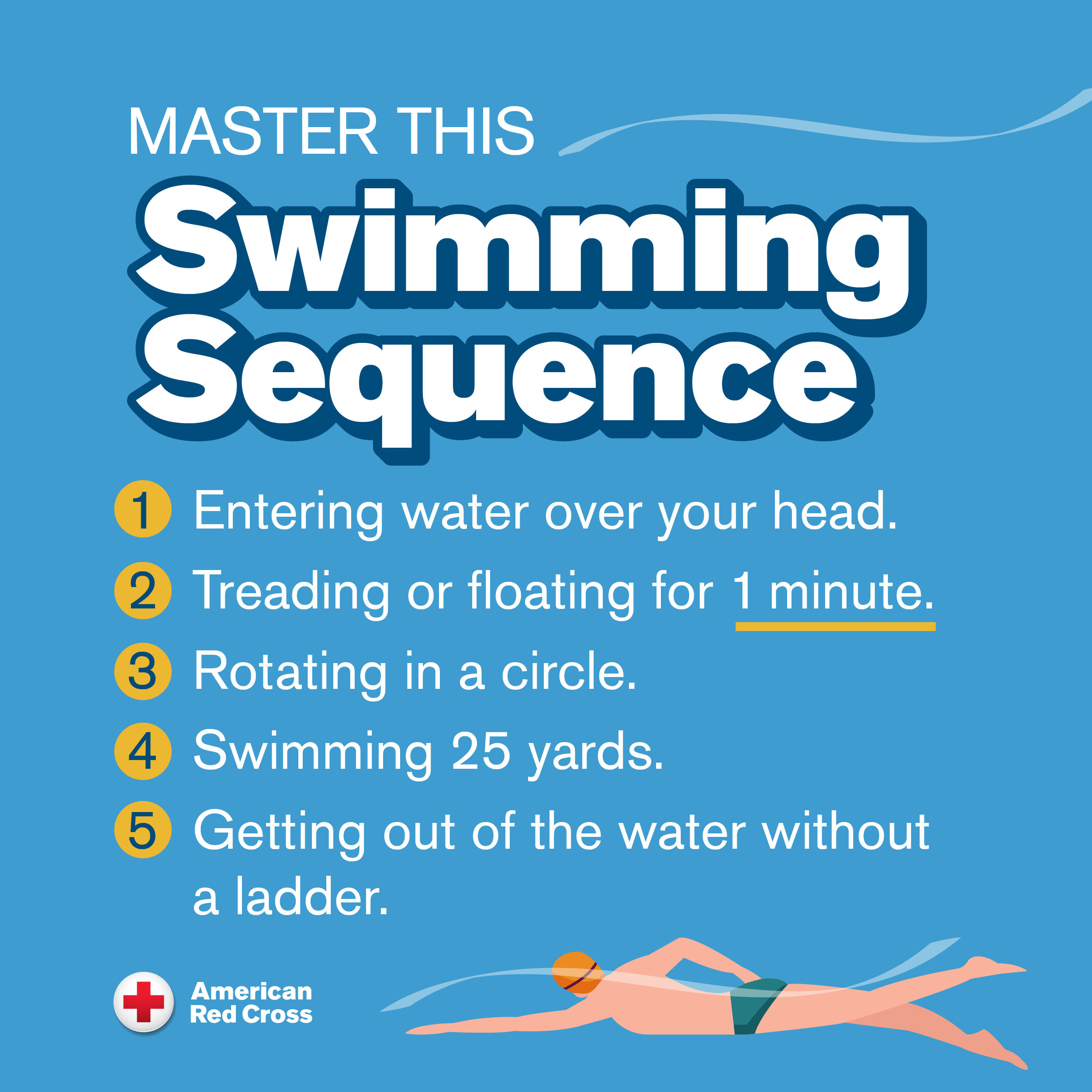
    Red Cross graphic – Master this swimming sequence: 1. Entering water over your head. 2. Treading or floating for 1 minute. 3. Rotating in a circle. 4, Swimming 25 years. 5. Getting out of the water without a ladder.

    Helping Others

    Emergencies can happen in a matter of seconds. Be prepared to:

    • Supervise children or weak swimmers closely.
    • Recognize the signs of drowning.
    • Use safe rescue methods.
    • Know CPR and basic first aid.
    • Use safe rescue methods.
    • Know CPR and basic first aid.

    Visit Water Safety USA—a partnership of organizations including the American Red Cross—for more tips on water competency.

    Layers of Protection: Barriers for Maximum Safety

    No single precaution can prevent all water accidents. That’s why using layers of protection is essential:

    • Supervision: Always supervise children near water, even if lifeguards are present. Young children should never be left alone.
    • Life Jackets: Children, non-swimmers, and all boaters should wear U.S. Coast Guard-approved life jackets.
    • Environment Awareness: Swim in lifeguarded areas and be aware of local conditions, such as currents, drop-offs, water clarity, and weather.

    Be a Water Watcher: The First Line of Defense

    Drowning often happens quickly and discreetly, which is why designating a Water Watcher is one of the most important steps you can take. A water watcher should:

    • Be at least 16 years old (adults preferred).
    • Focus solely on supervision—no phones, reading, or distractions.
    • Know CPR or be able to alert someone who does.
    • Have access to a phone, flotation device, and rescue tool.
    • Be focused and alert.
    Red Cross graphic – Don’t do this! Never go in after someone who is in trouble in the water. Instead, reach out to them or throw them something that floats, such as a ring buoy.

    The Chain of Drowning Survival:

    If a water emergency occurs, the steps you take next can save a life:

    1. Recognize the signs: Vertical in the water but not making progress, motionless face-down, or calling for help.
    2. Rescue and remove: Use a reaching or throwing device—never put yourself at risk unless you’re trained.
    3. Call for emergency help: Dial 9-1-1 immediately.
    4. Provide care: Begin rescue breathing and CPR; use an AED if available.
    5. Transfer to advanced care: Continue care until EMS arrives.

    Swim Lessons Save Lives

    One of the most effective ways to prevent drowning is to ensure every family member knows how to swim. The American Red Cross Learn-to-Swim program offers lessons for infants, children, teens, and adults—all taught by trained instructors in safe, supportive environments.

    These classes help students become comfortable in the water, teach survival and stroke techniques, and promote rescue skills that can save lives. 

    You can also stay on track between classes with the free Red Cross Swim App, which offers skill tracking, safety tips, and activities to help swimmers improve and remain engaged.

    Visit our website to find Red Cross swim classes and Learn-to-Swim providers near you, as well as more water safety tips and resources.

    By building water competency, applying layers of protection, and developing your role as a water watcher, you can help create a safe environment where water can be enjoyed without fear of danger. So, suit up, stay smart, and swim safe this summer!

  • It’s Severe Weather Awareness Week in Pennsylvania: Are you ready?

    NWS Severe Weather Safety video

    By Zain Ahmad

    As spring approaches, Pennsylvania residents face an increased risk of severe weather events, including thunderstorms, tornadoes, and flash flooding. 

    Severe Weather Awareness Week serves as a reminder to understand these dangers and take steps to protect yourself, your loved ones, and your property. From the Red Cross, here is key information on severe weather risks and how to stay safe during these events.

    Common Severe Weather Hazards

    Thunderstorms
    Thunderstorms are among the most frequent severe weather events in Pennsylvania. They are considered severe when they produce winds exceeding 58 mph.

    These storms can cause significant damage, such as uprooting trees, damaging roofs, and disrupting power lines. Thunderstorms can also bring lightning strikes, heavy rainfall, and even spawn tornadoes or flash floods.

    Red Cross graphic – If thunder roars, go indoors!

    Tornadoes
    Tornadoes remain a serious threat during the spring and summer months. These violent windstorms can destroy homes and infrastructure within minutes, leaving little time to react.

    Red Cross graphic – During a tornado: 1. Seek shelter in a basement or sturdy building. 2. Stay away from bridge or highway overpasses. 3. If strong winds and flying debris occur when driving, pull over. Put your head down below the windows, covering your head with your hands.

    Flash Flooding
    Heavy rain from storms can lead to flash flooding, which develops rapidly and poses a significant danger to both life and property. Floodwaters can sweep away vehicles and damage buildings.

    Red Cross graphic – Turn Around. Don’t Drown.

    Understanding Weather Alerts: Watch vs. Warning

    Knowing the difference between a watch and a warning is extremely useful:

    • Watch: Conditions are favorable for severe weather to develop
    • Warning: Severe weather is occurring or inevitable. Take immediate action to protect yourself.
    Red Cross graphic – Tornado Watch: When tornados are possible in and near the watch area. VS. Tornado Warning: When a tornado has been sighted or indicated by weather radar.

    Preparing Before Severe Weather Strikes

    Preparation is essential to reduce risks during severe weather events. Here’s how you can get ready:

    • Identify a safe location in your home, such as a basement or an interior room without windows.
    • Stock up on bottled water, non-perishable food, flashlights, first aid kits, and phone chargers.
    • Trim trees near your property to minimize the risk of falling branches during high winds.
    Red Cross graphic – How to prepare for storms: 1. Fill your car’s has tank in case of evacuation. 2. Fill plastic bottles with drinking water. 3. Unplug small appliances.

    Staying Safe During Severe Weather

    When severe weather is imminent:

    • Move to your designated safe area immediately and avoid windows or glass doors. 
    • If you cannot reach a sturdy shelter in time, park away from trees or power lines and remain inside your vehicle until it’s safe to move again.
    Red Cross graphic – If you have no shelter during a thunderstorm: 1. Immediately get off elevated areas like hills. 2.Crouch down for minimal ground contact. 3. If you’re in a group, separate to reduce the number of injuries if lightning strikes.

    What to Do After the Storm

    Once the storm has passed:

    • Stay updated on any additional weather alerts through reliable sources like local news or NOAA Weather Radio.
    • Check on neighbors who may need assistance, particularly older adults or those with disabilities.
    Red Cross graphic – After a flood, beware of snakes, insects and other animals that may be in or around your home.

    What about a Tornado?

    Tornadoes can strike quickly, so here are tips to get to safety:

    • Go to the lowest level of your house, preferably the basement, or an interior room with no windows. 
    • If you cannot get indoors, lie flat in a ditch or low area and cover your head with your hands to protect yourself from debris. 
    • In a Vehicle: Drive to the nearest sturdy building if there’s time. If not, stay in your car with your seatbelt fastened and cover your head with your arms.
    Red Cross graphic – Myth: Tornadoes never hit big cities because they have a lot of skyscrapers.

    By following these guidelines and staying informed through Severe Weather Awareness Week resources, residents can better prepare for severe weather events and reduce risks to their safety and well-being. Stay safe this season!

  • Game day: Score big on safety

    By Monica Weikel

    Picante Sauce And Tortilla Chips 2 by Sheila Brown. Published under CC0 Public Domain license.

    Each year, the big game is an opportunity for friends and family to have fun cheering on their favorite teams. Whether you’re hosting a party or attending one, it’s important to keep yourself and others safe so you can enjoy the celebration. To make sure your game day is a winning experience, follow these food and alcohol safety tips!

    Kickoff to Cleanup – Food Safety Tips

    Chicken wings, burger sliders, and chili may be the MVPs of your party, but cooked food can quickly sideline the fun if they’re not prepared and stored properly. Here’s some tips to keep your snacks fresh and safe to eat:

    1. Tackle Germs: Before preparing or serving food always make sure to wash your hands for at least 20 seconds with soap and warm water. Clean hands are one of the best ways to prevent the spread of food-borne illnesses.

    2. Cook to Win: When cooking, make sure your food reaches a safe internal temperature with a food thermometer. Here’s examples of some staple game day food:

    • Chicken wings: 165°F (74°C)
    • Burgers and sliders: 160°F (71°C)
    • Chili and reheated dishes: 165°F (74°C)

    3. Time Out: If any food has been sitting out for more than 2 hours, it’s time to either refrigerate or throw them away. No one wants a post-game stomachache!

    Cheers to Safety – Responsible Drinking Tips

    It’s easy to get wrapped up in all the game day excitement, but drinking responsibly will prevent any fumbles. Here’s how to keep yourself and others safe while enjoying drinks:

    1. Play by the Rules: Driving with a blood alcohol level of 0.08 or higher is illegal and could result in a DUI charge with costs reaching upwards of $10,000.

    2. Make a Game Plan: Before the party, plan how you are getting home after the big win. There are many great options available like rideshares, public transportation, or a designated driver.

    3. The True MVP: Consider being a designated driver for friends, family, and other partygoers. There are plenty of tasty non-alcoholic drink options, like mocktails, soda, or flavored water, to enjoy so you can make sure others have a safe ride home.

    Keep the Fun Going

    The big game is all about creating memories with great people, lots of laughs, and plenty of food and drinks. Practicing food and alcohol safety ensures that everyone can cheer on their favorite team worry-free.

    Stay safe, play it smart, and may the best team win!

  • Deck your halls safely this holiday season

    By Zain Ahmad

    Holiday ornaments on a tree. Photo by Bill Thawley / American Red Cross

    As the holiday season approaches, many of us are eager to put up festive decorations. However, it’s crucial to prioritize safety while creating that perfect holiday environment. From the American Red Cross, here are some essential tips to keep your home merry, bright, and most importantly, safe.

    Candle Safety

    Candles add a warm glow to holiday decor, but they’re also a leading cause of home fires. Up to 40% of home decoration fires are started by the candles in the winter months. To enjoy them safely:

    • Keep candles at least 12 inches away from anything flammable
    • Use sturdy candle holders that won’t tip over easily
    • Never leave candles unattended or burning near exits
    • Keep children and pets away from the lit candles.
    • Consider using flameless LED candles as a safer alternative

    Lighting Precautions

    Twinkling lights are a holiday favorite, but they can pose risks if not used properly:

    • Inspect light strings for frayed wires, broken sockets, or loose connections. 
    • Don’t overload electrical outlets or run cords under carpets or across doorways
    • Read manufacturer’s instructions for the number of the light strands to connect
    • Turn off all lights and decorations before leaving home or going to bed
    • Only use lights rated for indoor or outdoor use appropriately

    Fireplace Safety

    A cozy fireplace can be the heart of holiday gatherings. Keep it safe by:

    • Having your chimney inspected and cleaned annually
    • Using a sturdy screen to catch flying sparks
    • Keeping flammable decorations away from the fireplace
    • Disposing of ashes in a metal container, stored away from the house

    Christmas Tree Care

    If you opt for a live tree, follow these guidelines:

    • Choose a fresh tree with green needles that don’t fall off easily
    • Cut 2 inches from the base of the trunk before placing it in the stand
    • Keep the tree well-watered and at least 3 feet away from heat sources like fireplaces or space heaters.
    • Remove the tree promptly after the holidays or when it becomes dry

    General Decorating Tips

    • Use flame-resistant or flame-retardant decorations
    • Keep exits clear of decorations to ensure easy escape in case of emergency
    • Test your smoke alarms monthly and have a fire escape plan
    • When using a ladder to hang decorations, ensure it’s on stable ground and have someone spot you

    Remember, the joy of the season shouldn’t be overshadowed by preventable accidents. By following these safety tips, you can create a festive atmosphere that’s both beautiful and secure. From the Red Cross, happy decorating, and stay safe this holiday season!

    Resources

  • Stay safe while shopping online

    By Zain Ahmad

    One of the most important ways to stay safe while online shopping is to always think before you click.

    With Black Friday here and Cyber Monday approaching fast, there can be many roadblocks in the way that can prevent shoppers from safely purchasing their favorite items. Fraud from the previous years has also increased by 22%, reports NordLayer, a popular cybersecurity company. This makes safety during the shopping time periods even more important. Lets learn how we can stay safe when shopping online during this holiday season.

    Cyberattacks

    Cyberattacks pose serious risks to personal and financial security. They can lead to identity theft, loss of financial funds, and unauthorized access to sensitive information. To stay safe online, it’s very important to adopt smart practices to counter cyberattacks.

    Protecting Personal Information

    • The best way to start is by limiting the personal information you share online.
    • Do not share your location and use privacy settings on popular social media platforms. 
    • Always ensure your software, apps, and operating systems are updated, as updates often include critical security patches.
    • Use antivirus solutions and firewalls to block any threat.

    Passwords

    • Do not share your passwords.
    • Strong passwords are very crucial to staying safe online. Use a mix of upper- and lowercase letters, numbers, and special characters. 
    • Consider using a password manager to keep track of them and enable Two-Factor Authentication(2FA) whenever possible. This way extra verification is required even if the password entered is correct.

    Cyber Hygiene

    • One of the most important lessons during online shopping is to always think before you click. 
    • Do not click on links on text messages and emails from people that you do not know. 
    • Always use authentic secure websites.
    • Avoid shopping on your phone or laptop using public wifi.

    What if Something Happens?

    If you ever fall victim to a cyberattack, take swift action. For example:

    • If you notice strange activity on your credit card or bank account, either immediately call the credit card. company to change your card or inform the bank to stop the suspicious transaction. 
    • Disconnect the affected device from the internet, run a security scan, and change all passwords. 
    • report the incident to authorities, such as the FBI Internet Crime Complaint Center or even file the report with local police.

    Cyber Monday Safety Tips

    Cyber Monday, along with Black Friday, is one of the most popular shopping days of the year, with sales rising in the billions. Thus, many scammers try to catch unsuspecting online shoppers to obtain money. 

    • The best way to stay safe during Cyber Monday is to buy items from authorized and trusted retailers.
    • Avoid shopping from third party vendors or ads which display deals too good to be true.
    • Opt for credit card and not debit card because debit card offers direct access to your bank account.
    • Do not save your credit card information at time of checkout for future purchases.

    Online shopping is convenient but requires caution. By staying alert, you can enjoy a safer online experience while being able to protect your personal and financial well-being. From the Red Cross, be sure to stay safe online during Black Friday and Cyber Monday!

  • Severe drought conditions increase the risk of wildfires

    By Alana Mauger

    Red Cross graphic – The safest wildfire is one that never starts.

    If you live in Southeastern Pennsylvania and have the Red Cross Emergency App on your phone (which of course you should), you’ve gotten a lot of “red flag warnings” over the past few weeks.

    Issued by the National Oceanic and Atmospheric Association (NOAA), a red flag warning, means that there’s an increased risk of fire danger due to a combination of warm temperatures, very low humidity and strong wind.

    The current fire risk is exacerbated by severe drought conditions in Philadelphia and surrounding counties. According to NOAA, the entire region experienced the driest October in 130 years. The drought has led to a burn ban in all five SEPA counties.

    A burn ban prohibits open burning, defined by PA Department of Natural Resources (DNRC) as the ignition and subsequent burning of any combustible material (garbage, leaves, paper, food scraps, etc.) in a burn barrel or on the ground. While Pennsylvania hasn’t activated a burn ban statewide, agencies have enacted bans in state forests, parks and game lands.

    Wildfires are uncommon in SEPA, but they do happen. Our neighbors in New Jersey and Berks County have battled wildfires in the past two weeks, and hundreds of smaller outdoor fires have popped up throughout the Philly region.

    According to the DNRC, 98% of the wildfires in Pennsylvania are a direct result of people’s actions. Below are some steps you can take to avoid sparking a wildfire:

    • Avoid driving or parking your vehicle on dry grass. Your vehicle’s exhaust can reach temperatures of 1,000+ degrees. Vehicles and other gas-powered equipment can shoot sparks from their exhaust, especially if they are not properly maintained.
    • Check your tires, bearings and axels if you’re towing a trailer. Do a maintenance check to ensure the tires are not worn, the bearings and axles are greased, and safety chains are properly in place and not dragging on the ground.
    • Don’t operate equipment that produces sparks near dry vegetation. Clear the area of flammables around your workspace – at least 10 feet under normal conditions or up to 25 feet if it’s windy.
    • Create a clearing where flammable materials have been removed. For example, if you rake a pile of leaves, that pile should be positioned at least 10 feet from other flammable materials or up to 25 feet if it’s windy.
    • Dispose of cigarette butts and matches in a closed container or cup of water. As always, keep lighters and matches out of the reach of children.
    • Practice off-road vehicle safety. Whether it’s a car, truck or off-highway vehicle (OHV), make sure it’s current on all mechanical inspections and is suited for off-road adventures. Carry a shovel, bucket and a fire extinguisher in your vehicle to put out fires. Off-highway vehicles must have a spark arrester.
    • If a campfire is allowed at your location, only start it in an appropriate pit that is cleared of vegetation and ringed by stones. Never leave a fire unattended, and always make sure your fire is completely doused with water and smothered with dirt before leaving. Don’t start a campfire on a windy day.

    Visit redcross.org to learn about how to prepare for disasters like wildfires. Download the free Red Cross Emergency App for real time alerts about disasters in your community.

  • Cybersecurity Awareness Month: Lessons from the movies and real life

    By Christal Harte

    “Background Wallpaper” by Kai Stachowiak published under CC0 Public Domain license.

    October marks Cybersecurity Awareness Month, a reminder that in today’s digital age, protecting our online world is everyone’s responsibility. With cyber threats evolving and becoming more frequent, safeguarding our data is critical for individuals and businesses alike. A great example of this playing out on screen is in the movie Blackhat (2015). In this film, a hacker remotely takes control of systems and causes devastating damage, including shutting down a nuclear reactor. While Hollywood amps up the drama, the real-world consequences of cyberattacks can be equally catastrophic—ransomware locking down hospitals, data breaches exposing millions of personal records, and even attacks on critical infrastructure, .

    So, what can you do to stay secure in a world where cybercriminals are constantly innovating? Cybersecurity Awareness Month, led by the Cybersecurity and Infrastructure Security Agency (CISA), focuses on simple steps that can make a big difference:

    1. Use Strong Passwords: Weak or reused passwords make it easy for hackers to break in. Use unique, complex passwords and consider a password manager to keep track of them.
    2. Enable Multi-Factor Authentication (MFA): MFA adds an extra layer of protection, requiring you to verify your identity through a second step like a text or app code.
    3. Be Wary of Phishing: Phishing emails trick people into revealing sensitive information. Always verify the source before clicking on any links or sharing data.
    4. Update Software Regularly: Outdated software can leave you vulnerable to attacks. Regular updates help patch known weaknesses and keep you secure.

    The theme for this year’s Cybersecurity Awareness Month is “Secure Our World,” emphasizing that everyone plays a role in protecting the digital space. From individuals at home to companies managing critical data, we all share the responsibility of staying vigilant and proactive.

    So, this October, let’s take inspiration from both Hollywood and real life. By following a few simple cybersecurity practices, we can help secure the online world and protect our personal and professional lives from potential threats.

  • Tips for keeping trick-or-treaters safe this Halloween

    By Dave Skutnik

    Halloween is just around the corner. Soon masses of little superheroes, goblins, ghosts and cartoon and television characters will be out in their neighborhoods for trick or treat fun. The American Red Cross has tips parents can follow to help keep the kids safe while enjoying the festivities.

    “Halloween is fast becoming one of the most popular holidays in this country, and people should expect more visitors in search of treats,” said Jennifer Graham, Regional CEO for the American Red Cross of Southeastern Pennsylvania. “Whether you’re handing out goodies or going door-to-door, a few simple considerations can help ensure your family and those around you are safe and sound.”

    Red Cross graphic – Glow this Halloween! Keep children seen by adding reflective tap or glow sticks to their costumes.

    Here are the top tips for parents to keep in mind while getting their kids ready for Halloween this year:

    • Make sure trick-or-treaters can see and be seen. Give kids a flashlight to light their way and consider adding reflective tape to costumes and trick-or-treat bags.
    • Plan the trick-or-treat route in advance and make sure adults know where their children are going. A parent or responsible adult should accompany young children door-to-door. 
    • Walk only on the sidewalks, not in the street. Avoid running. Look both ways before crossing the street, and cross only at the corner. Don’t cross between parked cars.
    • Be considerate of other people. Only visit homes that have a porch light on, and never go inside.
    • Be cautious around animals. It’s not only vampires and monsters people have to look out for. Be alert around unknown animals, especially dogs.
    • Keep your hands clean. Bring hand sanitizer with you while trick-or-treating and use it after touching objects or other people. Wash your hands when you get home.
    • Make sure a grown-up checks the goodies before eating. Make sure to remove loose candy, open packages and choking hazards. Discard any items with brand names that you are not familiar with.
    Red Cross graphic – Welcome, Trick-or-Treaters! Turn porch lights on so kids and adults don’t trip.

    For those planning to welcome trick-or-treaters to their doors, follow these safety steps:

    • Provide proper lighting and sweep your sidewalks and steps. Having good lighting and a clear path helps visitors see where they are walking and avoid getting hurt.
    • Do not hand out candy if anyone in the household is ill or isolating. This helps keep everyone as healthy as possible.
    • Wash your hands before handing out candy and between trick-or-treaters.

    Download the free Red Cross First Aid app for instant access to expert advice in case your ghost, goblin or superhero has a mishap. Use the Emergency app for weather alerts and to let others know you are safe if severe weather occurs. Find these and all of the Red Cross apps in smartphone app stores by searching for the American Red Cross or going to redcross.org/apps.