Category: Safety Tips

  • PA Lightning Awareness Week: Crack down on the facts!

    By Susan West

    Red Cross graphic – What to do if lightning strikes someone: 1. Call 911. 2. Check for burns and other injuries. 3. Perform CPR if the person isn’t breathing.

    Lightning: It’s sudden, it’s scary, and it can indeed strike in the same place twice. But while these bolts from the blue may seem random, there are lots of ways you can keep yourself safe. Here are some summertime scenarios to think about:

    Scenario #1: You’re golfing and hear thunder.

    DO: As the saying goes, “When thunder roars, go indoors.” You’re close enough to be struck, so seek shelter in a substantial, enclosed structure—not a shed, picnic shelter, tent, carport, or patio. There is no safe place outside during a storm, and an open field or beach is the most perilous place of all.

    DON’T: Stand under a tree or near anything tall, such as a light pole. You don’t want to be the highest object in the area. Don’t even think about crouching; you won’t be protected, and lying flat may actually increase your chance of being impacted by a ground current.

    Scenario #2: A beach day turns dark and stormy.

    DO: Get out of the water and take shelter—in your car, if you have to. Lightning doesn’t strike the ocean as much as land, but when it does, it spreads out over the water, which acts as a conductor. It can hit nearby boats and even electrocute fish near the surface.

    DON’T: Wait on the beach. Remember, the beach is a big, flat, sandy open space.

    Scenario #3: Whew! The storm is raging, but you’re safely indoors.

    DO: Stay away from windows, upper floors, and electrical appliances. Exterior doors can have metal both inside and out—like that doorknob. Any metal, wires, and pipes extending from the house could provide a deadly route for electricity coming in from outside.

    DON’T: Take a shower, wash dishes, or use a landline phone. Metal doesn’t attract lightning, but it does conduct it—that is, it provides a path for the current to follow.

    Scenario #4: You hit a nasty squall while driving.

    DO: Stay in the car; pull over if you have to. Your metal-topped vehicle can provide shelter from lightning when no building is available. The tires aren’t what protect you; instead, the car’s metal body and frame conducts the current around you, through the tires, and into the ground.

    DON’T: Touch any metal inside the car. Note: A convertible or soft-topped vehicle is not safe.

    Scenario #5: Bases are loaded and your kid is at bat. The sky darkens and rumbles.

    DO: Look for the person who’s been assigned to call off the game. There is someone assigned, right? About two-thirds of lightning deaths happen during outdoor recreational activities. Planning is essential for everyone’s safety.

    DON’T: Wait until it’s too late. If you hear thunder, the storm is probably within 10 miles. Sorry, kid.

    The nightmare scenario: Your friend was struck and has collapsed!

    DO: Call 911 and provide first aid if you can. Want to learn CPR? The American Red Cross can help: www.redcross.org/take-a-class/CPR. This could make the difference between life and death.

    DON’T: Be afraid to touch your friend. People struck by lightning do not carry a charge and are safe to touch. You will not be electrocuted.

  • Tips for staying safe during extreme heat

    By Zain Ahmad

    Red Cross graphic – Evacuate your home! If it becomes too hot, go to an air-conditioned place like a library, mall or public cooling center.

    According to the U.S. Centers for Disease Control and Prevention (CDC), extreme summer heat is increasing. Climate projections indicate that extreme heat events will be more frequent and intense in coming decades. The American Red Cross has information to help keep everyone safe during summer heat.

    Dangers of extreme heat

    Exposure to extreme heat poses significant health risks and even heat related health emergencies and deaths, all of which have increased over the years. The main health conditions directly related to heat include heat stroke and heat exhaustion. Older people, those with chronic medical conditions and  young children are specifically prone to heat-related health problems. Hot temperatures also contribute to heart attacks and strokes.

    The increased heat can also cause wildfires, which are also more common. Southeastern Pennsylvania was even affected by the smoke from Canadian wildfires last year.

    Red Cross graphic – You need to drink at least 12 cups of water per day during a heat wave.

    Safety tips

    With rising incidence of the heat wave around the nation, here is how to keep yourself safe from the heat:

    • Stay in air conditioned buildings if possible. Find out about any cool places in your area, such as a library or a shopping center. If you do not know of any near you, then contact your local health department and find a cooling center near you.
    • Install air conditioners in your home. A fan is not enough as it gives the body a fake sensation of comfort and does not reduce body temperature.
    • Stay well hydrated. Drink more water than usual. If you have health conditions that limit fluid intake, then check with your doctor about the amount of water that you can drink
    • Never leave children or pets in a parked vehicle. Inside of the parked cars can quickly get heated to 120 F.
    • Avoid any outdoor activities especially from 10 a.m. to 4 p.m., if possible. This will reduce your risk for any heat-related conditions
    • Wear loose and light colored clothings. Take cool showers or baths.
    • If by any chance you have to wear a mask, be sure to wear one that has breathable fabric, such as cotton. Polyester is not a breathable fabric.
    • Be sure to check on your neighbors, family, or friends who may not be safe from the heat.
    • As for pet safety, make sure pets have cool water and shade. Check on them frequently to find out if they are feeling well.
    Red Cross graphic – Don’t use an electric fan during warm weather. Using a fan when the indoor temperature is over 95 degrees F may cause your body to gain heat instead of losing it.

    Following these simple tips will keep yourself and your family safe from the heat. Visit our website or download our free First Aid app for more tips.

  • May is Clean Air Month: Do you know your air?

    By Haley Heisley

    EPA graphic – Knowing your Air.

    If you’re reading this, you’re also breathing in the air around you. It makes sense that by bettering the environment outside of us, we better the inside of us. 

    Air pollution can occur from many things: factories, cars running on gas, insulation, caulk, mold inside the home, candles, cleaning products, natural disasters like wildfires, and a plethora of other causes, all of which have many different effects on the body. 

    How can we keep ourselves safe? The first step is identifying the Air Quality Index (AQI) for your location to determine what precautions should be taken. Access your AQI at AirNow.gov or by downloading the free AirNow mobile app.

    Red Cross graphic – Know Your Air. Air Quality Levels: 0-50 Good. 51-100 Moderate. 101-150 Unhealthy for sensitive groups. 151-200 Unhealthy for everyone. 201-300 Increased health risks and effects. 301+ Hazardous breathing conditions.

    As you can see on the above graphic, AQI categorizes air quality into several levels, each corresponding to a different level of health concern:

    When air quality alerts are issued, it’s essential to take appropriate actions to protect your health and well-being. Consider the following if the AQI is unhealthy:

    • Wear an n95 mask to go outside.
    • Limit outdoor activities until the AQI improves.
    • Ensure those with respiratory conditions have medications or equipment they may need.
    • Refrain from burning candles, smoking or using a gas stove indoors.
    Red Cross graphic – Protect Yourself from Poor Air Quality: Check the Air Quality Index where you live. Do less strenuous activities like running. Avoid busy roads. Shorten or reschedule outdoor events. If you have asthma, keep your inhaler with you at all times.

    By understanding precautions to take, identifying air quality levels and what they indicate, and being educated on common air pollutants that we may not even realize can be in our homes are crucial steps in keeping the air clean and us safe. This month, as well as every month, we need to pay attention to bettering ourselves inside and outside. 

  • It’s National Bike Month. Enjoy the ride!

    By Christal Harte

    Spring is officially here, and this month marks National Bike Month! Biking is a wonderful way to get around, stay fit and get immersed with the outdoors! Whether you are new to biking or a seasoned cyclist like my step dad who really enjoys biking 100 miles at a time, safety should always be your top priority. Let’s dive into some helpful tips and tricks to keep you safe on two wheels as we cruise towards the end of the year.

    Rules of the Road

    Drivers aren’t the only one who need to follow traffic laws. Cyclists are expected to stop at red lights and stop signs, ride in the same direction as traffic, and use hand signals to show where you’re going. You should wear bright clothing and use lights or reflectors, especially when it’s dark to help you stay visible and most importantly keep you safe. When riding, ride predictably- no sudden swerves or stops.  

    Prep Before Biking

    Before you head out on your bike, make sure you are prepared. You should have a helmet that fits. Your bike should be inspected for any issues- are your tires flat? When was the last time you took your bike in for proper maintenance?  Do you know if your brakes still work? Make sure you have a tire repair kit, a bottle of water and some ID. Do you know your local cycling rules, get a copy from your local DMV to stay current on any laws and adjustments. 

    Special Tips for Kids & Older Adults

    For kids and older adults there are several things to consider. For kids, adult supervision is essential. Adults should endeavor to teach kids road safety basics including basic hand signals. Ensure that the bikes are in optimal condition, ensure they have properly fitting helmets and have them bike in safe areas. Older adults should bike in areas with less traffic, and avoid rush hour traffic. 

    Bike Maintenance

    Regular maintenance is essential for safe riding. This includes checking tire pressure, ensuring brakes are functioning correctly, and keeping the chain lubricated. Periodic professional tune-ups can catch issues that might not be immediately apparent. Keeping the bike clean can also prevent wear and tear on its components.

    Electric Bikes

    Electric bikes (e-bikes) are becoming increasingly popular. While they offer the advantage of assisted pedaling, they also come with specific safety considerations. E-bike riders should be aware of the higher speeds they can reach and should practice in a safe area before riding on busy roads. It’s also important to check local regulations, as some areas have specific laws for e-bikes regarding speed limits and where they can be ridden.

    Movie Pick for Bike Lovers

    If you’re looking for a great bike-themed movie, check out “Breaking Away” (1979). It’s about a group of teenagers in Bloomington, Indiana, who are passionate about cycling. The film captures the excitement of biking and the personal growth of its characters, making it a must-watch for any cycling enthusiast.

    Headed Out

    For more detailed tips, head over to the National Safety Council’s bicycle safety page and the League of American Bicyclists’ Bike Month page. These resources are packed with info to help you ride safely and enjoy every moment on your bike.

    So, gear up, stay safe, and happy riding!

  • Red Cross offers tips to help you have a safe summer

    By Dave Skutnik

    As we all head outside to enjoy the sunshine and warm weather this summer, the American Red Cross Southeastern Pennsylvania Region has steps you can follow to help stay safe.

    “Here in the Delaware Valley many of us enjoy spending time outdoors with loved ones as we head down the shore, up to the Poconos or simply hang out at home,” said Jennifer Graham, CEO for the American Red Cross of Southeastern Pennsylvania. “The Red Cross wants you to avoid any danger no matter what your plans include and offers steps you can follow to have a safe summer.” Visit redcross.org/summersafety for more information.

    WATER SAFETY

    Drowning can happen quickly and silently. Unless rescued, it could take as little as 20 to 60 seconds for a drowning person to submerge.

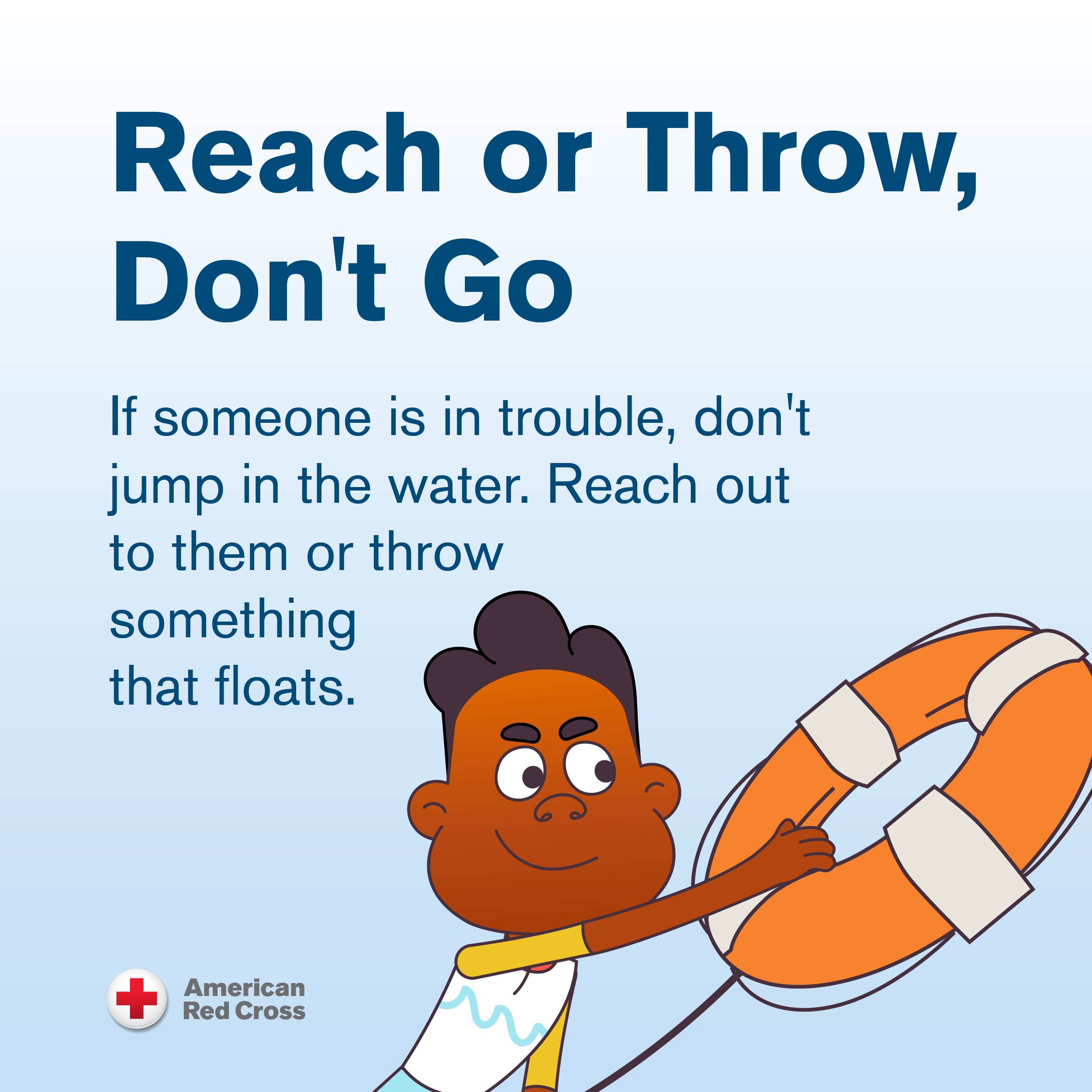
    Red Cross graphic – Reach or Throw, Don’t Go! If someone is in trouble, don’t jump in the water. Reach out to them or throw something that floats.
    • Learn to be safe, make good choices, learn to swim and know how to handle emergencies.
    • Provide constant, active adult supervision and know how to swim.
    • Swim in an area with lifeguards. Designate a “water watcher” to keep a close eye and constant attention on everyone in and around the water until the next water watcher takes over.
    • Wear your life jacket.
    • Reach or throw, don’t go! In the event of an emergency, reach or throw an object to the person in trouble. Don’t go in! You could become a victim yourself.
    • Swimming classes are available for both children and adults. Visit redcross.org/watersafety for a map of Learn-to-Swim providers in your community.
    • Download the Red Cross Swim app for safety tips, kid-friendly videos and activities, and take the free Water Safety for Parents and Caregivers online course in English or Spanish.

    PICNIC & GRILLING SAFETY

    Summer is a great time to get outside for a picnic or to fire up the grill. Follow these tips to prevent illness and keep everyone safe.

    Red Cross graphic – Places you shouldn’t grill: in a tent, inside a camper, inside your house.
    • Wash your hands, utensils and workstation before preparing the food.
    • Separate uncooked meats, poultry and seafood from ready-to-eat foods like salads, fruits, vegetables, cheeses and desserts. Use separate plates and utensils to prevent cross-contamination.
    • Bring hand sanitizer if your picnic site doesn’t have hand-washing facilities.
    • If you are going to cook on the grill, bring a food thermometer to be sure grilled foods are cooked enough. 
    • Always supervise a barbecue grill when in use.
    • Don’t add charcoal starter fluid when coals have already been ignited.
    • Never grill indoors.
    • Make sure everyone, including pets, stays away from the grill.
    • Keep the grill out in the open, away from the house, deck, tree branches or anything that could catch fire.
    • Use the long-handled tools especially made for cooking on the grill to help keep the chef safe.
    • Wash your hands before preparing the food.  
    • Don’t leave food out in the hot sun. Keep perishable foods in a cooler with plenty of ice or freezer gel packs.  

    OUTDOOR SAFETY

    Whether camping or just enjoying the outdoors, follow these tips.

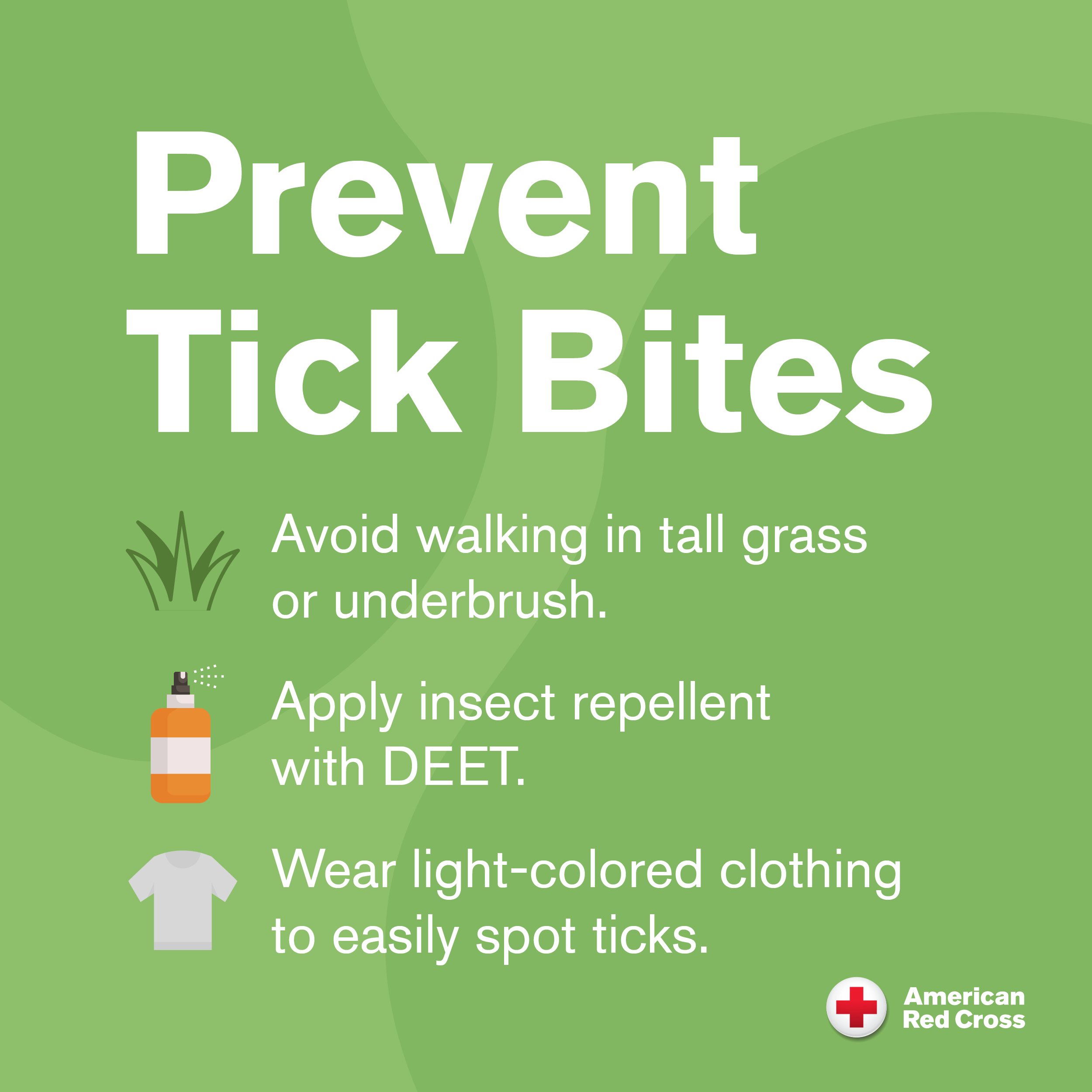
    Red Cross graphic – Prevent Tick Bites: Avoid walking in tall grass. Apply insect repellent with DEET. Wear light-colored clothing to easily spot ticks.
    • If a camping trip is in your plans, know the level of ability of the people in your group and the environment around you. Plan accordingly.
    • Pack a first aid kit.
    • Take a Red Cross first aid and CPR course and download the First Aid app.
    • Watch for sprains, falls and dehydration.
    • Share your travel plans and locations with a family member, neighbor or friend.
    • Bring nutritious food items and water, light-weight clothing to layer and supplies for any pets.
    • There is a greater chance of getting bitten by mosquitoes and ticks outdoors Use insect repellents containing DEET (N, N-diethyl-meta-toluamide) when you are outdoors. Be sure to follow the directions on the package.
    • Consider staying indoors at dusk and dawn, when mosquitoes are most active.
    • Wear long-sleeved shirts and long pants and tuck your pant legs into your socks or boots.
    • Use a rubber band or tape to hold pants against socks so that nothing can get under clothing.
    • Tuck your shirt into your pants. Wear light-colored clothing to make it easier to see tiny insects or ticks.
    • When hiking in woods and fields, stay in the middle of trails. Avoid underbrush and tall grass.
    • If you are outdoors for a long time, check yourself several times during the day. Especially check in hairy areas of the body like the back of the neck and the scalp line.
    • Inspect yourself carefully for insects or ticks after being outdoors or have someone else do it.
    • If you have pets that go outdoors, spray with repellent made for their breed/type. Apply the repellent according to the label and check your pet for ticks often.
    • Get rid of mosquito breeding sites by emptying sources of standing water outside of the home, such as from flowerpots, buckets and barrels.
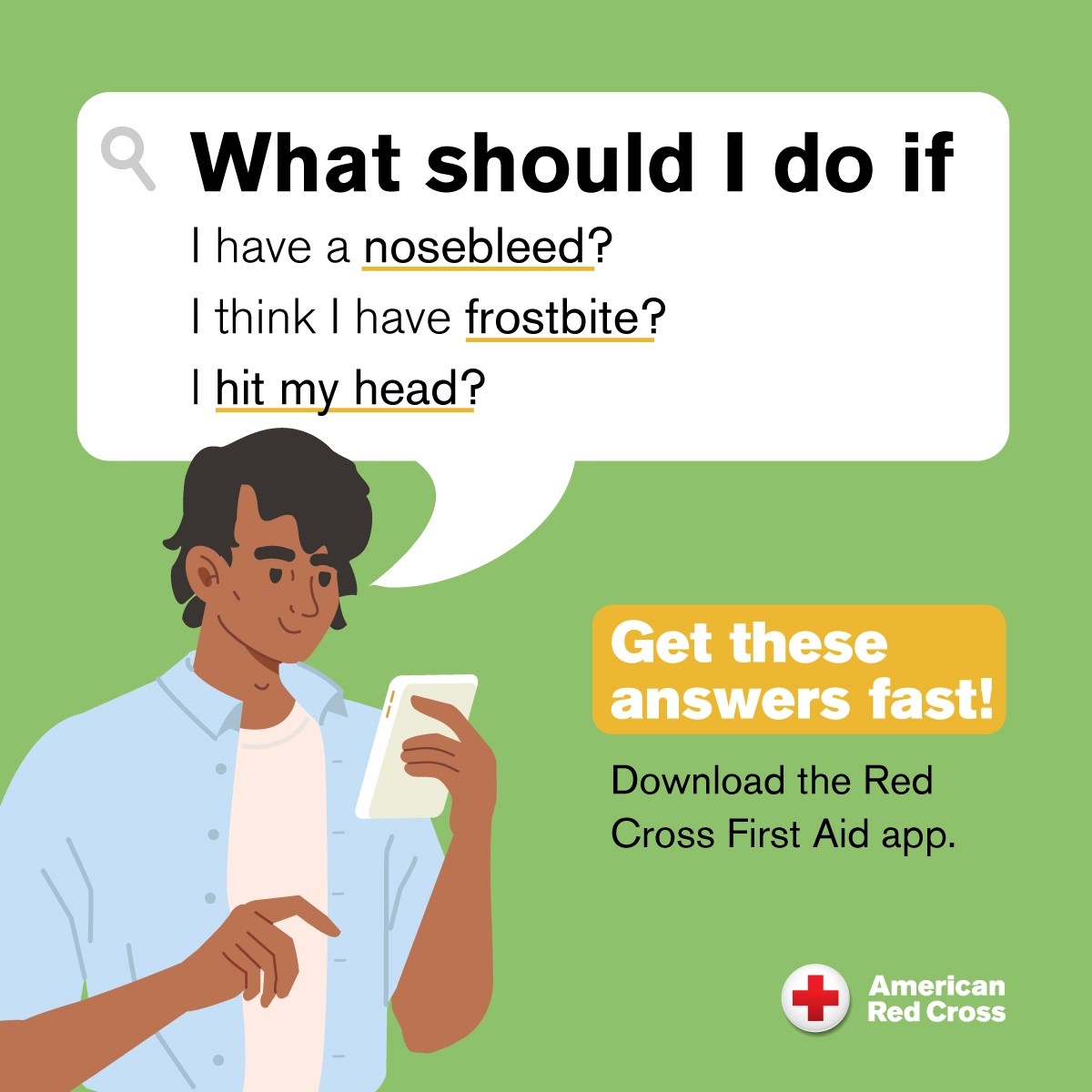
    Red Cross graphic – What should I do if: I have a nosebleed? I think I have frostbite? I hot my head? Get these answers fast! Download the Red Cross First Aid app.

    Download the FREE Red Cross First Aid app so you’ll know what to do if emergency help is delayed and the FREE Emergency app for weather alerts, open Red Cross shelter locations and safety steps for different emergencies. Choose whether you want to view the content in English or Spanish with an easy-to-find language selector. Find these and all of the Red Cross apps in smartphone app stores by searching for the American Red Cross or going to redcross.org/apps.

  • Food safety tips for the Big Game

    By Susan West

    Uncle Mike’s Super Bowl party was legendary. People raved about the wings, the nachos, the game, everything… until the next day. Unfortunately for Mike and his guests, foodborne pathogens had crashed the party. He could have saved everyone a lot of gut misery if he’d just taken a few precautions. Here are a few easy ways to avoid the same fate.

    Before the big day: Avoiding cross-contamination starts in your shopping cart. Keep raw meats apart from produce, and grab a food thermometer while you’re in the store. When you get home, stash everything in its own area, and get to cleaning. (Don’t forget the bathroom. Make sure it has soap, wipes, and paper towels.)

    CDC graphic: Rules of the Game for Food Safety – Keep it Clean. Before you eat or handle food, wash your hands, food prep tools and surfaces.

    Food prep time: Start by washing your hands for at least 20 seconds. Then rinse your produce, and if you’re handling raw meat or chicken, use a separate knife and cutting board. As you prep your protein, grab the thermometer; it’s your only tool for making sure your wings or meat are cooked. Place the probe in the thickest part of the wing, avoiding the bone. The temp should be 165°F. Check multiple wings, not just one.

    Buffet basics: Super Bowl Sunday is notorious for foodborne illnesses, because people tend to leave munchies out for hours. Don’t do that. (That was Uncle Mike’s big mistake!) Keep buffet portions small, and replenish often so bacteria can’t thrive. Two hours is the maximum safe time for leaving food at room temperature. Set a timer to remind yourself. Set out individual utensils and small plates—no double dipping, folks!

    CDC graphic: Rules of the Game for Food Safety – Watch the clock. Throw out perishable food that has been sitting at room temperature for more than two hours; one hour if it’s 90 degrees F or warmer.

    The numbers: Keep hot foods hot (140°F minimum), and cold foods cold (40°F or colder). Ordering takeout? You’re not off the hook; use the same precautions noted above.

    The chafing dish, slow cooker, and warming tray are your friends. For cold foods like salsa or guac, nest serving dishes in bowls of ice. If you plan on serving food for the whole game, hold back half of the food in the fridge or oven. Serve half your food as the game starts, and swap it out at halftime.

    CDC graphic: Rules of the Game for Food Safety – Serve at the right temperature. Keep hot foods at 140 degrees F or warmer, and cold foods at 40 degrees F or colder.

    After the party: If you accidentally left perishable food at room temp for too long, toss it. (This includes meat, chicken, turkey, seafood, eggs, dairy, cut fruit, cooked rice, and leftovers.) Refrigerate or freeze leftovers immediately—it’s OK to put hot foods directly into the refrigerator! Your leftovers will last three or four days in the fridge, max. Hungry the morning after? Reheat leftovers to at least 165°F. This includes leftovers warmed up in the microwave.

    Sadly, Uncle Mike’s party is no longer an annual bash. Make yours an event to remember, for all the right reasons!

  • National Burn Awareness Week – Focus on flammable liquids

    By Sanaya SinhaRoy

    Red Cross graphic – How to treat a burn: 1. Eliminate the cause of the burn. 2. Cool it under cool running water for 10 minutes or apply a cool compress. 3. Loosely cover it with a clean dressing if it needs medical care. 4. Call 911 if needed.

    National Burn Awareness Week, observed February 4th-10th, serves as a crucial reminder of the potential dangers associated with burns. This year’s theme is flammable liquids, which emphasizes the understanding of how flammable liquids can ignite in the air and travel considerable distances, posing risks that require awareness.

    In the culture of safety, the American Red Cross promotes knowledge and preparedness for any situation that puts one’s health in jeopardy. Offering comprehensive First Aid classes, the Red Cross ensures that individuals are equipped with the skills needed to respond effectively in burn emergencies. These classes cover various topics, including immediate burn care, wound management and the importance of swift action.

    Moreover, in an era dominated by technology, the Red Cross provides a free First Aid App, a useful tool that empowers individuals to access any information instantly. This app serves as a valuable resource during National Burn Awareness Week and beyond, offering step-by-step instructions, safety tips, and emergency resources.

    Here are some general guidelines in first aid procedures to attend to a burn situation:

    1. Assess the Situation – Prioritize your safety and the safety of others. Ensure that the area is safe and free from potential hazards before approaching the burn victim.
    2. Call for Help – In case of severe burns or if the victim is in distress, immediately call for medical assistance.
    3. Remove the Source of Burn – If the burn is caused by a hot liquid or object, carefully remove the source to prevent further damage.
    4. Cool the Burn – For minor or first-degree burns, cool the affected area with cold, running water for 10 minutes. Avoid using ice as it can further damage the skin.
    5. Cover up the Burn – Use a sterile, non-stick bandage or clean cloth to cover the burn.
    6. Do not Pop Blister – If blisters form, do not pop them, for blisters act as a protective barrier and popping them can increase the risk of infection.
    7. Seek Professional Medical Attention – For second and third-degree burns, seek immediate medical attention. Do not attempt to treat these burns at home.

    This National Burn Awareness Week, let’s commit to learning, sharing knowledge, and utilizing resources like First Aid Classes and the free First Aid App. By doing so, we collectively contribute to creating safer environments for ourselves and those around us.

  • Enjoy winter weather safely

    By Haley Heisley

    Red Cross graphic – Burrrr! Stay warm outside by changing wet clothing frequently to prevent body heat loss.

    Hot cocoa, snowball fights, fireplaces, and warm pajamas — winter is truly a wonderland, but among all of the joy and excitement we can’t forget to take care of ourselves.

    You know that feeling when the snow melt through your gloves and your hands become numb from the cold, or when there is a piece of ice melting inside of your shoe and your sock becomes soaked? Those moments where you feel as if it is unbearable, but yet tolerable enough that you will deal with it so you can stay outside?

    Listen to your body. When your hands or feet freeze, it damages your skin cells and tissue leaving you with frostbite. And frostbite can get worse — all it takes it for your body’s temperature to fall below 95 degrees F (35 C) for it to lose more heat than it is making and cause hypothermia.

    Your normal body temperature is around 98.6 degrees F (37 C), which aids in helping your entire organ system function properly. When your body temperature drops into a state of hypothermia your heart, respiratory system, nervous system and other organs don’t function properly. If untreated or mistaken for just being cold, hypothermia can even cause heart failure, lung failure, and/or death.

    Hypothermia is typically caused by the cold weather or submersion in cold water, which is common when snow seeps through your gloves or socks. Common symptoms of hypothermia that make it different from just being too cold are shivering, slurred speech, slow breathing, weak pulses, lack of coordination, drowsiness, confusion, memory loss, bright red, cold skin, and/or loss of consciousness.

    What to do if you think you or someone you know is experiencing Hypothermia? Call 911 immediately, and while waiting for their arrival, remove any wet clothing in exchange for warm blankets. This must be a very gentle process, because quick movements can trigger a dangerous irregular heartbeat.

    Once in the emergency room or in medical care, the healthcare professionals will focus on passively rewarming your body by recirculating your blood , warm IV fluids, rewarming your airway, and tons of blankets!

    Sometimes I think, “Oh, this could never happen to me!” then I remember how this can happen to anyone of any age through different circumstances. This being said, many risk factors can also increase your risk of getting hypothermia, like those of older and very young ages, exhaustion, mental disabilities, alcohol and drug use, certain medical conditions, and even certain medications.

    This winter, enjoy the snow, the hot cocoa, the building igloos, and warming up afterwards by your fireplace — but don’t forget about the possible risk, don’t forget to prevent! Get more info on staying safe at redcross.org. Download our free Red Cross First Aid App for tips on how to respond to a variety of first aid issues.

  • Keep safety in mind when buying toys and gifts this holiday season

    By Zain Ahmad

    Toys! by Mike Femia, published under CC BY-NC 3.0.

    Did you know that December is the “Safe Toys and Gift Month”?

    It’s that time of the year for gift giving and sharing, and children are especially happy for it. Buying the right toys and gifts are very crucial to children’s safety and well being. From the American Red Cross, we share safety tips that one can take in buying and gifting toys this holiday season.

    What should you watch out for?

     According to the Consumer Product Safety Commission (CPSC), emergency rooms in 2022 had over 145,500 toy-related injuries, and more than 50% of the injuries were in the head and neck area. Some of them have resulted in blindness. Toys that have caused deaths are in a wide range, but the most common are non motorized scooters, small balls and building sets that cause choking hazard and few water-related toys.

    To prevent injuries, follow theses steps facilitate safe buying and gift-giving:

    • Please buy age appropriate toys.
    • Watch out for presents with sharp edges, points, or spikes. 
    • Avoid toys with shooting or fly off parts for younger kids.
    • Please be aware of cords and small parts that can be removed from toys, especially for less than 3 years old children because those can be choking hazard.
    • CPSC has established a standard for toy safety. Please check that the toy has the ASTM (American Society for Testing and Materials) seal on it.
    • Please read reviews on the toys you are buying. Also pay attention to toxic substances, like lead, used in manufacturing.

    Now, for the Parents and Guardians: What should you do?

    • Always make sure to dispose of any wrapping immediately upon opening the gift. This can be dangerous to children.
    • Read the instructions and more importantly, show children how to use the toy safely. This would help them know more about the toy and have fun with it.
    • Watch your child when they play, as this is extremely important to make sure that nothing serious happens to the child when they are exploring gifts and toys.
    • Make sure that younger children are not using any toys for older children, especially with those with small parts or inedible materials.
    • Batteries should only be used by adults because the battery can get hot and burn the child. 
    • For sport toys and gears, please ensure that children wear helmets and knee pads when indicated.
    • Store any toys that would cause someone to trip or fall.

    Stay safe and enjoy gift giving this holiday season! We all love fun, but there has to be safety involved even with toys, because that fun can turn to disaster within a matter of seconds. For more resources, check out the CPSC website. From the Red Cross, Happy Holidays!

    Video: “Toy Safety 365 Days a Year” from The Toy Association.
  • Tips for a safe and peaceful Thanksgiving

    By Jackie Faiman

    “Autumn Background” by Circe Denyer, published under CC0 Public Domain license.

    Thanksgiving is the quintessential American holiday, a reminder for gratitude, an opportunity for family gatherings, and an excuse to throw dietary caution to the winds. For many, the extended holiday weekend necessitates travel to visit loved ones, making it one of the busiest times on roads and in airports. The American Red Cross hopes that you enjoy a peaceful and delicious holiday, and to that end, we offer here cooking safety tips and travel suggestions to help you on your way.

    Keep an eye on what you fry

    Like millions of Americans, you may be spending hours in the kitchen prepping and cooking for the holiday. We encourage you to read now and follow these safety tips—some of which you can put in place before the actual holiday. Most of these address the risk of fire. (Cooking fires are the top cause of home fires and home fire injuries.)

    Red Cross graphic – If a fire starts on your stove, use a cookie sheet to smother it.
    • Never leave cooking food unattended, particularly when frying, grilling, or broiling. If you must leave the kitchen, turn off the stove.
    • Keep other people, especially young children, away from cooking areas.
    • Keep anything flammable, such as potholders and paper towels, away from cooking flame or other heat source. Avoid cooking while wearing loose sleeves or clothing.
    • Keep a fire extinguisher in your kitchen within easy reach and if necessary, contact your fire department to learn how to use it properly.
    • Always check that all appliances are turned off before retiring for the night.
    • Install smoke alarms near your kitchen, on each floor of your home, and near each sleeping area. Use the test button to test them every month, and replace all batteries at least once per year.

    Turkey frying can be dangerous

    As frying whole turkeys has risen in popularity, we offer these additional safety guidelines:

    Red Cross graphic – Turkey Frying Tips: Never use a fryer near your house or other structure. Never fry a turkey that’s not fully thawed. Place the fryer on a flat, even surface.
    • OUTDOORS ONLY; never attempt to deep-fry a turkey indoors. Set up the fryer in an open area, away from flammable structures, and never leave the fryer unattended.
    • Thaw and dry the bird completely before immersing it in hot oil; excess moisture can lead to dangerous oil splatters.
    • Fill the fryer with the proper oil level, accounting for the volume displacement of the turkey. Too much oil can overflow and cause a fire, while too little can overheat and ignite.
    • Monitor the oil temperature with a reliable thermometer.
    • Read and follow the manufacturer’s instructions carefully.

    Arrive to your feast safety

    While cooking safety is well within your control, travel challenges are another story. With so many people on the go, crowds and delays are inevitable, but you can minimize the impact of these with a little forethought.

    Red Cross graphic – Holiday Road Trip DONT’S: Don’t forget to pack snacks, water and a first aid kit. Don’t rely on cell phone service; download offline maps of your route. Don’t let you gas tank get too low; in rural areas, there may be limited has stations to refuel at.
    • If possible, travel during non-peak hours or days to avoid heavy traffic and mobbed airports. Thanksgiving morning and late at night are typically less congested times. Check your airline’s daily number of flights, average flight delay risk, and reimbursement policies.
    • Stay informed: keep an eye on weather forecasts for your travel route and be prepared for changing conditions. Consider revising your trip if severe weather is predicted.
    • If driving, prepare a travel emergency kit with essentials such as first aid supplies, snacks, and a flashlight.
    • Make sure your vehicle is well maintained. Ensure its tires are properly inflated, its brakes are in good condition, and the oil, coolant, and wiper fluid levels are adequate.
    • Utilize navigation apps that provide real-time traffic updates to choose the best routes and avoid potential bottlenecks.
    • Minimize stress and fatigue: Take regular breaks if driving. Wear a face mask if traveling in crowded areas and concerned about infection. Try to sustain an attitude of patience and a sense of humor!

    Whether you are mastering the art of turkey frying or navigating through traffic, a bit of planning can help you and your loved ones to celebrate a memorable and incident-free Thanksgiving holiday.