Category: Safety Tips

  • Keep Your Furry Friends Safe and Healthy this Winter

    By: Alana Mauger

    Between cold temperatures, ice, snow, and shoveling (and shoveling…and shoveling), it’s shaping up to be a tough winter for many of us. As we take precautions to keep our families safe and warm, it’s important to remember that Fido, Fluffy, and all their furry (and not so furry) friends have special seasonal needs as well. 

    Inside is best

    In the words of cartoonist Charles Schultz, “Happiness is a warm puppy.” As a general rule, if you’re cold, so is your pet. According to the American Veterinary Medical Association (AVMA), dogs and cats should be kept inside during cold weather, as they are susceptible to frostbite and hypothermia, just like people. For farm animals that must live outside or neighborhood pets (like feral cats), it’s important to provide areas where they can shelter against wind, rain, and snow. Be sure they have access to non-frozen drinking water and plenty of food.

    Cold vehicles, just like hot ones, can be deadly for pets. As a car cools down in the winter, it becomes like a refrigerator and can rapidly chill dogs, cats, and other domesticated animals. The AVMA recommends limiting your pet’s travel during cold weather and never leaving your pet unattended inside a vehicle.

    Winter walks

    Don’t worry – Fido can still enjoy his walks this winter, but you may want to shorten them during very cold days to protect you both from weather-related health risks. Also, be sure to wash and dry your pup’s feet and stomach after each walk to remove ice, salt, and chemicals that can cause dryness and cracking or may be toxic if ingested. Don’t forget to wash between each toe!

    For especially sensitive paws, the American Society for the Prevention of Cruelty to Animals (ASPCA) suggests applying petroleum jelly to your pup’s paw pads before going outside for an added layer of protection. Coats and booties are also available for purchase if your pooch has a flair for fashion.

    Be an advocate

    Some people genuinely don’t know the risk that cold weather poses to animals. If you encounter a pet left out in the cold, the Humane Society of the United States encourages you to politely express your concern to the owner. If the neglect continues, the organization offers guidance on how to report your concerns.

    Get prepared

    If Fido or Fluffy get sick or injured, you need to be prepared to take immediate action. The free Red Cross Pet First Aid app puts veterinary emergency advice and pet care information in the palm of your hand. The app includes step-by-step guidance for treating dogs and cats in 24 emergency scenarios, as well as informative videos and interactive quizzes. The Red Cross also offers a 35-minute online course in Cat and Dog First Aid. The course costs $25 and is available any time.

    Primary image description: a graphic with the American Red Cross logo and an illustration of a cat with a red scarf. Next to the cat is the phrase “Bring your pets inside during cold weather.”

    Secondary image description: an image with three smartphones, all displaying the Red Cross Pet First Aid App. Next to the phones is the header “Pet First Aid App”. Underneath it is the sentence: “The free Pet First Aid App provides guidance on your pet’s health, what to do in emergencies and how to include pets in your preparedness plans.”

  • National Heart Month: Celebrating love and saving lives

    By: Sukripa Shah

    February is National Heart Month, and it’s also the month when we celebrate Valentine’s Day. In honor of both, our Volunteer Engagement Lead Sukripa Shah writes about how learning CPR/First Aid with the American Red Cross is an act of love.

    February is the month of love. When a person is in love, happy hormones are released in the body, leading to tangible health benefits. From improved mood and reduced stress level to a long life and overall well-being, the link between love and a healthy heart is strong. Being in love is great, but having a healthy heart also reduces the chances of experiencing Sudden Cardiac Arrest (SCA). 

    National Heart Month is celebrated mainly to acknowledge the importance of a healthy heart and to promote a heart-healthy lifestyle. The cause of SCA is hard to pinpoint, as the risk factors vary from underlying heart conditions, intense physical stress, to genetics. Sudden Cardiac Arrest is one of the leading causes of death in the United States. Tragically, 9 out of 10 people who experience out-of-hospital cardiac arrests die. Most people (7 out of 10) suffer cardiac arrest at home. 

    When a person collapses during a cardiac arrest, the heart stops beating and stops the flow of oxygen to the brain and other parts of the body. This significantly lowers the chances of one’s survival. Research states that bystander CPR, or Cardiopulmonary Resuscitation, can double or triple a person’s chances of living when implemented immediately. 

    We cannot always predict the occurrences of somebody experiencing sudden cardiac arrest, but what we can do is control their survival chances through timely CPR. The Red Cross promotes the critical need to train as many people to perform CPR and know how to use an automated external defibrillator (or AED) until help arrives. The Red Cross provides hands-on, OSHA-compliant training and certification classes on CPR and AED to anyone who wants to learn life-saving skills they can use during an emergency. If you want to learn how to perform CPR and use AED, you can enroll in a class here. 

    You can also download the free Red Cross First Aid App for instant access to information on handling the most common first aid emergencies, including Sudden Cardiac Arrest, at your fingertips. 

    The symbol of love is a heart. This Valentine’s Day, let’s celebrate love and compassionate care by learning and practicing critical CPR and AED use to help save your loves ones and people experiencing a cardiac emergency. You may also want to share the love through volunteering! The Red Cross depends primarily on its strong network of volunteers to facilitate its life-saving mission. If you are passionate about helping others and working with team members who are on the front lines of emergency relief, you can learn more about the available positions at Red Cross Volunteer Opportunities. 

    Primary image description: A graphic from the American Red Cross Training Services division. White words over a red background, reading: “The life you save with CPR is most likely someone you love.” The “o” in “love” is shaped like a heart.

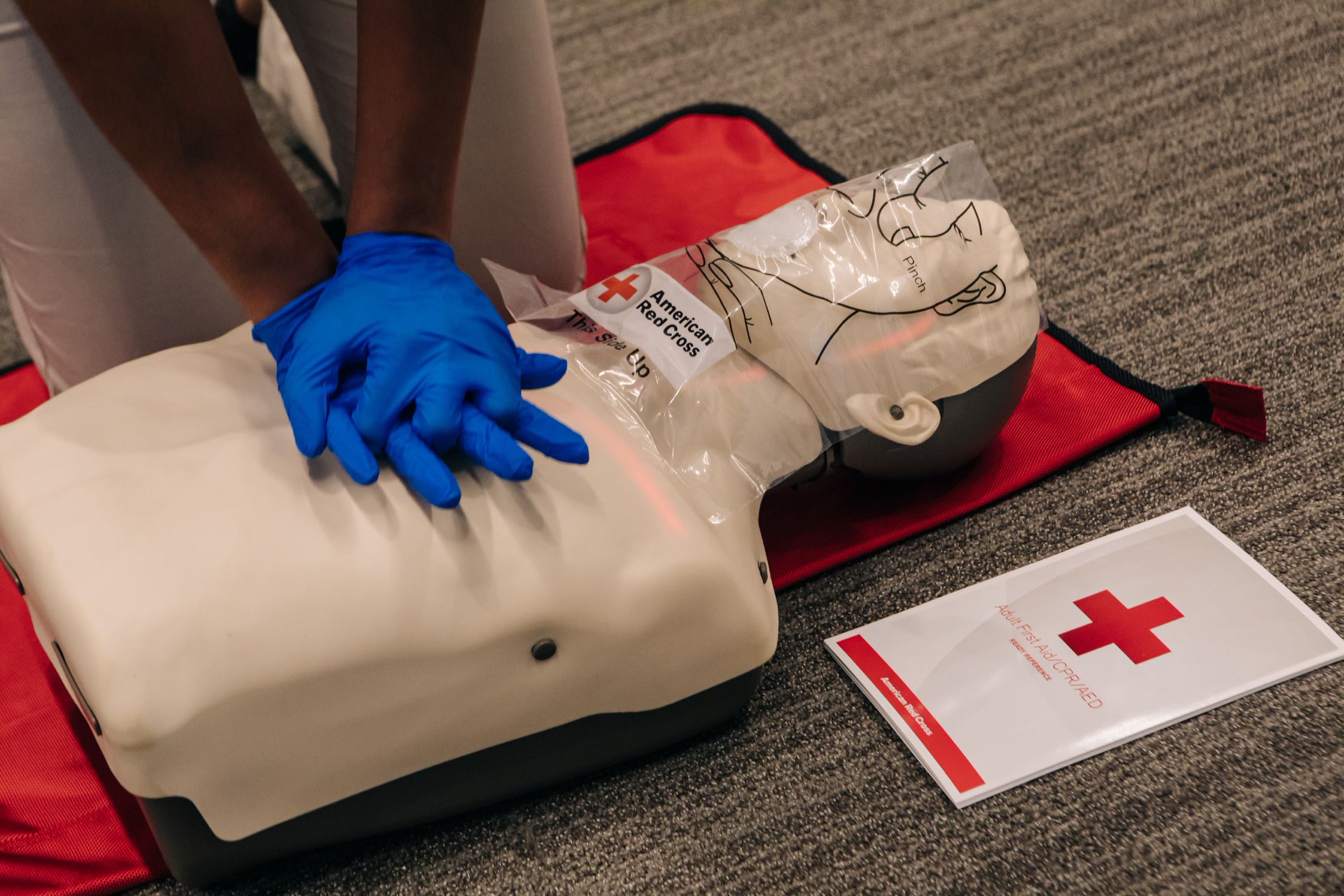
    Secondary image description: Picture of a participant’s gloved hands in a Red Cross First Aid/CPR/AED class, preparing to begin chest compressions on a CPR test Manikin.

  • Children at home? Make a home fire safety plan!

    By Judith Weeks

    When a fire disaster occurs, do you know who’s most at risk? Your kids—especially those under 5, who are twice as likely as others to die in a home fire. And here’s another scary fact: Because fire can spread rapidly, your family has as little as two minutes to escape before it’s too late.

    With the pandemic keeping everyone at home more, you may be looking for kid-friendly activities. The American Red Cross has some ideas on ways to keep the kids engaged while teaching them vital survival skills. Talk to them about fire safety, and make a Home Fire Safety Plan!

    Most children have a fear of fire. I know! When I was 8 years old, a fire occurred in my home. We all evacuated safely, but my bedroom had no outside exit. After the fire, I worried about the fire reoccurring and even worse, having no escape. I had nightmares of being trapped in my bedroom!

    Talking about fire safety with kids helps reduce their fear, and they’ll feel more confident if they know what to do. Be prepared for questions, especially if you have pets. Be as honest as you can, in a developmentally appropriate way.

    Here are some tips for making your Home Fire Safety Plan with your children.

    • Start by showing the kids where a fire can begin, such as a stove, fireplace, or portable heater. Banish candles from your home! Instead, use electric ones that won’t catch fire. Keep matches and flammable items safely stored.
    • Take a home tour with your kids, showing them smoke alarms and talking about escape routes. Teach them what a smoke alarm sounds like. Then repeat this phrase over and over: GET OUT, STAY OUT, CALL FOR HELP. Let it sink in. Emphasize they must never go back inside! Ask them to suggest an outdoor meeting place where the whole family can gather during an emergency.
    • Assign an adult to evacuate infants and toddlers under 5 years old. Stress to the older children that it is an adult’s responsibility—not theirs—to evacuate the younger siblings.
    • Ask each child to make a Fire Escape Map of their bedroom. Include two escape routes. Make sure they can open windows and doors. Include everyone in mapping the entire house.
    • Make a checklist for testing smoke alarms monthly and practicing the Fire Escape Plan twice a year. Post the Fire Escape Map and Checklist on a bulletin board. Have each child attach their map to their bedroom wall.

    YOU CAN SAVE YOUR CHILD’S LIFE BY PRACTICING YOUR HOME FIRE SAFETY PLAN!

    Now for the “fun” part: Practice your fire escape plan as a family. Crawl low and go to the outdoor meeting site. The escape should only take two minutes. Reward each child after each smoke alarm check and evacuation practice. Perhaps you could give them a smiley face sticker to attach to the Fire Escape Map in their room.

    Here are additional resources for kids’ emergency preparedness:

    Primary image description: A young girl holds up her Red Cross Home Fire Escape Plan.

    Second image description: A graphic from the American Red Cross entitled Mapping Out Your Escape Plan: Single Family Home, with an image of a single-family home interior with directions on identifying at least two exits from every room, making there are smoke alarms on all levels of the home, and that the members of the household know where to meet outside in the event of a fire emergency.

    Third image description: A graphic from the American Red Cross entitled Mapping Out Your Escape Plan: Multi-Family Dwelling, with an image of a multi-family home interior with directions, including identifying at least two exits from every room, making there are smoke alarms on all levels of each individual dwelling, and that the members of the household know where to meet outside in the event of a fire emergency.

  • Winter Weather Precautions for Home and On the Go

    By Maria Marabito

    Now that the holidays are over, you might already be dreaming of warm weather. But spring and summer are still a ways away, and you never know what else Mother Nature will throw at you in the middle of winter. Whether you’re at home or on the go, read on for tips to stay prepared from the Red Cross.

    At Home

    Keep fire prevention in mind. If you’re keeping cozy with a space heater or fireplace, make sure that any combustible materials, such as furniture or curtains, are at last three feet away. In fact, any heat producer, such as a stove and radiator, should be three feet from anything that could catch on fire. Never leave your portable heaters and fireplaces unattended while on. Likewise, test your smoke detectors. The U.S. Fire Administration recommends testing smoke detectors at least once a month and replacing them every 10 years.

    Collect flashlights. In the case of a power outage, use flashlights instead of candles. Prepare for inclement weather by making an inventory of your flashlights, making sure that every room has one and every person knows where they are.

    Home maintenance. Keep the cold from creeping in by caulking and weatherstripping doors and window edges. If you don’t have storm windows, covering your windows on the interior with plastic can go a long way toward helping your home feel warm. These inexpensive kits can be found at any hardware or home center.

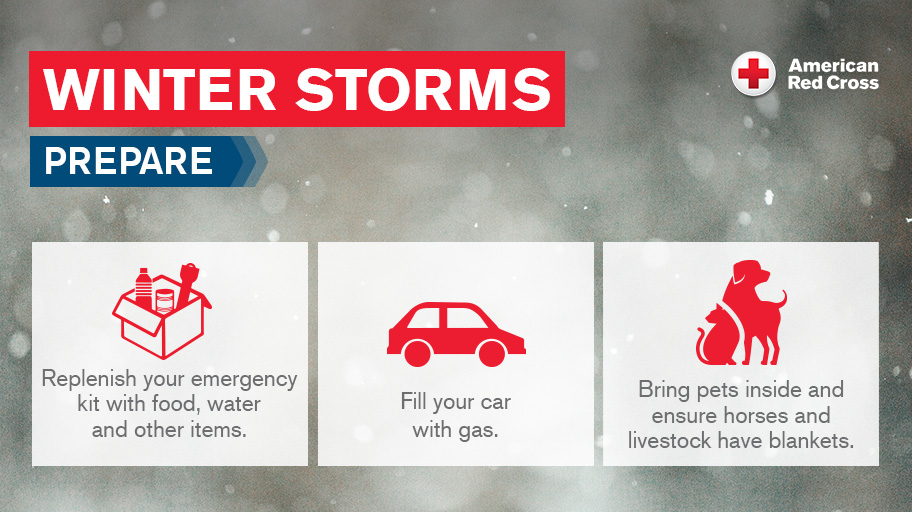
    Don’t forget your pets! Bring your pets indoors with you during extremely cold weather. Make sure you have supplies to clean up after them, since the weather might prevent them from doing their business outside. Shelter animals like horses or livestock as best you can against wind, snow, rain and ice.

    On the Go

    If you need to go outside during freezing temperatures and snow, take these precautions to make the trip safer.

    Bundle up. Wear layers, gloves, and a hat to keep yourself warm and protect against frostbite. The American Red Cross recommends that outer garments be tightly woven and water repellent.

    Remember your mask! Covering your mouth and nose protects your lungs from the cold air—and protects you and your community from coronavirus.

    Double-check your safety kit. Your car, just like your home, should have an emergency kit. Don’t have one? Don’t worry—the Red Cross has many online resources to guide you. In addition to seasonal essentials like windshield scrapers and extra gloves, make sure you have an emergency blanket in case your car breaks down in a snowstorm or deep-freeze situation.

    Phone a friend. If you must set out in less-than-optimal weather, make sure at least one person knows your route, destination, and estimated arrival time. Establish a check-in time so your friend knows whether to send for help.

    Cold weather can be unpredictable. A rainstorm can turn into ice or snow quickly, so take your preparations seriously. Keep an eye on the weather forecast and make responsible choices if going out into a storm.

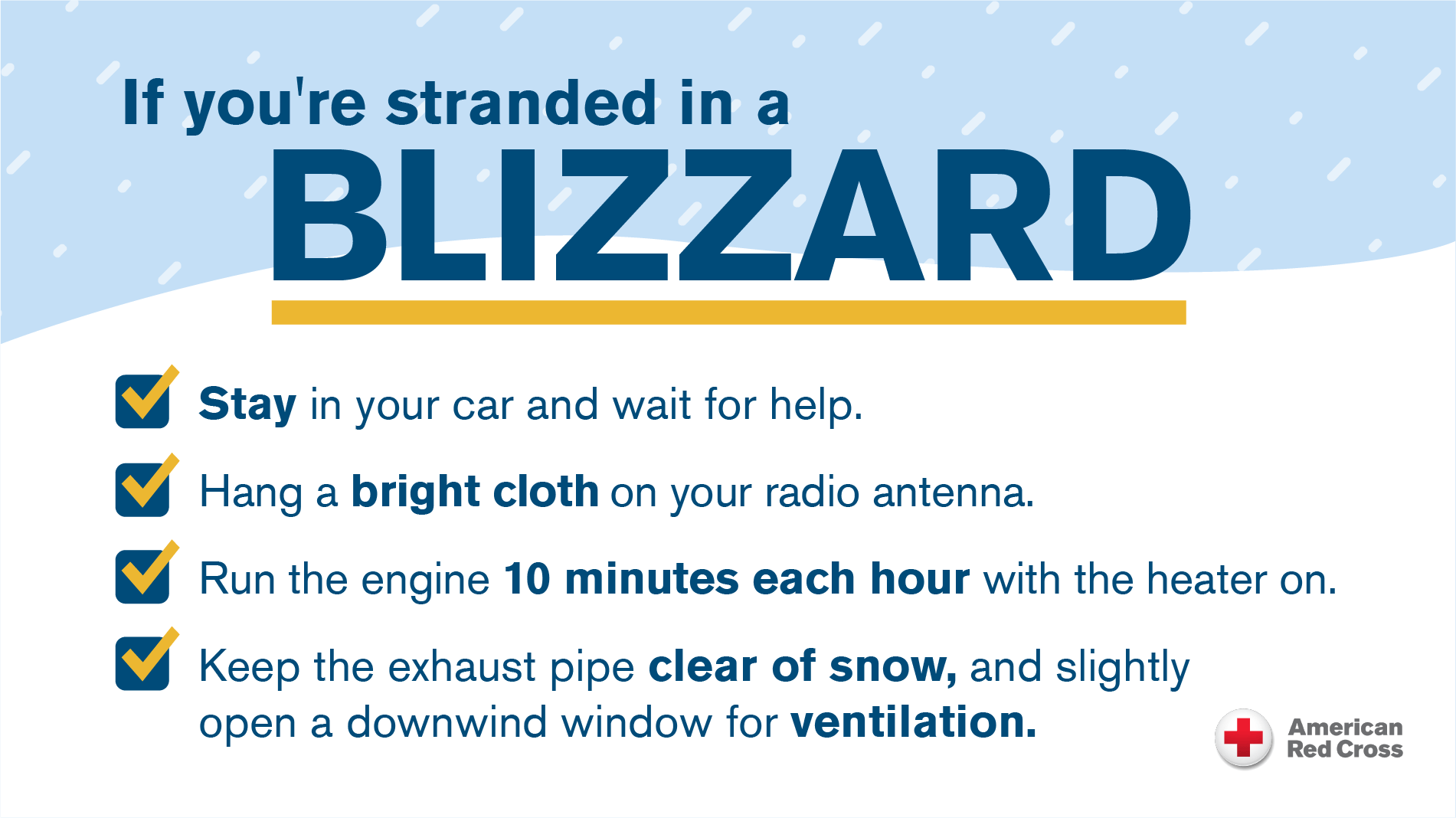
    This image has an empty alt attribute; its file name is rc-stranded-in-a-blizzard.png
  • Don’t Forget to ‘Turn and Test’ This Weekend!

    By: Marta Rusek

    Daylight Savings Time ends this Sunday, and you know that means – time to ‘Turn and Test’ your smoke alarms at home!

    Home fires are unfortunately the most common household disaster in America, even during COVID-19. During the month of October alone, volunteers from the Red Cross of Southeastern Pennsylvania responded to over 35 home fires in our five-county region, which impacted the lives of more than 140 people.

    “The need to protect ourselves from home fires hasn’t stopped during COVID-19,” said Guy Triano, CEO of the Red Cross Southeastern Pennsylvania. “That’s why it’s critical to have working smoke alarms, which can cut the risk of dying in a home fire by half. This weekend, take a few minutes to ‘turn and test’ to help keep you and your loved ones safe.”

    New to the ‘Turn and Test’ game? No problem! After you turn back your clocks, just press the button on your smoke alarms, following the manufacturer’s instructions. Replace the batteries in your alarm(s) if needed — at least once a year, if your model requires it.

    If you or a member of your family is deaf or hard-of-hearing, there are fire safety devices and even apps for your smartphone or tablet that can help alert you to a fire in your home.

    Looking for more ways to make sure you and your family are safe in case of a fire? Do the following:

    ∙ Replace smoke alarms that have been in use for 10 years or longer. The sensor inside becomes less sensitive as the years go by.

    ∙ Install smoke alarms on every level of your home, especially inside or right outside of bedrooms and sleeping areas.

    ∙ Create a two-minute escape plan and practice it with everyone in your home (including your pets). Two minutes is the amount of time you may have to escape a burning home before it’s too late. Practice at least two ways to get out of every room and choose a meet-up point where everyone can gather outside of your home, at a safe distance.


    Visit the Red Cross website to learn how to make an escape plan with your family and access additional resources. You can also download the FREE Red Cross Emergency app to your smartphone or tablet for safety tips on-the-go (just search for “American Red Cross” in the app store).


    Image description: A graphic with the American Red Cross logo at the top and a headline that reads – “Don’t forget to #TurnAndTest!” Underneath, there’s an illustration of a hand changing the time on an alarm clock, with the words “Step 1: Turn your clocks back one hour.” Next to Step 1 is an illustration of a hand pressing the Test button on a smoke alarm, with the words “Step 2: Test your smoke alarms.”

  • Fire Prevention Week is October 4 – 10: Test your Smoke Alarms and Practice your Escape Plan

    By Judith Weeks

    If you live in or around the city of Philadelphia, your evacuation plan may look something like this. | Design by the American Red Cross

    Did you know that if a fire starts in your home you may have as little as two minutes to escape? Home fires claim seven lives a day in the U.S., but a new 2020 national Red Cross survey shows most of us aren’t taking the steps to protect ourselves.

    Testing your smoke alarms each month helps ensure that they’re working — which can cut the risk of dying in a home fire by half. Still, the study shows 65% of us don’t. Practicing your escape plan twice a year also increases the odds of survival. But 70% of us don’t. Escaping in less than two minutes can be the difference between survival and tragedy, according to fire experts. Yet more than half of us think we have more time.

    During a fire, early warning from a smoke alarm plus having a practiced escape plan in place can save lives. Smoke alarms should be placed on each floor and strategically located throughout your home. Each alarm should be tested once a month. Replace batteries at least once a year and check the manufacturer’s date of your smoke alarms. If they’re 10 years or older, they need to be replaced because the sensor becomes less sensitive over time. Follow the manufacturer’s instructions.

    These two safety tips will protect your family in the event of a fire. | Design by the American Red Cross

    MAKE AN ESCAPE PLAN.

    • Include at least two ways to exit every room in your home. 

    • Make a map showing the location of each exit using this template.

    • Select a meeting spot at a safe distance away from your home, such as your neighbor’s home or landmark like a specific tree in your front yard, where everyone knows to meet.

    • Teach children what a smoke alarm sounds like. Talk about fire safety and what to do in an emergency.

    • Practice evacuation with all occupants, including caregivers and babysitters until everyone can get out in less than two minutes.

    • If a smoke and fire alarm is activated, evacuate immediately.

    Is an escape plan in your family’s playbook? We can help you make one! Design by the American Red Cross

    Many row homes are old with few escape options. Consider all exit possibilities. Fire can quickly spread from one row house to another. If you see or smell smoke from your house or someone else’s, immediately evacuate. Once you and others are safely out of your home, knock on your neighbors’ doors to notify them of a fire.

    Apartments, high rise buildings, and school dormitories are required to have an escape map posted on each floor with designated exits and reminder not to use the elevator. When moving a student into a dorm make sure the student knows where the escape map and exits are. If possible, practice an escape. This is probably an “aw Mom” moment but explaining the ‘why’ could save a life.

    Even in a year filled with wildfires, hurricanes and other storms, home fires remain the most common disaster that the American Red Cross responds to. From July 1 through August 31, the American Red Cross Southeastern Pennsylvania Region responded to 104 local emergencies, providing assistance for 443 families and 1,296 people in the five-county area.

    For more home fire preparedness tips, head to our Home Fire Preparedness page.

  • Four Ways to Keep Your Pet Safe in an Emergency

    By Marta Rusek

    Cats enjoy their "Cat-trastrophe" preparedness kit.
    Cats enjoy their “Cat-astrophe” preparedness kit. | Image credit: The American Red Cross

    This article was written for National Preparedness Month.

    Pets are family. They share in our joys and comfort us when we’re enduring life’s disappointments. So as you prepare for household emergencies and natural disasters, it’s vitally important to make sure your pets are part of that planning.

    Fortunately, the American Red Cross can help guide your planning: With these four tips, you’ll be better positioned to handle what life throws at you—and at your pet.

    Download the Red Cross Pet First Aid App. Your smartphone or tablet is always at hand—and this app provides first-aid and emergency care info for your cat or dog at your fingertips. Access step-by-step instructions, including pictures and videos, for more than 25 first-aid and emergency scenarios. You’ll learn to treat wounds, control bleeding, and provide care for breathing and cardiac emergencies. There’s also guidance on caring for your pet in the case of burns, vehicular accidents, falls, and cold- and heat-related emergencies. Learn more and download it here.

    Keep pet supplies in your emergency kit. You’ll want at least a week’s worth of your pet’s food, along with water and food bowls and any necessary medications. Toys and other calming items from home are also worth bringing. Don’t forget a leash and pet waste bags for your dog, a carrier and litter box (with litter) for your cat, and a small tank or cage to comfortably transport any fish, reptiles, birds, rodents, or pets of the eight-legged variety. Keep a recent photo of your pet in case you become separated during your evacuation, and jot down feeding schedules, medical conditions, behavior problems, and the name and number of your veterinarian in the event that you have to foster or board your pet for a bit.

    Ozzy the dog shares his review of the Red Cross' Cat and Dog First Aid Training.
    Ozzy the dog shares his review of the Red Cross’ Cat and Dog First Aid Online Training.
    Image credit: The American Red Cross

    Make an evacuation plan. If staying in your house during an emergency or natural disaster isn’t safe for you, then it’s definitely not safe for your pet. As part of your planning, reach out to a friend or relative who lives within driving distance. Ask if they’d be willing to shelter you and your pet if the need arose. (Of course, assure them that you’d mask up and take other pandemic precautions.) Know the locations and pet policies of all the hotels and motels in your areas. If you live in an area where natural disasters like hurricanes or floods are more likely to happen, make sure your pet is microchipped and up to date on vaccines.

    Do an evacuation rehearsal. Natural disasters and emergencies can feel overwhelming, and time is of the essence when it comes to getting to safety. To avoid panic and wasted time in a crisis (such as a house fire), practice your evacuation route with your pet ahead of time. Doing this can also alert you to any potentially problematic behaviors from your pet. Some animals run and hide under a bed when they’re frightened by loud noises or when they see their owner reaching for the carrier. Keep your furry family member’s favorite treats handy in case you need to coax your pet out of a hiding place or into a carrier. Have a towel or a blanket handy to drape it over the carrier; this may help your pet stay calm during the evacuation.

    Planning ahead for emergencies is one of the best ways to show your pets how much you love them, and the American Red Cross is always here to help you expect the unexpected with up-to-date preparedness tips and resources.

  • Don’t Forget to Mask Up This Fall!

    By: Caitlin McLafferty

    One of the most essential tools to stop the spread of the novel coronavirus is a mask. Many coronavirus patients show no symptoms of the virus – however, they are still able to infect others. A mask helps reduce the spread of the corona virus across communities and can help protect those we love most. The Red Cross also encourages mask-wearing as a way to slow the spread of COVID-19.

    Face Coverings - What to Look for Illustration

    In a July 14 press release, Center for Disease Control (CDC) Director Dr. Robert R. Redfield stated, “Cloth face coverings are one of the most powerful weapons we have to slow and stop the spread of the virus – particularly when used universally within a community setting. All Americans have a responsibility to protect themselves, their families, and their communities.”

    Dr. Redfield’s statement is supported by previous studies from the SARS outbreak. “Universal Masking to Prevent SARS COVID 2 Transmission-The Time Is Now,” published in the Journal of the American Medical Association, reported that, “the more individuals wear cloth face coverings in public places where they may be close together, the more the entire community is protected.”

    The evidence for wearing a mask is clear, but for some there is some confusion on what type of mask is recommended.

    In the clinical setting, N95 respirators are used for healthcare providers to treat coronavirus patients. Surgical masks are disposable and filter large particles, but are not as tight fitting as N95 masks, which filter 95% of large particles.

    In community settings, cloth masks are recommended since they stop the virus from spreading to others through droplets. Therefore, a mask should be worn to cover one’s nose and mouth. When the mask is not covering both the nose and the mouth, the mask cannot serve as a barrier to prevent droplets from spreading. Masks should consist of multiple layers to help filter droplets and particles. According to The University of Pennsylvania’s Environmental Health and Radiation Safety website, masks that have valves are not recommended since the mask does not prevent air from escaping the mask, hence defeating the purpose of wearing a mask.

    It is not recommended to touch a mask while it is being worn, and if a mask needs to be touched, hands should be washed before and after adjustment. The Mayo Clinic recommends washing a mask with soap and water or even in the washing machine.


    Together through social distancing, frequent hand washing, and cloth masks can drastically reduce community infection rates. The CDC, governor’s offices across the U.S., well-known research universities, and leading hospitals are constantly updating their sites with the latest information. By staying updated on leading information, everyone can do their part to help slow the spread of the novel coronavirus.

  • Red Cross Offers Tips for a Safe Labor Day Weekend

    The Labor Day holiday is fast approaching, signaling the unofficial end of summer and time for that last hurrah of summer fun. The American Red Cross has steps everyone can take to help stay safe over the long holiday weekend.

    TRAVEL SAFETY Many families see the holiday weekend as their last chance to travel and celebrate the end of the season. Many will hit the road sometime over the three-day holiday weekend. The Red Cross offers these travel tips to help keep you safe on the highway:

    • Find out what disasters may occur where you are traveling and how you would get information in the event of a disaster (local radio systems, emergency alert systems).
    • Pay attention to the weather forecast for your destination.
    • Buckle up, slow down, and don’t drink and drive. Designate a driver who won’t drink.
    • Be well rested and alert; give your full attention to the road.
    • Use caution in work zones.
    • Observe speed limits.
    • Make frequent stops.
    • Be respectful of other motorists.
    • Clean your vehicle’s lights and windows to help you see, especially at night.
    • Turn your headlights on as dusk approaches, or during inclement weather, and don’t overdrive your headlights.
    • Carry a Disaster Supplies Kit in your trunk.
    • Don’t let your vehicle’s gas tank get too low.
    • If you have car trouble, pull as far as possible off the highway.
    • Let someone know your destination, your route, and when you expect to arrive. If your car gets stuck along the way, help can be sent along your predetermined route. 

    RIP CURRENTS If a trip to the beach is part of your weekend plans, remember the possibility of dangerous rip currents which are responsible for deaths on our nation’s beaches every year, and for most of the rescues performed by lifeguards. For your safety, be aware of the dangers of rip currents and remember the following:

    • If you are caught in a rip current, swim parallel to the shore until you are out of the current. Once you are free, turn and swim toward shore. If you can’t swim to the shore, float or tread water until you are free of the rip current and then head toward shore.
    • Stay at least 100 feet away from piers and jetties. Permanent rip currents often exist near these structures.

    GRILLING SAFETY Perhaps your plans include an old-fashioned barbecue at home. The Red Cross offers these steps you should follow to use that backyard grill safely:

    • Always supervise a barbecue grill when in use.
    • Never grill indoors – not in your house, camper, tent, or any enclosed area.
    • Make sure everyone, including the pets, stays away from the grill.
    • Keep the grill out in the open, away from the house, the deck, tree branches, or anything that could catch fire.
    • Use the long-handled tools especially made for cooking on the grill to help keep the chef safe.
    • Never add charcoal starter fluid when coals have already been ignited.
    • Always follow the manufacturer’s instructions when using grills.

    The Red Cross hopes everyone enjoys their Labor Day weekend and stays safe whatever their plans may be. For more information, visit redcross.org/prepare.

  • Red Cross Offers Back to School Safety Steps

    Back-to-School-Safety-FEAT

    Summer vacation for students is coming to a close as local schools open their doors for the new school year. The American Red Cross has these safety steps to help make your student’s trip back to the classroom a safe one.

    American Red Cross Eastern Pennsylvania Regional CEO Guy Triano suggests looking over the safety steps with the entire family. “While you’re making that list of school supplies the kids will need, talk with them about school bus safety and getting to school by car, bike or on foot. Keeping all students safe is the primary concern for everyone. But there are special steps for parents of younger kids and those going to school for the first time,” he says.

    • Make sure the child knows their phone number, address, how to get in touch with their parents at work, how to get in touch with another trusted adult and how to dial 9-1-1.
    • Teach children not to talk to strangers or accept rides from someone they don’t know.

    SCHOOL BUS SAFETY

    • If children ride a bus to school, they should plan to get to their bus stop early and stand away from the curb while waiting for the bus to arrive.
    • Board the bus only after it has come to a complete stop and the driver or attendant has instructed you to get on.
    • Only board your bus, never an alternate one.
    • Always stay in clear view of the bus driver and never walk behind the bus.
    • Cross the street at the corner, obeying traffic signals and staying in the crosswalk.
    • Never dart out into the street or cross between parked cars.

    GETTING TO SCHOOL BY CAR, BIKE, ON FOOT

    • If children ride in a car to get to school, they should always wear a seat belt. Younger children should use car seats or booster seats until the lap-shoulder belt fits properly (typically for children ages 8-12 and over 4’9”), and ride in the back seat until they are at least 13 years old.
    • If a teenager is going to drive to school, parents should mandate that they use seat belts. Drivers should not use their cell phone to text or make calls, and should avoid eating or drinking while driving.
    • Some students ride their bike to school. They should always wear a helmet and ride on the right in the same direction as the traffic is going.
    • When children are walking to school, they should only cross the street at an intersection, and use a route along which the school has placed crossing guards. Parents should walk young children to school, along with children taking new routes or attending new schools, at least for the first week to ensure they know how to get there safely. Arrange for the kids to walk to school with a friend or classmate.

    DRIVERS, SLOW DOWN!

    Drivers should be aware that children are out walking or biking to school and slow down, especially in residential areas and school zones. Motorists should know what the yellow and red bus signals mean. Yellow flashing lights indicate the bus is getting ready to stop and motorists should slow down and be prepared to stop. Red flashing lights and an extended stop sign indicate the bus is stopped and children are getting on or off. Drivers in both directions must stop their vehicles and wait until the lights go off, the stop sign is back in place and the bus is moving before they can start driving again.