For the third year, the Southeast Pennsylvania Region (SEPA) of the American Red Cross is offering Camp Save-A-Life, a free summer program in partnership with the City Philadelphia Parks and Recreation. The program is delivered by Red Cross counselors to summer day camps held at neighborhood parks, recreation centers and playgrounds throughout the City.
This summer, eight Camp Save-A-Life counselors have been hired and trained to teach this program. These dedicated and energetic counselors make the program fun and informative for kids ages 4-8.
The counselors engage kids using “Prepare with Pedro the Penguin” a character that teaches home fire safety and coping skills. The lesson is 30 minutes. Within this brief period, it is important to catch the kids’ attention and keep them involved throughout the lesson. Pedro the Penguin is the perfect character for the job!
Red Cross Disaster Cycle volunteers Kathy Mullen Mary Ann Santangelo train this year’s Camp Save-A-Life counselors to teach fire safety with Pedro the Penguin, Photo by Judith Weeks / American Red Cross
Pedro tells a story that young children can understand, a story about a family or a single parent learning the three steps of fire safety. The counselors learn how to tell this story with colorful visual graphics to grab the attention of the young audience. When telling the story they repeat in a rhythmic phrase “gotta get outside in under two minutes” emphasizing evacuation in less than two minutes. When the smoke alarm goes “beep beep beep” it is time to “get out and go low” because there is less smoke on the ground. The counselor demonstrates how to go low and not crawl. Continuing repetition, the story is told “once you’re out you gotta stay out” and never go back into the house. The counselors ask the kids to repeat these phrases throughout the lesson.
Daijan Fleming, a Camp Save-A-Life team lead counselor, has participated in the program since its inception three years ago. She is pictured using Pedro and colorful images to reinforce “beep beep beep!” Photo by Judith Weeks / American Red Cross
Lucille Alexander, a substitute teacher who was looking for something to do this summer, is a team lead counselor for Camp Save-A-Life. For Lucille, the idea of empowerment is most important. She explains “We’re going to teach them things they will remember. Kids do have a lot of power because they can influence the adults in their lives. We teach them to get your grown-ups involved. You always have the power to let people know how they can be safer.”
She continues, “Getting the kids to understand some of the basic things they need to do to be prepared for a fire is important and impactful. The kids are encouraged to share fire safety with their families. One of the facts we learned early on is 70% of the kids share what they learned with their family.”
Lucille Alexander, a team lead Camp Save-A-Life counselor, practices teaching Pedro the Penguin curriculum during training in July. Photo by Judith Weeks / American Red Cross
Pedro the Penguin will have a significant impact on fire safety this summer! Ryan Gaul, SEPA Disaster Preparedness Manager, estimates a thousand kids ages 4-8 will learn fire safety from Pedro this summer.
In addition to Prepare with Pedro, Red Cross Camp Save-A-Life counselors will also present “Longfellow’s WHALE Tales” to children ages 4-12. WHALE Tales stands for Water Habits Are Learned Early. Like Pedro is used to teach fire safety, Longfellow helps children learn safer behaviors in and around water.
Observing kids in Camp Save-A-Life, Ryan exclaims “they are right on the edge of their chairs focused and wanting to be there. It is something really exciting!”
Editor’s Note: Our fictional friends Jane and Zymir pet-proof their house for a furry house guest just in time for National Pet Fire Safety Day.
IAF graphic – 5 tips from fire fights to keep your pets safe. 1. Consider installing monitored smoke detectors to receive an alert when you’re not home. 2. Secure hazards out of paw’s reach, especially electrical wires and stove-top knobs. 3. Make sure your pet is microchipped or wearing a collar with up-to-date contact information. 4. Keep pets near an entrance door where fire fighters can easily get to them. 5. Affix a pet alert decal on the door or window of your home.
By Robert Ambrose
ZYIR: Your mom called me about babysitting her dog.
JANE: Here we go.
ZYIR: Just so happens our first day of sitting is National Pet Safety: Tuesday, July 15.
JANE: So?
ZYIR: Look, half million pets are hurt by fires. What really struck me is: 100,000 pets started the fires.
JANE: Seriously?
ZYIR: A dog or cat could knock over a candle or a stovetop pan…we can get stove knob covers so the dog cannot turn on our stove.
JANE: Never would have thought…or just remove the stove knobs.
ZYIR: And I never thought of that. Anyway, I was just catching up on the Red Cross blog. We need exit points…
JANE: to escape.
ZYIR: And keep your mom’s dog near a door when we’re away…
JANE: So, the fire department can rescue the dog. How about a pet sticker on the window?
ZYIR: Yes. Google ASPCA for free pet safety pack. We’re gonna’ microchip your mom’s pet…
JANE: next to the dog’s ID tag.
ZYIR: We have a smoke alarm on every floor. How about a fire drill practice?
JANE: Do you think this is grade school?
ZYIR: Then our escape plan is an automatic reaction instead of panic, delay and overreaction.
JANE: Okay. Let’s practice evacuation.
ZYIR: I love your mom, but it’s a hassle to remove every extension cord from where Humphrey will play. I don’t want the dog to eat half the cord and then we have an electrical fire.
JANE: Like most dogs, this dog is not trained to behave itself. Humprey chomped through an electrical cord last week at my mom’s house. Luckily, there was no current in that extra cord.
ZYIR: Forgiven. But we can assure against any repeated devouring of extension cords.
JANE: Dog eat dog world.
ZYIR: Nice one. How’s work?
JANE: Gonna’ share with them this Red Cross reminder about learning to use fire extinguishers.
ZYIR: Does any adult not know how to use a fire extinguisher?
JANE: Yes. And people need to learn. Aim, pop the pin and squeeze.
ZYIR: I guess we’ll keep tuning in to the Red Cross blog to have these interesting discussions about what if scenarios and ways to prevent those emergencies.
JANE: Prevention is key. That smoke alarm upstairs is beeping by the way.
As you get ready to celebrate the 4th of July with family and friends, the American Red Cross Southeastern Pennsylvania Region offers tips to help keep everyone safe during the holiday festivities.
Fireworks safety
The safest way to enjoy fireworks is to attend a public firework show put on by professionals. As an alternative to fireworks at home, consider celebrating with glow sticks, noise makers or silly string instead. If you choose to set fireworks off at home, follow these safety steps:
Never give fireworks to small children and never throw or point a firework toward people, animals, vehicles, structures or flammable materials.
Always follow the instructions on the packaging.
Keep a supply of water close by.
Make sure the person lighting fireworks always wears eye protection.
Light only one firework at a time and never attempt to relight “a dud.”
Store fireworks in a cool, dry place away from children and pets.
Never use fireworks around pets and keep pets indoors. Exposure to lit fireworks can potentially result in severe burns or trauma, and many pets are also fearful of loud noises and can become lost, scared or disoriented.
Water safety
July 4th temperatures are projected to be in the mid-to-high 80s, which is the perfect weather for a dip in a pool, a visit to a water park or a getaway at the shore. The Red Cross recommends steps you should take to help stay safe around the water:
Designate a “water watcher” to keep a close eye and constant attention on children and weaker swimmers in and around the water until the next water watcher takes over.
Always swim with a buddy in a lifeguarded area and follow the rules of the facility.
Provide close and constant attention to those you are supervising in the water.
Stay within arm’s reach of young children and new swimmers.
Check the water depth and don’t swim or play beyond your swimming abilities.
Children, weak or non-swimmers, and all boaters should wear a properly fitted U.S. Coast Guard-approved life jacket.
Watch the weather and get out of the water at the first sign of lightning or rumble of thunder. Stay indoors and away from the water for 30 minutes after the last lightning flashes or thunder roars.
Picnic and grilling safety
On average, grilling sparks more than 10,000 home fires each year. To keep your picnic guests safe, the Red Cross recommends following these tips:
Always supervise a barbecue grill when in use.
Don’t add charcoal starter fluid when coals have already been ignited.
Never grill indoors – not in the house, camper, tent or any enclosed area.
Make sure everyone, including pets, stays away from the grill.
Keep the grill out in the open, away from the house, deck, tree branches or anything that could catch fire.
Use long-handled tools designed specifically for grilling to help keep the chef safe.
Wash your hands before preparing the food.
Don’t leave food out in the hot sun. Keep perishable foods in a cooler with plenty of ice or freezer gel packs.
Safety at your fingertips
Take the Red Cross with you this summer by downloading the free Red Cross First Aid app so you’ll know what to do if emergency help is delayed and the free Emergency app for real-time weather alerts and heat safety information. Content is available in English and Spanish with an easy-to-find language selector. Find both apps in smartphone app stores by searching for the American Red Cross or going to redcross.org/apps.
NOAA graphic – One Strike, You’re Out. When thunder roars, go indoors. weather.gov
Each year, National Lightning Safety Week (June 22–28) highlights the importance of protecting ourselves from one of nature’s most dangerous forces. Although lightning can strike in an instant, the damage it causes can last a lifetime. Staying informed and taking simple precautions can help prevent injuries and save lives. From the American Red Cross, here are ways to stay safe during a lightning strike.
Understanding Lightning Dangers
Lightning is unpredictable and deadly. It can strike miles away from a storm and travel through ground, metal, and even plumbing. Each year, hundreds of people in the U.S. are injured or killed by lightning-related incidents. The key to staying safe is awareness and preparation.
When thunder roars, go indoors. If you can hear thunder, you are close enough to be struck.
Avoid open fields, tall objects, and water during a thunderstorm.
Stay away from windows, plumbing, and electrical equipment during a storm.
NOAA graphic – Lightning is hotter than the surface of the sun and can reach temperatures around 50,000 degrees F. When thunder roars, go indoors. weather.gov
Staying Safe Outdoors
Outdoor activities are especially risky during a thunderstorm. Whether you’re hiking, playing sports, or working, having a lightning safety plan can make a difference.
Always check the weather forecast before heading outside.
Have a shelter option nearby—fully enclosed buildings are best.
Avoid high ground and metal objects like fences, poles, and bikes.
Your chance of being struck by lightning greatly increases when remaining outdoors during a thunderstorm. Lightning can strike from up to 10 miles away! When thunder roars, go indoors! See a flash, dash inside! Some of the activities people were doing when they were recently struck by lightning include: golfing, boating, running, grilling, walking, constructing, riding, gardening, swimming.
Staying Safe Indoors
Many people are surprised to learn that lightning injuries can also occur inside the home. When lightning strikes a building, it can travel through wiring, plumbing, and even metal window frames. That’s why it’s important to avoid anything that conducts electricity while indoors during a storm.
Do not touch anything plugged into an outlet.
Avoid sinks, bathtubs, and other plumbing.
Use cordless or cell phones instead of corded ones.
Stay away from windows and exterior doors.
Avoid lying on garage or concrete floors, which may conduct electricity.
NOAA graphic – Your Safe Place from Lightning: Lightning strikes the U.S. 25 million times a year, which sometimes results in death or permanent injury. You are safest indoors or inside a hard-topped and enclosed vehicle. If you hear thunder or see lightning, take shelter immediately.
The American Red Cross provides tools to keep you safe before, during, and after thunderstorms. Their Emergency App sends real-time weather alerts, preparedness tips, and emergency instructions directly to your phone. Download it from the Red Cross Mobile Apps Page to stay informed of an upcoming disaster.
National Lightning Safety Week is a great opportunity to build awareness, make smart choices, and feel more confident when storms roll in. With the right knowledge and tools, like the Red Cross Emergency App, you can take control of your safety and enjoy the season knowing you’re prepared.
“Hi, I am Haley and I will be your Nurse today.” This is not only a phrase I use to introduce myself to all of my patients at work every shift, but also the start to these articles for all of you as well. What inspired me to start this monthly column was realizing that all of the teaching I do with patients I meet is because something has already happened. Teaching for health prevention and awareness should not begin after a hospital visit, but beforehand to prevent anyone from needing the hospital in the first place.
In Nursing School, I learned that there are obviously a difference between factors in one’s health that can be changed, like diet and exercise, but we also know that there are things that cannot be changed, like genetics and age. I like to emphasize the modifiable risk factors, so that no matter who you are or what your age, it is something that you can be implemented right now as soon as you are done reading.
Red Cross graphic – Stay hydrated.
With the warmer temperatures coming out, we get to enjoy swimming, spending time out doors and being in the warm sun more. What this also means is that as our bodies are warming up, they sweat. Sweating is a normal human characteristic that our bodies go through in order to cool ourselves down. Sweating is also a way our body gets rid of fluids and electrolytes, hence why in the warmer weather it is easier to become dehydrated.
Hydration is always important, but especially at a time of year that we are loosing more fluids. Individual factors like preexisting health conditions, age, climate, activity levels and more impact exactly how much hydration you need. But according to Mayo Clinic, men should consume approximately 3.7L (15.5 cups) of fluids a day and women should consume approximately 2.7L (11.5 cups) of fluids a day in the warmer months.
When researching the daily recommendations for children through Johns Hopkins Medicine, they made it simple. children should drink their age in 8-ounce glasses until they reach the age of 8. Children age 8 and older should drink eight 8-ounce glasses of water per day. If you have a 6-year old, he or she should drink six 8-ounce glasses per day. Although this may seem like a lot, the volume can easily be accomplished by drinking water with meals, as most cups that families use are between 12 and 16 ounces.
Red Cross graphic – How hydrated are you? Check your urine color. Clear-light is good. Yellow or gold means you need to drink more water.
If you are worried that you are dehydrated, pay attention to the warning signs and symptoms. Some common signs include fatigue, muscle cramps, dark urine/decreased urine, headaches and thirst. More critical signs and symptoms can worsen to electrolyte imbalances. The danger with electrolyte imbalances is that they affect muscle function, fluid balances, nerve signals and many other bodily processes. This is why it is important to seek medical attention if concerned, because dehydration sometimes cannot be fixed by just drinking a gatorade if severe.
Now that we are at the end of the article, I want you to go drink a glass of water and remind yourself that your health should be taken seriously before you hear this information as you are laying in a hospital bed.
Sound the Alarm participants gather for a group picture before going out into the community to install free smoke alarms and provide fire safety education. Photo by Katerina Luchinina / American Red Cross
The American Red Cross Southeastern Pennsylvania (SEPA) Region wrapped up its 2025 Sound the Alarm initiative – part of the year-round Home Fire Campaign – with a signature event in South Philadelphia on May 2, 2025.
Meeting at the Murphy Recreation Center on Shunk Street, teams of Red Cross volunteers and staff worked together with community partners and sponsors to Sound the Alarm. The event successfully helped people in more than 100 homes become safer with education about how dangerous fires can be and the installation of free smoke alarms.
Jennifer Graham, CEO of Red Cross SEPA, enthusiastically welcomed the large crowd on a beautiful hot day in the Whitman neighborhood.
“I’m excited to Sound the Alarm with you here in Philadelphia!”
Her greeting received loud cheers and applause.
“Today, we will install free smoke alarms — which can cut the risk of dying in a home fire by half. By the time we leave their homes, residents should know how to prevent home fires and how to get out and stay out if one does occur,” she said.
Left: Red Cross Southeastern PA CEO Jennifer Graham kicks off the 2025 signature Sound the Alarm event on May 2. Right: Philadelphia City Council Member Mark Squilla tests a newly-installed smoke alarm in someone’s home. Photos by Alana Mauger / American Red Cross
Philadelphia 1st District Council Member Mark Squilla spoke to the crowd before going out with a team to help install smoke alarms. He thanked the Red Cross and said he was impressed by how many volunteers showed up to help out. One volunteer shared a moving story the Council Member, which he shared with the crowd.
“The volunteer told me they had a smoke alarm installed in their home and the reason why they’re a volunteer today to give back is because they actually had a fire and the smoke alarm went off and they were able to get out of their home.” He explained that “their lives were saved.”
Philadelphia Fire Department Commissioner Jeffrey Thompson also thanked the crowd for coming out and the Red Cross for always being there whenever there is a need.
“They are our partners through good times and bad and today is a really good time because today we are leaning into fire safety by installing smoke alarms.”
Left: Philadelphia Fire Commissioner Jeffrey Thompson (left) and Council Member Mark Squilla look on as Red Cross Philadelphia Chapter Board Chair Larry Pockers installs a smoke alarm in a resident’s home. Photo by Alana Mauger / American Red Cross. Right: Philadelphia OEM Director Dominick Mireles speaks at Sound the Alarm kick off event. Photo by Katerina Luchinina / American Red Cross
Dominick Mireles, the director of the Philadelphia Office of Emergency Management, spoke about the importance of smoke alarms and encouraged people to test their alarms to make sure they are working, something the Red Cross teams do when they go door to door to install them.
“Smoke alarms as you heard are often the difference helping loved ones and their pets get out of a home fire alive.” He said smoke alarms are part of home readiness and help give “the women and men of the fire department a chance to stop that fire.”
Drew Davis is a board member for the Red Cross Philadelphia Chapter and is the director of distribution system operations at PECO, an event sponsor. He was amazed by the size of the crowd.
“I see a group of heroes out there.” He said, “I’m specifically talking about the great men and women of the Philadelphia Fire Department. They put themselves in harm’s way so we can be safe. They’re running in while we’re running out. It takes a hero to do that so thank you so much.”
“Also, the volunteers. Wow, what a turnout today!” he added.
Top left: Drew Davis speaks at Sound the Alarm kickoff. Photo by Katerina Luchinina / American Red Cross. Bottom left: PECOs team, including Davis, at Sound the Alarm. Photo by Alana Mauger / American Red Cross. Bottom right: Red Cross volunteer Chris Robold knocks on doors in South Philadelphia. Photo by Jenny Farley / American Red Cross
Christopher Robold was one of those Red Cross volunteers who trained his four-person team on how to install the free smoke alarms before going door to door in the South Philly neighborhood.
Chris retired two years ago after teaching high school chemistry for 33 years, and he loves volunteering for the Red Cross.
“I’m a people person and I enjoy talking to people and making people’s houses safer,” he said.
Kareem Ali works as a lineman for PECO. Kareem had a special reason for volunteering with Chris and the team at his first Sound the Alarm event.
“This is something that means a lot to me. I lost a family member in a fire before, so this is very near and dear to my heart.”
Kareem helped install smoke alarms for people like Valerie Reaves. Valerie has lived in Philadelphia for 60 years and said there was recently a fire on her neighborhood block.
“I woke up and I heard sirens,” she said.
Valerie used to work in a daycare and was one of the people responsible for mapping out escape routes for the staff and kids in case of fire. She was grateful to the Red Cross team who installed the smoke alarms in her grandson’s home and said it made her feel safer.
“That’s a beautiful thing,” she said.
Left: Kareem Ali from PECO and Melissa Knox with Red Cross Biomedical Services volunteer to make a Philadelphia neighborhood safer during their first Sound the Alarm event. Right: A Red Cross Sound the Alarm volunteer team goes door to door installing free smoke alarms in South Philadelphia. Shown from left to right: Kareem Ali, Eden Laroque, Melissa Knox and Christopher Robold. Photos by Jenny Farley / American Red Cross
Red Crosser Melissa Knox is the supplies supervisor for the kitting department in Biomedical Services and has worked for the Red Cross for 13 years. It was her first time volunteering at Sound the Alarm too.
“It’s very nice. I didn’t know what to expect. I was overwhelmed with the amount of volunteers that are here.”
One of Melissa’s jobs while working with Chris, Kareem and Red Cross volunteer Eden Laroque, was to talk to residents about how to escape their home during a fire, and to keep track of how many smoke alarms were installed in each home.
“This gets me out and talking to people and doing good with the company that I love working for,” she said.
According to Red Cross Disaster Preparedness Manager Ryan Gaul, Red Cross teams installed 412 smoke alarms for 440 people during the May 2 Sound the Alarm event while also delivering critical fire safety information to 128 households.
“We also greatly appreciate our colleagues from the Red Cross Blood Services team who join us regularly for these events.” Ryan said during the May 2nd event, “More than 150 participants contributed over 1,200 volunteer hours.”
In addition to the signature event in South Philadelphia, the Red Cross held Sound the Alarm events in Upper Darby and West Philadelphia. Altogether, the Red Cross installed 1,173 smoke alarms, making 364 homes safer during the month-long initiative. More than 235 Red Crossers and community volunteers participated.
Left: Volunteer teams from Sound the Alarm sponsors Clark & Cohen (top) and Morgan Properties (bottom) at the May 2nd event. Photos by Alana Mauger / American Red Cross. Top right: John Poplawski, vice president of real estate and fuel for Wawa, speaks at the Sound the Alarm kickoff. Photo by Katerina Luchinina / American Red Cross. Bottom right: Red Cross SEPA mascot Fred Cross hanging out with Wawa before the event. Photo by Ellen Ginda /American Red Cross.
The 2025 Sound the Alarm events were made possible thanks to generous financial donations from regional partners: Clarke & Cohen Property Loss Consultants, Independence Blue Cross, Morgan Properties, PECO, an Exelon Company and The Wawa Foundation. National sponsors are FEMA and State Farm.
Wawa fed teams a wonderful breakfast before they headed out for the day to install smoke alarms and a delicious lunch when they returned from making homes safer.
John Poplawski is vice president of real estate and fuel for Wawa and is a Red Cross Philadelphia Chapter board member.
“Wawa has been a part of this from the very beginning,” he said. “On behalf of the Wawa Foundation, our 4,000 associates here in the city of Philadelphia and our 50,000 associates organization-wide, we just want to say thank you for being here to support this.”
If you need smoke alarms, the Red Cross may be able to help. You can submit a request on our website or call 215-299-4029. If you live in the City of Philadelphia, you can also call 3-1-1. To learn more or to get involved with Sound the Alarm or our Home Fire Campaign, visit SoundTheAlarm.org/Philly.
International Water Safety Foundation video: “International Water Safety Day: Global Drowning Problem”
As temperatures rise and families head to pools, lakes, and beaches, it’s important to remember that water can be as dangerous as fun. Every year, thousands of lives are lost to drowning, tragedies which could be prevented with simple knowledge and preparation. Whether you’re a parent or recreational swimmer, understanding water competency, using layers of protection, and knowing the chain of survival can be vital in any life-or-death water situation.
What is Water Competency?
Water competency focuses on safety for yourself and others by recognizing water dangers, building fundamental skills, and knowing how to respond to emergencies. We define water competency in three key components:
Water Smarts
Taking precautions in and around water is critical. These include:
Knowing your physical limitations and being aware of any medical conditions.
Never swimming alone. Always have a buddy or swim in areas supervised by lifeguards or water watchers.
Wearing a U.S. Coast Guard-approved life jacket suited for your size and activity.
Wearing a U.S. Coast Guard-approved life jacket suited for your size and activity.
Swimming sober—never mix alcohol or drugs with aquatic activities.
Understanding and being aware of specific risks like river currents, rip currents, temperature, or underwater hazards.
Learning how to call for help and being aware of the signs of drowning or distress in others.
Swimming Skills
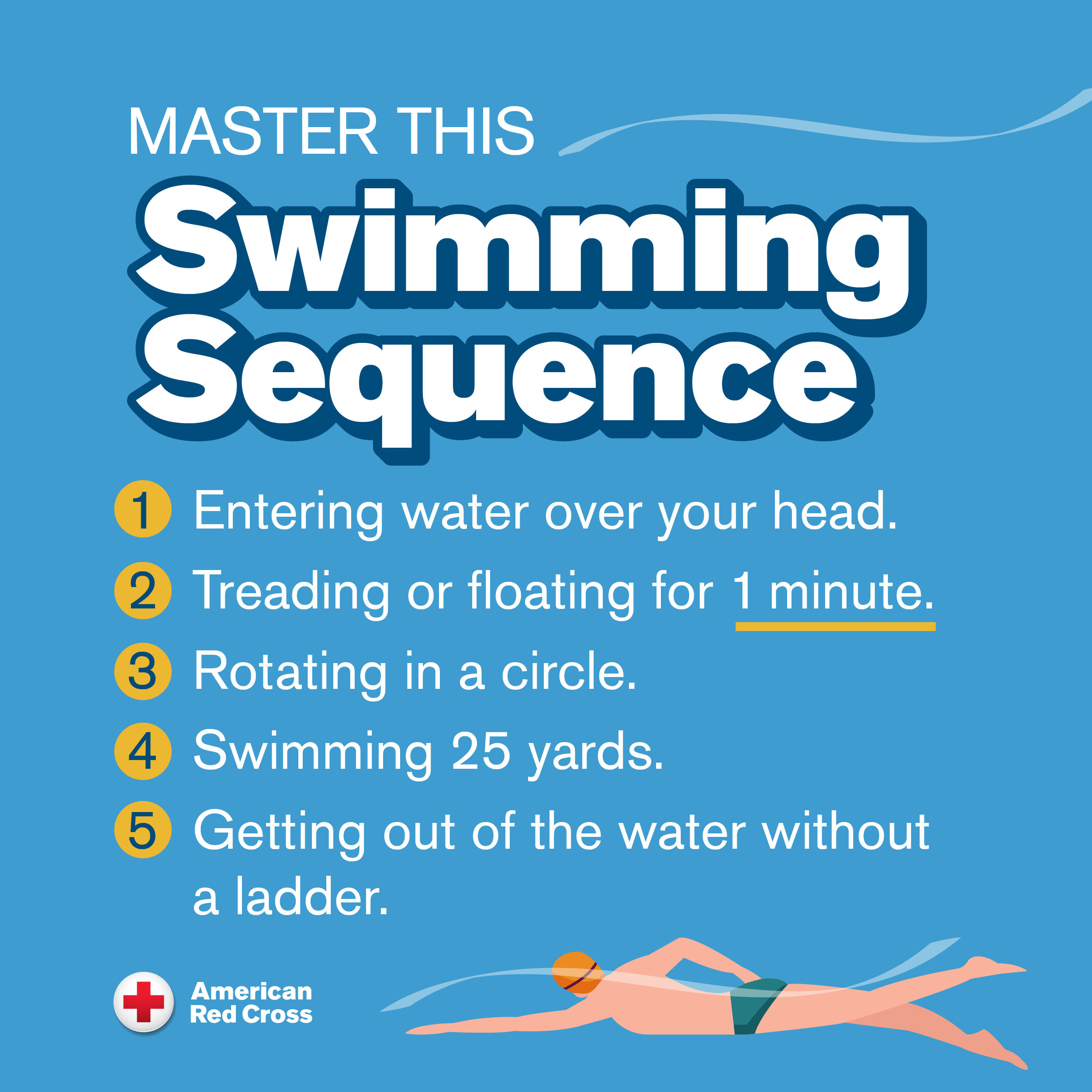
Everyone should be able to perform these five basic skills in any aquatic setting:
Enter deep water and return to the surface.
Float or tread water for at least one minute.
Turn around in the water.
Swim at least 25 yards.
Exit the water safely.
Red Cross graphic – Master this swimming sequence: 1. Entering water over your head. 2. Treading or floating for 1 minute. 3. Rotating in a circle. 4, Swimming 25 years. 5. Getting out of the water without a ladder.
Helping Others
Emergencies can happen in a matter of seconds. Be prepared to:
Supervise children or weak swimmers closely.
Recognize the signs of drowning.
Use safe rescue methods.
Know CPR and basic first aid.
Use safe rescue methods.
Know CPR and basic first aid.
Visit Water Safety USA—a partnership of organizations including the American Red Cross—for more tips on water competency.
Layers of Protection: Barriers for Maximum Safety
No single precaution can prevent all water accidents. That’s why using layers of protection is essential:
Supervision: Always supervise children near water, even if lifeguards are present. Young children should never be left alone.
Life Jackets: Children, non-swimmers, and all boaters should wear U.S. Coast Guard-approved life jackets.
Environment Awareness: Swim in lifeguarded areas and be aware of local conditions, such as currents, drop-offs, water clarity, and weather.
Be a Water Watcher: The First Line of Defense
Drowning often happens quickly and discreetly, which is why designating a Water Watcher is one of the most important steps you can take. A water watcher should:
Be at least 16 years old (adults preferred).
Focus solely on supervision—no phones, reading, or distractions.
Know CPR or be able to alert someone who does.
Have access to a phone, flotation device, and rescue tool.
Be focused and alert.
Red Cross graphic – Don’t do this! Never go in after someone who is in trouble in the water. Instead, reach out to them or throw them something that floats, such as a ring buoy.
The Chain of Drowning Survival:
If a water emergency occurs, the steps you take next can save a life:
Recognize the signs: Vertical in the water but not making progress, motionless face-down, or calling for help.
Rescue and remove: Use a reaching or throwing device—never put yourself at risk unless you’re trained.
Call for emergency help: Dial 9-1-1 immediately.
Provide care: Begin rescue breathing and CPR; use an AED if available.
Transfer to advanced care: Continue care until EMS arrives.
Swim Lessons Save Lives
One of the most effective ways to prevent drowning is to ensure every family member knows how to swim. The American Red Cross Learn-to-Swim program offers lessons for infants, children, teens, and adults—all taught by trained instructors in safe, supportive environments.
These classes help students become comfortable in the water, teach survival and stroke techniques, and promote rescue skills that can save lives.
You can also stay on track between classes with the free Red Cross Swim App, which offers skill tracking, safety tips, and activities to help swimmers improve and remain engaged.
By building water competency, applying layers of protection, and developing your role as a water watcher, you can help create a safe environment where water can be enjoyed without fear of danger. So, suit up, stay smart, and swim safe this summer!
Last summer, Mia’s family thought they had time. The skies were clear, the storm was still days away, so it didn’t seem like a big deal. “We’ll stock up tomorrow,” her dad said.
But tomorrow was too late. Within a short few hours, the power was out. Streets were flooded, and stores were shuttered. With no emergency kit, no evacuation plan, and no way to contact relatives, they were left scrambling.
They were luckily able to make it through, but they swore they would never wait to again.
National Hurricane Preparedness Week (May 4-10) is your reminder to get ready before the next storm forms.
🌀 When is Hurricane Season?
The Atlantic hurricane season runs from June 1 until November 30, with peak activity between August and October. But these strong storms can form earlier and intensify faster than ever before.
Hurricanes can cause destruction far inland, bringing high winds, power outages, and road closures. Everyone in a hurricane-prone area should prepare.
Red Cross graphic – Getting ready for a hurricane. 1, Move furniture and valuables to higher floors of your home. 2. Bring anything that can be picked up by wind inside. 3. Protect windows with one-half inch marine plywood.
✅ How to Prepare – Before the Storm
According to Ready.gov, NOAA and the American Red Cross, here are three key steps:
1. Make a Plan
Know your evacuation zone and route.
Account for pets, medications, and special needs.
Choose a meeting place and emergency contacts.
2. Build an Emergency Kit
Include:
Water, food, flashlights, batteries, and a radio
First-aid supplies, medications, and hygiene products
Important documents, cash, and chargers
3. Prepare Your Home
Clear gutters, trim trees, bring inside any outdoor items.
Review your insurance, especially for flood coverage.
As spring approaches, Pennsylvania residents face an increased risk of severe weather events, including thunderstorms, tornadoes, and flash flooding.
Severe Weather Awareness Week serves as a reminder to understand these dangers and take steps to protect yourself, your loved ones, and your property. From the Red Cross, here is key information on severe weather risks and how to stay safe during these events.
Common Severe Weather Hazards
Thunderstorms Thunderstorms are among the most frequent severe weather events in Pennsylvania. They are considered severe when they produce winds exceeding 58 mph.
These storms can cause significant damage, such as uprooting trees, damaging roofs, and disrupting power lines. Thunderstorms can also bring lightning strikes, heavy rainfall, and even spawn tornadoes or flash floods.
Red Cross graphic – If thunder roars, go indoors!
Tornadoes Tornadoes remain a serious threat during the spring and summer months. These violent windstorms can destroy homes and infrastructure within minutes, leaving little time to react.
Red Cross graphic – During a tornado: 1. Seek shelter in a basement or sturdy building. 2. Stay away from bridge or highway overpasses. 3. If strong winds and flying debris occur when driving, pull over. Put your head down below the windows, covering your head with your hands.
Flash Flooding Heavy rain from storms can lead to flash flooding, which develops rapidly and poses a significant danger to both life and property. Floodwaters can sweep away vehicles and damage buildings.
Red Cross graphic – Turn Around. Don’t Drown.
Understanding Weather Alerts: Watch vs. Warning
Knowing the difference between a watch and a warning is extremely useful:
Watch: Conditions are favorable for severe weather to develop
Warning: Severe weather is occurring or inevitable. Take immediate action to protect yourself.
Red Cross graphic – Tornado Watch: When tornados are possible in and near the watch area. VS. Tornado Warning: When a tornado has been sighted or indicated by weather radar.
Preparing Before Severe Weather Strikes
Preparation is essential to reduce risks during severe weather events. Here’s how you can get ready:
Identify a safe location in your home, such as a basement or an interior room without windows.
Stock up on bottled water, non-perishable food, flashlights, first aid kits, and phone chargers.
Trim trees near your property to minimize the risk of falling branches during high winds.
Red Cross graphic – How to prepare for storms: 1. Fill your car’s has tank in case of evacuation. 2. Fill plastic bottles with drinking water. 3. Unplug small appliances.
Staying Safe During Severe Weather
When severe weather is imminent:
Move to your designated safe area immediately and avoid windows or glass doors.
If you cannot reach a sturdy shelter in time, park away from trees or power lines and remain inside your vehicle until it’s safe to move again.
Red Cross graphic – If you have no shelter during a thunderstorm: 1. Immediately get off elevated areas like hills. 2.Crouch down for minimal ground contact. 3. If you’re in a group, separate to reduce the number of injuries if lightning strikes.
What to Do After the Storm
Once the storm has passed:
Stay updated on any additional weather alerts through reliable sources like local news or NOAA Weather Radio.
Check on neighbors who may need assistance, particularly older adults or those with disabilities.
Red Cross graphic – After a flood, beware of snakes, insects and other animals that may be in or around your home.
What about a Tornado?
Tornadoes can strike quickly, so here are tips to get to safety:
Go to the lowest level of your house, preferably the basement, or an interior room with no windows.
If you cannot get indoors, lie flat in a ditch or low area and cover your head with your hands to protect yourself from debris.
In a Vehicle: Drive to the nearest sturdy building if there’s time. If not, stay in your car with your seatbelt fastened and cover your head with your arms.
Red Cross graphic – Myth: Tornadoes never hit big cities because they have a lot of skyscrapers.
By following these guidelines and staying informed through Severe Weather Awareness Week resources, residents can better prepare for severe weather events and reduce risks to their safety and well-being. Stay safe this season!
According to the National Weather Service (NWS), flooding causes more damage in the U.S. than any other weather-related event over the past 20 years. Southeastern Pennsylvania is no stranger to flooding, especially around parts of the Schuylkill and Delaware rivers as well in communities surrounding parts of the Brandywine, Darby, Neshaminy and Perkiomen creeks, among others.
Flash flooding is especially dangerous because it happens so quickly – sometimes in minutes – and can be very powerful. It takes only 6 inches of fast-moving water to knock a person off their feet and only 12-18 inches of water to sweep a vehicle off the road.
Citing flooding as the most common natural disaster in Pennsylvania, the Commonwealth’s House of Representatives recognizes March 17-21, 2025 as Flood Awareness Week. The American Red Cross and NWS has five days of important info to help keep you safe when flooding occurs.
Day 1 – Flood Preparedness
As a first step in preparing for flooding, arm yourself with information. Learn about the types of flooding that can impact your home and community. The Federal Emergency Management Agency (FEMA) has an interactive flood map tool that allows you to look up flooding hazards near your address.
Make a plan for you and your family before flooding happens. Decide where you’ll go and how you’ll get to higher ground in different scenarios. Ready.gov offers a Family Emergency Communications Plan template, which you can fill out and email to members of your family as a PDF. The Red Cross also has Flood Safety Checklists in nine languages, including English, Spanish, Arabic and Chinese.
Be sure to pay attention to flooding alerts issued for your community. Local news and social media are good ways to get breaking info. Another great tool is NOAA Weather Radio All Hazards, a nationwide network of radio stations broadcasting continuous weather and river information direct from nearby NWS offices.
NOAA graphic – Prepare for flooding before it happens. Are you located in a flood plain? What is the fastest way to higher ground? What roads nearby are most likely to flood? weather.gov/flood
Day 2 – Turn Around, Don’t Drown
It’s more than a catchy slogan. Turn Around, Don’t Drown is a reminder to never drive, walk or swim through a flooded area. NWS informs us that more deaths occur due to flooding than from any other severe weather-related hazard, and more than half of all flood related deaths result from vehicles being swept downstream. Many of these deaths are preventable.
If flooding occurs, Turn Around, Don’t Drown. Get to higher ground and avoid low areas that are prone to flooding. Stay away roads that are already flooded and never attempt to cross flowing streams. Don’t assume you can make it through the water; roads may be washed out under flood water and debris may be present. Remember that it takes as little as 12 inches of moving water to wash a vehicle off a roadway.
NOAA graphic – Do you really know how deep the water is? 12 inches of fast-moving water can carry away a small car. 6 inches of fast-moving water can knock over and carry away an adult. 18-24 inches of fast-moving water can carry away most large SUVs, vans and trucks. When flooded, turn around, don’t drown.
Day 3 – More Accurate Flood Information
NOAA’s National Water Prediction Service (NWPS) provides river and flood forecasts across the U.S. These helps emergency agencies be more proactive in making better lifesaving decisions about evacuating people or moving property before a flood. The suite of tools can provide more accurate info about how high a river will rise, when it’s expected to peak, how long a flood will last and the certainty of the forecast.
NOAA graphic – Learn about flooding in your state. What kind of flooding can you expect? Find out at weather.gov/floodsafety.
Day 4 – Flooding Causes and Severity
According to NWS, flooding typically develops in Pennsylvania because of excessive rainfall or snow melt combined with excessive rainfall. The main causes of excessive rain are widespread heavy rain to the north of a warm front, slow moving thunderstorms and tropical cyclones – aka hurricanes, typhoons or tropical storms. Intense rain from these storms often causes more damage than their associated winds.
The NWS categorizes flood severity into five categories: minor, moderate and major.
Below Criteria = No impact.
Action = Water is over banks and into flood plain; minimal threat.
Minor = Minimal property damage; some public threat.
Moderate = Some structure and road flooding near streams; some evacuations of people/property.
Major = Significant damages and evacuations.
NOAA graphic – Major flooding: Extensive inundation of structures and roads. Significant evacuations of people and/or transfer of property to higher elevations. Moderate flooding: Some inundation of structures and roads near stream. Some evacuations of people and/or transfer of property to higher elevations. Minor flooding: Minimal or no property damage, but possibly some public threat. Record flooding: flooding which equals or exceeds the highest stage or discharge observed at a given site during the period of record.
Day 5 – Flood Alerts
Anticipating flood severity helps inform if and when NWS issues a flood warning, watch or advisory. A flood/flash flood warning means a flood is imminent for a specific area and you should take action immediately. A flood watch is issued when conditions are favorable for flooding, meaning you should be prepared to act if needed. NWS issues a flood advisory when flooding is not expected to be bad enough to issue a warning.
NOAA graphic – Flood watch means be prepared: Flooding is possible. Check for forecast updates. Prepare to move to higher ground. Stay weather readyNOAA graphic – Flood warning means take action! Flooding is expected. Move to higher ground immediately. Use extra caution if driving. Check forecast updates. Stay weather ready.