“Hi, my name is Haley, and I will be your nurse today!”
I introduce each article this way every month since that is how I introduce myself to each of my patients when I begin a shift. I started this blog once I graduated nursing school back in May 2024, and I am currently a few weeks into starting in the Intensive Care Unit (ICU).
I have met so many patients between my nursing clinical and shifts as a nurse that shared with me their concerns of how they never knew about certain diseases or the prevention of them before they were diagnosed. Now, as they lay in a hospital bed, I educate them on the maintenance and care that each diagnosis needs. Some of these diagnoses are not just the flu or something acute, but rather something like diabetes that is a chronic condition my patients will now have to live with for the rest of their lives. It is sad to just provide education once disaster or a crisis already had struck. I started this column with the hopes of providing education before the hospital and to hopefully even be able to prevent that trip to the emergency room in the first place.
As we approach the November and December holidays, one thing that is guaranteed – besides the family time, time off work/school, presents, and maybe some snow – is that there will be a lot of food. We deserve to enjoy this time of year and to indulge in these meals and desserts, but as the New Year approaches, how many of us really stick to our resolutions of wanting to eat healthier and work out?
Obesity is something that needs to be discussed globally. If you struggle with your weight, you are definitely not alone. In fact, obesity affects 2 in 5 adults in the United States.
A BMI of 30 or higher in adults is considered being obese. But when you think about the BMI scale, it’s important to remember it doesn’t accurately predict specific health risks.
Now I do not bring this topic up because of how obesity alters one’s appearance, because that would not be a health discussion. Obesity can alter one’s mental health and self-esteem, and it really increases the risk of serious medical conditions.
Obesity is directly linked to hypertension, type 2 diabetes, heart disease, strokes, sleep apnea, reproductive issues, kidney disease, asthma, infertility and even certain cancers. The scary part is how each of these diagnosis’ have complications in themselves that can lead to more and more problems if uncontrolled.
A lot of things, some even out of our control, can cause obesity. Certain medications, disabilities, diets and genetics play a big role in cause of obesity. Lack of sleep, lack of physical activity and increased stress also have a correlation to obesity. Be sure to visit your primary care provider if you are concerned, because sometimes obesity can even be caused by underlying health issues.
While doing further research, Cleveland Clinic discusses in great depth the metabolic changes that happen to your body with obesity, which in turn can cause the previously discussed health issues.
According to the Cleveland Clinic:
Your metabolism is how your body converts calories into energy to fuel your body. When your body has more calories than it can use, it converts the extra calories into lipids and stores them in your body fat. When you run out of tissue to store lipids, the fat cells themselves become enlarged. Enlarged fat cells secrete hormones and other chemicals that cause inflammation.
Inflammation can lead to insulin resistance so your body can’t use insulin to lower the sugar and fats in your blood. High levels of sugar and fats in your blood lead to high blood pressure. Combined, these conditions lead to metabolic syndrome. Metabolic syndrome is a common factor in obesity.”
Diet and exercise are the main treatments that we can even start now. We don’t have to schedule an appointment, wait in a waiting room, go to the ER or even buy special supplements to change our diet and our physical activity. Always be sure to go to your primary care provider for at least your yearly physical examinations to compare your weight over the years and for them to diagnose obesity and plan the care and management with you.
As temperatures drop, home heating becomes essential; however, it also becomes dangerous. After cooking, heating equipment is the second leading cause of home fires in the United States, with space heaters responsible for the majority of deaths and damage. Knowing a few simple precautions can protect your home, family, and community.
Why Heating Safety Matters
Not only is heating the second leading cause of home fires in the United States, but space heaters, in particular, account for the majority of heating-related fire deaths. Due to the dropping temperatures, winter months see a spike in heating-related emergencies. Many of these incidents are preventable through safe use and maintenance and by following the tips listed below.
How to use a space heater: Place it on a nonflammable surface, not rugs. Ensure it has an auto shut-off feature if it tips over. Unplug the heater when you go to bed.
General Safe Heating Practices
Ensure that you keep anything that can burn at least 3 feet away from any heating equipment.
Never block vents, radiators, or heat registers.
Keep children and pets away from heat sources.
Install smoke alarms on every level of the home and test them monthly!
Install carbon monoxide (CO) alarms if using fuel-burning devices.
Create and practice a home fire escape plan.
Space Heater Safety
Choose heaters with automatic shut-off if tipped over.
Plug space heaters directly into the wall and never use extension cords.
Turn heaters off before sleeping or leaving the room.
Place on a stable, flat surface.
Keep cords out of walkways.
Follow manufacturer instructions for spacing and wattage.
Fireplace & Wood Stove Safety
Have chimneys and vents inspected and cleaned yearly.
Use a metal or heat-tempered glass screen to stop sparks.
Dispose of ashes in a metal container that you keep outside.
Burn only dry, seasoned wood.
Keep flammable items away from fireplace openings.
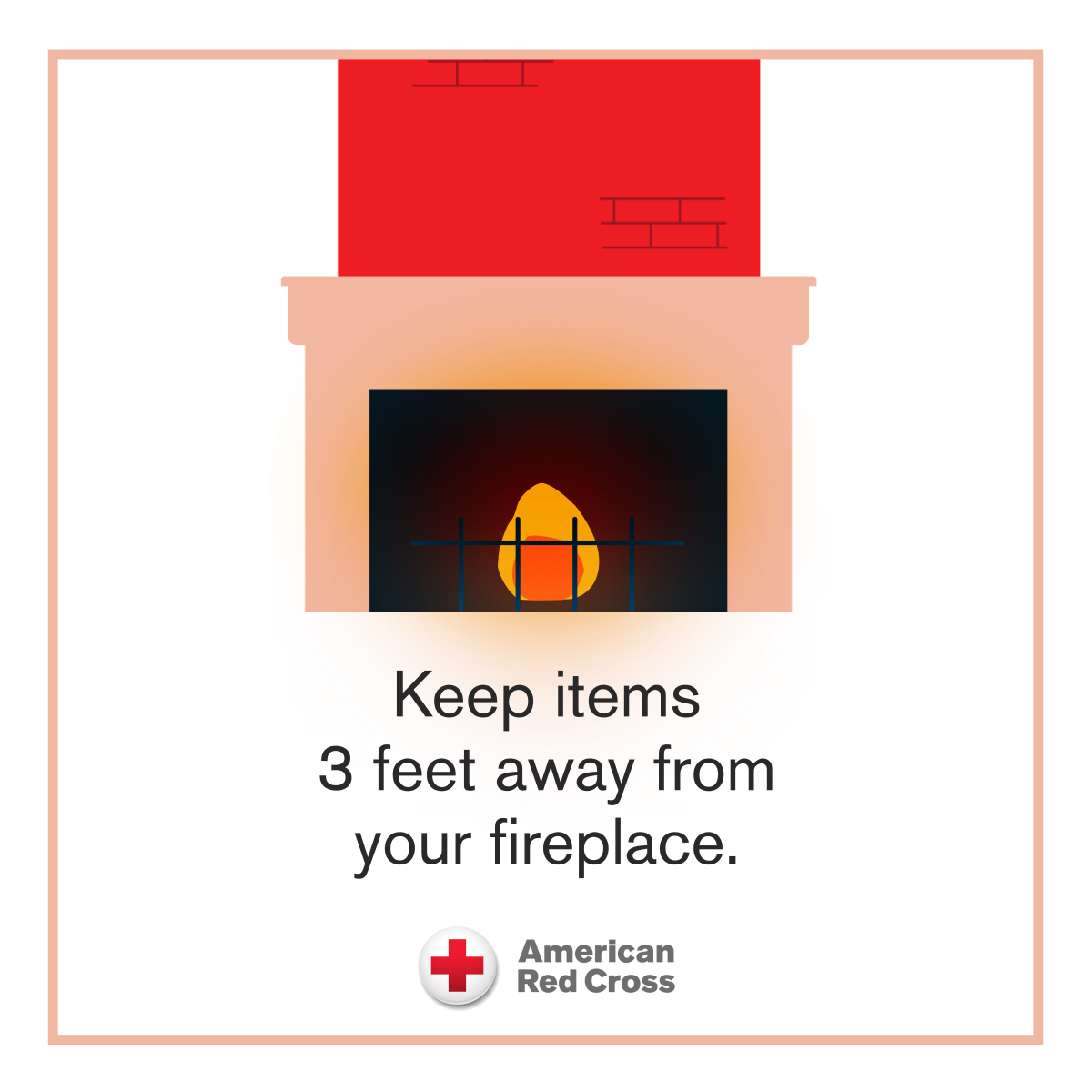
Keep items 3 feet away from your fireplace.
Furnace, Boiler & Central Heating Safety
Schedule annual professional inspections!
Replace filters regularly to prevent overheating.
Ensure furnace rooms have adequate ventilation.
Keep combustible materials away from the unit.
Carbon Monoxide Prevention
CO is produced by all gas heaters, fireplaces, wood stoves, and generators.
Install CO alarms outside sleeping areas.
Never run ovens, grills, or generators for heating.
If the alarm sounds → move outdoors immediately and call 911.
What to Do in an Emergency!
Call 911
Use a fire extinguisher only if the fire is small and contained.
Evacuate immediately if the fire spreads.
Never re-enter a burning home.
Heating is necessary in winter, but it comes with risks that are easy to prevent. Simple steps, such as using heaters safely, maintaining equipment, and having working alarms, can significantly reduce the risk of a home fire. By following guidance from organizations such as the American Red Cross, National Fire Protection Association, and the U.S. Fire Administration, families can stay warm while keeping their homes safe.
Red Cross graphic: What to do during daylight saving time: Turn your clock back. Test your smoke alarm.
Daylight saving time ends on Sunday, November 2 and the American Red Cross encourages everyone to test their smoke alarms as theyturn their clocks back to make sure the devices are working.
“Working smoke alarms cut the risk of dying in a home fire in half, and that’s critical because you may have less than two minutes to safely get out,” said Jennifer Graham, CEO, Red Cross Southeastern Pennsylvania Region. “Every second counts when there’s a home fire. The sooner an alarm alerts you to a fire, the sooner you can get to safety. As daylight saving time ends this weekend, take a moment to test your smoke alarms. It’s a simple step that could save your life.”
So far this year, local Red Cross volunteers responded to help more than 2,200 people in Southeastern Pennsylvania affected by nearly 500 home fires, which account for most of the about 65,000 disasters that the Red Cross responds to annually across the country.
Smoke Alarms
When turning your clocks back this weekend, test your smoke alarms and replace the batteries if needed. For more fire safety information – including how to create and practice a home escape plan with your family – visit redcross.org/fire or download the free Red Cross Emergency app by searching “American Red Cross” in your app store.
Here are a few simple steps you can take to help protect your home and loved ones from a fire:
Install smoke alarms on every level of your home, including inside and outside bedrooms and sleeping areas.
Replace smoke alarms that are 10 years old or older. Components such as sensors can become less sensitive over time. Follow your alarm’s manufacturer instructions.
Practice your two-minute home fire escape plan. Make sure everyone in your household can get out in less than two minutes — the amount of time you may have to escape a burning home before it’s too late.
Include at least two ways to get out of every room and select a safe meeting spot outside your home, such as your neighbor’s home or a familiar landmark like a specific tree in your front yard, where everyone can meet.
If You Need Help
If you cannot afford to purchase smoke alarms or are physically unable to install one, the Red Cross may be able to help. Visit soundthealarm.org/philly or call 215-299-4029 to schedule an appointment. In the city of Philadelphia, you can also call 3-1-1.
Home Fire Campaign Saves Lives
Since October 2014, the Red Cross Home Fire Campaign, working with community partners, has saved at least 2,479 lives, including 28 in Southeastern Pennsylvania, by educating families about fire safety, helping them create escape plans and installing free smoke alarms in high-risk areas across the country. To learn more about the campaign and how you can get involved, visit redcross.org/homefires.
Thank You to Our Generous Partner
State Farm® is the National Sound the Alarm Sponsor. Their funding helps our efforts to build safer, stronger, better-educated communities. For decades, State Farm has teamed up with the Red Cross in support of home safety, disaster preparedness and relief efforts. State Farm is committed to helping individuals and families manage everyday risks like home fires by sponsoring Sound the Alarm.
It’s that spooky time of year. Jack-o-lanterns, ghosts and ghouls abound. Time for kids to roam our streets offering a trick or two and getting the treats! It’s a fun time of year for kids and adults. But there are some things we need to be aware of so this holiday is fun and safe for everyone.
There are three areas we can look at to ensure a safe and fun Halloween: Driving safety, trick or treating safety and costume safety.
Red Cross graphic – Be on the lookout for trick-or-treaters!
Trick or Treating Safety
Walk on sidewalks whenever possible. If you must walk in the street, make sure to face traffic.
Use the most direct paths to houses.
If someone’s house lights are off, go to the next house.
Do not eat any candy or treats until you get home and have an adult look through everything first.
Trick or treat in groups. It’s much safer than going alone.
Red Cross graphic – Trick-or-treating tip: Small foods can be a choking hazard. Keep an eye on children under 5 years old eating candy.
Driving Safety
Stay alert! Children are excited and might run into the street or driveway without looking.
Drive slowly through neighborhoods so you have time to stop if people are crossing the street without looking.
When making turns or backing up, be sure to look carefully to see if anyone is in your path.
Avoid any distractions like your phone and even the radio.
Red Cross graphic – Drive with caution! Watch out for kids on Halloween.
Costume Safety
Make sure costumes fit well so that they don’t cause tripping.
Carry a flashlight to light your path.
Put reflective tape on your child’s costume to make them visible to drivers.
Masks can obstruct a child’s vision. It’s better to use non-allergenic makeup.
Red Cross graphic – Glow this Halloween! Keep children seen by adding reflective tape or glow sticks to their costumes.
If kids are trick or treating without adult supervision, make sure they know the route they are going on and that they have check in times. Have them check in with you in a half hour, or hour. Designate the time they will return home. Also, make sure your trick or treaters know not to enter anyone’s home.
Halloween is one of the most fun times of the year for children and adults. Employing these simple safety tips will ensure that everyone has a good, safe time.
So, remember, if the vampire bites or the werewolf howls, don’t be scared! It’s probably your friend behind you. Have a spooky, safe time out there!
Fire Prevention Week, observed from October 5-11, brings a critical and timely theme into focus: the safety of lithium-ion batteries in one’s home. These powerful batteries are in our phones, laptops, and e-bikes, but they require careful handling to prevent fire hazards. Understanding their risks and following safety guidelines is essential for protecting you, your family, and your household. From the Red Cross, here are ways to stay safe from an incoming fire in the scope of lithium-ion batteries.
Understanding the Risk
Lithium-ion batteries store a large amount of energy in a very compact space, and the danger arises if they become damaged, are used improperly, or are made with poor quality.
If a battery fails, it can enter a state called thermal runaway, which is an uncontrollable self-heating reaction that can lead to a fire that spreads quickly, burns extremely hot, and is very difficult to put out.
NFPA graphic – Fire Prevention Week. Buy only listed products.
Ways to Stay Safe
You can significantly reduce the risk of a lithium-ion battery fire by adopting these key safety practices:
Only use the charging equipment provided by the device’s manufacturer, as third-party or incompatible accessories can cause dangerous overheating.
Make a habit of unplugging your device once it reaches a full charge; continuous charging, especially overnight, increases the risk of failure.
Always charge devices on a hard, flat, and stable surface like a countertop to allow for proper heat dissipation, and avoid soft, flammable surfaces like beds or sofas.
Immediately stop using any battery that shows signs of damage, such as bulging, cracking, or leaking, and be alert to warning signs like unusual heat, strange smells, or odd sounds during use or charging.
Dispose of old or damaged batteries responsibly by taking them to a designated recycling center; they should never be thrown into your regular household trash.
NFPA graphic – Fire Prevention Week. Power or lawn tools? Always charge outside on a flat, dry spot.
E-Mobility: Bikes and Scooters
Devices like e-bikes and e-scooters have larger, more powerful batteries, making it critical to only purchase products that are listed by a qualified testing laboratory. Always follow the manufacturer’s instructions for charging and storage, and ensure you never block your primary exit or escape route with a device that is charging.
While today’s technology may be life-changing, it comes with its dangers; lithium batteries are among them. However, by integrating these simple habits into your daily routine, one can easily and safely enjoy the convenience of modern technology.
Video – Freedom From Fire: American Red Cross/Second Alarmers #1501. Watch it on YouTube.
American Red Cross Southeastern PA Disaster Preparedness Manager Ryan Gaul spoke with Philadelphia Firefighter Kamilah Bayete for episode #1501 of Philadelphia Fire Department’s “Freedom From Fire” program on La Salle TV. They discussed how the Red Cross helps families prepare for emergencies by installing smoke alarms and providing fire safety education, like how to create an escape plan. They also covered how the Red Cross helps families after they experience a home fire. The episode initially aired on Sept. 29 and was broadcast on Comcast and Verizon Fios in the city.
Increasingly we see new products available that contain lithium-ion batteries. But how do we use these batteries safely? What are the risks in buying, charging and recycling them? These are important questions we must ask ourselves in our growing electronic world.
While a lithium-ion battery might not look like it could cause any risks or damage, the risks can be serious. For example:
Thermal Runaway – If the battery overheats, it can catch fire or explode. This can happen if you overcharge your battery because it causes it to overheat. If the battery is punctured or crushed, short circuits can occur. Also, storing a battery in excessive heat can cause damage that can become dangerous.
Fires from lithium-ion batteries burn hotter than other types of fires. They can also give off toxic gases like carbon monoxide.
What can you do to minimize these risks? Following the next three steps will help. They involve which batteries to buy as well as charging and recycling safely.
Buying
Always make sure any product you purchase has a safety certification mark such as:
UL -The product or component has been tested and meets specific safety and performance standards.
ETL – The product has been tested by Intertek (the testing and certification division of Electrical Testing Laboratories) and found to meet accepted North American safety standards.
CSA – The product was tested and has met the certification requirements for electrical, plumbing and/or mechanical products.
These certifications show that the battery minimizes risks like thermal runaway, fire and explosion. Following these tips will ensure you are using a product that meets important safety standards and is safe to buy.
Charging
When charging your device that uses a lithium-ion battery, make sure that you always use the charger that came with the product. Using other charges could damage the battery, making it unsafe and prone to risks. If you need to replace the charger, make sure to buy one from the same company where you purchased the device.
Make sure that you do not overcharge your device. When they are fully charged, remove them from the charger.
Recycling
Lastly, make sure to recycle correctly. Lithium-ion batteries should never be thrown in the trash or a recycling bin used for other types of recyclables. They can start a fire when disposed of incorrectly. You can find a recycling location near you at Call2Recycle.org.
In our ever-growing world that is advancing in technology at the speed of sound, we must stay vigilant and know how to buy, use and recycle safely.
The Red Cross celebrates National Preparedness Month every September – and every month of the year. Also referred to as September Safety Month, this national campaign is dedicated to empowering individuals, families, businesses, and communities with the knowledge and resources they need to respond to and recover from emergencies.
The Federal Emergency Management Agency (FEMA) launched National Preparedness Month in 2004, following the tragic events of September 11, 2001, to respond to the growing need for emergency readiness. FEMA partnered with the Ad Council to develop their “Ready” campaign, a campaign that garnered attention through its messaging and widespread reach. The campaign was significant in motivating Americans to prepare for emergencies and contributed to the overall success of National Preparedness Month.
Since its creation, National Preparedness Month has evolved into a nationwide collaboration among government agencies, nonprofits, schools, businesses, and communities. The American Red Cross supports this mission across the country and in Southeastern Pennsylvania. This year, the Red Cross highlights its partnership with the Upper Darby School District through the Preparedness Initiative.
Upper Darby Preparedness Initiative
Red Cross volunteers John Gebhardt (far right) and Justin Abraham (center) with students from Stonehurst Elementary School in Upper Darby in March 2025 after Red Cross Ready and hands-only CPR presentations. Photo courtesy of Upper Darby School District.
The Upper Darby Preparedness Initiative was spearheaded by Volunteer John Gebhardt, Regional Volunteer Preparedness Lead Kathy Mullen, and Regional Disaster Preparedness Manager Ryan Gaul. The idea was sparked when Red Cross volunteer and Upper Darby firefighter Justin Abraham identified a need for fire safety education and recognized the Red Cross’ ability to address it. From there, the team connected with key leaders in the Upper Darby School District to turn the vision into reality.
The initiative is typically introduced in school districts with higher volumes of home fires. The Southeastern Pennsylvania Red Cross has worked with relevant districts across Bucks, Chester, Delaware, Montgomery, and Philadelphia counties. However, Upper Darby presented its own challenge as the largest school district in Delaware County with a diverse population representing over 80 birth countries and more than 100 different home languages. Gaul and Gebhardt reported this was a challenge they were aware of and the program was able to overcome. The initiative exercised its stores of certified volunteers and was well received across its continuum regardless of the large and diverse district population
The Preparedness Initiative included three core programs:
Prepare with Pedro – A 30–45-minute interactive program for K-2 students on preparedness and appropriate responses during an emergency.
Be Red Cross Ready – A 45-60-minute presentation for middle and high school students covering local hazards and family preparedness through a “Learn, Practice, Share” framework.
Hands-Only CPR – A 30-minute training for students in grades 5-12, teaching recognition of emergencies, calling 911, and preforming continuous chest compressions.
To deliver the initiative, certified volunteers visited all nine elementary schools for in-person instruction. To reach the broader middle and high school audiences, PowerPoint presentations were sent to school Principals and disseminated to each classroom. Volunteers utilized Zoom to interact and engage with the students for each presentation.
As all programs tied back to the Sound the Alarm campaign, which installs free smoke alarms in at-risk homes, a key measure of success was the increase in smoke alarm requests from Upper Darby families. “The kids do go home and tell their parents,” said Gebhardt. “I’ll go install a smoke alarm in the house and the parent will say, ‘Hey, my kid learned this and this.’ It really does come full circle, which is satisfying.”
Both Gebhardt and Gaul referenced instances in which classrooms and teachers wrote a collection of ‘thank you’ cards to volunteers for taking the time to prepare instruction and speak with their classrooms. Gebhardt cites his experience with the initiative as his most fulfilling, he finds the most satisfaction in teaching to populations where it will do the most good.
Gebhardt and Gaul’s advice for organizations thinking of a similar rollout? Take the time to foster community relationships, be aware of your audience, don’t over teach, and be prepared for any questions that might come up in the classrooms. Another major piece of advice? Patience. Both Gaul and Gebhardt emphasized the importance of patience in establishing relationships and in the roll out.
The success of the 2024 Spring Preparedness Initiative was built upon this past spring and will continue in 2026 as the Red Cross and Upper Darby School District grow their partnership to strengthen community preparedness.
30 days to prepare. Photo by Alana Mauger / American Red Cross
Emergency preparedness can feel overwhelming, especially when you consider the many scenarios it covers. From natural disasters to first aid, the scope of what “being prepared” means can make it hard to know where to start.
This September, the American Red Cross Southeastern Pennsylvania Region is breaking down preparedness topics to make them more manageable. Throughout National Preparedness Month, we’ll be sharing 30 Days of Preparedness—a daily dose of practical actions you can take to strengthen your readiness.
Monday, Sept. 1 – Download our apps
Since the month starts out on Labor Day, we’ll make the first one easy. Whether you’re enjoying a day at the beach or a backyard picnic, take a minute to download our FREE Red Cross Emergency and First Aid apps. With the Emergency app, you’ll get real-time weather alerts, open Red Cross shelter locations and safety steps for different emergencies. Our First Aid app provides step-by-step instructions for a wide range of situations. Download them from your favorite app store by searching for American Red Cross.
Tuesday, Sept. 2 – Sign up for alerts
We’ll stick with the communications theme for day two. When emergencies strike, public safety officials use timely and reliable systems to alert you. You’ve already downloaded our Emergency app (see day 1), but you should have multiple ways to get alerts, including Wireless Emergency Alerts (WEAs) on your mobile device or by having a NOAA Weather Radio on hand. Many counties and municipalities also have opt-in alert systems. In Southeastern PA, these include Ready Bucks, Ready ChesCo, Delco Ready, Ready Montco and Ready Philadelphia.
Wednesday, Sept. 3 – Know your risk
The Federal Emergency Management Agency (FEMA) offers a National Risk Index that shows which communities are most at risk from natural hazards. For today’s preparedness task, check out FEMA’s interactive map and learn about vulnerabilities that could impact your home.
Thursday, Sept. 4 – Learn how to use a fire extinguisher
Fire extinguishers can save lives and property. If you don’t already have at least one fire extinguisher on every level of your home, your task is to research and buy them. If you already have fire extinguishers, give yourself a high-five! Your task is to make sure you know how and when to use them. It’s too late to read the instructions when a fire breaks out on your kitchen stove! The U.S. Fire Administration has resources to get you started, but you can also check in with your local fire department for guidance.
Friday, Sept. 5 – Learn CPR
Today, we challenge you to learn CPR! You can sign up for a class to get certified in CPR, AED and First Aid or watch this video to learn how and when to perform hands-only CPR. Already certified? Take a few minutes to refresh your skills.
Saturday, Sept. 6 – Create an escape plan
Did you know you have less than two minutes to escape a home fire? That’s why it’s critical to make a home fire escape plan for everyone in your household, including children and pets. Each person should know two ways out of every room and where to reconvene outside when you’re safe. Download our home fire escape plan template to get started.
Sunday, Sept. 7 – Practice your escape plan
Yesterday, you created your plan. Today, you’re going to practice it. Take 15 minutes to walk through the plan with everyone in your household. Then practice it until everyone can safely evacuate in two minutes or less. Commit to practicing your plan at least twice a year.
Monday, Sep. 8 – Learn the difference between watch and warning
Regardless of the weather hazard, watch and warning alerts inform the public of an impending risk. A watch means that conditions are possible, and you should be prepared to take action. A warning means conditions are expected, and you should take immediate action. FEMA’s Guide for Alerts and Warnings breaks down each alert and actions that should be taken.
Tuesday, Sept. 9 – Know your numbers
Most of us have important phone numbers and information in our cell phones, but do you really have everything you’ll need? FEMA provides a family emergency plan template to help you keep track of important information like your family’s doctors or medical providers, insurance information and contact info to help you stay connected if you have to evacuate.
Wednesday, Sept. 10 – Review hurricane preparedness tips
September is the peak month for Atlantic hurricane activity. Review Red Cross info on what to do before, during and after a hurricane so it’s top of mind if you need it.
Hurricane preparedness information on the free Red Cross Emergency app. Photo by Alana Mauger / American Red Cross
Thursday, Sept. 11 – Dig out your old-school radio
On day 2, we stressed the importance of emergency alerts. Old school battery-operated or hand-crank radios are still the best for times when power, cell and internet service is out. If you don’t already have a device, consider purchasing one with NOAA Weather Radio. This is the official voice of the National Weather Service and is the fastest, most reliable way to receive information about life-threatening weather. Find your local station here.
Friday, Sept. 12 – Upload docs to the cloud
Having important documents at your fingertips can help you recover faster after a disaster. Consider uploading documents like insurance policies, rental agreements, mortgage statements, driver’s licenses, medical records and banking information to a secure, password-protected external drive or in the cloud. CISA.gov has steps you can take to keep yourself and your information safe online.
Saturday, Sept. 13 – Build emergency kits (plural)
Think about what you and the people in your home need every day to be comfortable and safe. Make a list and prepare kits for different scenarios, like evacuating and sheltering in place. Food, water and medications are a good start, but there’s so much more to consider. Review these checklists from the Red Cross and FEMA, then customize your kits to meet your household’s specific needs. Don’t forget about children and pets! Pre-made emergency, survival and first aid kits can also be purchased from the Red Cross Training Services store.
Sunday, Sept. 14 – Build vehicle emergency kits
Since we’re already thinking about the various emergency items we’ll need, take time today to build or customize a kit for your vehicle. In addition to the items in your emergency kit, consider adding a blanket, ice scraper, jumper cables, tire repair kit, boots and flares. Check out these lists from FEMA and AAA for inspiration.
Monday, Sept. 15 – Stash flashlights around your home
Severe thunderstorms are not uncommon in Southeastern PA, and where there is lightning, there can be power outages. When you can spare a few minutes today, gather and place flashlights and extra batteries around your home in easy-to-access places to help you navigate when the lights go out.
Tuesday, Sept. 16 – Sign up for the Great ShakeOut Register your family, school or workplace to participate in the Great ShakeOut – the largest earthquake drill in the world! On Thursday, Oct. 16 at 10:16 a.m. (your local time) you are encouraged to practice earthquake safety by performing a “Drop, Cover and Hold On” drill. Last year, over 56.8 million people participated! Register in advance (it’s free!) to ensure that you’re counted.
Great ShakeOut graphic – ShakeOut. Don’t Freak Out. October 16, 2025. Register: ShakeOut.org.
Wednesday, Sept. 17 – Test your smoke alarms
Take a few minutes today to test every smoke alarm in your home. Working smoke alarms cut the risk of dying in a home fire by HALF. If you need smoke alarms, the Red Cross may be able to help. Submit a request to have free smoke alarms installed by the Red Cross. Many fire departments also offer this service free of charge.
Thursday, Sept. 18 – Turn Around, Don’t Drown
It’s more than a catchy slogan. “Turn Around, Don’t Drown” is a reminder to never drive, walk or swim through a flooded area. Flooding is the most frequent natural disaster in Pennsylvania, so it’s important for all of us to be prepared. Take time to review flood preparedness and safety tips from our blog.
Friday, Sept. 19 – Check your vehicle’s gas tank
Today’s entry is more of a tip than a task. As a rule of thumb, always maintain at least a half tank of gas in your vehicle. This should be enough to get you out of danger until you can refuel should you have to evacuate quickly. Check yours now. Is it at least half full?
Saturday, Sept. 20 – Build first aid kits
We’re not done with kits just yet! You should have first aid kits as part of your emergency and vehicle kits as well as at home. At minimum, kits should contain materials to treat burns, cuts, abrasions, stings, splinters, sprains and strains, as well as medications that can alleviate fever, nasal congestion, coughs and sore throats. Also include maintenance medications that people in your home are taking, and consider items for skin problems, allergies, gastrointestinal issues and mild pain. Insect repellant, lip balm and sunscreen round out the list. Know how to use all the items in your kit, and store them in a water-resistant, drop-proof container. Review this checklist from the Red Cross.
Sunday, Sept. 21 – Learn about amateur (aka ham) radio
You may be surprised to learn that Philadelphia has an active Amateur Radio Emergency Service (ARES) that provides emergency communications support for the Red Cross! In fact, many operators are also Red Cross volunteers. Ham radio operators are licensed by the FCC and can be critical during disasters when traditional communications infrastructure is inoperable. Watch this news segment from CBS 17 in North Carolina about how ham radio operators helped connect families during Hurricane Helene.
Monday, Sept. 22 –Donate blood
Blood may not be top of mind when you think about preparedness, but where would we be without it? During an emergency, it’s the blood that has already been donated and is on the hospital shelves that helps save lives. If you’re able, schedule an appointment to donate blood this month. If you’re unable to donate, consider asking a family member or friend to donate. Visit RedCrossBlood.org or download our FREE Blood Donor app to schedule your appointment.
Red Cross graphic – In an emergency, it’s the blood already on the shelves that saves the day. Give now.
Tuesday, Sept. 23 – Familiarize yourself with your utilities
Do the adults and older children in your household know how to shut off utilities if needed? Educate your family on how and when to turn off the water, gas and electricity at the main switches or valves. Don’t forget to place necessary tools near the gas and water shut-off valves. Note: You should only turn off utilities if you suspect a leak or damaged lines or if you are instructed to do so by authorities. If you turn the gas off, you will need a professional to turn it back on.
Wednesday, Sept. 24 – Store extra water
Without the proper amount of water, you can become dehydrated, which can impair thinking and key bodily functions. One gallon per person per day is the recommended minimum. You’ll need at least a three-day supply of water if you’re evacuating and a two-week supply if you’re sheltering in place. Once you have stored the appropriate amount of water, take time to review the CDC’s guidance for making water safe in an emergency.
Thursday, Sept. 25 – Help prepare older adults
Some people, including older adults and those with mobility challenges, may need extra attention during an emergency. Being prepared and ready before an emergency will greatly impact one’s ability to help and be helped during a disaster. Review our Red Cross checklist and preparedness booklet for older adults.
Friday, Sept. 26 – Volunteer with the Red Cross
Building and maintaining a trained disaster workforce is one of the ways the Red Cross prepares for emergencies. More than 90% of our disaster workforce is volunteer. Check out some of our key volunteer opportunities – like shelter workers, disaster action team responders and duty officers – that are most needed here in Southeastern PA.
Saturday, Sept. 27 – Plan for pets
Your pets are part of your family, so it’s important you have a disaster plan for them. This includes knowing a safe place you can take them when disaster strikes, having your pets microchipped with up-to-date contact information and making a kit that includes items like food, water, leashes and any medications they take. Review Red Cross pet disaster preparedness info today to get started on your plan.
Sunday, Sept. 28 – Conduct a home hazard hunt
You can turn today’s task into a game! During a disaster, ordinary objects can cause injury or damage. Anything that can move, fall, break or cause a fire is a hazard. There could also be electrical and chemical hazards. Gather your family and go on a hunt! Make it an annual event to keep your home as safe as possible. FEMA’s Earthquake Home Hazard Hunt poster can help you get started.
Red Cross graphic – Is your home a fire hazard?
Monday, Sept. 29 – Talk to your children about disasters
Disasters are frightening for adults and can be traumatic for children. Your family may have to leave home and change your daily routine. Be prepared to give your children guidance that will help reduce their fears. Click here for resources and tips for talking with children about disasters. Review our tips for guiding children through disasters.
Tuesday, Sept. 30 – Spread the word
Preparedness isn’t just a one-month effort; it’s a mindset that strengthens our families and communities year-round. Before September ends, take a moment to share one tip, one resource or one insight with someone you care about. Because when we spread the word, we build resilience.
Red Cross video – How to stay safe in extreme heat: Tips from the Red Cross.
Did you know that extreme heat leads to an increase in deaths during the summer months in the United States? Fortunately, the American Red Cross has launched a new online resource called Heat Check, which provides prevention and health safety tips.
Who is at risk?
Anyone can be at risk when the temperature and humidity rise. However, certain groups are especially vulnerable and should take extra precautions in extreme heat. These groups include seniors, babies and small children, those on medications or with chronic health conditions, pregnant women, the disabled, those without air conditioning or who are unhoused, athletes and people using drugs or alcohol. Heat Check offers a comprehensive list of individuals at risk of heat-related injuries and provides practical tips for preventing heat stroke and heat exhaustion.
Since Heat Checkis a Red Cross resource, it also includes links to the Red Cross Emergency App, fact sheets, posters, and other informational materials, all available free of charge in both English and Spanish.
Do Not Forget!
Your pets are also affected by extreme weather. Keep them hydrated, shaded, and off hot pavements to avoid paw burns, as cement or asphalt can reach temperatures of 150 degrees or more during a heat wave.
One final reminder: never leave young children, the elderly, disabled individuals or pets unattended in a hot car, even for a few minutes. In the heat, a closed car can become an oven.
Spread the word about Heat Check and the Emergency App to your family and friends. As Red Crossers, we are all on a mission to prevent disasters and save lives!