Category: Biomedical Services

  • Red Cross celebrates opening of renovated Spring Garden Campus in Philadelphia

    By Alana Mauger

    A new feature of the Red Cross Spring Garden Campus is an historical timeline from 1916 to present day that spans the curved hallway connecting the main entrance to the atrium. Photo by Katerina Luchinina / American Red Cross

    The American Red Cross Southeastern Pennsylvania Region officially opened its new headquarters with a two-part celebration and ribbon cutting on March 5, 2025.

    Already home to Biomedical Services for more than 30 years, the newly renovated Spring Garden Campus now incorporates Red Cross Humanitarian Services work – Disaster Cycle Services, Training Services, Service to the Armed Forces and International Services – under one roof at 700 Spring Garden St. in Philadelphia.

    “Right from this building, we lead with heart and hope,” Red Cross Regional CEO Jennifer Graham shared during the ceremony. “Our commitment is community and presence is our promise.”

    That commitment was on display Wednesday when partners from across the region joined local and Northeast division Red Crossers to commemorate the opening.

    Community partners join American Red Cross officials to cut the ribbon during the evening program at the Spring Garden Campus grand opening on March 5, 2025. Photo by Konrad Jones / American Red Cross

    Representing the City of Philadelphia, Dominick Morales, director of the Philadelphia Office of Emergency Management (OEM), said the Red Cross is not only a partner, but a “physical pillar” in the city.

    “This new space embodies your commitment by providing a base of operations for safety training to respond to disasters and catastrophes and for blood donation. And unfortunately, Philadelphia and Southeastern Pennsylvania are no stranger to needing those services daily,” he said.

    Morales added that the campus “stands as a symbol that service and volunteerism are important because in times of need, we truly need one another.”

    Left: Director of the Philadelphia Office of Emergency Management Dominick Morales; Right: Philadelphia Fire Department,Deputy Commissioner Gustav Bauman. Photos by Konrad Jones / American Red Cross

    Representing the Philadelphia Fire Department, Deputy Commissioner Gustav Bauman recalled being in an older iteration of the very same Red Cross building 30 years ago on his first day as a firefighter.

    “In this building, you’ve provided decades of partnership and service to our whole community,” he said. “Through the application of science, compassion and action, you have exemplified what is success in a community.”

    Wrapping up his remarks, Bauman thanked the Red Cross.

    “I know that I speak on behalf of the almost 3,700 hearts that make up the Philadelphia Fire Department that we can’t do this – could never have done this – without you.”

    Red Cross Blood Services labs are on the second floor overlooking the atrium at the Spring Garden Campus in Philadelphia. Photo by Donn Greenberg / American Red Cross

    While much Red Cross disaster work happens outside of the building, Biomedical Services has been serving the Greater Philadelphia community and beyond from Spring Garden Street for more than 30 years.

    Several national Red Cross laboratories are unique to Philadelphia and highlight the facility’s state-of-the-art technology. Here, scientists and technicians solve complex immunohematology and platelet transfusion cases; help hospital partners find lifesaving rare blood through the American Rare Donor Program; use molecular testing to match blood at a genetic level; and perform specialized testing for transplants.

    Director of Red Cross National Laboratories Dr. Margaret Keller offers guests a behind-the-scenes look at the labs on the second floor of the Spring Garden Campus. Photo by Konrad Jones / American Red Cross

    The Spring Garden Campus also includes a new, larger blood donation center with private health history rooms and improved reception and recovery areas. And thanks to evolving technology, the building now has two specialized donation centers that support clinical apheresis and cellular therapy treatments for seriously ill patients.

    “Our new donor centers ensure that every blood and platelet donor who walks through our doors has a welcoming, positive experience,” said Dr. Shraddha Babariya, executive director of Red Cross Laboratory Services. “A positive donor experience means donors come back, and repeat donations save more lives.”

    Expanded Blood Donation Center at the Spring Garden Campus in Philadelphia. Photo by Dave Skutnik / American Red Cross

    Representatives from Red Cross corporate partners West Pharmaceutical Services and Cencora rounded out the evening’s speakers.

    “What a fantastic facility! You can feel the passion towards helping the local communities, not just here in Philadelphia, but beyond,” said Eric Green, CEO of West Pharmaceutical Services, which hosts blood drives across the U.S. and supports local disaster responses and the Red Cross sickle cell initiative.

    “We’re honored to have our name in the lobby, which is so close to where we started 100 years ago just several blocks from here. But more importantly, our purpose at West is to improve patient lives, and our partnership with American Red Cross is simply a partnership of common purpose,” he shared.

    Left: West Pharmaceutical Services CEO Eric Green; Right: Cencora Director of Community Impact and Cencora Impact Foundation Program Director Nicole Gordon. Photos by Konrad Jones / American Red Cross

    Like Green, Nicole Gordon, director of community impact for Cencora and program director for the Cencora Impact Foundation, said her organization’s work with the Red Cross “is grounded in our purpose.” Cencora sponsored the new Revolution Conference Room by supporting Red Cross International Services, as well as hosting blood drives and facilitating a Service to the Armed Forces kit build.

    “We’re united in our responsibility to create healthier futures, and for us, I couldn’t think of a better way to do that than to partner with the Red Cross,” she said.

    Visit our website to learn more about the Spring Garden Campus renovation along with building campaign and recognition opportunities. Visit our Flickr albums for photos from the day and evening events.
    Watch media coverage of the American Red Cross Spring Garden Campus Grand Opening celebration on March 5, 2025 in Philadelphia as seen on Fox 29, NBC 10 and Telemundo 62.
  • Boosting community health: Red Cross offers free A1C testing for blood donors during March

    By Alana Mauger

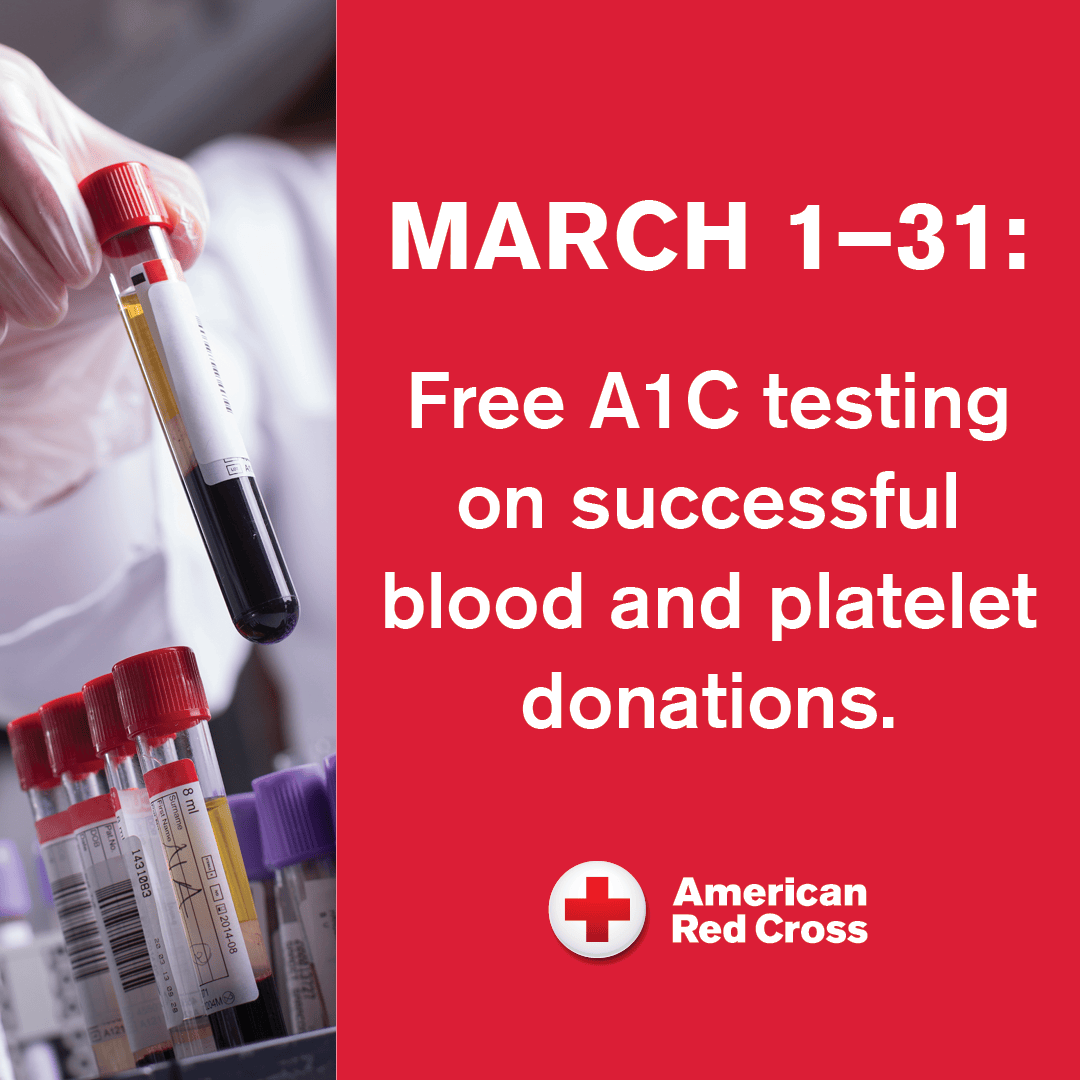
    Red Cross graphic – March 1-31: Free A1C testing on successful blood and platelet donations.

    The American Red Cross Southeastern Pennsylvania Region is helping to bridge access to health care for blood donors by providing free A1C testing, commonly used to screen for diabetes and prediabetes, on all successful blood, platelet and plasma donations in March.

    One-third of people lack access to regular primary care in the U.S., where diabetes affects 1 in 10 people and nearly a quarter of those living with it have been undiagnosed, according to the Centers for Disease Control and Prevention (CDC). The free A1C screening aims to help address this gap by empowering blood donors with valuable information to maintain their health and well-being. This new offering is among the longtime work of the Red Cross to support the health of communities, which also includes disaster relief efforts such as basic disaster health and mental health services among other assistance.

    Visit RedCrossBlood.org, use the Red Cross Blood Donor App or call 1-800-RED CROSS to book a time to give in March and learn more about your health. Additionally, all who come to give blood, platelets or plasma March 1-31 will receive a $10 Amazon.com Gift Card by email. See RedCrossBlood.org/March for details on both offers.  

    You can also make a financial donation at redcross.org/GivingDay on March 26 to support people with disaster services such asemergency shelter, food, relief supplies, basic health care, emotional support and financial assistance. Both efforts are part of its Red Cross Month activities in March, which locally includes a ribbon cutting and open house for our renovated Spring Garden Campus in Philadelphia on March 5.

    In addition, from now through April 6, Wawa customers can donate their spare change to the Red Cross through the in-store coin collection campaign or round up their in-store purchases to the nearest dollar at the register with the difference going to the Red Cross. Also, be on the lookout for Red Cross banners around LOVE Park and Broad Street in March!

    Supporting the health of communities has long been part of the American Red Cross and traces its roots to its founder, Clara Barton. A lifelong humanitarian and pioneer in the nursing field, Barton first led the organization to deliver relief and care after disasters more than 140 years ago.

    Bridging health care access through AIC screening

    According to the CDC, some 90% of people living with diabetes in the U.S. have Type 2, a largely preventable and often reversible insulin-resistant condition that can cause dangerously high blood sugar levels. Left untreated, Type 2 diabetes can lead to serious health complications, such as kidney failure, stroke and heart issues.

    “Type 2 diabetes develops over years and may not cause obvious symptoms until serious damage has been done,” said Dr. Courtney Lawrence, medical director for the Red Cross. “By understanding our own health, we can create a foundation to help prevent chronic illness, improve the quality of day-to-day living and save lives. Blood donation can now be part of that journey.”

    The Red Cross will begin the month-long A1C screening for successful donations starting on March 1. Donors can expect to receive the results of their test within one to two weeks through the Red Cross Blood Donor App or online donor portal, and they are encouraged to consult their health care provider if their A1C level is elevated. A1C is the latest health insight that the Red Cross provides to blood, platelet and plasma donors, who can already access ongoing donation information such as pulse, blood pressure, body temperature and hemoglobin levels.

    Delivering care amid intensifying disasters

    As part of disaster relief efforts, disaster health and mental health services are as important as ever in the face of intensifying extreme weather across the country. The Red Cross is responding to nearly twice as many major disasters than it did a decade ago across the country — on top of everyday crises like home fires, flooding and storms in Southeastern Pennsylvania After disasters of all sizes, the Red Cross also provides emergency lodging, food and financial assistance.

    Red Cross health and mental health support may include replacing lost prescription medications and medical equipment, helping people in its shelters cope with chronic illnesses aggravated by the disaster, and providing emotional support and referrals to community health and mental health professionals for additional care.

    So far this year, the Red Cross has helped people affected by large disasters such as the record-breaking wildfires in California. And in just the first two months of 2025, our local teams have responded to more than 100 local disasters, including home fires, helping close to 900 people in Southeastern Pennsylvania. This comes on the heels of 2024 having the second-highest number of billion-dollar disasters in a single year, due to major events like hurricanes, floods and tornadoes, according to the National Oceanic and Atmospheric Administration.

  • Nelson family speaks out about what it’s like to live with sickle cell disease and why blood donations are so important

    By Jenny Farley

    Julius Nelson is shown with his dad Jonathan Nelson, mom Julie Nelson and sister Jonna Nelson. Julius and Jonna Nelson are sickle cell warriors who both have Hemoglobin SC disease (Hb SC). Julius Nelson said, “My family has been like my biggest rock in my whole life, so they really help me out any way they can.” Submitted photo

    Julius Nelson has lived with sickle cell disease since he was born 27 years ago to his parents Julie and Jonathan Nelson.

    “People with sickle cell will tell you we are very good actors because a lot of times we just have to go through life pretending like we’re fine when we’re not,” he said.

    There are different types of sickle cell disease and Julius has Hemoglobin SC disease (Hb SC). Hb SC is said to be a milder form of sickle cell disease, but that’s not always true.

    “That has not been our experience with Julius,” his mom Julie said.

    Julius and his mom Julie are speaking out about what it’s like to be sickle cell warriors and why having a diverse blood supply is so important.

    Julius Nelson said one of the most important things to help cope with sickle cell disease is to build a supportive community. He said, “Just find people you can surround yourself with who will understand you and can help you because that’s really the only way you can get through it.” Submitted photo

    It’s estimated that more than 100,000 people in the United States have sickle cell disease, the majority of whom are Black or African American.

    In people who have sickle cell disease, red blood cells are hard and shaped like a crescent. They don’t flow smoothly through the body and the cells have trouble carrying oxygen. The cells can accumulate and harden because they aren’t soft and round.

    Patients can have severe pain (episodes referred to as a “crisis”), tissue and organ damage, anemia and even strokes. They may need several blood transfusions throughout their lives to treat symptoms and help manage the disease. Those blood transfusions can increase life expectancy.

    Julius has had several surgeries, including operations on his hip, stomach, appendix and eye. Before at least two of his major surgeries he required a blood transfusion so that his blood would be “healthier, stronger blood to make sure that you will be okay through the process,” he said.

    In 2021, the Red Cross launched the Sickle Cell Initiative to increase the number of Black blood donors to help patients with sickle cell disease. Julie said the Red Cross means a lot to her because she’s personally seen how it has helped her family.

    “When my son was having to have several surgeries, blood was always available and that’s because someone took the time out of their busy day to give blood,” Julie said.

    Julie works for the Philadelphia Senior Center and became a blood program leader, working with the Red Cross to host sickle cell blood drives.

    “We have been really blessed by our organization to allow me for several years now – I think I started in maybe 2010 – hosting blood drives at our senior centers,” she said.

    Her husband Jonathan is a blood donor and Julie wanted to donate but couldn’t, so that’s why she started hosting the drives.

    “I wanted to know how I can support the Red Cross if I’m not able to give because I’m anemic,” she said.

    One in three African American blood donors are a match for people with sickle cell disease.

    “People don’t understand that if you are an African American person the blood is better to come from another African American person to help someone with sickle cell,” she said.

    Julius Nelson is an animal lover who works at a doggy daycare/boarding center. He studied mass media in college and helps with social media and filming training videos at his work. Submitted photo

    Julius said one of the biggest challenges growing up with sickle cell disease was school and work. “Just attendance. You miss a lot of time when you’re sick often. You often have to work twice as hard.”

    He described a childhood full of explaining his disease in terms that people could understand.

    “It’s not a disease as well known as things like cancer, or like diabetes,” he said. “I got really used to explaining my disease in the simplest terms.”

    He also has had to frequently cope with horrible pain, which required him to be admitted to the hospital.

    “I wouldn’t wish what sickle cell does to you and the pain you go through on my worst enemy,” he said.

    Julie and Jonathan do everything they can to help ease their son’s agony during a crisis, but seeing him suffer is difficult.

    “It’s hard to see your child crying out because of pain,” Julie said.

    Along with staying in good physical shape and doing all he can to stay healthy, the emotional support Julius gets from his family is one of the things that has helped him the most.

    “I was very lucky to have two parents who were willing to do pretty much anything to make sure that I was healthy and could live a normal childhood – as normal as we could get it.”

    That support also comes from his beloved sister Jonna, who also has Hb SC disease. Julius said, “When I’m sick, she’ll bring me stuff, she’ll make sure I’m okay and vice versa.”

    Jonna is a 19-year-old college student who has had a less severe experience with sickle cell disease. She has been able to manage her pain at home and she doesn’t experience a crisis nearly as often as Julius.

    Pictured from Left to Right: Julius Nelson with his mom Julie Nelson, who is a blood program leader, and sister Jonna Nelson. Jonna is in college and studies marketing and public relations. Submitted photo

    Julius encourages everyone to donate blood.

    “You have no idea how that’s going to change someone else’s life, even if you can’t see it. But the important part is that you know that you did your part and that you are helping out your fellow African Americans and making our community stronger and better.”

    The next blood drive Julie is hosting, along with the Red Cross and the University of Maryland Eastern Shore Philadelphia Alumni Chapter, is on Juneteenth. Juneteenth is the day that commemorates the end of slavery in the United States. June 19th is also World Sickle Cell Day and falls on a Thursday this year.

    The blood drive is from 10 a.m. to 3 p.m. at the Philadelphia Senior Center located at 509 S. Broad Street. You can make an appointment to donate blood by visiting RedCrossBlood.org, using the Red Cross donor app or by calling 1-800-RED CROSS. That’s 1-800-733-2767.

  • From blood recipient to donor: Officer Ashley Hoggard pays it forward

    By Jenny Farley

    Retired Philadelphia Police Officer Ashley Hoggard lost 6 pints of blood when he was shot in the line of duty on June 14, 2009. Today, he donates blood, platelets and plasma. Submitted photo

    Growing up in Philadelphia, Ashley Hoggard knew he wanted to be a cop. Almost four years into his career, he got shot in the line of duty on June 14, 2009, two weeks before his 27th birthday. The bullet nearly killed him.

    “It ripped my lung in half. I died three times that night. I was in a coma. I lost six pints of blood in the time it took my partner to get me to the hospital and they were operating on me,” he said.

    Blood transfusions helped save his life.

    On that summer night, Officer Hoggard was responding to a call to assist other police officers around 2:47 a.m. He remembers crowded bars were letting out, people were rowdy, and three shootings were happening at the same time when he was hit.

    “It seemed like it was going on forever, but it really happened in a matter of seconds.”

    The last thing he remembers is saying a prayer.

    A nurse later told Officer Hoggard she had never seen someone lose that much blood and live. He spent 27 days in the trauma and intensive care units (ICU) at Temple Hospital.

    Over the next several years, he endured 15 surgeries. Doctors tried to repair the nerve damage on his left side and restore feeling in his dominant hand. In one grueling nine-hour operation, surgeons removed the bullet that nearly ended his life.

    “I worked 12 years with the bullet still lodged in my body.”

    When Officer Hoggard was a child he learned he had O negative blood, the universal blood type. After getting shot, he received so many blood transfusions that his blood type actually changed from O negative to O positive. O positive blood is the most transfused blood type.

    One day while watching a commercial for St. Jude’s Children’s Hospital, he was deeply moved by the sight of sick children.

    “It broke my heart. I was just sitting there watching these children fight. I got up, and then I started donating blood.”

    Now Officer Hoggard donates as often as possible. When he’s donating, he thinks about the people he’s helping.

    “I started donating platelets and I started donating plasma and stuff like that.” He said, “I try to give as much as I can.”

    He also makes Power Red donations, where a donor can give two units of red blood cells during one donation. Plasma and platelets get returned to the donor along with saline during that process.

    Officer Hoggard tells people about what he’s been through in the hopes it will inspire them to donate blood. He said before he was shot, he never took his life for granted, but he may have taken the “little things” for granted.

    “The fact that you can just wiggle your fingers right now. Or the fact that you could drink wine and read a book, or you can drive with one finger,” he said. “I never knew one bullet would cause that much damage.”

    After retiring from the Philadelphia Police Department after 18 years, he went to work for the Fraternal Order of Police Lodge 5. He runs the Injury Division.

    “This is the best job I have ever had. I love what I do. I love the people I work with.”

    He doesn’t take anything in life for granted now.

    “People are scared of death. I died three times in one night and the good Lord brought me back. The best way to beat death is how you live.”

    For Officer Hoggard, that means living each day striving to be a better person than the day before and continuing to donate blood.

    “The night I got shot, I needed six pints of blood just to stay alive. It came from six different strangers. Six people that I never met. Six people that I can’t even say thank you to. They saved my life.”

    To make an appointment to donate blood, visit RedCrossBlood.org, use the Red Cross donor app or call 1-800-RED CROSS. That’s 1-800-733-2767.

  • Red Cross labs support breakthrough cancer cure

    By Rob Wilder

    T Cell – A “living drug” that could save more cancer patients’ lives. Submitted photo

    It’s called CAR T cell therapy—a one-time treatment for blood cancer in which genetically engineered immune cells destroy each and every cancer cell in the body. The American Red Cross laboratory in Philadelphia works with worldwide pharmaceutical leader Novartis to isolate these powerful immune cells from a patient’s blood, genetically modify them and subsequently transfuse T cells back to the patient, where they attack and eliminate cancer cells.

    “Genetically modified cell therapy has found clinical success in blood cancers and rare diseases such as leukemia and sickle cell disease,” says Dr. Samuel Molina, Executive Director for Therapeutic & Cellular Solutions Manufacturing. “The CAR (chimeric antigen receptor) T cell concept is now being applied to other diseases such as lupus.” It is also in the R&D stage for treating various rare diseases.

    Red Cross Executive Director for Therapeutic & Cellular Solutions Manufacturing Dr. Samuel Molina. Submitted photo

    The central role of the Red Cross in this relatively new treatment is the collection of T cell rich white blood cells for processing by Novartis as well as patient care during the entire lifesaving process. “We are there for patients along every step of the way, from collection to transfusions of the finished CAR T cell product,” says Dr. Molina. He explains that Red Cross teams provide the required collections equipment and the bedside support needed for patients to receive their personalized cell therapy. The Red Cross team also provides critical cryogenic logistics that are required to freeze and transport cell therapies from manufacturing to the patient.

    The treatment employs apheresis, a centrifugal blood separation process, to isolate white blood cells from whole blood. “We envision bringing apheresis equipment to community locations where various cancer physician groups can send patients.” Community apheresis has the potential to unlock CAR T therapy for many more people, he says.

  • Blood donor Larry DiPiano is celebrated for a lifetime of giving

    By Nikhitha Raigir

    Ann Beal (right), American Red Cross Southeastern PA donor services account manager, presents a plaque to Larry DePiano (center) on Jan. 18, 2025 for his service as a blood program leader at St. Eleanor Catholic Church in Collegeville for the past 25 years. Carol Muniz (left) will take over that role going forward. Photo by Donn Greenberg / American Red Cross

    Sometimes, the most extraordinary legacies are built not through fame or fortune, but through quiet, consistent acts of kindness. Larry DiPianno is one such person. For him, donating blood was never about recognition or accolades—it was simply a way to help others, one donation at a time.

    Larry’s journey began in 1968 while working in Connecticut. Donating blood wasn’t something he had planned; it was just something that felt like the right thing to do. Life moved on, and for a time, his donations paused. But in 1979, when he started working at General Electric in King of Prussia, everything changed.

    GE organized regular blood drives, and Larry embraced every opportunity to give. “They did it twice a year, and I always donated whenever there was a blood drive,” he recalls. Over time, what started as a workplace routine became a deeply ingrained habit of generosity.

    Larry DePiano donated blood at St. Eleanor Catholic Church on Jan. 18, 2025. During his tenure as blood program leader for the church, he helped organize 97 blood drives, which collected more than 4,000 units of blood. Photo by Donn Greenberg / American Red Cross

    When he retired in 1998, Larry didn’t step back—he stepped up. With more time, he noticed that his church and the Red Cross needed someone to coordinate their blood drives. Without hesitation, he took on the role. “The Red Cross holds blood drives three to four times a year, and whenever I had a chance, I made sure to donate,” he says.

    But Larry’s impact extended beyond his own donations. He wasn’t just a participant; he became a leader, ensuring others could contribute as well. He organized sign-ups, collaborated with his church to spread awareness, and ensured each event ran smoothly. He welcomed donors, made sure supplies were in order, and stayed until the last chair was folded.

    His commitment led him to work closely with the Red Cross, expanding outreach efforts and encouraging more people to donate. Over time, he extended his efforts to schools, understanding the importance of fostering a spirit of giving in younger generations.

    Despite the profound impact he has made, Larry remains humble. “I’m just a very ordinary person, nothing special,” he says. Yet, it’s people like him—who act without expectation of praise—who make the biggest difference. His quiet dedication has inspired friends, family, and community members to step forward and give, creating a ripple effect of generosity.

    Communications volunteer Nikhitha Raigir interviews Larry DiPiano at the St. Eleanor Catholic Church blood drive on Jan. 18. Photo by Donn Greenberg / American Red Cross

    When asked about his philosophy, he simply says, “I just go one day at a time.” It’s a reminder that change isn’t always about grand gestures—it’s about consistency, about showing up and making a difference whenever possible.

    One of the things that continues to amaze Larry is the dedication of older donors. “I always was amazed by how old people would be and still come and donate,” he says, acknowledging that generosity knows no age limit.

    Larry’s story is a beautiful testament to how small, repeated acts of kindness can create lasting change. He may see himself as just another person, but his actions prove otherwise. His life is a quiet but powerful reminder that the best way to make a difference is simply to keep showing up, one donation at a time.

  • World Cancer Day and the lifesaving role of blood and platelet donations

    By Samantha Antenucci

    Red Cross graphic – What blood types are ideal for platelet donation. Be a #CancerKicker. RedCrossBlood.org/Platelets

    Tuesday, February 4th, marks World Cancer Day, a global initiative dedicated to raising awareness, encouraging early detection, and supporting cancer patients and their treatment. Cancer does not discriminate- it affects people from all walks of life, from youth to the elderly, and while the fight against cancer can be overwhelming, there is something anyone can do to make a powerful difference in patient’s lives- donating blood.

    How does your donation help?

    One might not realize how vital a blood transfusion can be in cancer treatments. As a matter of fact, nearly 40% of all donated platelets and 25% of blood products go directly to cancer patients. Many treatments, like chemotherapy and radiation, though life-saving, can severely reduce the blood cell counts and lead to complications like anemia, infection, and difficulty clotting. For instance, when red blood cells are low, the body has a reduced ability to carry and transport oxygen throughout the body. A patient can experience fatigue, weakness, and shortness of breath as a consequence. Similarly, if a patient is low in platelets, their body has a reduced ability to form blood clots, which can lead to uncontrolled bleeding from even small cuts or bruises.

    Additionally, patients with leukemia, lymphomas, and other blood cancers are especially dependent on frequent blood and platelet transfusions for survival. Those undergoing bone marrow transplants or major surgeries to help remove cancers often require blood as well to help during recovery.

    Every blood donation has a chance to help make a difference in the life of a cancer patient. Unfortunately, blood products are always in constant need and come from generous donations from people in the community. Not only can these donations help give patients the strength to keep fighting, but many patients after recovery are able to become donors themselves, showing how powerful a single donation can be!

    World Cancer Day is not just about awareness, but a call to action to help those fighting against cancer, and providing resources needed to continue their treatments. Though a cancer diagnosis can leave patients feeling powerless and overwhelmed, we have the power to help give them strength. A single donation takes less than an hour to do, but can go on to have a powerful impact and save more than one life per donation.

    If you haven’t donated before, now is a wonderful time to start! The Red Cross hosts many drives all throughout the Philadelphia area, as well as a blood donation center. You can schedule here for an appointment and be a part of the fight against cancer. To learn more about how your donation can impact patients with cancer, the American Cancer Society provides a breakdown of how your donation will be used: Kinds of Blood Product Transfusions | Blood Transfusions for Cancer Patients | American Cancer Society. When it comes to the fight against cancer, every drop counts!

  • Red Cross cuts ribbon on first Bucks County donation center

    By Alana Mauger

    Red Cross officials cut the ribbon for the new Langhorne Blood Donation Center on Jan. 30, 2025. Pictured (from left), Regional CEO Jennifer Graham; Regional Donor Service Executive Helen Munizza; platelet donor Jeff Rowlands; Fixed Site Collections Manager Katrell Patterson; Northeast Division Fixed Site Director Andree Baylor-Lloyd; Philadelphia Chapter Board of Directors Tine Hansen-Turton; PA Senator Frank Farry. Photo by Tatiana Madise / American Red Cross

    The American Red Cross celebrated the grand opening of its new Langhorne Blood Donation Center with a ribbon cutting ceremony on Jan. 30th. The Red Cross began collecting blood and platelet donations on Dec. 5, 2024. The new center is located at 100 N. Bucks Town Drive in Suite 204 in Langhorne.

    The site is one of four new blood donation centers the Red Cross has opened in Southeastern Pennsylvania, plus another one less than mile from the Pennsylvania state line in Wilmington, Delaware.

    “By opening this, and other locations like it, we’re able to collect more blood products to supply to hospitals all over the Greater Philadelphia region,” said Jennifer Graham, CEO, Red Cross Southeastern Pennsylvania.

    While mobile blood drives will continue to operate at businesses, schools, churches and other locations throughout the region, some donors may find it easier to fit a blood donation into their busy schedules at convenient, fixed locations with consistent hours.

    Donation centers are the only places the Red Cross collects platelets – tiny cells in your blood that form clots and stop bleeding. With a shelf life of only five days, platelets are in constant demand to treat patients with cancer and others facing life-threatening illnesses and injuries.

    Platelet donor Jeff Rowlands joined Red Cross and community officials to cut the ribbon. He was the very first platelet donor on the schedule when the center opened on Dec. 5th.

    Jeff first donated blood in high school and picked up again later when his younger brother battled a rare blood disorder and required transfusions.

    “He passed in 2021 after complications. I continue to give in his honor,” he shared.

    Jeff went to our Blood Donation Center in Princeton near his place of work at the time to make a Power Red blood donation during his lunch break. One day, a member of our collections team asked him to consider giving platelets.

    “After learning about it, I went ahead and have been donating ever since,” he said. “Yes, giving platelets is a little bit of a time commitment, but it is so rewarding knowing the impact it has for others in need.

    The Langhorne Blood Donation Center is open Tuesdays and Wednesdays, 11:45 a.m.-8 p.m., Thursdays 10:15 a.m.-6:30 p.m. and Saturdays 7:15 a.m.-3:30 p.m. To schedule an appointment to donate, visit RedCrossBlood.org, use the Red Cross Blood Donor App or call 1-800-REDCROSS (1-800-733-2767).

  • High school Red Crosser shares first blood donation experience

    By Kai Kwong

    Kai Kwong with Fred Cross at WMMR’s 2024 “I Bleed For Preston & Steve” blood drive in Oaks. Photo by Jenny Farley / American Red Cross

    My name is Kai. I’m a high school student and I recently donated blood for the first time at my school Student Senate’s annual fall blood drive for the American Red Cross.

    I’ve wanted to donate blood for a long time, especially after my mom started volunteering for the Red Cross, and even more so after I started to volunteer. I’ve been nervous to donate because I have hated needles and any other procedure where I needed to get poked since I was really young. I was worried about whether donating would hurt.

    Something that helped motivate me to donate blood was that I knew how much good it would do for people who need it, especially because I have seen and heard about it from volunteering for the Red Cross. A single blood donation can help save more than one life.

    The process that I went through is probably not what most people will go through, since mine was through my school and not at a regular blood drive or donation center.

    On the day that I donated, I went from my math class down to the gymnasium where the drive was being held. I checked in with the intake people and moved over to a waiting area before I talked to the phlebotomist for the health screening. Then, I was moved over to the area where the actual donations were happening.

    During the health screening process, I was worried that I wouldn’t be able to donate. Last year in my junior year, I tried to donate but I was told I couldn’t because my pulse was too high. This time, when I was told that my health was good enough, I was really glad that I would be able to donate.

    When it was time to actually donate, the kindness of the phlebotomist was what helped me most. Even though I am afraid of needles, it was a very easy process because he told me what was happening.

    Throughout the whole thing, from when they prepped my arm to when I was going to the after-donation area, I was never in pain – even the insertion of the needle only felt like a small prick, and I felt at-ease the whole time.

    I would recommend that anyone donate blood. It’s very important, and it doesn’t hurt nearly as bad as you’d think it would. I am glad that I was able to donate blood, and I can’t wait until I can donate again, hopefully at my school’s spring blood drive.

  • National Blood Donor Month: Janette Olson makes her first Power Red donation

    By Jenny Farley

    Jannette Olson makes her first Power Red donation on Dec. 5th at the opening day of the new Red Cross Blood Donation Center in Langhorne. Photo by Jenny Farley / American Red Cross

    Jannette Olson decided to move to Pennsylvania from New Hampshire to be closer to her kids and their families. One of the first things she did as a new resident is find a place to donate blood, something she did frequently before the big move.

    “I always donated locally there with a major trauma center,” she said.

    Jannette discovered the new Red Cross Blood Donation Center in Langhorne and made her first Power Red donation on the site’s opening day.

    “I saw that there was a new center and it was close to my house so I figured I’d come in.”

    Jannette has O negative blood, which makes her a universal donor. O negative blood is what emergency room personnel reach for when there’s no time to determine a patient’s blood type.

    During her Power Red donation, Jannette gave a concentrated dose of red blood cells during a single donation. The red blood cells were separated out from the other blood components and the plasma and platelets were safely returned to her. Power Reds can be donated every 112 days.

    Donors at the new center in Langhorne can make Power Red donations as well as whole blood, plasma and platelets.

    “It’s great. People are very helpful and nice,” Jannette said.

    She appreciated that phlebotomists explained everything about how a Power Red donation worked, and she felt the energy of the center’s opening day.

    “Everybody’s pretty excited to be here.”

    If you are thinking about donating blood but haven’t done it yet, Jannette has some advice.

    “Everybody should do it. It’s easy. It doesn’t take too much time and it’s the right thing to do.”

    Make an appointment to donate blood by visiting RedCrossBlood.org, using the Red Cross donor app or by calling 1-800-RED CROSS. That’s 1-800-733-2767.