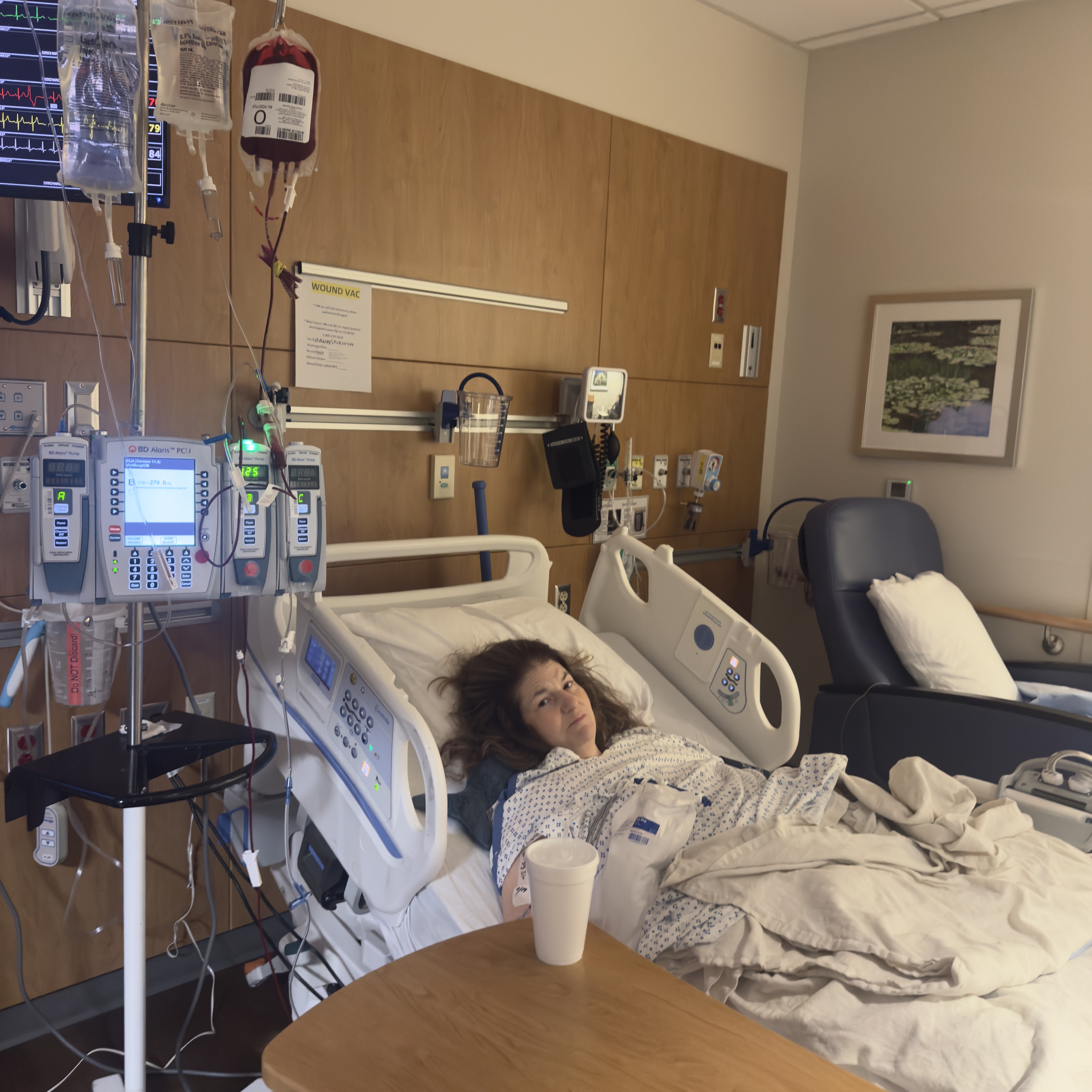
During my week in the hospital a planned abdominal surgery led to five blood transfusions, ICU and a second surgery. Thank you to the blood donors who made my recovery possible. Photo by Kai Kwong / American Red Cross
For the past three and a half years I have been a volunteer writer and photographer for the American Red Cross. I have interviewed so many people whose life was saved or enriched by blood transfusions.
I’ve heard many times that the blood that’s already on the shelves is what’s needed to save a life in an emergency. Right. I get it I always thought. But I didn’t. Until now.
I have been out of the hospital for less than a week. I went in for a routine major abdominal surgery and ended up bleeding internally. By the time I left the intensive care unit (ICU) after a second surgery, five blood transfusions, my wonderful surgeon and a team of incredible nurses saved my life.
I admit I’m writing this in a lot of pain and on medication. So, my recollections of what happened are told through that haze. I have an incision that spans hip to hip and several staples that will be in for another week. When I stand up, or walk, or move, I feel a deep searing agony.
But throughout my pain, I still am in complete awe that the blood I never thought I would need was there because someone I didn’t know took the time to give it.
I remember my blood pressure being really low before I was transferred to the ICU. I’m not a numbers girl. I have never remotely paid attention to what number makes a good blood pressure. I know my top number (systolic blood pressure) hit 71. When my mother died the top number was 61.
It was low enough that both my sisters got in the car and drove nearly 15 hours from their southern states to come be with me.
Low enough that I moved from the fourth floor that houses post-surgery patients at Bryn Mawr Hospital to the third floor ICU for monitoring.
Low enough that the blood pressure cuff just stayed on my arm and routinely took my pressure every few minutes.
And my hemoglobin number from constant blood checks became the most important number of each day. The only thing that brought that number up was getting another blood transfusion.
I remember when the nurse told me I was going to get a blood transfusion I lovingly spoke about my time with the Red Cross. I wondered where the blood was coming from and she said something like “When I need it I just go to the shelf and get it.”
The only reason it was there is because as I’ve already said, someone I didn’t know took the time to give it. I just can’t get over that.
When you’ve been told it’s the blood on the shelves that saves a life, you can’t understand what that means until you contemplate that you needed FIVE transfusions to survive.
What if the blood wasn’t already on the shelf? What if when the nurse went to just get it out of the blood bank at the hospital the shelves were empty?
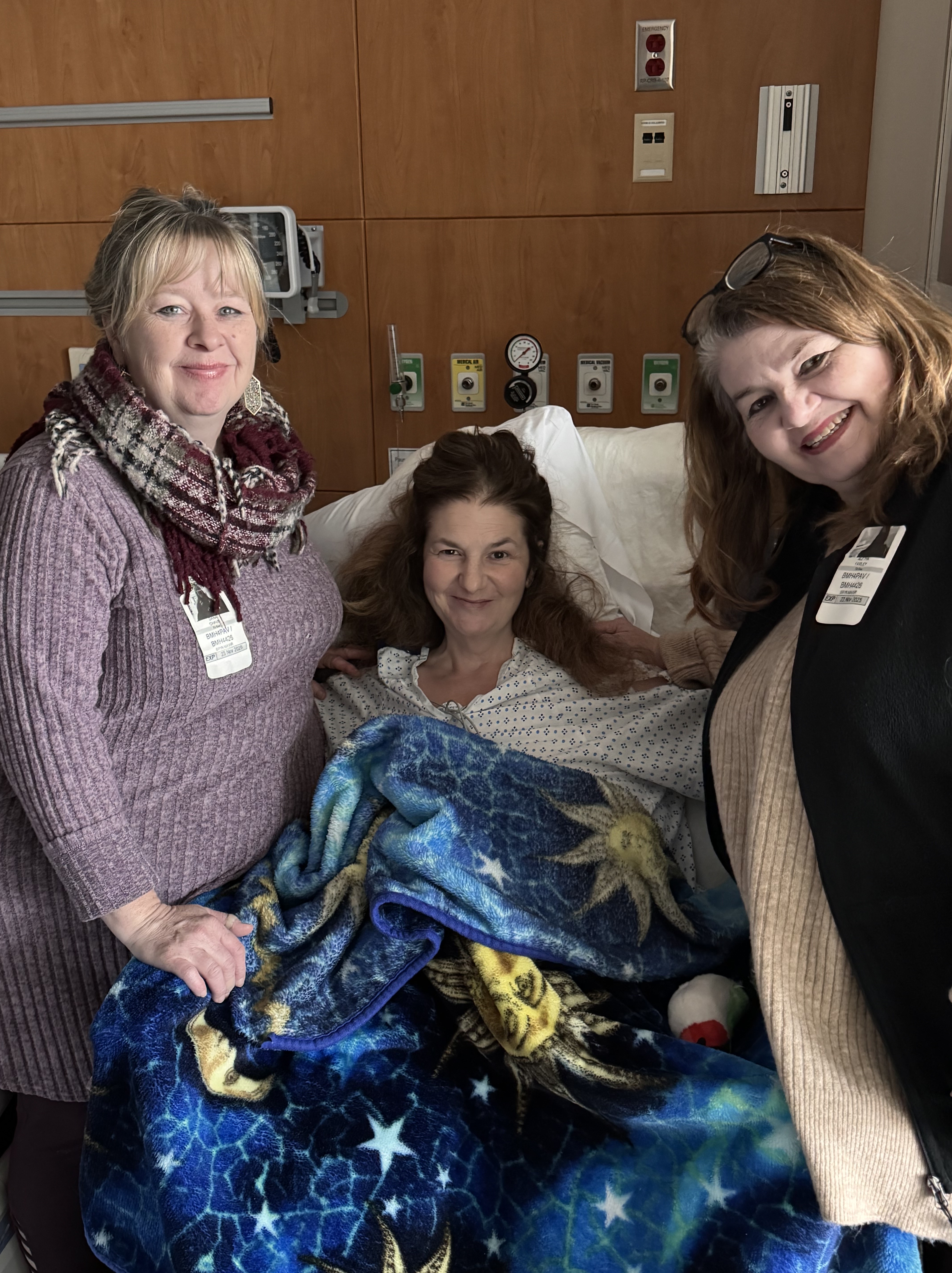
Shown from left to right are my sister Dana Chavis, who drove to Pennsylvania from Tennessee, me in the middle after two surgeries, and my sister Claire Farley who drove to see me from Georgia. We are smiling here because I was getting better.Submitted photo
In the United States, someone needs blood every two seconds and the Red Cross supplies about 40% of our country’s blood supply. That blood is only there because of generous donors like my son Kai, who as a teenager is also a Red Cross volunteer and has donated platelets and whole blood.
Kai couldn’t have known that one day his mom would be on the receiving end of another donor’s generosity. He donated because he likes to help people and wants to be a doctor one day. His blood may be on a hospital shelf right now. Is yours?
If you would like to donate blood or platelets, visit RedCrossBlood.org for info on how to become a blood donor.
To the people whose blood is now flowing through my veins, I want you to know I will make it count. Thank you from my healing body and ever grateful heart.
Ava Conley won a Red Cross scholarship for her work as a blood program leader. Submitted photo
Ava Conley of Harleysville helped save lives by hosting an American Red Cross blood drive and earned a $2,500 scholarship as a result of her lifesaving efforts.
As part of the Red Cross Leaders Save Lives program, Ava was eligible to be entered into a drawing for a scholarship and was chosen as a winner. She also received a gift card.
The Penn State University freshman stepped up to be the blood program leader for Peter Powerhouse Foundation blood drives in March 2024. Her Leaders Save Lives qualifying drive, which collected 119 units of blood, took place on July 9 at Towamencin Mennonite Church in Kulpsville.
Ava was inspired to become a blood program leader by her brother Logan, who received blood transfusions while undergoing chemotherapy.
“I wanted to help others feel better with receiving blood, as my brother did,” she said. “It felt good knowing we collected so much blood, which will help so many people.”
She encourages other students to give it a try.
“It’s fun to organize, you get closer to people in your community and are helping people in need of blood,” she said.
Ava is grateful for the scholarship opportunity and plans to put the money toward her next college tuition bill.
The Leaders Save Lives program encourages community-minded high school and college students to host blood drives to help maintain the blood supply for patients in need of lifesaving transfusions.
Students can sign up to host Leaders Save Lives blood drives during seasonal timeframes throughout the year. For more information, visit RedCrossBlood.org/LeadersSaveLives.
You’ve probably seen those pharmaceutical commercials – people dancing in the streets, singing catchy tunes about lowering their A1C. The jingles stick in your head for hours. But since its National Diabetes Awareness Month, it’s worth asking: what exactly is A1C, and why does it matter for your health?
November is Diabetes Awareness Month. Untreated diabetes can cause serious health concerns.
Diabetes Basics
Diabetes is a condition that occurs when your blood glucose – also known as blood sugar – is too high. There are two main types:
Type 1 diabetes is an autoimmune condition where the body cannot produce insulin. It’s usually diagnosed in childhood and treated with insulin. Only about 5-10% of Americans with diabetes have type 1.
Type 2 diabetes accounts for 90–95% of cases. In type 2, the body doesn’t make enough insulin or doesn’t use it effectively. Risk factors include age, family history, race and ethnicity, as well as lifestyle factors like weight, waist circumference and physical activity. Treatment options include medications, insulin and/or lifestyle changes.
Type 2 diabetes is a chronic condition that requires ongoing management. Without proper control, it can lead to serious complications such as cardiovascular disease, kidney damage, vision and nerve problems and a weakened immune system.
What Does the A1C Test Measure?
A1C is a simple blood test that can be used to diagnose type 2 diabetes and prediabetes. It’s also the primary tool used for monitoring diabetes over time. Unlike a fingerstick test that shows blood sugar at a single moment, the A1C test measures your average blood sugar over the past three months.
The U.S. Centers for Disease Control and Prevention (CDC) breaks it down like this. When sugar enters your bloodstream, it attaches to hemoglobin, a protein in red blood cells. Everyone has some sugar, but people with higher levels have more. The A1C test measures the percentage of your red blood cells that have sugar-coated hemoglobin. Here’s the breakdown:
For those living with diabetes, the goal is typically an A1C below 7%.
Diabetes impacts over 38 million people in the U.S. Nearly 25% don’t know they have it.
Why Your A1C Matters
While there’s no cure for type 1 diabetes, evidence shows that type 2 can be prevented, delayed and even put into remission with medications and/or lifestyle changes, especially during the prediabetes stage, which has little or no symptoms. Even without developing diabetes, an elevated A1C can indicate a higher risk for other health complications like heart disease, stroke and kidney disease.
Getting Tested
The CDC recommends A1C testing every three years for adults age 45 and older. Testing should be more frequent for those who:
Have a family history of diabetes
Are overweight or obese
Have been diagnosed with prediabetes
Had gestational diabetes during pregnancy
Show symptoms of diabetes
Your primary care provider can order the test and explain results. If your A1C level is high, your provider will likely order a fasting blood glucose test before making a diabetes diagnosis.
Nov. 1-30: Free A1C testing on successful donations. 1 test result per donor in a 12-month period. Don’t fast before donating.
Understanding Diabetes as a Blood Donor
To help empower and educate blood donors in November, the American Red Cross will perform free A1C testing on successful donations (one result per donor in a 12-month period).
Since March, the Red Cross has performed about 550,000 A1C tests, empowering donors with vital health insights. Of those, about 145,000 individuals were notified of concerning A1C levels – potential indicators of chronic conditions like prediabetes and diabetes.
Fasting is not required for the A1C test, which measures an individual’s average blood sugar levels over the past three months. It’s always important to eat a nutritious meal before giving blood or platelets.
People with prediabetes and diabetes are generally eligible to donate blood, platelets and plasma if they are feeling well and their diabetes is well managed. To learn more about understanding diabetes as a blood donor, visit RedCrossBlood.org/Diabetes.
Red Cross graphic – September is Sickle Cell Awareness Month.
About every two and a half minutes, someone with sickle cell disease arrives at a U.S. emergency room. Most often, they’re in severe pain. It can affect any part of the body, but is most often in the back, chest, arms or legs. Some sickle cell warriors say the pain feels like being repeatedly stabbed or electrocuted. Others compare it to broken bones or feeling like broken glass is flowing through their body. Each person experiences their pain differently.
This episode of pain is a vaso-occlusive crisis, also known as a sickle cell crisis, and it’s the top reason sickle cell warriors are hospitalized. It happens when sickle-shaped red blood cells block the body’s blood vessels and prevent oxygen from flowing to tissues and organs, causing severe pain. The episodes can last for hours, days or even weeks and can lead to complications like tissue and organ damage, anemia, kidney failure and strokes.
According to the Center for Disease Control and Prevention (CDC), sickle cell disease affects one in every 365 African American newborns, making it the most common inherited blood disorder in the country. Many sickle cell warriors require blood transfusions throughout their lifetime – as many as 100 transfusions each year – to manage their symptoms and improve health outcomes.
Unfortunately, frequent transfusions can lead patients to develop an immune response to blood that is not closely matched to their own, making it difficult to find compatible blood types. Beyond the well-known A, B, O and AB, there are more than 300 known antigens for red blood cells and some are unique to specific racial and ethnic groups.
Red Cross graphic – Normal Red Blood Cell: Soft and round, Blood flows freely in blood vessels vs. Sickled Red Blood Cell: Hard and crescent shaped, Blood flow could be blocked.
Diversifying the blood donor base
Blood donors who identify as Black or African American are almost three times more likely to be a match for sickle cell patients compared to other donors. In 2021, the American Red Cross launched its Sickle Cell Initiative to grow the number of donors who can help people living with sickle cell disease.
Since the launch, the initiative has reached several impressive milestones. More than 140,000 Black individuals gave blood for the very first time, reversing the trend of declining donors overall for this group. The Red Cross also provided more than 300,000 sickle cell trait screenings to donors who self-identified as African American, Black or multiracial, helping to raise awareness in communities most impacted by sickle cell disease.
Focusing on youth, the Red Cross invested $205,000 in future leaders through the Sickle Cell Fighter High School Scholarship Program, awarding $5,000 scholarships to 41 students who demonstrated outstanding commitment to helping patients with sickle cell disease. Through the historically Black colleges and university (HBCU) Ambassador Program, the Red Cross collected 7,300 units of blood at more than 320 blood drives on HBCU campuses – including Lincoln and Cheyney universities locally.
Red Cross graphic – Blood donors who are Black are almost 3x more likely to match the blood most commonly needed by patients with sickle cell disease.
Joined by Blood
Patients with sickle cell disease undergoing stem cell or gene therapy treatments also benefit from blood and platelet donations that are closely matched to avoid transfusion-related complications. To help ensure these lifesaving treatments remain available, the Red Cross is mobilizing communities through its fall “Joined by Blood” activation.
From September through October, more than 750 Joined by Blood drives will take place nationwide. Partners include the Sickle Cell Disease Association of America, 100 Black Men of America, The Links, Incorporated, Delta Air Lines, Chi Eta Phi Sorority, Jack and Jill of America, member organizations of the National Pan-Hellenic Council, HBCUs, faith-based organizations and more.
Upcoming Joined by Blood drives in Southeastern PA Sept. 7 – WeLoveU Foundation at Philadelphia, 9 a.m.-2 p.m. Sept. 9 – Upper Darby High School, Drexel Hill, 2-7 p.m. Sept. 13 – Bethlehem Baptist Church, Spring House, 9 a.m.-2 p.m. Sept. 18 – Mt. Carmel Baptist Church, Philadelphia, 1-6 p.m. Sept. 23 – Office of City Commissioner Omar Sabir, 10 a.m.-3 p.m. Sept. 23 & 24 – Internal Revenue Service, Philadelphia, 8 a.m.-6 p.m. Sept. 25 – Lincoln University, Lincoln University, 1-6 p.m. Oct. 9 – Philadelphia High School for Girls, Philadelphia, 8:30 a.m.-1:30 p.m. Oct. 16 – Temple University ROTC, Philadelphia, 10 a.m.-3 p.m. Oct. 18 – CareView Community Church, Lansdowne, 9 a.m.-2 p.m. Oct. 22 – Lankenau High School, Philadelphia, 7:30 a.m.-12:30 p.m. Oct. 27 – Imhotep Institute Charter School, Philadelphia, 8:30 a.m.-1:30 p.m. Oct. 30 – Orleans Technical College, Philadelphia, 9:30 a.m.-2:30 p.m. Oct. 30 – Philadelphia International Airport, Philadelphia, 6 a.m.-6 p.m. Oct. 31 – Academy Park High School, Sharon Hill, 8 a.m.-1 p.m.
To schedule an appointment to donate, visit RedCrossBlood.org, download the free Red Cross Blood Donor App or call 1-800-RED CROSS.
Red Cross graphic – We’re all joined by blood. Please donate.
Governor Josh Shapiro and First Lady Lori Shapiro signed a proclamation designating Sept. 4, 2025 as Blood Donation Day in Pennsylvania – part of a National Blood Donation Week effort to encourage eligible donors to give blood around Labor Day. The American Red Cross invites the Greater Philadelphia community to help save lives at blood drives scheduled this week and beyond.
Image of the proclamation signed by PA Governor Josh Shapiro and PA First Lady Lori Shapiro designating Sept. 4th as Blood Donation Day
For the 10th consecutive year, media personality Dr. Daliah Wachs has worked to enlist all 50 states in promoting blood donation. Dr. Daliah, who hosts a syndicated radio program on Talk Media Network and is heard on iHeart Radio, speaks to her listeners weekly about various medical topics and understands why it’s important to have a robust blood supply. After hearing about an emergency need for more donors, she decided to establish a National Blood Donation Day, strategically timed right around the Labor Day holiday, when blood donations often decline due to busy holiday schedules. Dr. Daliah has asked each state governor to join her by proclaiming the service day in their home state.
“Every two seconds, someone in the U.S. needs blood, from medical emergencies to critical treatments for conditions such as cancer or sickle cell disease,” said Jennifer Graham, Regional CEO, Red Cross Southeastern PA. “Giving blood is a meaningful way to help your community, and now is the perfect time to roll up a sleeve to make a potentially lifesaving difference.”
To find a donation opportunity and learn more about blood donation, including eligibility information, download the Red Cross Blood Donor App, visit RedCrossBlood.org or call 1-800-RED CROSS (1-800-733-2767).
The American Red Cross asks donors to give blood or platelets now to help maintain a healthy blood supply. Donors of all blood types, especially those with types O positive and B negative blood, are urged to make an appointment to keep lifesaving blood products ready the moment patients need them.
People coming together to care for one another is the humanitarian spirit shared by our Red Cross community and fans of PEANUTS. And this month, the Red Cross and PEANUTS are once again joining forces to remind people that a little good goes a long way. In celebration of the 75th anniversary of PEANUTS, those who come to give blood Aug. 29-Sept. 21, 2025, will get an exclusive Red Cross x PEANUTS mystery bag with one of four special T-shirt designs, while they last.
Each design is iconic, and donors won’t know which one they’ll get until they open the bag. Additionally, there will be a number of golden tickets randomly in the mystery bags hidden throughout the country. Donors who find a golden ticket when they open their bag will have the chance to redeem it through an online form for all four T-shirts! See RedCrossBlood.org/Peanuts for details.
Peanuts x American Red Cross graphic – Which iconic T-shirt design will you get?
Seasonal challenges
Routines are changing, and schedules are filling up before fall, which could keep people from coming out to help save lives. In addition, the threat of severe weather and hurricanes remains strong in late summer. As we near National Preparedness Month, it’s important to note the significant disruption weather can cause all year long. Between July 1, 2024, and June 30, 2025, weather canceled about 1,500 blood drives, causing more than 40,000 blood donations to go uncollected. Making and keeping donation appointments where it’s safe to do so can help patients when and wherever they need it most.
How to donate blood
Simply download the American Red Cross Blood Donor App, visit RedCrossBlood.org, call 1-800-RED CROSS (1-800-733-2767) or enable the Blood Donor Skill on any Alexa Echo device to make an appointment or for more information. All blood types are needed to ensure a reliable supply for patients. A blood donor card or driver’s license or two other forms of identification are required at check-in. Individuals who are 17 years of age in most states (16 with parental consent where allowed by state law), weigh at least 110 pounds and are in generally good health may be eligible to donate blood. High school students and other donors 18 years of age and younger also have to meet certain height and weight requirements.
Blood and platelet donors can save time at their next donation by using RapidPass® to complete their pre-donation reading and health history questionnaire online, on the day of their donation, before arriving at the blood drive. To get started, follow the instructions at RedCrossBlood.org/RapidPass or use the Blood Donor App.
Red Cross communications volunteer Kai Kwong donated platelets for the first time in May. Photo by Jenny Farley / American Red Cross
I’m Kai Kwong, a recent graduate from Haverford High School and incoming freshman at Temple University, and I wrote an article about donating blood for the first time last year. Recently, I donated platelets for the first time, and I wanted to share about that experience too.
I actually donated whole blood for the second time at my school, just a couple weeks before the platelets. I was looking in my blood donor portal and received a call from the Red Cross asking me to donate platelets. I thought I would try it, so I scheduled an appointment that weekend.
On May 17, I booked an appointment for platelet donation at the Philadelphia Red Cross Blood, Platelet and Plasma Donation Center on Spring Garden Street.
The whole process was very easy and worked the same way as whole blood. I filled out the Rapid Pass, answering its questions, which only took a few minutes.
When I got to the center, I buzzed in and the person at the virtual doorbell let me in and told me where to go, which was to the left of the entrance.
I checked in with the person there and showed my donor ID card in my app. After that I went to health screening, and the person was very kind and explained what was happening. After the blood pressure, pulse and hemoglobin checks, I was led to the donation chair.
Kai stands outside of the Philadelphia Blood Donation Center at the Spring Garden Campus. Photo by Jenny Farley / American Red Cross
I was able to select a movie on Netflix to watch during the donation, as it would be a longer process compared to whole blood – nearly three hours in total. I chose to watch “Dune 2” and was loaned a pair of headphones to listen to the movie.
The phlebotomist cleaned my inner elbow regions and used the sphygmomanometer (blood pressure cuff) as a tourniquet to get the veins to appear. She marked my arms with a little pen for the placement of the IVs. She then used antiseptic scrub for a few seconds and let it dry. After that she inserted the IVs. An important part of platelet donation is that you can’t move your arms at all once the IVs are inserted.
For me, the blood was taken out of my right arm, where it led to the apheresis machine, which separated the blood into components. They kept the platelets and the machine returned everything else back into my left arm.
Like a normal whole blood donation, I had to squeeze a little ball in my hand, on the arm the blood was taken from.
It was a long process, but it wasn’t that uncomfortable. I sat there for the whole donation, which itself was probably a little over two hours. During the donation, I was able to relax and watch the movie, which was apparently the perfect choice because the credits were rolling just as my donation finished.
The phlebotomist was great throughout the whole process and checked on me multiple times. Other phlebotomists in the room also would ask if I was doing alright when they passed by me. I thought that was really nice.
When it’s done, they let your fluids finish returning into you, then the tubing is removed and they bandage you like they do after a whole blood donation, with gauze and a red bandage.
I was led to the waiting area stocked with food and water, and was told to wait for 10-15 minutes to make sure I was feeling okay.
I was also given a cool bag that was Red Cross branded and said “Platelet Donor” on the bag. Inside was a few pamphlets with information on what platelet donation does to save lives.
Kai shows off his new “Platelet Donor” bag after making his first platelet donation in Philadelphia. Photo by Jenny Farley / American Red Cross
Something I learned about platelet donation is that platelets have to be transfused within five days of donation so new platelet donors are always needed to keep up with the demand for them. Platelets help blood clot, and they help burn and accident victims as well as cancer patients.
Overall, I was very satisfied with my platelet donation, and even though it took a while, I would recommend other people do it. I had an amazing phlebotomist which made the process very easy.
Something that I really liked about donating whole blood and platelets is that I know what it can do to save lives. I want to be a doctor someday and I have been in hospital clinicals before, and I have seen how blood transfusions can benefit people. As a Red Cross communications volunteer, I’ve also talked with people who said how important blood donations are and how much they help.
Though I’ve only given platelets once as of writing this article, I’d still like to give some tips to potential donors: In addition to drinking plenty of water leading up to donating, I’d say if you have long hair make sure it’s comfortable and also do what you need to before the needles are inserted because you cannot move your arms during the donation.
Most importantly, donating blood saves lives, but another bonus was a promotion where donors who gave platelets for the first time in May, received a gift card, and another for giving between May 1 and May 18.
I can’t wait to donate platelets again as soon as I have time, and I plan to give whole blood as soon as I’m allowed to. You can donate platelets every 7 days, up to 24 times a year, and whole blood every 56 days, up to 6 times a year.
If you want to donate, I would highly recommend it. I really liked doing it and it isn’t as hard of a process as one might think. You can make an appointment to donate blood by visiting RedCrossBlood.org, using the Red Cross donor app or by calling 1-800-Red-Cross. That’s 1-800-733-2767.
Rebecca Baranowski prepares to donate platelets at the American Red Cross Philadelphia Blood Donation Center in May 2025. Photo by Judith Weeks/American Red Cross
Rebecca Baranowski has donated over 700 units of platelets knowing her donations will help someone!
For more than 40 years, Rebecca has rolled up her sleeve and donated 707 units of platelets helping someone at risk for bleeding. Imagine the impact she has had on saving lives!
While a student at Penn State, Rebecca and her friends began donating and selling plasma for extra money to buy pizza and beer. When she moved to Philadelphia and got a job, she didn’t need the money and switched from donating plasma to donating platelets at the American Red Cross.
Why are platelets so important? They are tiny cell fragments in blood that form clots preventing or stopping bleeding. Patients fighting cancer, those with a bone marrow transplant or who have traumatic injuries, could need platelets. Platelets can be donated up to 24 times a year. Platelets have a very limited shelf life of five days! Donors are needed for frequent and consistent donations to replenish hospital supply.
If you want to donate platelets, you must go to an American Red Cross Blood Donation Center that has an apheresis machine. The platelet donation process begins with blood drawn from one arm that moves through a tube into the apheresis machine where it is rapidly spun around separating platelets from blood. The platelets go into a sterile bag and the rest of the blood is returned by a tube to the other arm.
“The staff is friendly. I don’t mind giving up 90 minutes or two hours every couple of weeks. I get to watch a movie and relax on a comfy chair,” she said.
About the procedure, Rebecca explains, “The needles don’t bother me. When the blood is returned to my vein, it gets a little cold because of the citrate added to the blood. They give me a warm blanket!”
Rebecca says once the needle sticks are done, it’s easy, but she cautions, “You have to remember not to move your arms too much!
“It’s not a difficult process,” she said. “It’s one of those things one would do like recycling to benefit people. I like to think that if I needed blood there would be somebody who would donate for me. It’s important and something easy to do, and I get a T-shirt!”
Rebecca enjoys wearing the Red Cross T-shirts because they bring attention to donating blood and give her an opportunity to tell people about her experience!
Rebecca donates granulocytes too. Granulocyte transfusions are given to patients who have severely suppressed immune systems and are undergoing cancer therapy or have had a bone marrow transplant. A patient must be transfused within 24 hours of granulocyte collection. Rebecca explains she could get a call to donate within hours. The pool of matched donors is limited. Her granulocytes have been typed and only matched with a patient 15 times over 40 years of donating.
When she’s not giving platelets, Rebecca is committed to working out with her trainer at a local gym. She’s a member of a Dragon Boat Team, and it’s important for her to stay strong so she can paddle with them.
There are six American Red Cross Blood Donation Centers in Southeastern Pennsylvania, plus one in Wilmington, Delaware less than a mile from the Pennsylvania border near Chadds Ford.
BUCKS COUNTY Langhorne Blood Donation Center 100 N. Bucks Town Drive, Suite 204, Langhorne Tuesday-Wednesday: 11:45 a.m.-8 p.m. Thursday: 10:15 a.m.-6:30 p.m. Saturday: 7:15 a.m.-3:30 p.m.
CHESTER COUNTY West Chester Blood Donation Center 1065 Andrew Drive, West Chester Monday-Thursday: 11:45 a.m.-7:45 p.m. Friday-Saturday: 7:15 a.m.-3 p.m.
MONTGOMERY COUNTY East Norriton Blood Donation Center 2880 DeKalb Pike, East Norriton Monday: 11:45 a.m.-8 p.m. Thursday: 10:15 a.m.-6:30 p.m. Friday-Saturday: 7:15 a.m.-3:30 p.m.
PHILADELPHIA COUNTY Philadelphia Blood Donation Center 700 Spring Garden St., Philadelphia Monday-Wednesday: 11:45 a.m.-8 p.m. Thursday: 10:15 a.m.-6:30 p.m. Friday-Sunday: 7:15 a.m.-3:30 p.m.
Northeast Philadelphia Blood Donation Center 1401 Rhawn St., Philadelphia Monday-Wednesday: 11:45 a.m.-8 p.m. Thursday: 10:15 a.m.-6:30 p.m.
STATE OF DELAWARE Wilmington Blood Donation Center 5329 Concord Pike, Wilmington, DE Monday: 11:45 a.m.-8 p.m. Wednesday: 10:15 a.m.-7 p.m. Thursday-Sunday: 7:15 a.m.-3:30 p.m.
Are you thinking of getting a tattoo? July 17th is National Tattoo Day and is the perfect time to get the ink you’ve been thinking about. The good news is you can be a loyal blood donor for the American Red Cross and still get your tats without them preventing you from donating blood.
There are a few rules about it, and we’ll get to that later, but first meet two passionate blood donors who explain why their tattoos mean so much to them and why they think donating blood is so important.
Red Cross graphic – About tattoos and blood donation
Meet Elizabeth Carden: A blood donor with 16 tattoos
Elizabeth Carden donated blood at the recent “I Bleed for Preston and Steve” Red Cross blood drive at the Greater Philadelphia Expo Center in Oaks on June 13th. She donated with her mom Leslie Carden, a nurse who has also been a lifelong blood donor and was thrilled to donate again for the first time after surviving cancer.
Elizabeth is a patient care technician for Main Line Health. She started donating in high school where she ran her school’s blood drives.
“I always try to donate when I can, especially in the past couple of years since her diagnosis. I try to keep track of when I’m eligible again and go when I can,” she said.
Elizabeth is the oldest of three sisters and her first tattoo is one she and her sisters all got – a lotus flower.
She loves insects, nature and horror movies and trusts her tattoo artist to come up with the art in her ink. Now, many of her tattoos have a specific theme.
“Spooky, creepy, Halloween inspired tattoos. Not all of my tattoos have a greater meaning, but they just show what I’m interested in and who I am and what I’m about.”
Elizabeth works with many patients over the age of 60 and she thought at first that people might judge her tattoos but she said, “Honestly, people might question me about them, but I’ve gotten a lot more compliments than I would have ever expected.”
She likes it when people appreciate the beauty and thought behind each tattoo. She calls them “permanent accessories” and said the one that gets the most compliments is the one on her wrist that looks like a bracelet.
“My tattoos show who I am. That’s why I love them.”
Elizabeth Carden started donating blood in high school and has 16 tattoos. She said, “I love them. I have a whole bunch on my leg and one behind my ear.” She got her most recent tattoo for her birthday. Photos by Jenny Farley / American Red Cross
Meet Mel Palmer: She started donating blood at 16 and got her first tattoo at 30
Like Elizabeth, Mel Parmer donated blood at the “I Bleed for Preston and Steve” Red Cross blood drive and made her first blood donation in high school. And like Elizabeth, she has a lot of super cool tattoos.
“I like being able to express myself and show people what I’m interested in, and just it gives them a better idea of who I am as a person and that there’s many different facets of me,” she said.
Mel has a degree in criminal justice and is a singer who plays the violin, guitar, piano and that’s not all.
“I just bought a cello so I want to learn how to play that,” she said.
Mel has a “Lord of the Rings” tattoo, a “Game of Thrones” Targaryen tattoo and several BTS and KPop tattoos. One on her arm that illustrates the BTS message to “love yourself” says “Save me,” and when you look at her arm from another view it says “I’m fine.”
She said, “It’s a reminder that I’m fine to myself but a call to people that sometimes I need people to save me, so it’s actually like a mental health awareness tattoo, and each part of it represents a different journey and part of the journey of loving yourself.”
Mel has donated whole blood and platelets and like Elizabeth, plans to keep donating.
“You feel like you’re doing something that makes a difference,” she said.
Getting tattoos has never stopped her from giving blood.
“It’s never been an issue as long as I haven’t gotten the tattoo within a certain amount of time.”
Mel Palmer has donated blood for years and loves her tattoos as a form of self-expression. Several of her tattoos are related to KPop and BTS. She said, “One year I donated platelets on a member of BTS’ birthday as a way of giving back and celebrating life.” BTS is a boy band from South Korea. Photos by Jenny Farley / American Red Cross
Understanding the guidelines about tattoos and donating blood
So, let us break down for you what you need to know about tattoos and donating blood.
In states that regulate tattoo facilities there is no delay required between getting a tattoo and donating blood, as long as the tattoo establishment uses sterile needles and fresh ink.
Pennsylvania is one of 9 states and the District of Columbia that don’t regulate tattoo businesses. That means people who want to donate blood will have to wait 3 months after getting their latest tattoo before doing so.
New York, Maryland, New Hampshire, Massachusetts, Georgia, Idaho, Utah and Wyoming also do not regulate tattoo facilities.
The reason for the 3-month delay is related to concerns about transmitting hepatitis. The Red Cross tests blood donations extensively for hepatitis B and hepatitis C, but it takes time to properly detect the virus.
It’s important for people who may be infected with the hepatitis virus to not donate blood.
You will also have to honor the 3-month delay if you apply your own tattoos or get tattoos in states with regulations, but from unregulated artists or businesses.
Red Cross graphic – Can you donate blood if you have tattoos? Your tattoo must: Be applied with a sterile needle. Use fresh ink that’s not reused. Be done in a state-regulated facility. If the state the tattoo was applied in doesn’t regulate tattoo facilities, wait 3 months.
Sign up to give blood or platelets at RedCrossBlood.org, by calling 1-800-REDCROSS, or by using the Red Cross Blood Donor App.
American Red Cross Regional Donor Services Executive Helen Munizza and Regional CEO Jennifer Graham pose for a pic with the Preston & Steve Morning Show team at the Greater Philadelphia Expo Center in Oaks. Photo by Konrad Jones / American Red Cross
The Preston & Steve Morning Show debuted on 93.3 WMMR in May 2005. That same year, the duo launched two annual philanthropic endeavors that have stood the test of time: Camp Out For Hunger, a week-long food and money collection benefitting Philabundance, and “I Bleed For Preston & Steve,” a blood drive in partnership with the American Red Cross. Both campaigns turn 20 in 2025.
Growing from a small storefront affair in the former Franklin Mills Mall to one of the largest blood drives in the country, “I Bleed For Preston & Steve” has collected 21,999 donations since its inception. More than 900 of those donations came from this year’s drive, which was held on June 12th at Live! Casino & Hotel in Philadelphia and June 13th at the Greater Philadelphia Expo Center in Oaks.
Steve Morrison of the Preston & Steve Morning Show gives a thumbs up as he donates blood at Philly Live! Casino on June 12th. Preston is on the cot to Steve’s right, also donating. Photo by Alana Mauger / American Red Cross
“You guys came out and you did it once again,” said Morning Show co-host Preston Elliot when announcing this year’s totals during their June 17th show. “Our 20-year grand total is 21,999 units of blood. Wow. Let’s call that 22,000.”
Co-host Steve Morrison added, “that’s a crap load of blood. Needless to say we’re thrilled.”
Like last year, the Friday portion of the blood drive featured 13 hours of live broadcasts, starting with the Preston & Steve Show (6-11 a.m.), Pierre Robert (11 a.m.-3 p.m.) and Brent Porche (3-7 p.m.). Jacky Bam Bam (7 p.m.-midnight) greeted donors Thursday morning at Live! Casino between 8-11 a.m.
Clockwise from top left: 7 p.m.-midnight DJ Jacky Bam Bam calls in to the Preston & Steve Morning Show from Philly Live! Casio on Thursday; Jacky Bam Bam grabs a photo with the Red Cross Collections Team at the start of Thursday’s blood drive; 3-7 p.m. DJ Brent Porche broadcasts live from Oaks on Friday; Brent Porche interviews Red Cross Communications Manager Alana Mauger at Oaks; 11 a.m.-3 p.m. DJ Pierre Robert chats on-air with producer Ryan Shuttleworth as he donates blood at Oaks; Pierre Robert with Regional Donor Services Executive Helen Munizza at Oaks on Friday. Photos by Konrad Jones, Alana Mauger, Allison Mafodda and Jenny Farley.
20 years of giving
Two long-time fans donated blood at the “I Bleed for Preston and Steve” drive for the 20th year in a row. Tom VanDuyne and Craig Powell consider it a can’t miss event.
“20 years I’ve been doing it. I think it’s pretty cool.” Tom said. “There should be a get together of all the people that did 20 years.”
It’s a chance to help people while having a great time.
“I still make sure I do not miss this. I start looking on my calendar and making sure that if I am going to donate before, that I’m still within the range,” Craig said.
Left: Tom VanDuyne donated blood for the 20th year in a row at the “I Bleed for Preston and Steve” blood drive. Photo by Alana Mauger. Right: Craig Powell made a Power Red donation at his 20th “I Bleed for Preston and Steve” blood drive. Photo by Jenny Farley.
Craig remembers making his first Power Red donation at the second drive and has since kept up the tradition. During a Power Red donation, red blood cells are separated out from the other blood components and the plasma and platelets get returned back to you. Power Reds can be donated every 112 days.
Craig liked all the advancements the Red Cross has made in making the blood donation process more efficient. “It’s been fun to take part in this,” he said.
Blood donor Lena Marsh agreed. “It’s always very organized. You’re in. You’re out,” she said.
Lena started donating blood because her mother hemorrhaged when she was born and needed a lot of blood, so she donates every 8 weeks to “give back.” She likes to track where her blood ends up.
“I get emails every time I donate and they tell me who it went to, so I say a little prayer for these people and then I move on,” she said.
Left: Lena Marsh sits in the canteen area after she donated blood on Friday at Oaks. Photo by Jenny Farley. Right: Pat Pavelka poses for a pic with Preston & Steve Morning Show Executive Producer Casey Boy and one of the two Bird Bots that were on display at the drive. Photo by Alana Mauger.
In the 20 years since the drive began, Pat Pavelka has only missed once. She’s such a fan of Preston and Steve that she joked the Red Cross might want to check her blood pressure when they are around. “I just get excited when I see them!” she said.
The show is what inspired her to donate in the first place.
“When they were talking about it and advertising that they were doing it, I said ‘I need to do this’ and I’ve been hooked ever since,” she said. Like Craig, Pat also makes Power Red donations.
20 years of service
The blood drive couldn’t happen without volunteers like Carolyn Brehm and Stephanie Long. Carolyn started volunteering for the Red Cross in January and attended the Preston and Steve blood drive for the first time.
“I’m just very impressed. This is a great way to get the word out that people can donate blood,” she said.
Carolyn calls herself a “relatively new” Red Cross volunteer. She was surprised to learn that 90% of American Red Cross workforce is volunteer. “90%. That’s huge! They do so much.”
Left: Carolyn Brehm is a volunteer with the Red Cross Community Outreach Team. Photo by Donn Greenberg. Right: Volunteer Stephanie Long helps out at the Red Cross “I Bleed for Preston and Steve” blood drive. Photo by Jenny Farley.
Stephanie is a blood donor who started volunteering for the Red Cross three years ago; this was her second Preston and Steve blood drive. She’s a trained social worker who said she loves volunteering for the Red Cross and she listens to Preston and Steve every day on her way to work.
“Everyone’s been really upbeat and happy to be here. Seems like people are enjoying the live broadcast, so it’s been a good day,” she said.
20 years of T-shirts
There’s a common bond among the many people who donated blood at the drive. First, a genuine desire to help save lives. Second, a brotherhood with other Preston and Steve fans, and third, a breathless anticipation to get this year’s featured “I Bleed for Preston and Steve” limited edition T-shirt.
The shirts have a following of their own and people talk about them with glee and view them as prized possessions.
Most of the “I Bleed for Preston & Steve” T-shirts were on display at Oaks on Friday. Pictured are the shirts from 2017, 2018 and 2019. Photo by Konrad Jones / American Red Cross
For graphic designer Kristen Kimball, who came to donate blood with her husband Jay on Friday, this year’s shirt was uniquely special. She designed it.
Her husband calls her a Preston and Steve “super fan.” Kristen’s T-shirt art features the Philadelphia skyline with the names of the Morning Show crew inside the buildings’ outline.
She said, “I love these guys, and I love Philadelphia, so I just kind of started puttering around with it and then made the graphic.” Kristen and a friend decided to make their own T-shirts featuring her design.
“It was very organic. It wasn’t meant to be anything big. Just us having a little fun,” she said.
When she, her husband and two friends wore their shirts to spring training when Preston and Steve were broadcasting live from Clearwater, Florida, it caught their attention and you know what happened next.
“It’s very humbling that they wanted to use it,” she said.
Left: Kristen Kimball and her husband Jay Kimball prepare to donate blood at the “I Bleed For Preston and Steve” Blood Drive at Oaks Friday. Photo by Jenny Farley. Right: Kristen is a graphic designer whose artwork was chosen for the official donor shirt. Photo by Alana Mauger
Looking ahead to 21
Plans are already in the works for the 21st annual “I Bleed For Preston & Steve” blood drive, which will be held in June 2026. But you don’t have to wait until next year to make an impact. Blood donations are needed 365 days per year. Whole blood donations can be made every 56 days and Power Red donations can be made every 112 days.
“If you didn’t get a chance to join us to donate blood, sign up, find a blood drive near you. They’re going on every single day,” Elliot said during the show’s June 17th broadcast. “If you’ve held off, take a shot at it because you save lives.”
Slide show photos by Jenny Farley, Donn Greenberg, Konrad Jones, Kai Kwong, Bernadette Mathis, Alana Mauger, Maxine Mayer, Colin McPoyle and others. Check out our Flickr album for more photos.