Category: Training Services

  • Get trained this National CPR/AED Awareness Week

    By Haley Heisley

    June 22, 2018. Washington, DC. CPR stock photos by Roy Cox for the American Red Cross.

    The first week of June (1st-7th) each year marks National CPR and AED Awareness Week – acronyms for procedures I always hear about, but up until I began working in the clinical healthcare setting, never truly understood how important efficiency with these procedures really is.

    In my Nursing classes at my university, all students are mandated to be certified in CPR/AED by the American Red Cross. I was shocked to learn that no one in my class ever had to perform CPR or use an AED on a real person outside of using a mannequin during the certification class – including myself. 

    How would I know if I was performing CPR effectively? A real person doesn’t light up green like the mannequins do if you are performing it right, so how would I know? What if did it completely wrong? To perform CPR and use an AED is something I am certified to do, but when realizing the major importance of these acts, I knew I had to do more research.

    What is CPR and an AED?

    People trained in CPR (Cardiopulmonary Resuscitation) and AED (Automated External Defibrillator) save lives. CPR is crucial to maintain blood flow to the heart, and an AED defibrillator ensures maintenance of a natural heart rhythm by shocking the heart, which prevents death and/or brain damage. It’s important to start CPR as soon as possible, especially if waiting on an AED to arrive to the scene. Even though CPR may only deliver a small amount of blood to the heart, it is a critical amount that can be the difference between life and death.

    When do we perform CPR and use an AED?

    One of the most challenging issues with CPR is knowing when to do it in an emergent situation.

    • You can tell if a person needs CPR performed if:
    • They are not breathing.
    • They are taking gasping breaths.
    • If you cannot feel a pulse.
    • They are unresponsive/unconscious.

    Once determining any of these factors, CPR must be started immediately to increase the risk of survival. CPR should only to be stopped if the person becomes responsive and stable or if an AED is present. An AED is extremely effective when used alongside CPR and increases rate of survival in the person.

    Red Cross graphic: Learn CPR.

    How do you perform CPR and use an AED?

    The Red Cross provides us with step-by-step directions on how to perform CPR and use an AED.

    7 Steps to perform CPR on an Adult:

    1. CHECK the scene for safety. Form an initial impression, and use personal protective equipment (PPE).
    2. If the person appears unresponsive, CHECK for responsiveness, breathing, life-threatening bleeding or other life-threatening conditions using shout-tap-shout.
    3. If the person does not respond and is not breathing or only gasping, CALL 9-1-1 and get equipment, or tell someone to do so.
    4. Kneel beside the person. Place the person on their back on a firm, flat surface.
    5. Give 30 chest compressions:
      • Hand position: Two hands centered on the chest.
      • Body position: Shoulders directly over hands; elbows locked.
      • Depth: At least 2 inches.
      • Rate: 100 to 120 per minute.
      • Allow chest to return to normal position after each compression.
    6. Give 2 breaths.
      • Open the airway to a past-neutral position using the head-tilt/chin-lift technique.
      • Pinch the nose shut, take a normal breath, and make complete seal over the person’s mouth with your mouth.
      • Ensure each breath lasts about 1 second and makes the chest rise; allow air to exit before giving the next breath.
        • Note: If the 1st breath does not cause the chest to rise, retilt the head and ensure a proper seal before giving the 2nd breath If the 2nd breath does not make the chest rise, an object may be blocking the airway.
    7. Continue giving sets of 30 chest compressions and 2 breaths. Use an AED as soon as one is available! Minimize interruptions to chest compressions to less than 10 seconds.

    7 Steps to use an AED:

    1. Complete the CHECK and CALL steps.
    2. As soon as an AED is available, turn it on and follow the voice prompts.
    3. Remove clothing and attach pads correctly.
      • Remove all clothing covering the chest. If necessary, wipe the chest dry.
      • Place one pad on the upper right side of the chest.
      • Place the other pad on the lower left side of the chest, a few inches below the left armpit.
        • Note: If the pads touch, place one pad in the middle of the chest and the other pad on the back, between the shoulder blades.
    4. Plug the pad connector cable into the AED, if necessary.
    5. Prepare to let the AED analyze the heart’s rhythm.
      • Make sure no one is touching the person.
      • Say, “CLEAR!” in a loud, commanding voice.
    6. Deliver a shock, if the AED determines one is needed.
      • Make sure no one is touching the person.
      • Say, “CLEAR!” in a loud, commanding voice.
      • Push the “shock” button to deliver the shock.
    7. After the AED delivers the shock, or if no shock is advised, immediately start CPR, beginning with compressions.

    By visiting our website for step-to-step narratives on how to perform CPR on children and babies and pets as well as adults.

    Red Cross graphic: Cardiac arrest can happen at any time.

    Why is CPR and AED efficiency so important?

    If there’s one thing I want you to take away from this article, it is the importance of efficiency in CPR and AED. It is a life-or-death skill in which every minute matters in a cardiac emergency. CPR can save the life of suffering from cardiac arrest, which can affect anyone, including infants and children. Scarily, many cardiac arrest victims don’t survive due to the lack of professional help outside of the hospital setting. If more Americans were trained in CPR, AED or Basic Life Support (BLS), cardiac arrest victims would survive long enough to receive the professional help their bodies need.

    Fear is another factor that prevents bystanders from performing CPR in the event of a cardiac emergency. A person may worry that they will suffer consequences if the person they are helping dies. However, there’s a law to protect these helpers in all 50 states. The Good Samaritan Law offers legal protection to people who give reasonable assistance to those who are, or whom they believe to be injured, ill, in peril, or otherwise incapacitated. Even if one is not certified in CPR, they are encouraged to perform chest compressions until EMS arrives. 

    CPR and AED is so important to me after realizing how profound its impact can be in life or death scenarios. Many people are familiar with its components, but I encourage all to be more than familiar – and strive for excellence and comfortability in this area. It can make all the difference if faced with the event of having to save someone you love. 

    Visit our website for full list of American Red Cross classes.

  • Red Cross Aquatics Centennial Swim Campaign promotes water safety and enjoyment

    By Maureen Zug

    Water Safety Instructor, Leila Horne, 17, teaches her students arm strokes during swim lessons as part of the Aquatics Centennial Campaign in Lee County, Florida. Photo by Connie Harvey/American Red Cross

    For more than 100 years, the American Red Cross has helped millions of children, teens, and adults learn how to swim as well as become lifeguards and instructors. Commodore Longfellow began the Red Cross’s program of drowning prevention and the professionalization of lifeguards in 1914. As part of his original program, Lifeguards learned how to respond to water emergencies and were also trained in First Aid procedures.

    The initial Aquatics Centennial Swim program was launched on 2014 in commemoration of 100 years of the American Red Cross’s creation of the first national water safety program in the U.S. Today it’s still the gold standard for aquatics training. Overall, aquatics training has made a significant difference. In the last century, the Red Cross has helped to reduce accidental drownings by nearly 90% in the United States.

    The current Aquatic Centennial Swim 2023-2024 Campaign includes lifeguard training and swim classes in diverse communities, as well as targeted water safety communications for underserved Black and Brown communities. The updated program is based in principles of equity and inclusion.

    As the result of historical Jim Crow laws, lack of access to pools, and stereotypes about non-swimming people of color, underserved communities have traditionally lacked swimming lessons and certified life guards. Centennial Swim aims to alleviate these issues and make the water safer for everyone.

    Cait Waxler, Red Cross aquatic and public safety specialist for Greater Philadelphia and New Jersey, provided me with an overview of the current Aquatic Centennial Swim program for 2023-2024. She explained that since the Red Cross does not own training  facilities equipped with pools in our region, the Red Cross partners with certified third-party  providers to train lifeguards.

    In the City of Philadelphia, the Parks and Recreation Department is offering $1,000 bonuses to attract lifeguards so that it can open approximately 65+ neighborhood pools.  Although the Aquatics Centennial program is not scheduled to be implemented in city pools during Summer, 2023, the Red Cross is acting in an advisory capacity to help build up a team of certified lifeguards so that Centennial Swim can be implemented in 2024.

    Meanwhile, Centennial Swim will implement 50 program locations nationally in 2023. An additional 50 locations are expected to go live in 2024, including the City of Philadelphia. Locations have been prioritized by the number of drowning deaths which occur annually.  Programs in Atlantic County and other vulnerable New Jersey locations start up this summer.

    The Red Cross offers a variety of free resources to help children and adults learn how to swim and observe water safety. Check out the links below.

    Free Online Content

    Free Online Courses

    Free Mobile App

  • Know what to do ‘Until Help Arrives’

    By Nancy Degnan

    Red Cross graphic: Know lifesaving first aid skills. Be the help until it arrives.

    Many times, when an emergency arises, the tendency is to shout, “is there a medical person available?” This excited utterance is a plea for knowledge or training to help sustain or save a life in need.

    In most emergency situations, family members, friends, or bystanders, are the help until professionals arrive on the scene. The thought of this can leave us feeling powerless, however, according to a recent survey from the American College of Emergency Physicians (ACEP), four in five adults (81%) said they would be willing to help in an emergency if they took a training course.

    Relying on their collective experience with assisting those in need and aligned with their commitment to providing lifesaving education, the American Red Cross and ACEP recently partnered to create a course called “Until Help Arrives.”  

    “We are very proud to collaborate with the American Red Cross on this important program,” said Christopher S. Kang, MD, FACEP, president of ACEP. “With the right knowledge, anyone can respond if a medical emergency occurs. This course can educate millions of potential lifesavers with basic, easy-to-remember training, empowering them to be the help, until help arrives.”

    Visit Until Help Arrives to learn more about the 90-minute online training that covers five fundamental actions that can be taken during a life-threatening emergency that can help sustain or save a life until EMS arrives:

    • Hands-only CPR (no breaths)
    • Automated external defibrillator (AED) education
    • Choking education
    • Severe bleeding control, including use of a tourniquet
    • Administering naloxone for an opioid overdose

    The American Red Cross offers up-to-date lifesaving knowledge and skills through comprehensive training that includes First aid, CPR, Lifeguarding, Basic Life Support (BLS), and others. Visit Learn about American Red Cross Programs for more details.

    Find out more on how to make a difference at https://www.redcross.org/.

  • National Burn Awareness Week

    By Michael Antonucci

    Red Cross graphic – How to treat a burn: 1. Eliminate the cause of the burn. 2. Cool it under running water for 10 minutes or apply a cool compress. 3. Loosely cover it with a clean dressing if it needs medical care. 4. Call 911 if needed.

    Each year, thousands of people experience burn injuries that can have a profound impact on their daily lives. During National Burn Awareness Week (Feb. 5-11), it is important to raise awareness about burn prevention and the proper treatment of burn injuries.

    The Causes of Burns

    Burns can be caused by a variety of sources, including fire, hot liquids, chemicals, electricity, and the sun. Understanding the various sources of burns is crucial in preventing them. For example, burns from hot liquids can be prevented by always pouring them into containers with a handle and never leaving them on the edge of a counter. Burns from the sun can be prevented by wearing protective clothing and applying sunscreen.

    Preventing Burns

    The following steps can be taken to prevent burn injuries:

    1. Install smoke detectors in your home and test them monthly.
    2. Keep flammable items, such as curtains and paper, away from heat sources.
    3. Store flammable liquids, such as gasoline and alcohol, in a safe place.
    4. Use oven mitts and potholders when cooking or handling hot objects.
    5. Teach children about the dangers of fire and hot objects.

    Treatment of Burns

    If you or someone you know experiences a burn injury, it’s important to take the right steps to care for it. For minor burns, one can take the following steps:

    1. Cool the burn with running water for at least 20 minutes.
    2. Remove any clothing or jewelry near the burn, but do not try to remove anything that is stuck to the skin.
    3. Apply a sterile, non-adhesive bandage or cloth to the burn.
    4. Take over-the-counter pain medication, if needed.

    In case of severe burns or burns covering a large area of the body, seek immediate medical attention.

    Red Cross graphic – Can you put ice on a burn? No! Ice may further damage the skin. Use cool water or a cold compress.

    Conclusion

    National Burn Awareness Week is an important opportunity to raise awareness about the importance of burn prevention and the proper treatment of burn injuries. By understanding the causes of burns and taking steps to prevent them, we can help reduce the number of burn injuries and fatalities. Take this week to educate yourself and those around you on the importance of burn awareness, prevention, and treatment.

    For information on how to treat a wide range of injuries, download the Red Cross app from your favorite app store or text GETFIRST to 90999.

  • Third-generation lifeguard recognized for lifesaving efforts

    By Alana Mauger

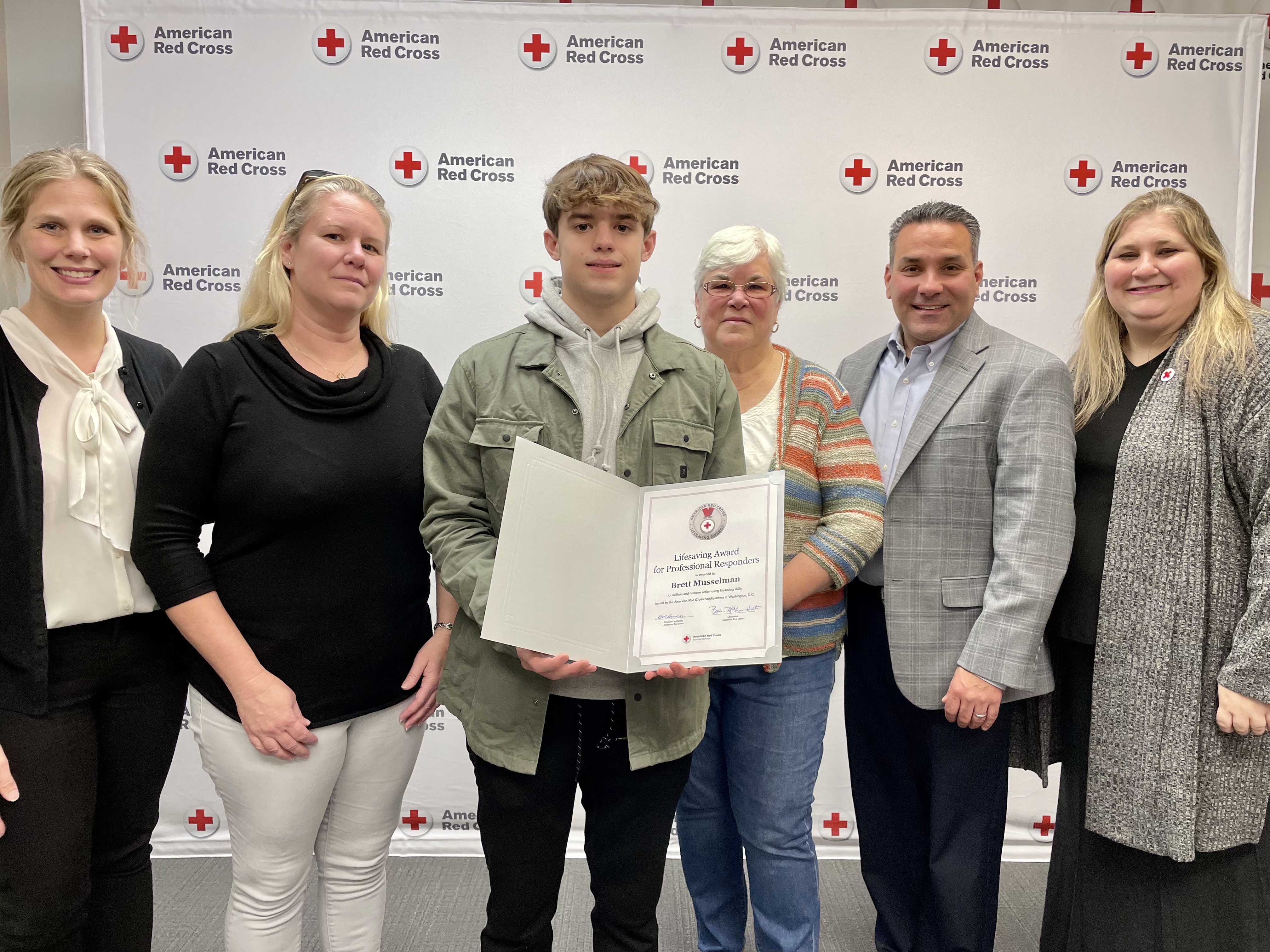
    Brett Musselman (holding certificate) received an American Red Cross Lifesaving Award for First Responders in November. Also pictured (from left) are Perkasie Borough Director of Parks and Recreation Lauren Moll; Brett’s mother Rebecca Musselman; Brett’s grandmother Margie Hartzell; Red Cross Regional CEO Guy Triano; and Red Cross Training Services Aquatic Specialist Cait Waxler. Photo by Alana Mauger/American Red Cross

    For 19-year-old Brett Musselman, of Perkasie, lifeguarding is a family affair. He was trained and certified by his mom Becky in 2018. She was trained and certified by her mom – Brett’s grandmother – Margie in 1992. Margie was certified in 1979 and taught swimming and lifeguarding skills until she retired in 2003.

    All three generations came to the American Red Cross Southeastern Pennsylvania headquarters in Philadelphia on Nov. 16 to see Brett accept a Red Cross Lifesaving Award for First Responders for his heroic actions on July 3 while working at Menlo Aquatics Center, a large, multi-pool facility in Bucks County.

    While on duty, Brett noticed a patron go unresponsive in the water from what he learned later was a medical incident. He activated the Emergency Action Plan (EAP) and entered the water. Brett kept the patron’s head above water while additional staff retrieved the backboard. In a single motion, they extracted the patron out of the water where staff and off-duty responders called 9-1-1, started CPR and retrieved the AED. After one shock of the AED, the patient showed signs of life and EMS arrived.

    “Brett was so clear in his whistle blows that he activated the EAP seamlessly, allowing other responders to carry out the following steps,” explained Lauren Moll, Brett’s supervisor who nominated him for the award. “The successful response all stemmed from the fact that he recognized it and activated it.”

    Becky, who is an active instructor at the YMCA of Bucks County, heard about the incident while at work. She certified many of the lifeguards at Menlo Aquatics Center and knew that some of her former trainees were likely involved in the incident. She was proud to learn Brett was a key player in that response.

    Brett is Red Cross-trained, having completed Lifeguarding with CPR/AED for Professional Rescuers, First Aid and Administering Emergency Oxygen courses. Thanks to his quick recognition of the patron’s medical emergency, activation of the Emergency Action Plan and extraction from the water, followed by CPR and the use of the AED, the patron’s life was saved.

    “Brett exemplifies the mission of the Red Cross to prevent and alleviate human suffering in the face of emergencies,” said Red Cross Southeastern Pennsylvania CEO Guy Triano. “We commend him for his willingness to help others in distress.”

    Lifesaving Awards program

    The Lifesaving Award for Professional Responders is awarded to Red Cross-trained first responders and healthcare professionals acting while on duty. It is one of four awards given as part of the Red Cross Lifesaving Awards program. To nominate and recognize a person or group who has taken action to save or sustain a life, visit LifesavingAwards.org.

  • Red Cross honors Pennsylvania State Police Sgt. Jeffrey Taroski for his lifesaving efforts

    By Alana Mauger

    Sgt. Jeffrey Taroski (center) with his wife Caitlin and Red Cross Southeastern PA Regional CEO Guy Triano. Photo by Dave Skutnik/American Red Cross.

    On Tuesday, the American Red Cross presented Pennsylvania State Police Sgt. Jeffrey Taroski, of Philadelphia, with a Lifesaving Award for Professional Responders to recognize his heroic actions last year.

    While on duty at a Philadelphia casino on June 8, 2021, Sgt. Taroski was alerted that an individual needed assistance after sustaining a severe arm laceration while working on a mechanical device in the wardrobe room. When he arrived, Sgt. Taroski observed the individual laying on the floor in a pool of blood, and he determined that 9-1-1 emergency services were needed.

    Based on his training, experience and quick thinking, Sgt. Taroski recognized that the bright red blood pumping from the individual’s arm was arterial blood. Observing that the pool of blood was getting larger, he acted quickly to preserve the individual’s arm and life. He used a belt as a tourniquet, tightly wrapping it above the wound until an actual tourniquet could be applied. Next, he used towels to apply pressure to the wound, preventing further blood loss. Finally, he called 9-1-1 back to upgrade the seriousness of the initial call

    In a letter of nomination, one of his colleagues writes that Sgt. Taroski “demonstrated strong leadership and remained calm throughout the stressful situation,” delegating necessary duties to other Troopers to maintain scene and crowd control, safety and effective communication with emergency services and involved personnel.

    Lifesaving Awards program

    The Lifesaving Award for Professional Responders is awarded to Red Cross-trained first responders and healthcare professionals acting while on duty. It is one of four awards given as part of the Red Cross Lifesaving Awards program. To nominate and recognize a person or group who has taken action to save or sustain a life, visit LifesavingAwards.org.

  • Take a Red Cross class this National Online Learning Day

    By Robert Ambrose

    Boasting of over 2 dozen online courses, the Red Cross is a go-to nexus to learn just about anything to help you deal with a host of emergencies and safety topics. Below are some examples. Visit redcross.org/takeaclass for a full list.

    First Aid

    So, you find yourself at the scene of an accident. You see an individual bleeding but you are not worried because you took the Red Cross First Aid for Severe Bleeding Online. In moments, you stop the bleeding (because you learned from us what to do). When paramedics arrive, they continue your work. One says without you, the patient never would have survived the accident. High-five! You saved someone’s life. 

    Water Safety

    Where would the Red Cross be without water safety? There are five online courses to learn how to prevent water problems, keep kids safe in the water, and how to save a drowning victim. Also, completing the Water Safety Ambassador training will give teachers and adult and youth leaders strategic data to warn youngsters where to avoid high-risk drowning areas. Separately, a 3.5-hour Lifeguard Management course gives scenario-activities, video lessons, a final exam and a certificate. Non-lifeguards are welcome to that course.

    Coping skills

    Got COVID stress? Coping skills are found in the course called, Psychological First Aid: Supporting Yourself and Others During COVID-19. No further explanation seems necessary, but it’s the first course listed on the Red Cross class list online if you want to check it out.

    Opioid Intervention

    As the U.S. and Philadelphia navigate the opioid epidemic, you can do more than read about it. A Red Cross online course can teach you how to save an individual on the edge of life and death. Overdose happens, but Good Samaritan tools are found at the Red Cross First Aid for Opioid Overdoses course. For example, if naloxone sounds like something to keep your potato chips fresh for six months, you will learn how to use this life-saving medication to prevent an overdosing heroin addict from racing to the great hereafter. Also, tools like the nasal atomizer, Narcan and EVZIO will be analyzed and demonstrated to help you save an overdosing opioid consumer.

    Babysitting Skills

    Baby-sitters are hard to find. But maybe you could prepare your baby-sitter with the Red Cross Babysitting Basics. Set expectations and learn together – online.

    CPR

    CPR’s life-saving methods vary depending on the patient’s heart. The Red Cross offers online courses for saving a baby, a child or an adult. Hearts are different, you know. If your job needs an OSHA certification, Red Cross has a required supplemental teacher-led course. Take the supplemental course within 3 months from the online course. CPR courses even teach how to handle the AED (i.e., automated external defibrillator). 

    Pet First Aid

    Not to leave our pets out, a Red Cross online course will teach how to give your dog or cat first aid care. How to respond to breathing and cardiac emergencies, wounds, bleeding and seizures will be taught. A pound of prevention is also discussed.

    To learn more about these online classes, or all of our Red Cross classes and programs, visit redcross.org/takeaclass.

  • National Preparedness Month: Is your first aid kit up to par?

    By Nathan Fligeman

    July 13, 2012. Be Red Cross Ready First Aid Kit open. Photo by Dan Bittinger

    A first aid kit is a very handy, and borderline necessary, item for a person to have in their possession. These kits, assuming that you pack them adequately and with proper due diligence, serve as a means of protection against a plethora of both emergency and minor, ‘just-in-case,’ scenarios. Remedies that help to treat burns, cuts, abrasions, stings, splinters, sprains, daily sicknesses, and strains are commonly included in these kits. Plenty of first aid kits are offered for commercial sale, but personalized ones can be made in order to serve specific, self-determined, purposes.

    Below is a brief guide on how to make your own first aid kit, based upon commonly included items and their functionalities.

    Aloe Gel – This is good for alleviating the pain of minor sunburn, cuts, burns, and rashes.

    Adhesive Tape – This therapeutic tape is designed to help treat strains and sprains, primarily.

    Antibiotic Ointments – These are meant to be applied to cuts and abrasions in order to prevent and/or help heal infections.

    Bandages – These are a staple of first aid kits. Bandaids are simple and can always be useful in the case of a minor cut.

    Book on First Aid – A guide to performing a plethora of medical techniques can never hurt when carrying a medical kit. You can also download the free Red Cross First Aid app to have this information at your fingertips.

    Breathing Barrier – These are considered to be a necessity for those who know how to perform CPR, especially. You never know when you may be in need of protection in order to complete the breathing portion of the CPR process.

    Emergency Blanket – Get an emergency blanket that reflects heat and can be used to signal for help.

    Gauze – This is another item which is almost always included in first aid kits. Gauze is utilized to wrap cuts which cannot be completely covered by a bandaid alone.

    Insect Repellant Bands – This item is common for people who frequently travel to wooded areas. Putting on one of these wrist bands each day keeps the bugs away!

    Instant Cold Compress – These are utilized in order to help combat heat-based illnesses and/or fevers.

    Latex-free Gloves – These are important for protecting yourself and keeping cuts and scraps you may be treating clean.

    Medication(s) – It is important to pack other-the-counter medications, such as Advil, Tylenol, and/or Aspirin. These items help to combat the symptoms of illness and general pain. Antidiarrheal medications, such as Pepto-Bismol, are also recommended as an addition to the kit.

    Oral Thermometer – These are important to include as a testing method for illnesses.

    Petroleum Jelly – Similar to aloe gel, petroleum jelly can be utilized to help treat minor sunburn, cuts, burns, and rashes.

    Swiss Army Knife – These versatile tools can come in handy in almost every scenario which requires any sort of physical effort. Swiss army knives often come equipped with at least a flashlight, knife, scissors, and tweezers.

    More items can certainly be added to a first aid kit, based upon personal preference and necessity. However, the listed items, along with a portable storage unit to encapsulate them, are the basis for a useful and properly-equipped first aid kit. Make sure to keep this kit within a near vicinity at all times; it is always better to be safe than sorry!

  • Local healthcare workers honored with Red Cross Lifesaving Awards

    By Alana Mauger

    Pictured at Gloria Dei Memory Care at the Park in Hatboro are (front row, from left) Rochelle Sajda, administrator; Justyna Witesk, charge nurse; (back row, from left) Dave Hoffer, dietary director; Christina Morasco, activities director; Jennifer Graham, executive director, Red Cross Delaware Valley Chapter; and Tina Toliver, med tech/CNA. Photo by Elisabeth von Baldas/American Red Cross

    On Thursday, three employees at Gloria Dei Memory Care at the Park in Hatboro, Montgomery County, received American Red Cross Certificates of Extraordinary Personal Action for stepping up to help save a resident in an emergency situation.

    In May, Charge Nurse Justyna Witesk, Dietary Director Dave Hoffer and Med Tech/CNA Tina Toliver took lifesaving action when a resident began choking during lunch. According to Activities Director Christina Morasco, who submitted the award nomination, the resident was in obvious distress, was turning blue and eventually lost consciousness.

    In response, Toliver called 9-1-1 immediately, then secured the area and kept residents safe and calm while Witesk and Hoffer administered abdominal thrusts. Their actions helped clear the resident’s airway, and she was able to breathe and begin speaking softly.

    On Sept. 8, Morasco and Administrator Rochelle Sajda staged a surprise lunchtime celebration for the recipients, during which Jennifer Graham, executive director, Red Cross Delaware Valley Chapter, presented the awards.

    “These individuals exemplify the mission of the Red Cross to prevent and alleviate human suffering in the face of emergencies,” said “We commend them for their willingness to help others in distress.”

    The awardees received a certificate and pin from the Red Cross, and flowers, lunch and lifesaver-theme cakes from the facility.

    Lifesaving Awards program

    The Certificate of Extraordinary Personal Action is awarded to people who step forward in an emergency situation to help save or sustain a human life. It is one of four awards given as part of the Red Cross Lifesaving Awards program. To nominate and recognize a person or group who has taken action to save or sustain a life, visit LifesavingAwards.org.

  • You can help save lives with Red Cross CPR/AED training

    By Sam Antenucci

    June 22, 2018. Washington, DC. CPR stock photos by Roy Cox for the American Red Cross.

    I remember the first time I received CPR training as an undergraduate student. I did not quite know what CPR entailed, but I knew it was an important skill to learn in an emergency. In the American Red Cross CPR course, I first learned what a cardiac arrest is. Cardiac arrest is more than just chest pain; the heart ceases to beat.

    After we learned more about the anatomy and physiology of the heart, we got to practice. We broke out the CPR manikins and learned the proper placement for hands and how to deliver effective breaths when delivering compressions. The golden rule was to push fast and hard on the chest for 30 sets of compressions with two breaths in between each set.

    After mastering adult CPR, we moved on to child CPR, talked about critical differences between adults and children, and focused on how to apply an automated external defibrillator (AED) for both age groups. It was an invigorating 4 hours with plenty of individualized practice. We left feeling capable of handling a cardiac emergency from thereon.

    It has been many years since my first CPR course, and in that time, I have become an EMT and taught CPR to new EMT students. Though it is one of the first skills we learn as EMTs, it is one of the most important because it can be the difference between life or death for a person in cardiac arrest. My students bring me stories of successful CPR attempts and instances where they had to perform CPR outside of a hospital. The techniques they have learned and refined have helped save someone’s life outside of our classroom. Thanks to the rigorous training a CPR class provides, they feel more capable of handling a cardiac emergency.

    In support of the National CPR and AED Awareness Week, the Red Cross urges everyone to become CPR certified. According to the American Heart Association, more than 475,000 Americans die from cardiac arrest each year. A more frightening statistic is that 90% of those who have an out-of-hospital cardiac arrest will die. However, bystander CPR can double the odds of survival if performed immediately!

    Within one course, you could be the difference in saving someone’s life. If you are interested in bringing down the above statistic, the American Red Cross CPR classes are designed with a busy schedule in mind! Courses are offered on weekdays and weekends with many different modalities that best suit your learning styles. These include instruction in-person, online or hybrid. You can get the skills and confidence needed to perform this lifesaving intervention when needed the most, regardless of which type of course you take.

    For more information on the courses offered in your area, you can search for classes through the American Red Cross’s CPR training website.