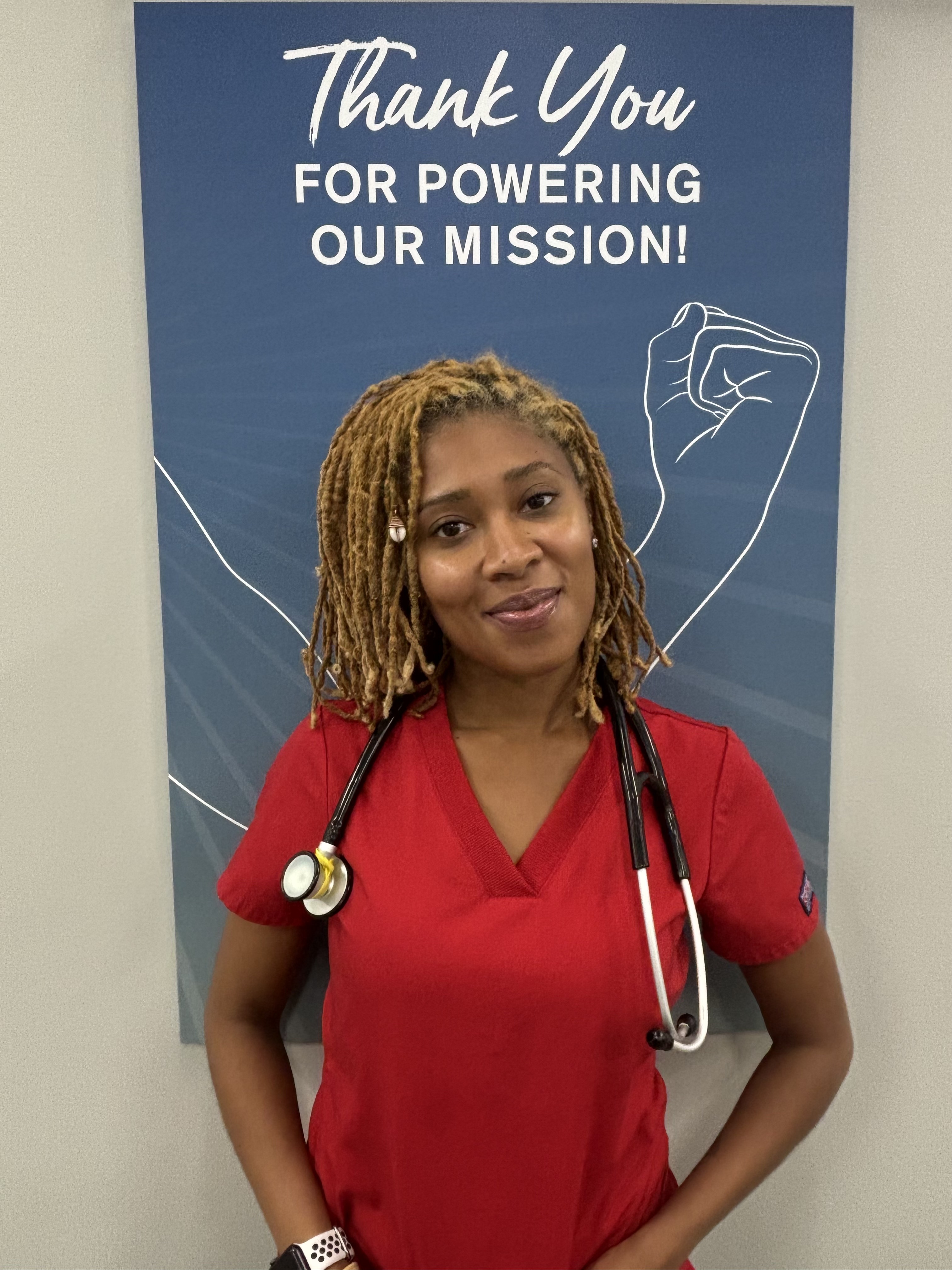
Doreen Lettman. Photo by Jenny Farley / American Red Cross
When the new Wawa Foundation American Red Cross bloodmobile debuted on July 24th in Wawa, Pennsylvania, one of the people most excited to check it out was blood collector Doreen Lettman.
After she finished her shift as a phlebotomist at the blood drive that day, she headed straight to the new bloodmobile for a self-guided tour.
Doreen spent several minutes examining how the equipment was set up and where donors would be located while giving blood.
“It’s nice! It’s spacious,” she said. “It’s well equipped.”
Is taking blood from someone in a bloodmobile more challenging than inside a building? “Not really. It all depends on how many are on the schedule,” she said.
Doreen has been a blood collector for 22 years. She has taken blood from donors in many different locations, including buses. “I have been doing buses for many years,” she said.
As a blood collector, Doreen knows how to help calm any fears donors may have and help them stay focused on giving. Do blood donors get nervous? “Some people are. We do a lot of high schools so kids are typically nervous.”
For Doreen, phlebotomy has been a fulfilling career.
“Get to meet new people. Go to different places every day, so that’s one of the most fascinating things,” she said. “I get to help people. That’s the whole goal is to help people. So that really sits well with me, to know that you’re helping people every day.”
Editor’s Note: National #BloodCollectorsWeek is Sept. 1-7, 2024. Celebrate those who ensure donors have great experiences and patients get the blood they need. Schedule an appointment to donate blood!
Tiffany Wright-Jackson may have only joined the American Red Cross Collections team this past spring, but she is certain she’s in the right place. While new to phlebotomy, she has worked in a variety of healthcare roles, and she enjoys helping others.
Now a Red Cross phlebotomist, her favorite thing about working at the Philadelphia Blood Donation Center is being part of a community – “being able to help others who help others.”
“I tell the donors we’re a team. If they’re nervous, they can trust me to get them through,” she said. Tiffany also enjoys meeting new people every day and hearing donors’ stories about why they give blood.
Just like phlebotomists support donors through the blood donation process on the Biomedical side of the house, Red Cross disaster workers support those who are impacted by natural disasters and home fires on the Humanitarian side.
A few months into her Red Cross employment, the unthinkable happened; in the middle of moving into a new apartment, the building caught fire. Tiffany lost almost everything and had nowhere to go. Her co-workers encouraged her to reach out to the Red Cross for help.
“The Red Cross made me feel like family,” she shared. “I don’t know how I would have gotten through it without them.”
Tiffany was grateful for the blanket and snacks Red Cross disaster volunteers provided immediately after the fire. “Everyone was so helpful, so nice,” she said. They also connected her with Christine, a Red Cross caseworker who helped with documentation that allowed her to extend the lease at her old apartment. Christine also provided resources that helped Tiffany jumpstart her search for a new apartment.
Tiffany says the support enabled her to focus on work and get back to her life. And now when swapping stories with donors, she has her own Red Cross mission moment to share.
Editor’s Note: National #BloodCollectorsWeek is Sept. 1-7, 2024. Celebrate those who ensure donors have great experiences and patients get the blood they need. Schedule an appointment to donate blood!
Governor Josh Shapiro signed a proclamation designating Sept. 4, 2024 as Blood Donation Day in Pennsylvania – part of a National Blood Donation Week effort to encourage eligible donors to give blood around Labor Day. The American Red Cross invites the Greater Philadelphia community to help save lives at blood drives scheduled this week and beyond.
Image of the proclamation signed by PA Governor Josh Shapiro designating Sept. 4th as Blood Donation Day
For the ninth consecutive year, media personality Dr. Daliah Wachs has worked to enlist all 50 states in promoting blood donation. Dr. Daliah, who hosts a syndicated radio program on Talk Media Network and is heard on iHeart Radio, speaks to her listeners weekly about various medical topics and understands why it’s important to have a robust blood supply. After hearing about an emergency need for more donors, she decided to establish a National Blood Donation Day, strategically timed right around the Labor Day holiday, when blood donations often decline due to busy holiday schedules. Dr. Daliah has asked each state governor to join her by proclaiming the service day in their home state.
“Every two seconds, someone in the United States needs blood, from medical emergencies to critical treatments for conditions such as cancer or sickle cell disease,” said Jennifer Graham, Regional CEO, Red Cross Southeastern PA. “Giving blood is a meaningful way to help your community, and now is the perfect time to roll up a sleeve to make a potentially lifesaving difference.”
The Red Cross is experiencing an emergency blood shortage as summer winds down. Since July 1, the Red Cross national blood supply has fallen by more than 25%, and blood donors of all types, especially those with type O blood, are urged to give as soon as possible to help patients receive lifesaving medical care.
To find a donation opportunity and learn more about blood donation, including eligibility information, download the Red Cross Blood Donor App, visit RedCrossBlood.org or call 1-800-RED CROSS (1-800-733-2767). If you were deferred from donating in the past, you may be able to donate again.
Red Cross Collections Supervisor Tamirra Ranton. Submitted photo.
When Tamirra Ranton was in the 8th grade, her teacher awarded her a certificate and told her, “You’re going to do something great in science!” At age 22, Tamirra remembered that teacher’s prediction and said, “It was like I had a revelation.”
She decided to pursue a career in healthcare and began working at Mercy Hospital as a phlebotomist. She went back to school to become a Medical Lab Technician (MLT). Among her other areas of expertise, including training in pediatrics and geriatrics, she helped train nursing students in venipunctures before they could receive their degrees.
“In order to get your RN, you have to get a certain amount of sticks, so they would have me train them.”
Tamirra has worked in clinical lab services for more than 15 years. In May of 2023, the American Red Cross hired her to be a phlebotomy Team Supervisor, which required months of specialized training.
“The favorite part about my job is the science. I love science.” Tamirra said she loves learning about the human body, how cells and veins operate, how arteries carry oxygen through the blood to the organs, and how the chambers of the heart function. She said, “It’s amazing how the body works.”
She’s also excited about what’s ahead for her as a Red Cross supervisor – coaching, teaching and team building.
“We’ll be working on projects and different things just to make the experience better for the employees as well as the donors and the recipients.”
As a supervisor, Tamirra always wants her team to remember how important the job of a phlebotomist really is, even if they never need a blood transfusion or end up in the hospital. “We have to take pride in what we do. We’re actually affecting life, and life is so valuable,” she said.
“We have people depending on us to do our jobs.”
Tamirra has a unique perspective because after years of working in a hospital, including during the pandemic, she witnessed what happens when there isn’t enough blood on the shelves to meet the critical needs of patients.
“I used to be the person sitting in the blood bank at the hospital when the orders would come down.” Sometimes those orders couldn’t be met because of a shortage of blood. That meant she had to scramble by calling other hospitals to try and locate the requested blood.
“We would have people on the operating table. We would have people waiting for transplants. We would have people waiting for an array of services that required a transfusion or possible transfusion.”
Every 2 seconds in the United States, someone needs blood and/or platelets. Tamirra said working for the Red Cross and supervising a team of blood collectors means her life has come full circle.
“When the heart stops pumping the blood, it’s over. So, if I have a job where I can continue to make sure that the heart has something to pump, that’s amazing.”
Editor’s Note: National #BloodCollectorsWeek is Sept. 1-7, 2024. Celebrate those who ensure donors have great experiences and patients get the blood they need. Schedule an appointment to donate blood!
Red Cross volunteer Ava Arteaga will travel to the UK to pursue a master’s degree as a Fulbright Scholar. Photo by Bryant Montoya
Our own American Red Cross volunteer Ava Arteaga has a lot to celebrate. A recent graduate of Temple University, she now has become a Fulbright Scholar, the recipient of one of the most prestigious fellowships in the world.
“The application was a year-long process and took hundreds of hours, and I didn’t know if it would amount to the result I wanted. To accomplish something of this magnitude is surreal,” she said.
Ava started volunteering for the Red Cross two years ago at a Sound the Alarm event and found her perfect fit when she became a communications volunteer.
“I enjoy writing blogs because I’m able to write about all kinds of topics. It’s a mixture of education, reporting and sometimes stories about my first-hand experience,” she said.
During her time at Temple, she volunteered as a Blood Program Leader who organized blood drives and fostered a relationship between the Red Cross and Temple’s UNICEF chapter, “establishing a tradition of holding a blood drive each semester.” She said, “This is something I’m very proud of because its impact will persist long after my graduation.”
Although she was nervous at first to donate blood herself, she now is a regular donor, helped by the skilled Red Cross phlebotomists who eased her fears.
“I became a blood donor because I became aware of the blood shortage across the nation and learned how critical blood donations are for helping people with health conditions.”
Red Cross volunteer Ava Arteaga is a regular blood donor and was the Blood Program Leader at Temple University.Photo by Bryant Montoya
Ava’s favorite part about volunteering for the Red Cross is “being able to contribute to the health and safety of our communities. It’s a privilege to play even a small role for a major impact,” she said.
As a Fulbright Scholar, Ava will be moving to the United Kingdom where she will pursue her master’s degree, studying the stigma that people with addiction face in the way they are portrayed by digital news media.
For now, she’s making each day count with her family until the big move. “We have been celebrating by spending as much time together as possible, soaking up our time together before I leave.”
Congratulations Ava! The Red Cross is proud of you!
The American Red Cross continues to experience a national blood emergency as remnants of Hurricane Debby and other severe weather events across the country have further complicated efforts to rebuild the nation’s blood supply. Those in unaffected areas are urged to make an appointment to give now.
Weather in recent weeks has added to the summer shortfall in donations by forcing the cancellation of nearly 60 blood drives throughout the country, many of which were caused by Debby, causing approximately 1,500 lifesaving blood products to go uncollected. Annually, severe weather − such as blizzards, tornadoes, floods and hurricanes − impacts about 90,000 blood donations made to the Red Cross.
In Pennsylvania, nearly 700 blood drives have been canceled due to weather over the last 10 years, including 35 so far this year. Because blood has a short shelf life and can only come from volunteer blood donors, any disruptions in the ability to collect lifesaving blood can have serious consequences for hospitals and patients.
First-time donors and those who give regularly are critical to blood supply recovery. To make an appointment, download the Red Cross Blood Donor App, visit RedCrossBlood.org or call 1-800-RED CROSS (1-800-733-2767). In thanks, all who come to give through Aug. 31 will get a $20 Amazon.com Gift Card by email. See RedCrossBlood.org/Help for details.
Those who come to give Sept. 1-15 will receive an exclusive Red Cross raglan T-shirt, while supplies last.
Be ready for emergencies
September is National Preparedness Month, and a strong blood supply is key to preparedness for disasters and medical emergencies. As disasters occur more often and become more powerful due to the climate crisis, the Red Cross also encourages people to get their households ready for emergencies. This year the country has already seen the earliest Category 5 storm ever recorded with Hurricane Beryl,and wildfires have burned 2.7 million more acres compared to all of 2023.
Disasters can happen anywhere, at any time, often without warning. Get ready by making a plan to stay safe, gathering important supplies and knowing how you’ll stay connected. To learn what disasters may affect your community, visit redcross.org/hazardmap and then download the free Red Cross Emergency App for step-by-step guidance, real-time weather alerts and expert preparedness and safety advice in both English and Spanish.
Pictured at the West Chester Blood Donation Center ribbon cutting are (from left) Ashley Gagné, West Goshen Board of Supervisors Chair; Helen Munizza, Red Cross Regional Donor Services Executive; Katrell Patterson, Red Cross Fixed Site Collections Manager; Lynn Cohen, Red Cross Delaware Valley Chapter Executive Director; Emily Gindele, West Whiteland Volunteer Fire Fighter; Jennifer Graham, Red Cross Southeastern PA CEO; and Carly Spross, Red Cross Delaware Valley Chapter Board Chair. Photo by Donn Greenberg / American Red Cross
Located at 1065 Andrew Drive in West Chester, the new donor center replaces the location previously open on Gay Street.
West Whiteland volunteer firefighter Emily Gindele helped cut the ceremonial ribbon after sharing her story during the short program. Multiple blood transfusions helped save Emily’s life after she sustained catastrophic injuries in a car accident that killed her boyfriend Colin. She credits the generosity of blood donors for making her recovery possible.
“The trauma doctors raced against the clock, performing emergency surgery, giving me a blood transfusion, removing my spleen, and stitching me up. I was on a ventilator for over a week. Without the blood transfusion, I would have died. That blood gave me another chance at life,” she shared during her remarks.
Every two seconds, someone in the U.S. needs lifesaving blood. As new cancer cases rise — by an estimated 36% by 2040 — so will the demand for blood products. Remarkably, 25% of the U.S. blood supply goes to patients undergoing cancer treatment. Unfortunately, work and other factors have impacted when and where people give blood, creating new challenges we must overcome.
To meet the growing and changing needs for blood products, the West Chester site is one of four blood donation centers the Red Cross is building and/or renovating in Southeastern Pennsylvania. These strategically located facilities will provide more consistent and convenient locations for blood and platelet donors to give.
Patients – and their families rallying behind them – are counting on the generosity of volunteer blood donors to share their health. If you’re eligible and feeling well, please make an appointment by visiting RedCrossBlood.org, using the Red Cross Blood Donor App or calling 1-800-RED CROSS.
During Beckett Campbell’s treatment for Leukemia he received around 30 blood transfusions. He rang the bell for finishing chemo in November 2023. Photo by Jenny Farley / American Red Cross
The Haverford Community Recreation and Environmental Center, known as the CREC, is a place where health and fitness take center stage. The site features a walking track, a downstairs gym, a fitness center and large classroom spaces, all nestled in a wooded area with nature trails.
On August 1st, walking through the big glass doors of the CREC, signs pointed you to an American Red Cross blood drive on the ground floor. Before stepping inside, you heard the sound of two little boys, Beckett and Grady Campbell, wrestling and giggling as only siblings can, right inside the entrance, just feet away from an elaborate tri-fold poster that said it all, “Beckett Brigade.”
The poster, which featured pictures of Beckett during treatment, explained what brought friends, family and others out to the CREC to donate blood with a special thank you message: “Beckett is able to go to school, play sports and enjoy life thanks to the kindness of blood donors like you!”
Beckett Campbell and his little brother Grady played games together at the blood drive honoring him in Haverford, Pennsylvania. Photo by Jenny Farley / American Red Cross
Beckett, who is just ten years old, is recovering from leukemia. Blood transfusions helped him survive.
“A lot of people don’t understand that kids with cancer or adults with cancer – they can’t get chemotherapy unless their blood counts are at a certain number,” explained Beckett’s mom Amy.
Amy described how Beckett and other patients like him have to have high enough red blood cell and hemoglobin counts. If they don’t they can’t get the “chemo they need to save their lives.” Blood transfusions help get the numbers up where they need to be to get treatment.
Beckett had 9 different types of chemo over 2 ½ years and around 30 blood transfusions. Now, Amy is paying it forward. She worked with the Red Cross to organize the blood drive in honor of her son and to help people who may need blood.
“Beckett only had to wait one time – there wasn’t any blood available, but our goal is that no one ever has to wait if they need a transfusion,” she said.
When patients like Beckett need a transfusion, it’s the blood already on the shelves that helps save lives, which underscores the importance of giving blood regularly.
Allison Camara donates blood with the help of Collections supervisor Tamirra Ranton. Photo by Jenny Farley / American Red Cross
Having donated blood in the past, Allison Camara had been wanting to donate again when she saw a post in a mom’s group on Facebook.
“I read about Beckett and I know kids going through treatment need a lot of blood transfusions sometimes, so it’s just really important that people get out and do that if they are healthy and able to,” she said.
Allison’s own young daughter had to have a blood transfusion after doctors found her to be anemic and she may need more in the future.
Teresa Caponiti is another mom who saw the Facebook post and came to donate blood on her lunch break from work. She used to donate in college and her dad was a frequent blood donor.
“I’ve known a lot of people that have needed to get blood while they were in the hospital.”
Reading about Beckett touched her heart and made her think of her own kids.
“I’m feeling a lot of empathy for his family and what they went through,” she said.
Teresa Caponiti prepares to donate blood in honor of Beckett Campbell. She said, “It’s something you can easily do to help someone else in need.” Photo by Jenny Farley/ American Red Cross
When Beckett was asked what made getting a blood transfusion easier, you might think he said a bribe like a toy or a treat. When he answered he said something unexpected.
“Count. 1,2,3 and then they stick it in.”
Beckett’s mom explained he liked to stare at the needle and look directly at it. “He’s just not afraid. He’s had so many IVs and needles – he’s just a warrior with that,” she said.
Beckett finished chemo last November and said it made him feel “good” to be done. He will still go to oncology clinic for the next few years while his friends and family wait for a special calendar milestone. In November 2028, Beckett will enter “survivorship” and cancer will officially be behind him. For now, he’s looking forward to fifth grade. He has a big group of supporters in his “Beckett Brigade.”
Amy Campbell and her son Beckett stand outside the CREC where a blood drive was held in honor of her son. Photo by Jenny Farley / American Red Cross
Amy said, “We’ve always felt supported throughout Beckett’s whole journey by lots of people. People we know. People we don’t know. And it’s just been really special to have a relationship with the Red Cross and to help support other kids who are in need of blood donations and other adults who are sick and in need of blood transfusions.”
If you would like to make sure critical supplies of blood are available, learn how to donate blood at RedCrossBlood.org, by calling 1-800-REDCROSS, or by using the Red Cross Blood Donor App.
Red Cross graphic – Emergency Shortage: The Red Cross had a shortfall of 19K+ blood donations in July.
The American Red Cross is experiencing an emergency blood shortage as the nation faces dangerous levels of heat and people head out for final summer travel plans. Since July 1, the Red Cross national blood supply has fallen by more than 25%, and blood donors of all types, especially those with type O blood, are urged to give as soon as possible to help patients receive lifesaving medical care.
Heat impacted more than 100 blood drives in July in nearly every state where the Red Cross collects blood – compounding other seasonal obstacles to blood donation, such as travel and summer activities. Together these factors contributed to a shortfall of more than 19,000 blood donations in July. At the same time, hospital demand for blood products remains strong. Blood products are being sent to hospitals faster than donations are coming in. Right now, type O inventory is so low, distributions of this vital blood type are reduced below what hospitals count on.
“It’s critical hospitals have both type O positive and O negative blood ready to go for patients in the most life-threatening situations,” said Dr. Eric Gehrie, executive physician director for the Red Cross. “Type O is especially important for victims of accidents and other trauma who are receiving emergency treatment. Now is the time for donors of all blood types to give and ensure hospital shelves can be restocked before any impact to patient care.”
The Red Cross is working with hospitals around-the-clock to meet the blood needs of patients – but can’t do it alone. To make an appointment, download the Red Cross Blood Donor App, visit RedCrossBlood.org or call 1-800-RED CROSS (1-800-733-2767).
As a thank-you, those who come give blood, platelets or plasma Aug. 1-31, 2024, will get a $20 Amazon.com Gift Card by email. For details, visit RedCrossBlood.org/Help.
Even as we work to overcome this blood shortage, the Red Cross is providing food, shelter and comfort to communities affected by the hurricane in the Southeast and wildfires in the West. To help people affected by these disasters and other crises, we ask that you please visit redcross.org or call 1-800-RED CROSS to support Red Cross Disaster Relief.
A tattoo is one of the most personal choices you can make. Using your body as a human canvas is the ultimate form of artistic expression, and the reasons why people decide to get inked vary widely.
July 17th is National Tattoo Day, and despite what you may have heard, in most cases getting a tattoo does not prevent you from donating blood.
Most states regulate tattoo facilities. In those states there is no delay required before donating blood, as long as the establishment uses sterile needles and fresh ink that has not been reused.
Pennsylvania is one of nine states and the District of Columbia that don’t regulate tattoo businesses, which means potential blood donors are required to wait three months after getting a tattoo before giving blood.
We met several blood donors at the recent “I Bleed for Preston and Steve” American Red Cross blood drive that showcased tattoos as unique as their reasons for getting them.
Katy Raiser gives blood at the “I Bleed For Preston & Steve” blood drive on June 14, 2024. Photos by Jenny Farley / American Red Cross
Katy Raiser started donating blood in 2009 at a blood drive at her high school. Her dad is a liver transplant survivor who endured a 10-hour surgery and needed blood transfusions during the operation.
“Blood donations on surgeries like that are super important so I try to do my part to help out other people who need it,” she said.
Katy got her first tattoo on her back and now has at least 17, though she said she has lost track and it’s likely more.
“It was kind of a dedication to my mom who passed away when I was young. After that I just got hooked and clearly haven’t stopped ever since.”
On Katie’s left arm, she has an intricate array of tattoos that illustrate art and science. “I’ve kind of been patchworking this one,” she explained.
Pointing to her right arm, she said “I’m doing a Star Wars theme sleeve so I just got Darth Vader recently.” That took nearly 9 hours to complete.
Melvin Williams and Mary Mahoney show off their tattoos after they donated blood at the “I Bleed For Preston & Steve” blood drive. Photo by Elisabeth von Baldas / American Red Cross
Mary Mahoney and her husband Melvin Williams are blood donors who also love tattoos. Showing off a tattoo of skulls on her arm, Mary said, “This one was a gift a friend of mine bought me for Christmas 10, 12 years ago.” She then pointed to her left wrist. “This is a flower my husband got for me for Mother’s Day.”
Melvin has his own reasons for getting tattoos. He said, “I always thought they looked cool. Like bikers – they just look cool. And then it just became a thing. You get a tattoo and it’s like, I want more!”
Blood donor Mitch Powers said he has a “bunch of tattoos,” and they all illustrate sports or family. He pointed out his dinosaur tattoo which represents his three kids. He also has a tattoo that shows he’s a Phillies fan.
Mitch said getting tattoos doesn’t really hurt that much but something that hurts even less is donating blood.
“This is definitely ten thousand times less painful than the tattoos,” he said, gesturing to the blood drive behind him.
Mitch Powers gives blood at the “I Bleed for Preston & Steve” blood drive on June 14, 2024. Photo by Jenny Farley / American Red Cross
If you are interested in getting a tattoo, Katy Raiser offered this advice. “It’s really not as scary as people think. If it’s something you’ve always wanted to do, there’s plenty of amazing artists” who are out there and ready to create.
Now, you may be wondering why you have to wait three months in unregulated states to donate blood after getting a tattoo. It’s because of concerns over transmitting Hepatitis. All blood donations are screened for Hepatitis B and C through several tests, but it takes time to properly detect the viruses. People with Hepatitis should not donate blood.
The three-month delay also applies to people who apply their own tattoos, get tattoos in prison or who get tattoos in states with regulations but from unregulated artists or facilities.
Whether you have tattoos or not, the American Red Cross needs your blood and platelet donations this summer. All blood types are needed, especially type O.
You can sign up to give blood or platelets at RedCrossBlood.org, by calling 1-800-Red Cross, or by using the Red Cross Blood Donor App.