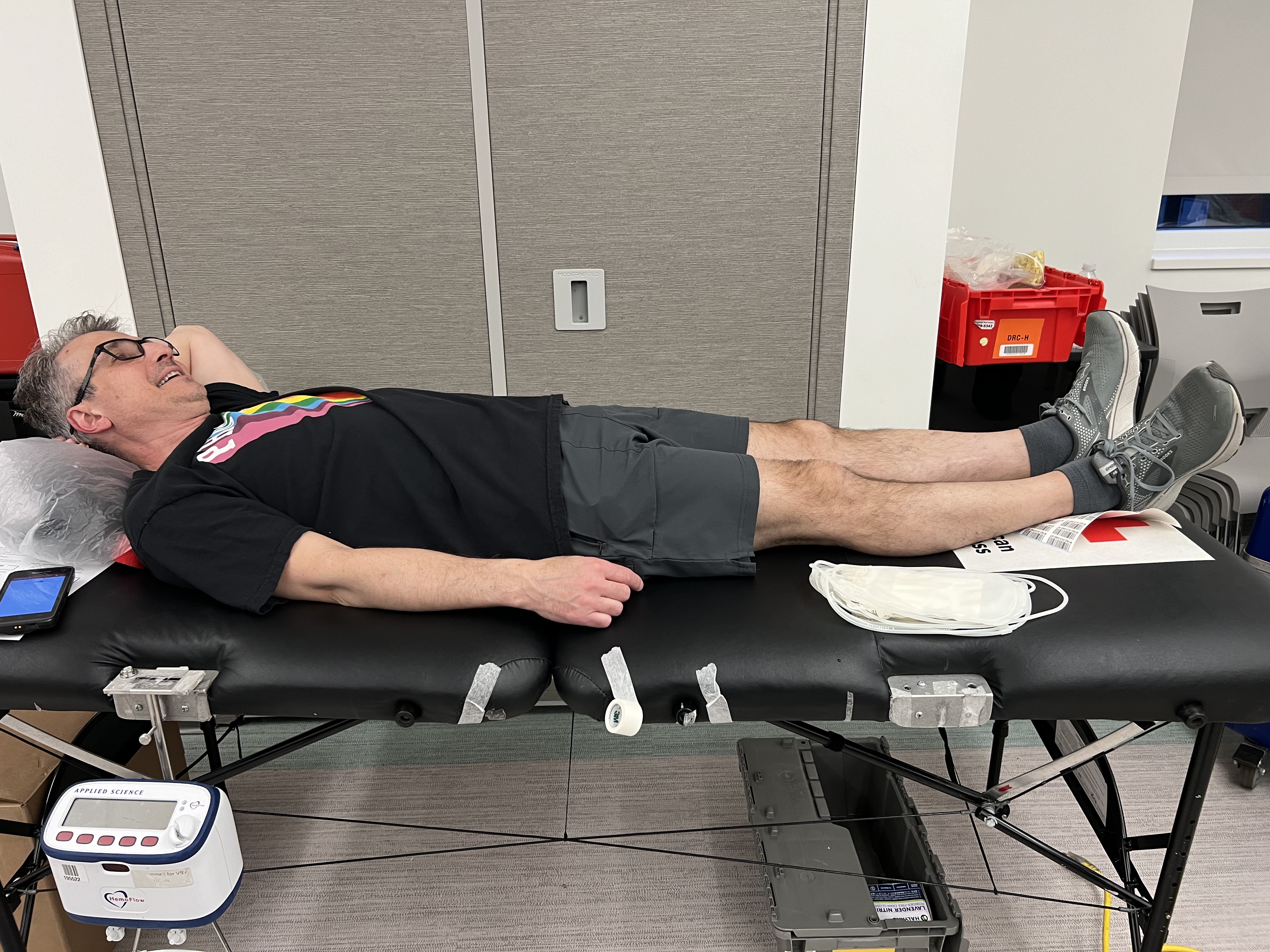
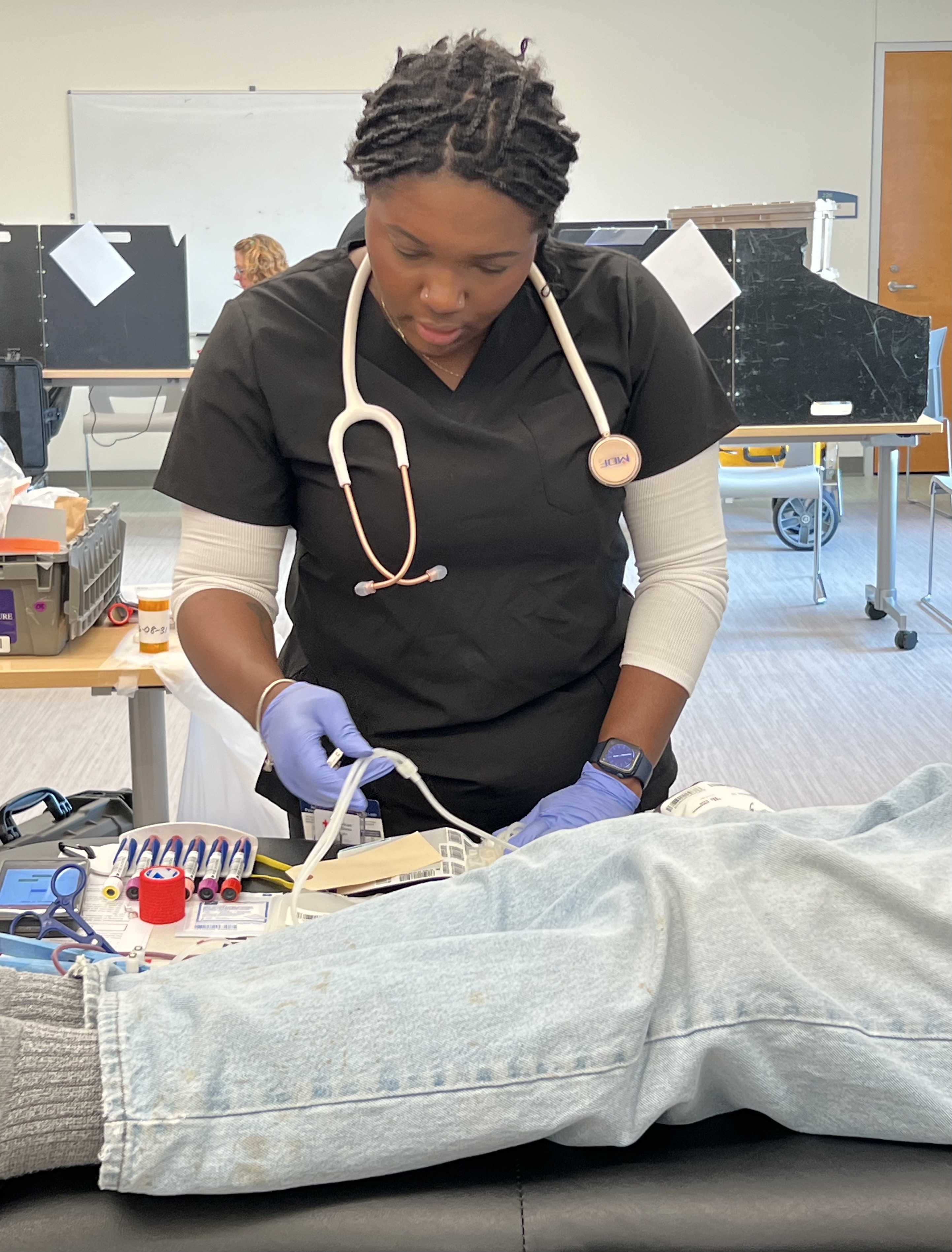
A record number of donors came out to give blood at the fourth annual 6abc Red Cross Month blood drive in Philadelphia and South Jersey. Photo by Konrad Jones/American Red Cross
The American Red Cross and 6abc held their fourth annual Red Cross Month blood drive on March 27 in Philadelphia and South Jersey, collecting 238 units of blood to help patients in the Delaware Valley and beyond.
A steady stream of people – including 67 first-time donors – came out to give blood throughout the day at Courtyard by Marriott in the Wynnefield section of Philadelphia and at the Collingswood Grant Ballroom and Scottish Rite Auditorium in New Jersey.
“To make sure we have a safe and stable blood supply is really critical,” said Red Cross Southeastern Pennsylvania CEO Jennifer Graham, who was on hand to thank donors in Philadelphia throughout the day. “The blood on the shelves today helps those who need it tomorrow.”
Watch reporter Caroline Goggin’s live afternoon coverage from the 6abc blood drive on March 27.
President and General Manager Bernie Prezenika was among the many 6abc employees who made time to donate.
“It’s a privilege to be able to donate and maybe help someone else who is in need,” said Prazenica. “We have a big metropolitan area with a lot of folks who have health issues. And I just think it’s important that we all do our part to try to help our neighbor.”
Since 2021, the annual drive has collected 734 units of blood.
“Donors look forward to this drive every year,” said Graham regarding the drive’s popularity. “They mark it on the calendars and come back year after year specifically for this event.”
6abc covered several stories leading up March 27 to help promote blood drive appointments.
One of those followed meteorologist Adam Joseph as he donated blood at Villanova University on March 12. It was the second time Joseph donated since the FDA updated its blood donor eligibility guidelines in 2023. 6abc covered Joseph’s first donation back on Aug. 7, 2023.
Watch 6abc meteorologist Adam Joseph’s blood donation at Villanova University.
For another story, Bucks County couple Sue Lowenstein and John “Fish” Fisher shared how blood donations saved Fish’s life after he suffered a medical emergency while on vacation in Colorado in 2016.
Watch as Sue Lowenstein and John “Fish” Fisher share their story with 6abc.
Every two seconds someone in the U.S. needs blood. It is essential for surgeries, cancer treatment, chronic illnesses, and traumatic injuries. Whether a patient receives whole blood, red cells, platelets or plasma, this lifesaving care starts with one person making a generous donation. Schedule a blood donation appointment at RedCrossBlood.org.
As spring approaches, the American Red Cross urges donors to give blood or platelets now to continue to strengthen the national blood supply. People of all blood types – especially those with type O blood – are critical to ensuring hospitals can meet the daily demand for lifesaving transfusions.
During Red Cross Month in March, the Red Cross celebrates the volunteers and blood and platelet donors who are critical to ensuring those in need receive relief and care. Help can’t wait – to book a time to give,visit RedCrossBlood.org, download the Red Cross Blood Donor App, or call 1-800-RED CROSS. As a thank-you, all who come to give by March 24 will get a $10 e-gift card to a pet supply merchant of choice, plus a chance to win one of five $3,000 gift cards. Visit RedCrossBlood.org/Pets for details.
Red Cross graphic – Give Blood. You deserve a round of a-paws!
Kennet Library and Red Cross partnered for a blood drive and day of preparedness presentations on March 4, 2024. Photo by Konrad Jones/American Red Cross
For the first time, the American Red Cross has teamed up with the Kennett Library in Kennett Square to host a blood drive and day of free classes on how to prepare for a disaster.
Rana Sakr, the Director of Health Literacy at Kennett Library, described it as a safe, social and comfortable place where the Library’s health literacy initiative “Live Better” inspired the decision to help the Red Cross save lives.
“We wanted to bring attention to the need to volunteer, and all the help – through crisis management and preparedness – that the Red Cross provides to our community.”
Before coming to work at Kennett Library, Rana worked as a medical doctor in France and Lebanon. She also volunteered for the Red Cross.
“I come from a medical background so I know where that blood goes and how needed it is,” she said.
Rana Sakr, Director of Health Literacy for Kennett Library. Photo by Jenny Farley/American Red Cross
Donors who arrived for their appointments at Kennett Library went to a large room on the second floor, past rows and rows of books.
Akin Davulcu waited patiently for his turn to donate. He’s a scientist who works in pharmaceutical research and development and has donated blood since college. He has been married for 32 years.
“A few years back, my wife got sick and required some blood transfusions, so it solidified in my mind the need to have blood available for patients that need it,” he said.
Akin Davulcu gives blood at Kennett Library. He encourages others donate as well. He said, “It’s the right thing to do. Help your fellow person.” Photo by Jenny Farley/American Red Cross
Red Cross phlebotomists, like Krysten Brown, collected 33 units of blood during the drive. Krysten is completing several weeks of training to be a Red Cross blood collector. She described what she does to put donors, who might be nervous about giving, at ease.
“Just kind of talk to them. Tell them about the whole entire process. You just want to make sure that they are comfortable, that they are ready, that they know what’s happening.”
Krysten Brown, Phlebotomist in Training. Photo by Jenny Farley/American Red Cross
While the blood drive was going on upstairs, a team of volunteers and Red Cross instructors worked downstairs to help recruit new volunteers to the Red Cross and teach disaster preparedness.
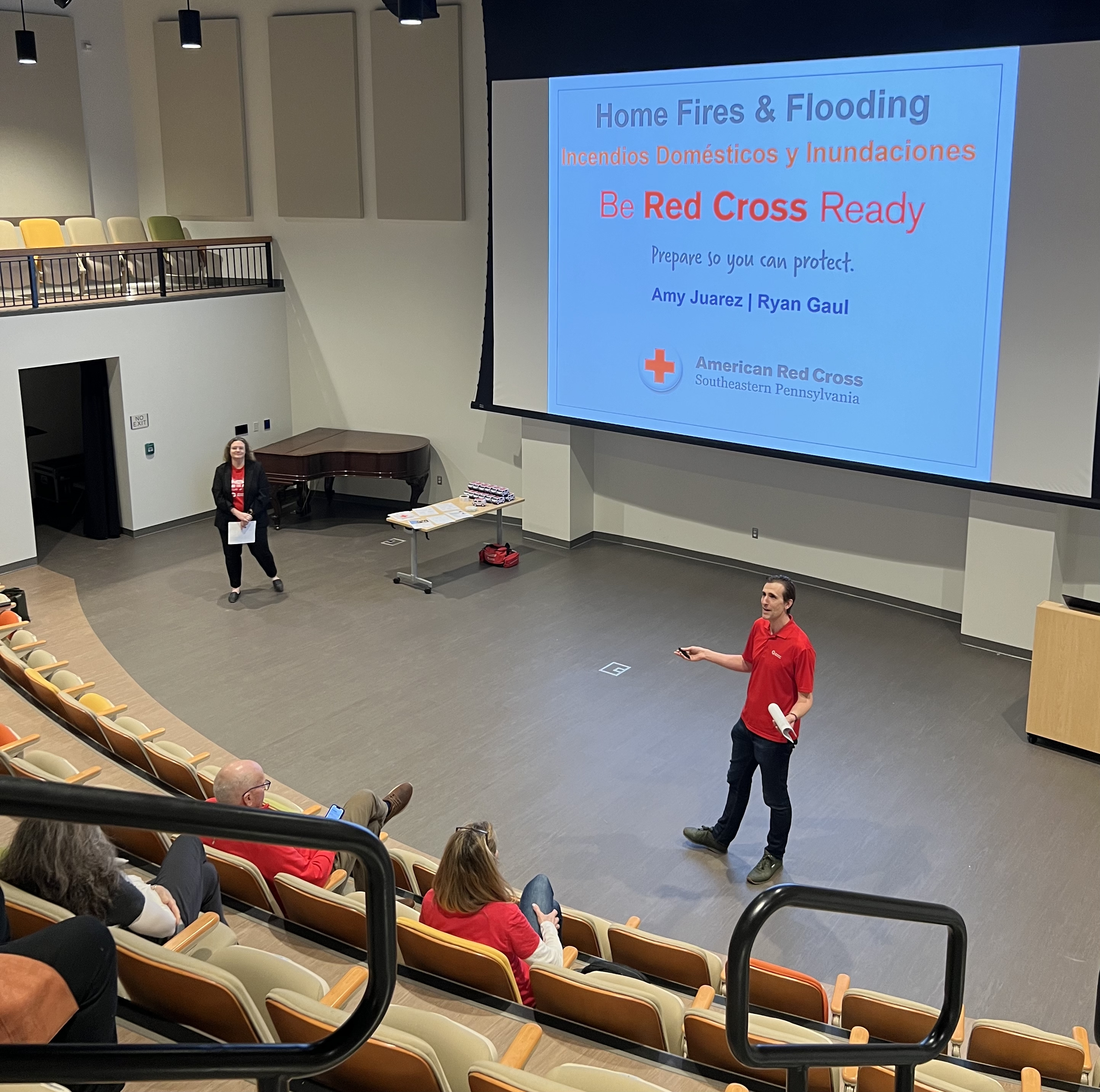
Along with volunteer instructor Amy Juarez, Ryan Gaul led classes in hands-only CPR and Red Cross Ready workshops, where flood and fire safety were top topics. Ryan is the Disaster Preparedness Manager for the Red Cross SEPA region.
“The part that I enjoy about the program, the Red Cross Ready program, is that while we are providing some specific information, really the goal is to motivate people to start taking actions to prepare.”
Red Cross volunteer Amy Juarez Disaster Preparedness Manager Ryan Gaul co-taught classes at the Kennett Library on March 4, 2024. Photo by Jenny Farley/American Red Cross
During the classes, Ryan reminded eager participants that now is the time to make an emergency plan with their family. He also stressed how important it is to have working smoke alarms in their home and if they don’t, to call the Red Cross to come out and help install them.
Ryan and Amy used small toy stress-ball ambulances to get down on the floor and show how chest compressions are performed during hands-only CPR. That training meant a lot to Chase Fallon, who came to the library specifically to take the Red Cross hands-only CPR class.
“I thought it was really nice, very informative, very interactive, and I really appreciate the help that the instructors gave,” he said.
Chase Fallon, a recent college graduate and former lifeguard pictured on the left, took the Red Cross hands-only CPR class at the Kennett Library along with Pierce Ruoff, shown on the right. Photo by Jenny Farley/American Red Cross
Red Cross volunteer Tracy Bell worked at a table near the front of the library, handing out brochures and information about Red Cross programs.
Tracy has volunteered for the Red Cross for 16 years and in her day job works for a local health system in Delaware.
“I love remembering that 1 in 7 patients walking through our doors needs blood. So, I feel like I’m contributing to our mission as a health system, as well as the Red Cross mission to providing those necessary services in the community.”
Tracy Bell has volunteered for the Red Cross for 16 years and loves encouraging others to donate blood. Photo by Konrad Jones/American Red Cross
Amy Juarez, who taught classes with Ryan, is a social worker who volunteers for the Red Cross in several community preparedness roles. She is getting her master’s degree in emergency management.
After the classes ended, Amy helped Ryan pack up supplies. She said she felt good about the day’s events.
“We ended up having a good number of people that we were able to communicate with and it’s great to be able to spread the information,” she said.
Amy Juarez, a Red Cross volunteer, co-taught classes on disaster preparedness at the Kennett Library. Photo by Jenny Farley/American Red Cross
The collaboration between the Red Cross and Kennett Library went well and there are tentative plans for another preparedness day and blood drive there again in the fall.
Dawn and Peter Zucca were recognized for their 9 years of service as Blood Program Leaders in February. Photo by Alana Mauger/American Red Cross.
The American Red Cross held a reception last month to celebrate the contributions of Blood Program Leaders Peter and Dawn Zucca, who coordinated Peter Powerhouse Foundation blood drives since 2015 in Kulpsville, Montgomery County. After hosting 117 drives and collecting 11,673 units of blood, the mother-son duo has passed the torch to the Conley family – with 16-year-old Ava and her mom Amy taking the reins.
Starting at age 12, Peter hosted dozens of blood drives annually through his Peter Powerhouse Foundation. The non-profit strives improve the lives of children currently fighting childhood cancer by providing donations to pediatric cancer treatment facilities and contributing financial support to researchers to improve the lives of childhood cancer survivors.
The foundation was born out of Peter’s desire to give back. At only 10 months old, he was first diagnosed with cancer. In addition to undergoing years of chemotherapy, radiation treatment and surgeries, Peter received 51 units of lifesaving blood.
With Peter now in college and Dawn returning to the workforce full time, the Conley family is stepping up. They are a Peter Powerhouse family – benefitting from the foundation’s services over the past 7 years as Logan, currently age 12, battles optic pathway glioma.
Amy Conley (left) and her daughter Ava (not pictured) have taken over leading Peter Powerhouse Foundation blood drives from Peter Zucca (center) and his mother Dawn. Photo by Alana Mauger/American Red Cross
Dawn and Peter were presented with a plaque on Feb. 21 for their extraordinary work over the past 9 years. The Foundation especially stepped up during the early days of the COVID-19 pandemic, holding daily blood drives and single-handedly collecting 4,000 units of blood in 2020. The Zucca family was previously recognized for reaching the milestone of 10,000 units of blood collected in August 2022.
The blood drives, which will continue monthly at Towamencin Mennonite Church, play a major role in supplying blood to patients in Southeastern Pennsylvania and New Jersey. The next Peter Powerhouse Foundation blood drive is on March 13, 2024 from 2-7 p.m. Schedule a blood donation appointment here.
The Southeastern Pennsylvania Region of the American Red Cross celebrates the positive impact students and alumni of Historically Black Colleges and Universities (HBCUs) make in helping ensure a diverse blood supply.
That blood supply supports patients battling sickle cell disease during February, Black History Month, and throughout the year. That’s why the Red Cross decided years ago to reach out and propose a partnership which leverages the strengths and commitments of Black college and university students.
For more than 100 years, HBCUs have been rooted in a tradition of community service to others. Blood drives hosted by HBCUs help ensure that students, alumni and community members have a place to donate blood, while also helping to meet the transfusion needs of black and brown patients.
There are currently 107 HBCUs in the United States; we have three HBCU-designated schools in our region. Let’s take a look:
Cheyney University
Cheyney University students sign in to give blood at a Red Cross blood drive on Feb. 23, 2023. Photo by James Jones/American Red Cross.
On February 25, 1837, Cheyney University of Pennsylvania became the nation’s first Historically Black College and University (HBCU). The University was established through the bequest of Richard Humphreys, a Quaker philanthropist who bequeathed $10,000 — one-tenth of his estate — to design and establish a school to educate free people of African descent.
First known as the African Institute, the school was soon renamed the Institute for Colored Youth. In its early years, it provided training in trades and agriculture, later adding teacher training courses. Other liberal arts and science degree programs were added in the Twentieth Century.
In 1902, the Institute was relocated to George Cheyney’s farm, a 275-acre property just 25 miles west of Philadelphia in Delaware County. The name “Cheyney” became associated with the school in 1913, though the school’s official name changed several times during the 20th century. The school finally became Cheyney University in 1983 and has a current enrollment of 706 students.
Delaware State University
The Delaware College for Colored Students, now known as Delaware State University, was established May 15, 1891, by the Delaware General Assembly under the provisions of the Morrill Act of 1890 by which land-grant colleges for Blacks came into existence in states maintaining separate educational facilities.
With the appointment of an inaugural six-member Board of Trustees, that governing body used part of the initial $8,000 state appropriation to purchase a 95-acre property north of the state capital of Dover to establish the new college.
Because there was already a private Delaware College (now the University of Delaware) located in Newark, Delaware, to avoid confusion new state legislation was passed and enacted in early 1893 to change the Black school’s name to the State College for Colored Students. That would be the institution’s name for the next 54 years.
Initially, Delaware State University had a strong emphasis on the normal school instruction (preparation for school teaching) mechanical arts, domestic science, and agricultural studies. As the Twentieth Century progressed, the university added more academic subjects and researched-based disciplines for which it is known today.
In 1993, Delaware Governor Tom Carper changed the name of the institution from its former name to Delaware State University. Currently, there are 6,218 students enrolled in undergraduate and graduate programs at the three DSU campuses: Dover (main campus), Georgetown and Wilmington.
Lincoln University
Lincoln University students staff a sickle cell blood drive on Sept. 22, 2023. Submitted photo
Lincoln University is located in southern Chester County, four miles north of Oxford, Pennsylvania. Founded in 1854, the university is the oldest existing Black institution of higher learning (degree-granting) in the United States.
Although Cheyney University was founded prior to the establishment of Lincoln U, it was not initially a degree-granting institution. To this day, the two universities banter about which school claims the honor of being the oldest school in the United States.
The university was founded by John Miller Dickey, a white senior pastor of the Oxford Presbyterian Church. Before founding Lincoln University, Dickey had been involved in anti-slavery activities and was concerned for the welfare of African Americans.
In 1850, he contributed decisively to the liberation of two sisters, Rachel and Elizabeth Parker, who had been kidnapped in Oxford for sale into slavery. Dickey also supported the American Colonization Society and felt that emancipated Africans should return to the African continent as missionaries.
In 1852, Dickey made unsuccessful attempts to place James Ralston Amos, an African American and the treasurer of the fund for the “Negro Church” building established by Richard Allen in 1794, into Princeton University Seminary and also at a religious academy managed by the Presbyterian Synod of Philadelphia.
Frustrated by a failed effort to secure admission for a Black student in a white institution, Dickey sought a solution in establishing an institution for Black men.
The institution Dickey established was originally chartered by the state of Pennsylvania as Ashmun Institute, named in honor of the first governor of Liberia. After the Civil War and in recognition of the role that President Abraham Lincoln played in the emancipation of the enslaved, Ashmun Institute was renamed Lincoln University. The educational curriculum was originally conceived to include not only all aspects of liberal arts but also law, medicine and theology. Financial problems and declining enrollment,
however, necessitated the closing of the seminary as well as the schools of law and medicine. The university’s charters of 1854 and 1866 restricted admission to male students.
However, in 1953, the university amended its charter to permit coeducation. In 1972, Lincoln University became a state-related institution within Pennsylvania’s Commonwealth System of Higher Education and was placed on the same basis for state aid as Temple University and the University of Pittsburgh and Pennsylvania State University. Lincoln University has a total population of 2,631 students enrolled.
ARC Provides Leadership Opportunities and Scholarships
Student leaders who plan and organize Red Cross blood drives at HBCUs are eligible for scholarships which support undergraduate students in qualifying majors. This program is known as the HBCU Ambassador Program and receives generous funding support from Delta Airlines. Visit the HBCU Ambassador Program webpage on RedCrossBlood.org to learn more.
Tiara Thomas with her son Ethyn, who was diagnosed with sickle cell disease soon after his birth. Submitted photo.
In the days after Tiara Thomas gave birth to her son Ethyn, she learned devastating news.
“The realization of having to be scared all the time, be on edge all the time, knowing that my child will never have a normal life,” she said.
The routine heel stick performed on newborns at the hospital revealed Ethyn had the most common genetic blood disorder in the United States — sickle cell disease. It affects 1 out of every 365 Black or African American births.
“He can never do some of the things that a normal child does. It was just very upsetting.”
In people who have sickle cell disease, red blood cells are hard and shaped like a crescent, instead of being soft and round. The blood cells can’t adequately carry oxygen throughout the body, which can lead to extreme pain, organ damage, anemia and sometimes even strokes. Many patients will need several blood transfusions throughout their life.
“The Red Cross has meant everything because, if my son has to get a transfusion, and even if it’s not my son, there are so many other people in the world that need these transfusions.”
Ethyn is a toddler now and like all toddlers, Tiara said sometimes he can be a “handful,” but most of the time he is “laid back or playful.”
He loves music and starts dancing when he hears it. He also loves books he can touch and feel.
At times it’s hard to know if he is in pain. Whenever he gets a fever, Tiara has to rush him to the emergency room to make sure he’s not having a complication that could threaten his life. Sometimes he has to be admitted.
When she thinks about the biggest challenge moms of kids who have sickle cell disease face, Tiara said unfortunately there are too many to choose from.
“One of the biggest, for sure, would be the fear of not knowing when my son could possibly take his last breath due to this disease.”
She’s speaking out about her son’s diagnosis to help other people who suffer from sickle cell disease and to get the word out about what everyone can do to help – most importantly donate blood. “Please donate, please.”
Tiara works as a community health worker at Crescent Foundation, an organization that helped her when her son was first diagnosed. “They have been a blessing to me and my son. I love working there.”
Crescent Foundation helps people learn about sickle cell disease and get the resources they need to thrive.
“They know how passionate I am about this cause and how dedicated I am.”
Discovering your child has a genetic disease can be overwhelming.Tiara said when she found out it hurt “unbearably” and she “cried like a baby for weeks.” A community of supporters, like the American Red Cross and Crescent Foundation, can help.
“You’re not in it alone, you’ll get through it.”
One in 3 African American blood donors are a match for people with sickle cell disease. To help make sure patients get the blood they need, the Red Cross is working with partners in Black communities to increase the number of blood donors who are Black.
Tiara said, “As African Americans, we have been in some trying times. Unfortunately, that’s always been our case. However, these last few years, we’ve seen us come together. And I feel like we should do the same when it comes to this call because this is another form of protecting our community.”
To schedule an appointment to donate blood, visit RedCrossBlood.org, use the Blood Donor App or call 1-800-RED CROSS.
Editor’s Note: To commemorate Phlebotomists Recognition Week, we’re highlighting select American Red Cross phlebotomists. These valuable team members carry out all aspects of the blood collection process while ensuring donors have a safe and welcoming experience.
Tennille Scheidt. Submitted photo
By Alana Mauger
Almost two years ago, Tennille Scheidt saw a job listing on Indeed for an American Red Cross phlebotomy position. She thought it would be a great opportunity for her daughter, who was working toward a career in health care.
When the training schedule didn’t fit with what her daughter was looking for at the time, she encouraged Tennille to apply herself.
“She said, ‘Mom, you should do it! They train you. You can start a whole new career,’” Tennille recalls.
Tennille left her job as a dining supervisor at an assisted living facility and started her training as a Red Cross phlebotomist.
The Red Cross offers six weeks of paid, comprehensive training for phlebotomists at all levels, including those like Tennille who have no prior experience in the field.
Because of her supervisory experience, Tennille was hired as a collections specialist II, also called a “charge,” which means she is responsible for all blood collection activities at assigned blood drives.
She calls her new career a “happy accident.”
“It’s the best thing that ever happened,” she shared. “I love it!”
Tennille likes being in a new place every day and enjoys meeting different people from a variety of backgrounds and hearing their stories.
And if you’re thinking about donating blood for the first time, she has some advice. “Everyone feels a little nervous. Just think about the people that benefit!” she said.
Donate Life graphic – Happy Donor Day: National Donor Day is February 14. Share the love and register today. RegisterMe.org
It is fitting that National Organ Donation Day is the same day as Valentine’s Day as it is an expression of love — the love of life! Observed every year on February 14th, National Donor Day is an observance dedicated to spreading awareness and education about organ, eye and tissue donation. National Donor Day was started in 1998 by the Saturn Corporation and its partner, the United Auto Workers and is supported by the U.S. Department of Health and Human Services.
No one wants to think of death, but when you associate it with the life of another, you may start thinking of it differently. More than 100,000 people are waiting for a lifesaving transplant, and every 8 minutes another person is added to the national transplant waiting list. Sadly 6,000+ people die each year while waiting for a lifesaving organ transplant.
National Donor Day is a day to recognize those who have given and received the gift of life through organ, eye and tissue donation, currently waiting for a lifesaving transplant, and those who died waiting because an organ was not donated in time.
Organ transplant surgeries are almost always accompanied by the use of blood donations. For example, in 2021, the average amount of blood products transfused during heart transplantation surgeries was 7.83 units of red blood cells, 2.67 units of fresh frozen plasma, 13.13 units of platelets and 1.74 units of cryoprecipitate. For lung transplantation surgeries, the average is even higher: 14.84 units of red blood cells, 12.29 units of fresh frozen plasma, 23.63 units of platelets and 2.57 units of cryoprecipitate.
This is why the American Red Cross strives to keep its inventory of blood products at a level to handle a possibility of multiple transplants, traumas and treatments. Visit our website to learn more about donating blood or to schedule an appointment.
To learn more about organ, tissue and blood donation check out these websites:
Editor’s Note: To commemorate Phlebotomists Recognition Week, we’re highlighting select American Red Cross phlebotomists. These valuable team members carry out all aspects of the blood collection process while ensuring donors have a safe and welcoming experience.
Theresa Morgan. Submitted photo
By Alana Mauger
When Theresa Morgan began her phlebotomy training at the American Red Cross in May 2022, she couldn’t have predicted that blood transfusions would help save her life a few months later.
Unknown to her doctors, the abdominal pain Theresa was experiencing after a car accident turned out to be from a rapidly growing tumor on her kidney. One day it ruptured, and her body went into sepsis. She received 8 units of blood.
Afterward, Theresa returned to work with a renewed focus.
“I love the fact that I can explain to the donors how their donations impact and help people in hospitals. I like sharing my story. I tell them how much I appreciate them coming out,” she said. “One of those people I stuck could have been the one to help me!”
A year ago, Theresa was promoted from donor collections assistant to collections specialist II or “charge,” which means she is responsible for all blood collection activities at assigned blood drives.
She’s driven to collect as much blood as possible, all while providing donors with a positive experience. Theresa is also focused on educating Black and African American donors about how their blood can help individuals living with sickle cell disease.
In the Southeastern Pennsylvania blood region, blood from donors who self-identify as Black is marked with a blue tag, designating it as a potential match for a sickle cell patient. For many people with sickle cell disease, closely-matched blood transfusions are lifesaving.
“I stress to my team, it’s so important to mark that blood with a blue tag,” she said. “I make sure we have blue tags at all of my drives.”
A natural caregiver, Theresa worked as a certified nursing assistant (CNA) for three years before coming to the Red Cross. She’s currently halfway through her studies at Montgomery County Community College on her way to becoming a registered nurse (RN).
Editor’s Note: To commemorate Phlebotomists Recognition Week, we’re highlighting select American Red Cross phlebotomists. These valuable team members carry out all aspects of the blood collection process while ensuring donors have a safe and welcoming experience.
Jasmine Glover. Photo by Jenny Farley/American Red Cross
By Jenny Farley
When Jasmine Glover’s mother beat cancer, it inspired her.
“Seeing everything she had to go through made me want to be in that health care setting just to help people,” she said.
Jasmine trained as a medical assistant before working for the American Red Cross as a phlebotomist, where she takes donor health histories as part of her job.
“I do hear a lot of stories. Sometimes you will find that one donor you just connect with,” she said.
Jasmine loves the perks of the job like traveling to meet new people and comforting first time donors.
“They’re always nervous when they come in.”
Jasmine described one donor who said he waited 30 years to give blood because he was “terrified.” She told him how she ended up working for the Red Cross.
“It eased his mind and he was like, ‘you know, I will come back. It’s not as bad as I thought it was.’ So I thought that was pretty cool.”
When people donate blood, they undergo a short physical exam.
Jasmine has heard donors talk about how the Red Cross saved their lives because those exams led them to their doctor where they discovered “they did have something going on.”
If you are interested in giving blood, Jasmine said it doesn’t take that long and you won’t be alone.
“We’re going to take care of them. We don’t really leave their side.”