Rebecca Baranowski prepares to donate platelets at the American Red Cross Philadelphia Blood Donation Center in May 2025. Photo by Judith Weeks/American Red Cross
Rebecca Baranowski has donated over 700 units of platelets knowing her donations will help someone!
For more than 40 years, Rebecca has rolled up her sleeve and donated 707 units of platelets helping someone at risk for bleeding. Imagine the impact she has had on saving lives!
While a student at Penn State, Rebecca and her friends began donating and selling plasma for extra money to buy pizza and beer. When she moved to Philadelphia and got a job, she didn’t need the money and switched from donating plasma to donating platelets at the American Red Cross.
Why are platelets so important? They are tiny cell fragments in blood that form clots preventing or stopping bleeding. Patients fighting cancer, those with a bone marrow transplant or who have traumatic injuries, could need platelets. Platelets can be donated up to 24 times a year. Platelets have a very limited shelf life of five days! Donors are needed for frequent and consistent donations to replenish hospital supply.
If you want to donate platelets, you must go to an American Red Cross Blood Donation Center that has an apheresis machine. The platelet donation process begins with blood drawn from one arm that moves through a tube into the apheresis machine where it is rapidly spun around separating platelets from blood. The platelets go into a sterile bag and the rest of the blood is returned by a tube to the other arm.
“The staff is friendly. I don’t mind giving up 90 minutes or two hours every couple of weeks. I get to watch a movie and relax on a comfy chair,” she said.
About the procedure, Rebecca explains, “The needles don’t bother me. When the blood is returned to my vein, it gets a little cold because of the citrate added to the blood. They give me a warm blanket!”
Rebecca says once the needle sticks are done, it’s easy, but she cautions, “You have to remember not to move your arms too much!
“It’s not a difficult process,” she said. “It’s one of those things one would do like recycling to benefit people. I like to think that if I needed blood there would be somebody who would donate for me. It’s important and something easy to do, and I get a T-shirt!”
Rebecca enjoys wearing the Red Cross T-shirts because they bring attention to donating blood and give her an opportunity to tell people about her experience!
Rebecca donates granulocytes too. Granulocyte transfusions are given to patients who have severely suppressed immune systems and are undergoing cancer therapy or have had a bone marrow transplant. A patient must be transfused within 24 hours of granulocyte collection. Rebecca explains she could get a call to donate within hours. The pool of matched donors is limited. Her granulocytes have been typed and only matched with a patient 15 times over 40 years of donating.
When she’s not giving platelets, Rebecca is committed to working out with her trainer at a local gym. She’s a member of a Dragon Boat Team, and it’s important for her to stay strong so she can paddle with them.
There are six American Red Cross Blood Donation Centers in Southeastern Pennsylvania, plus one in Wilmington, Delaware less than a mile from the Pennsylvania border near Chadds Ford.
BUCKS COUNTY Langhorne Blood Donation Center 100 N. Bucks Town Drive, Suite 204, Langhorne Tuesday-Wednesday: 11:45 a.m.-8 p.m. Thursday: 10:15 a.m.-6:30 p.m. Saturday: 7:15 a.m.-3:30 p.m.
CHESTER COUNTY West Chester Blood Donation Center 1065 Andrew Drive, West Chester Monday-Thursday: 11:45 a.m.-7:45 p.m. Friday-Saturday: 7:15 a.m.-3 p.m.
MONTGOMERY COUNTY East Norriton Blood Donation Center 2880 DeKalb Pike, East Norriton Monday: 11:45 a.m.-8 p.m. Thursday: 10:15 a.m.-6:30 p.m. Friday-Saturday: 7:15 a.m.-3:30 p.m.
PHILADELPHIA COUNTY Philadelphia Blood Donation Center 700 Spring Garden St., Philadelphia Monday-Wednesday: 11:45 a.m.-8 p.m. Thursday: 10:15 a.m.-6:30 p.m. Friday-Sunday: 7:15 a.m.-3:30 p.m.
Northeast Philadelphia Blood Donation Center 1401 Rhawn St., Philadelphia Monday-Wednesday: 11:45 a.m.-8 p.m. Thursday: 10:15 a.m.-6:30 p.m.
STATE OF DELAWARE Wilmington Blood Donation Center 5329 Concord Pike, Wilmington, DE Monday: 11:45 a.m.-8 p.m. Wednesday: 10:15 a.m.-7 p.m. Thursday-Sunday: 7:15 a.m.-3:30 p.m.
Are you thinking of getting a tattoo? July 17th is National Tattoo Day and is the perfect time to get the ink you’ve been thinking about. The good news is you can be a loyal blood donor for the American Red Cross and still get your tats without them preventing you from donating blood.
There are a few rules about it, and we’ll get to that later, but first meet two passionate blood donors who explain why their tattoos mean so much to them and why they think donating blood is so important.
Red Cross graphic – About tattoos and blood donation
Meet Elizabeth Carden: A blood donor with 16 tattoos
Elizabeth Carden donated blood at the recent “I Bleed for Preston and Steve” Red Cross blood drive at the Greater Philadelphia Expo Center in Oaks on June 13th. She donated with her mom Leslie Carden, a nurse who has also been a lifelong blood donor and was thrilled to donate again for the first time after surviving cancer.
Elizabeth is a patient care technician for Main Line Health. She started donating in high school where she ran her school’s blood drives.
“I always try to donate when I can, especially in the past couple of years since her diagnosis. I try to keep track of when I’m eligible again and go when I can,” she said.
Elizabeth is the oldest of three sisters and her first tattoo is one she and her sisters all got – a lotus flower.
She loves insects, nature and horror movies and trusts her tattoo artist to come up with the art in her ink. Now, many of her tattoos have a specific theme.
“Spooky, creepy, Halloween inspired tattoos. Not all of my tattoos have a greater meaning, but they just show what I’m interested in and who I am and what I’m about.”
Elizabeth works with many patients over the age of 60 and she thought at first that people might judge her tattoos but she said, “Honestly, people might question me about them, but I’ve gotten a lot more compliments than I would have ever expected.”
She likes it when people appreciate the beauty and thought behind each tattoo. She calls them “permanent accessories” and said the one that gets the most compliments is the one on her wrist that looks like a bracelet.
“My tattoos show who I am. That’s why I love them.”
Elizabeth Carden started donating blood in high school and has 16 tattoos. She said, “I love them. I have a whole bunch on my leg and one behind my ear.” She got her most recent tattoo for her birthday. Photos by Jenny Farley / American Red Cross
Meet Mel Palmer: She started donating blood at 16 and got her first tattoo at 30
Like Elizabeth, Mel Parmer donated blood at the “I Bleed for Preston and Steve” Red Cross blood drive and made her first blood donation in high school. And like Elizabeth, she has a lot of super cool tattoos.
“I like being able to express myself and show people what I’m interested in, and just it gives them a better idea of who I am as a person and that there’s many different facets of me,” she said.
Mel has a degree in criminal justice and is a singer who plays the violin, guitar, piano and that’s not all.
“I just bought a cello so I want to learn how to play that,” she said.
Mel has a “Lord of the Rings” tattoo, a “Game of Thrones” Targaryen tattoo and several BTS and KPop tattoos. One on her arm that illustrates the BTS message to “love yourself” says “Save me,” and when you look at her arm from another view it says “I’m fine.”
She said, “It’s a reminder that I’m fine to myself but a call to people that sometimes I need people to save me, so it’s actually like a mental health awareness tattoo, and each part of it represents a different journey and part of the journey of loving yourself.”
Mel has donated whole blood and platelets and like Elizabeth, plans to keep donating.
“You feel like you’re doing something that makes a difference,” she said.
Getting tattoos has never stopped her from giving blood.
“It’s never been an issue as long as I haven’t gotten the tattoo within a certain amount of time.”
Mel Palmer has donated blood for years and loves her tattoos as a form of self-expression. Several of her tattoos are related to KPop and BTS. She said, “One year I donated platelets on a member of BTS’ birthday as a way of giving back and celebrating life.” BTS is a boy band from South Korea. Photos by Jenny Farley / American Red Cross
Understanding the guidelines about tattoos and donating blood
So, let us break down for you what you need to know about tattoos and donating blood.
In states that regulate tattoo facilities there is no delay required between getting a tattoo and donating blood, as long as the tattoo establishment uses sterile needles and fresh ink.
Pennsylvania is one of 9 states and the District of Columbia that don’t regulate tattoo businesses. That means people who want to donate blood will have to wait 3 months after getting their latest tattoo before doing so.
New York, Maryland, New Hampshire, Massachusetts, Georgia, Idaho, Utah and Wyoming also do not regulate tattoo facilities.
The reason for the 3-month delay is related to concerns about transmitting hepatitis. The Red Cross tests blood donations extensively for hepatitis B and hepatitis C, but it takes time to properly detect the virus.
It’s important for people who may be infected with the hepatitis virus to not donate blood.
You will also have to honor the 3-month delay if you apply your own tattoos or get tattoos in states with regulations, but from unregulated artists or businesses.
Red Cross graphic – Can you donate blood if you have tattoos? Your tattoo must: Be applied with a sterile needle. Use fresh ink that’s not reused. Be done in a state-regulated facility. If the state the tattoo was applied in doesn’t regulate tattoo facilities, wait 3 months.
Sign up to give blood or platelets at RedCrossBlood.org, by calling 1-800-REDCROSS, or by using the Red Cross Blood Donor App.
American Red Cross Regional Donor Services Executive Helen Munizza and Regional CEO Jennifer Graham pose for a pic with the Preston & Steve Morning Show team at the Greater Philadelphia Expo Center in Oaks. Photo by Konrad Jones / American Red Cross
The Preston & Steve Morning Show debuted on 93.3 WMMR in May 2005. That same year, the duo launched two annual philanthropic endeavors that have stood the test of time: Camp Out For Hunger, a week-long food and money collection benefitting Philabundance, and “I Bleed For Preston & Steve,” a blood drive in partnership with the American Red Cross. Both campaigns turn 20 in 2025.
Growing from a small storefront affair in the former Franklin Mills Mall to one of the largest blood drives in the country, “I Bleed For Preston & Steve” has collected 21,999 donations since its inception. More than 900 of those donations came from this year’s drive, which was held on June 12th at Live! Casino & Hotel in Philadelphia and June 13th at the Greater Philadelphia Expo Center in Oaks.
Steve Morrison of the Preston & Steve Morning Show gives a thumbs up as he donates blood at Philly Live! Casino on June 12th. Preston is on the cot to Steve’s right, also donating. Photo by Alana Mauger / American Red Cross
“You guys came out and you did it once again,” said Morning Show co-host Preston Elliot when announcing this year’s totals during their June 17th show. “Our 20-year grand total is 21,999 units of blood. Wow. Let’s call that 22,000.”
Co-host Steve Morrison added, “that’s a crap load of blood. Needless to say we’re thrilled.”
Like last year, the Friday portion of the blood drive featured 13 hours of live broadcasts, starting with the Preston & Steve Show (6-11 a.m.), Pierre Robert (11 a.m.-3 p.m.) and Brent Porche (3-7 p.m.). Jacky Bam Bam (7 p.m.-midnight) greeted donors Thursday morning at Live! Casino between 8-11 a.m.
Clockwise from top left: 7 p.m.-midnight DJ Jacky Bam Bam calls in to the Preston & Steve Morning Show from Philly Live! Casio on Thursday; Jacky Bam Bam grabs a photo with the Red Cross Collections Team at the start of Thursday’s blood drive; 3-7 p.m. DJ Brent Porche broadcasts live from Oaks on Friday; Brent Porche interviews Red Cross Communications Manager Alana Mauger at Oaks; 11 a.m.-3 p.m. DJ Pierre Robert chats on-air with producer Ryan Shuttleworth as he donates blood at Oaks; Pierre Robert with Regional Donor Services Executive Helen Munizza at Oaks on Friday. Photos by Konrad Jones, Alana Mauger, Allison Mafodda and Jenny Farley.
20 years of giving
Two long-time fans donated blood at the “I Bleed for Preston and Steve” drive for the 20th year in a row. Tom VanDuyne and Craig Powell consider it a can’t miss event.
“20 years I’ve been doing it. I think it’s pretty cool.” Tom said. “There should be a get together of all the people that did 20 years.”
It’s a chance to help people while having a great time.
“I still make sure I do not miss this. I start looking on my calendar and making sure that if I am going to donate before, that I’m still within the range,” Craig said.
Left: Tom VanDuyne donated blood for the 20th year in a row at the “I Bleed for Preston and Steve” blood drive. Photo by Alana Mauger. Right: Craig Powell made a Power Red donation at his 20th “I Bleed for Preston and Steve” blood drive. Photo by Jenny Farley.
Craig remembers making his first Power Red donation at the second drive and has since kept up the tradition. During a Power Red donation, red blood cells are separated out from the other blood components and the plasma and platelets get returned back to you. Power Reds can be donated every 112 days.
Craig liked all the advancements the Red Cross has made in making the blood donation process more efficient. “It’s been fun to take part in this,” he said.
Blood donor Lena Marsh agreed. “It’s always very organized. You’re in. You’re out,” she said.
Lena started donating blood because her mother hemorrhaged when she was born and needed a lot of blood, so she donates every 8 weeks to “give back.” She likes to track where her blood ends up.
“I get emails every time I donate and they tell me who it went to, so I say a little prayer for these people and then I move on,” she said.
Left: Lena Marsh sits in the canteen area after she donated blood on Friday at Oaks. Photo by Jenny Farley. Right: Pat Pavelka poses for a pic with Preston & Steve Morning Show Executive Producer Casey Boy and one of the two Bird Bots that were on display at the drive. Photo by Alana Mauger.
In the 20 years since the drive began, Pat Pavelka has only missed once. She’s such a fan of Preston and Steve that she joked the Red Cross might want to check her blood pressure when they are around. “I just get excited when I see them!” she said.
The show is what inspired her to donate in the first place.
“When they were talking about it and advertising that they were doing it, I said ‘I need to do this’ and I’ve been hooked ever since,” she said. Like Craig, Pat also makes Power Red donations.
20 years of service
The blood drive couldn’t happen without volunteers like Carolyn Brehm and Stephanie Long. Carolyn started volunteering for the Red Cross in January and attended the Preston and Steve blood drive for the first time.
“I’m just very impressed. This is a great way to get the word out that people can donate blood,” she said.
Carolyn calls herself a “relatively new” Red Cross volunteer. She was surprised to learn that 90% of American Red Cross workforce is volunteer. “90%. That’s huge! They do so much.”
Left: Carolyn Brehm is a volunteer with the Red Cross Community Outreach Team. Photo by Donn Greenberg. Right: Volunteer Stephanie Long helps out at the Red Cross “I Bleed for Preston and Steve” blood drive. Photo by Jenny Farley.
Stephanie is a blood donor who started volunteering for the Red Cross three years ago; this was her second Preston and Steve blood drive. She’s a trained social worker who said she loves volunteering for the Red Cross and she listens to Preston and Steve every day on her way to work.
“Everyone’s been really upbeat and happy to be here. Seems like people are enjoying the live broadcast, so it’s been a good day,” she said.
20 years of T-shirts
There’s a common bond among the many people who donated blood at the drive. First, a genuine desire to help save lives. Second, a brotherhood with other Preston and Steve fans, and third, a breathless anticipation to get this year’s featured “I Bleed for Preston and Steve” limited edition T-shirt.
The shirts have a following of their own and people talk about them with glee and view them as prized possessions.
Most of the “I Bleed for Preston & Steve” T-shirts were on display at Oaks on Friday. Pictured are the shirts from 2017, 2018 and 2019. Photo by Konrad Jones / American Red Cross
For graphic designer Kristen Kimball, who came to donate blood with her husband Jay on Friday, this year’s shirt was uniquely special. She designed it.
Her husband calls her a Preston and Steve “super fan.” Kristen’s T-shirt art features the Philadelphia skyline with the names of the Morning Show crew inside the buildings’ outline.
She said, “I love these guys, and I love Philadelphia, so I just kind of started puttering around with it and then made the graphic.” Kristen and a friend decided to make their own T-shirts featuring her design.
“It was very organic. It wasn’t meant to be anything big. Just us having a little fun,” she said.
When she, her husband and two friends wore their shirts to spring training when Preston and Steve were broadcasting live from Clearwater, Florida, it caught their attention and you know what happened next.
“It’s very humbling that they wanted to use it,” she said.
Left: Kristen Kimball and her husband Jay Kimball prepare to donate blood at the “I Bleed For Preston and Steve” Blood Drive at Oaks Friday. Photo by Jenny Farley. Right: Kristen is a graphic designer whose artwork was chosen for the official donor shirt. Photo by Alana Mauger
Looking ahead to 21
Plans are already in the works for the 21st annual “I Bleed For Preston & Steve” blood drive, which will be held in June 2026. But you don’t have to wait until next year to make an impact. Blood donations are needed 365 days per year. Whole blood donations can be made every 56 days and Power Red donations can be made every 112 days.
“If you didn’t get a chance to join us to donate blood, sign up, find a blood drive near you. They’re going on every single day,” Elliot said during the show’s June 17th broadcast. “If you’ve held off, take a shot at it because you save lives.”
Slide show photos by Jenny Farley, Donn Greenberg, Konrad Jones, Kai Kwong, Bernadette Mathis, Alana Mauger, Maxine Mayer, Colin McPoyle and others. Check out our Flickr album for more photos.
Thursday, June 19th is an important day for celebration and awareness. It marks Juneteenth, our newest federal holiday and a day of reflection and pride that commemorates the ending of slavery in the United States.
It’s also World Sickle Day, established by the United Nations in 2008 and commemorated every June 19th to increase awareness about sickle cell disease – the most common genetic disorder in the U.S. An estimated 100,000 people in the U.S. are living with sickle cell disease, most of whom are of African or Latino descent.
Sickle cell disease causes red blood cells to be hard and crescent-shaped – like a sickle – instead of soft and round, making it difficult for blood to flow smoothly and carry oxygen adequately to the rest of the body. Sickle cell warriors can experience complications like severe pain, anemia, infections, stroke and organ damage.
Blood transfusions help relieve sickle cell disease symptoms by increasing the number of healthy red blood cells in the body, helping to deliver oxygen throughout the body and unblocking blood vessels. But ensuring hospitals have an adequate supply of the major blood types – O, A, B and AB – is only part of the equation.
There are more than 600 known antigens – substances on red blood cells that help determine your blood type – some of which are unique to specific racial and ethnic groups. Individuals who require regular blood transfusions, like those with sickle cell disease, need blood that is matched more closely to reduce possible complications. Therefore, a sickle warrior is more likely to find a compatible blood match from a donor of the same race or similar ethnic group.
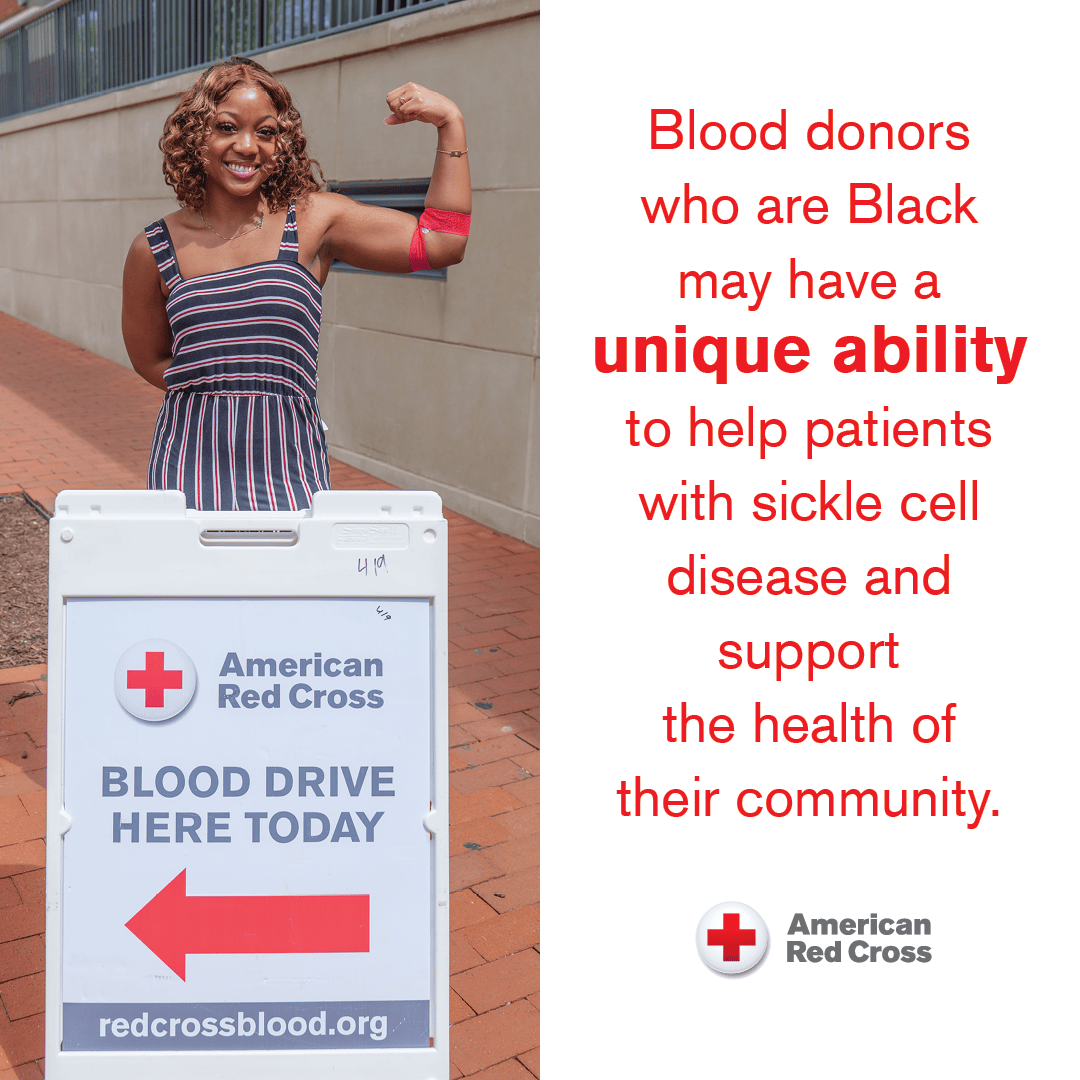
Red Cross graphic – Blood donors who are Black may have a unique ability to help patients with sickle cell disease and support the health of their community.
Over the next few months, the Red Cross Southeastern Pennsylvania and New Jersey regions will be holding several Community of Giving blood drives specifically to help people living with sickle cell disease. The drives are in memory of E. Steven Collins, a legendary Philadelphia radio icon and beloved community leader, who died of a heart attack in 2013.
E. Steven worked as a professional broadcaster for decades with a long tenure at Radio One. He also had numerous areas of civic outreach, including advocating for people with sickle cell disease. He helped bring attention to the cause by supporting community initiatives that increased education and funding.
More than a decade after his death, the Community of Giving blood drives to help those living with sickle cell disease will continue E. Steven’s long legacy of making a difference. The drives will take place from June 21st through September 20th at locations in Southeastern Pennsylvania and New Jersey.
To schedule an appointment to donate blood, visit RedCrossBlood.org.
2025 E. Steven Collins Community of Giving Blood Drives:
June 21, 8 a.m.-2 p.m. – Philly Area Ques at Beckett Life Center, 1410 N. 16th St. Philadelphia June 28, 9 a.m.-2 p.m. – Second Baptist Church of Mount Holly, 306 Washington St., Mount Holly, N.J.
July 17, noon-5 p.m. – Alpha Phi Alpha Fraternity at Pennsylvania Convention Center 1101 Arch St. Philadelphia
July 26, 9 a.m.-2 p.m. – Heart-2-Hut at Masonville Fire Station No. 361 105 Masonville Road, Mount Laurel, N.J.
Aug. 13, 10 a.m.-3 p.m.- Lott Carey at Marriott Downtown-Franklin 13, 1201 Market St., Philadelphia
Aug. 29, noon-5 p.m. – Assemblywoman Verlina Reynolds-Jackson at Capital Area YMCA 431 Pennington Ave., Trenton, N.J.
Aug. 30, 9 a.m.-2 p.m. – Kappa Alpha Psi Fraternity, 5521 Germantown Ave. Philadelphia
Sept. 13, 9 a.m.-2 p.m. – Bethlehem Baptist Church, 712 Penllyn Pike Spring House
Sept. 20, 9 a.m.-2 p.m. – St. Stephen AME Zion Church, 1001 Springwood Ave. Asbury Park N.J.
Anthony Talarigo (center) with his children Gemma and Max and Vanguard’s annual Strong Start for kids event in 2024. Submitted photo
For many blood donation is an occasional act of kindness. For others, it is a deeply personal service. For one father, Anthony Talarigo, a dedicated professional at Vanguard, it serves as an ongoing tribute to his son, a testament to resilience and the power of giving back.
Anthony’s son inspired him to begin his mission to donate blood. When talking about his children, he says “they are my whole world.” After witnessing his son’s bravery first-hand, Anthony was very moved to start this journey of blood donation.
A son’s inspiring strength
The journey began with his son Max. From just 3 months old, Max experienced health challenges. Max had surgery for cancer at around this time, and he was monitored till around age 5, when he was diagnosed with epilepsy. Despite these hardships, Max has “never looked down on himself and hasn’t let his health cause him stress or sadness,” according to his father.
“Just the other day he said to me, ‘you know Dad, when I have a seizure, it doesn’t affect me at all.’ And I said to him, ‘Buddy, I wish I could say the same,’” he shared.
After seeing his son’s spirit stay bright through difficulty, Anthony was motivated to start giving blood, saying “If he can do all that he’s done, I can avert my eyes, grab a stronghold of the donor bed, and give.”
Giving back to those who helped
Since starting his donations, Anthony has given blood seven times and counting. His first donation was incredibly meaningful. “The first time I donated, I found out that it went to CHOP. It brought such joy knowing that I’m giving back to them for the help they’ve given Max. We have known that hospital intimately for almost 20 years,” he said.
Anthony doesn’t plan to stop. He continues to donate regularly, inspired by Max’s strength and the leadership of Mike Wiley, a Vanguard colleague who works tirelessly to engage more donors.
Overcoming the challenges of donating
Despite Anthony’s dedication to donating, the process isn’t always easy. “I do not like seeing my blood on the outside of my body. It’s not a fear that will cause me to faint, just very uncomfortable,” he shared.
He makes it a point to encourage others to donate as well, whether it’s wearing his “just donated” sticker or explaining his reasons for giving. For those who are hesitant about giving blood, he offers the following advice: “keep donating as often as you can. I hate getting stuck by a needle. It’s a small price to pay to save someone’s life.”
The lasting impact of giving
Anthony knows firsthand how a crucial blood donation is. His son Max received a transfusion during surgery.
If you’re considering donating blood, he shares, “It doesn’t take long. Your body will replace what you donate. Donating saves lives, and if this wimp can do it so can you.”
His hope for the future? A world where synthetic blood advancements reduce blood shortages and reliance on donors. But until then, Anthony encourages everyone to give as much as they can.
By Alana Mauger and Judith Weeks photos by Konrad Jones and Jenny Duong
Three days before Metallica rocked Lincoln Financial Field in the first of two Philadelphia shows, more than 150 of the band’s fans came together to do some good.
The American Red Cross joined Metallica and its Foundation, All Within My Hands (AWMH), to encourage fans to give blood and help strengthen the blood supply leading into summer.
Philly is one of 11 cities across the U.S. to host a Red Cross X Metallica Blood Drive as part of the band’s M72 World Tour. The drive kicked off Metallica’s multi-day takeover of the city, which included tribute performances, pop-up shops, a film screening, volunteer opportunities and even bowling.
From teens going to their first Metallica show to those who rocked out to the band in the 1980s, fans descended on the stadium’s Field House on May 20th to roll up a sleeve and donate lifesaving blood for patients who need it. Those who came out to give left the drive with a limited-edition Red Cross X Metallica T-shirt and guitar pick.
The drive collected 152 units of blood. For more than a third of the donors, it was the first time they tried giving blood.
“Seeing how easy it was, I need to make it a regular thing. I was afraid of needles, and I didn’t even feel it,” shared Chris, who has been a Metallica fan for 28 years. “I’m wearing my Metallica T-shirt, and this will be my 35th show.”
Metallica fan and first-time blood donor Traci has traveled the world to see the band, including Europe, Canada, Mexico and Israel. She also had tickets to both Philly shows.
“I’m a first-time donor. I was nervous,” she said during her donation. “I’m a Metallica fan so I came, I did it, and apparently, I’m passing with flying colors.”
The drive also encouraged donors who don’t give regularly to give it another try.
“I gave blood in high school but haven’t done it for a while,” shared Zachary, who estimates seeing Metallica in concert around 20 times. “I saw the Metallica thing – the promotion. I’m a big fan, so this is a good reason to donate and give back.”
Ben hadn’t donated blood since having a heart attack eight years ago.
“Metallica sponsored this, so I said if I qualify, I’m going to start doing it again. So that’s why I’m here today,” he shared. “I’ll continue to do it and encourage others to donate too.”
Many Metallica fans who came out to drive were already long-time blood donors.
“Metallica brought me out today, wearing my Metallica T-shirt,” said Katherine. “I try to donate three times a year. I know donating blood can help people, so why not?”
A high school senior and “big fan of Metallica,” Jacob came to the drive looking to make his third-ever blood donation.
“I’ve only donated twice, but once the 56 days are done, I’ll donate again,” he said. “I’ve got O negative, and I’ve got to get it out as much as I can.”
Jordana was there to make her ninth donation. “I like going different places for blood drives in the city. And it feels good; it feels like I’m helping out,” she said. “I’m a little nervous when they put the needle in. After that, I find it relaxing.”
All Within My Hands takes advantage of opportunities on the road to contribute to each community Metallica’s M72 World Tour visits. To learn more about Foundation, visit allwithinmyhands.org.
Kasra Yaghouti received the Exceptional Biomedical Volunteer Award at the Celebration of Volunteers on March 8, 2025. Submitted photo
Kasra Yaghouti began volunteering for the American Red Cross as a blood donor ambassador in 2020. Just one year later, he took on additional responsibilities as Engagement Lead for the Southeastern Pennsylvania Region.
“I’m so appreciative of everything I’ve learned – all the incredible people that I’ve met,” he said.
On March 8, 2025 the Red Cross honored Kasra during the Celebration of Volunteers ceremony, where he won the Exceptional Biomedical Volunteer award for Philadelphia County.
“I was ecstatic to win this award,” he said. Kasra felt thrilled to have been chosen “among such amazing volunteers” who have dedicated years of their life to the Red Cross.
“My goal is always to help others in need,” he said.
In that spirit of helpfulness, Kasra is a dedicated blood donor, having contributed both whole blood and white blood cells through the Red Cross, with plans to continue donating in the future.
In 2021, Kasra co-founded a newsletter for blood donor ambassadors called “The Beat,” which will soon merge with the “Volunteer Voice” newsletter after nearly 30 issues were published. During the pandemic “The Beat” gave volunteers a chance to connect with one another during social distancing.
“Hopefully, the newsletters allowed them to understand that their dedication and support means so much and it goes such a long way towards saving lives.”
As a student at Temple University, volunteer Kasra Yaghouti partnered with the Red Cross to host blood drives. He donates whole blood and white blood cells. Submitted photo
Kasra also hosted bi-monthly online meetings for blood donor ambassadors to talk to each other and ask questions, which was especially helpful during the pandemic when people couldn’t meet in person.
He studied biology at Temple University and furthered his education with a post-baccalaureate program in health sciences, working toward his goal of becoming a nurse practitioner in dermatology.
He currently works as a dermatology medical assistant and this fall will begin nursing school. Although his free time will be limited because of an intense course schedule, Kasra said he won’t ever neglect the Red Cross.
“I love volunteering with the Red Cross. It’s always been one of my passions. It’s such a wonderful organization to be involved in — so welcoming. There’s always opportunities to help. I think I’ll always be a volunteer.”
The Red Cross needs more volunteers like Kasra to support ongoing blood collection efforts and disaster operations. Blood donor ambassadors and blood transportation specialists are two of the biomedical volunteer positions the Red Cross needs the most.
When you become a Red Cross volunteer, you will receive free online training to teach you what you need to know and help you learn new skills. If you would like to volunteer, find out how at redcross.org/volunteer.
Ken Soondar (second from right) received a 2024 Exceptional Volunteer Award for his work as a Blood Donor Ambassador on March 8 at the Red Cross Celebration of Volunteers event. He is pictured with Red Cross Philadelphia Board of Directors Chair Larry Pockers (far left); Regional CEO Jennifer Graham (second from left); and Delaware Valley Board of Directors Chair Carly Spross (far right). Photo by Bernadette Mathis / American Red Cross
Who among us serves the Red Cross as:
a Blood Donor Ambassador,
a Disaster Action Team ”DAT” responder – 24-hour on-call for local disaster relief such as fires in Bucks, Delaware and Philadelphia counties
a Red Cross smoke alarm installer
a pastor deploying far away to mass care shelters to provide spiritual support to disaster victims?
Enter Kenneth “Ken” Soondar.
Ken recently earned a volunteer recognition award through five years of action. But what is equally remarkable is his perfect background fit for each type of volunteerism. Working for nearly 40-years as a blood testing veteran in Philadelphia-area hospital labs, Ken has covered each test variety (e.g., coagulation, urine, and microbiology).
His professional experience organizing blood labs ensures the Red Cross’ careful system is upheld. Matching daily blood donor’s profiles with each bottles’ correct label begins the intricate Red Cross system to test and distribute the area’s bona fide blood supply to hospitals. (It’s no small feat involving dozens of volunteers and compensated staffers). Blood collections are primary, but Ken’s typical blood drive day brings camaraderie with plasma and platelet donors as well. He says he enjoys “the people and the challenge.”
But then there are local emergencies like fires. If families have smoke alarms, odds are greater to survive a fire than if no smoke alarms are present. Then what? Many families do not have rental insurance – and lose everything.
Ken comes through to meet the people with only the clothes on their backs. Surely, helping those souls drew Ken to attend the free Red Cross smoke alarm installation events. Yes, he does both: (1) Both helping the fire victims and (2) preventing other potential fires with free smoke alarm installations and fire safety education. It’s Ken’s modus operandi when he is not serving as a church pastor.
Ken’s pastor background further underscores his generous Red Cross volunteerism in other states. The widespread community-leveling disasters (e.g., tornadoes, wildfires, earthquakes) need Red Cross volunteers from around the nation to meet the intense needs. While we see the disasters on news playbacks, Ken is on location. Recently, Ken was on location during the Los Angeles wildfires.
A two-week minimum with the possibility to run six weeks, deployment disasters involve Ken catching planes and staying in multiple hotels. Sometimes renewing his stay in these spots where individuals have lost homes, cars, jobs, family and friends, this volunteerism is platinum-level support to humanity. Ken brandishes his heart of gold offering pastoral support. Red Cross volunteer healthcare professionals provide medical and even mental health assistance to these individuals right in Ken’s midst.
Ken and his wife Molly get CPR certified at a Red Cross training event in 2024. Photo by Debbie Tevlin / American Red Cross
In 1969, meeting his wife in healthcare school, the two people were united. But that union left Trinidad, their origin country losing two superheroes. Philadelphia is extraordinarily lucky to have them here.
During part of my interview, one finished the sentence of the other. Both volunteer for the Red Cross. Anyone reading this: Do they even have couples as dedicated to community anymore?
If that was not enough, Ken was on site in the days and weeks after the tragic Northeast Philadelphia plane crash, working with emergency responders and providing pastoral care to those impacted.
Lab Week graphic in maroon with a blood bag illustration in the word Lab and the words Medical Laboratory Professionals Week in black underneath.
The American Red Cross Southeast Pennsylvania Region celebrates Medical Laboratory Professionals Week, April 20-26, with the spotlight on Joan Maurer BS, SBB (ASCP) and the American Rare Donor Program
There are three American Red Cross Laboratories in Philadelphia that work with the American Rare Donor Program (ARDP). The National Molecular Laboratory (the only one in the U.S.) performs genotyping of rare blood donors and patients; the National Reference Laboratory for Specialized Testing (again, the only one in the U.S.) tests blood donors using a panel of antibodies for rare blood serology; and the Iargest of the Red Cross’ 44 Immunohematology Reference Laboratory that provides specialized support for blood transfusion services and consultation for complex antibody cases. They maintain an inventory of antigen negative red blood cell units and access rare blood units through the ARDP. The medical laboratory professionals who work in these laboratories perform tests on blood and blood products and have the responsibility to ensure safe transfusions.
Joan Maurer BS, SBB (ASCP) is a specialist who can conduct all blood bank operations from routine testing to the most advanced procedures. Joan’s laboratory career began in 1982 working in the Red Cross Laboratory in Wilkes-Barre, Pennsylvania. In 1985 she was certified as a Specialist in Blood Banking (SBB) by the American Society of Clinical Pathologists (ASCP). In 1989 she transferred to the Immunohematology Reference Laboratory in Philadelphia.
Joan Maurer, SBB (ASCP), in her senior softball league uniform. Submitted photo
She is now Lead Associate for the American Rare Donor Program (ARDP). Joan explained, “we put people in touch with one another for rare blood units, what’s needed, where it has to go, and how many units are needed. We coordinate blood shipments for all kinds of requests, not just domestic, but international cases as well, including requests from New Zealand, Australia, South Africa, Canada, and the United Kingdom. We as the ARDP in the U.S. have donors who can provide units for these folks.”
The American Rare Donor Program, established in 1998 and headquartered in Philadelphia, is a collaborative program with the American Red Cross and the Association for the Advancement of Blood and Biotherapies (AABB). The ARDP maintains a database of rare blood donors for patients who need rare blood and blood products for treatment, organ and bone marrow transplant and gene therapy.
A person with rare blood has either a rare antigen on their red blood cells or antibodies in their blood from multiple transfusions. Sickle cell disease is the most common condition requiring rare blood. Some of these patients need hundreds of red blood cell units to replace “sickled cells” and may develop antibodies after exposure to red blood cell antigens from the transfusions. Determining blood compatibility requires specialized laboratory testing. The American Red Cross Laboratories provide these tests, identifying rare blood donors and matching with recipients who need rare blood.
Red Cross graphic – Text reads patients with sickle cell may become immune to blood that’s not a close match.
Joan describes a case that was particularly rewarding. Beginning in 2018, the ARDP Resource Center in Philadelphia sourced hundreds of units of rare blood for young woman in Atlanta, Georgia who has sickle cell disease. In April 2025, the Resource Center received a message that the patient had undergone a successful gene therapy procedure producing normal blood cells!
Joan exclaimed, “this patient who needed our support for the past seven years will no longer need rare blood units. So that’s really cool!”
Joan and her husband Ed Turner are huge sports fans. “I love the Phillies, and on my desk, I have a couple bobble heads.” A graduate from Penn State, she is a football fan too. Joan and Ed are team members in a senior softball league, which won the championship two years ago!
Graphic: Donate Blood To Save Lives with Metallica.A Sea Of Hearts Beat As One Unified. RedCrossBlood.org/Metallica#BleedingMe
This spring, the American Red Cross is joining Metallica and its Foundation, All Within My Hands (AWMH), to urge fans to give back by giving blood at 11 M72 World Tour locations across the U.S., including Philadelphia.
A Red Cross X Metallica Blood Drive will be held in the Field House at Lincoln Financial Field on Tuesday, May 20 from 9 a.m.- 7 p.m. To schedule an appointment, visit RedCrossBlood.org/Metallica. All who come to give at this drive will get a limited-edition Red Cross X Metallica T-shirt*, while supplies last.
This new collaboration between the Red Cross and Metallica will help ensure hospital patients never have to wait for critical, lifesaving care in the weeks and months ahead. By rolling up a sleeve to give, the Metallica family can help trauma victims, those facing cancer, new mothers, people living with sickle cell disease and so many more. Donors of all blood types are needed, especially type O.
All Within My Hands takes advantage of opportunities on the road to contribute to each community the tour visits. To learn more about All Within My Hands, visit allwithinmyhands.org.
*Offer applicable to presenting donors only at designated Red Cross X Metallica blood drives. Sizes are limited and while supplies last. Offer subject to availability of donation opportunities in presenting donor’s area. No substitutions and not transferable by presenting donor. Not redeemable for cash.