Category: Blood Services

  • National Volunteer Week: On the road with Bob Duaime

    By Judith Weeks

    Long-time Red Cross volunteer Bon Dumaine serves as a Blood Transportation Specialists. Photo by Judith Weeks / American Red Cross

    Transportation Specialist Bob Duaime has been delivering blood for the American Red Cross for 40 years!  “Blood is in my Blood” he proudly exclaims! 

    I wanted to learn more about what these dedicated drivers do and Bob invited me to join him on his run. I arrived at the loading dock at the American Red Cross Hub in Philadelphia and met Bob who was loading two large boxes containing platelets into a Red Cross Van. Today’s trip was from Philadelphia to St. Joseph Medical Center in Reading then on to the Hershey Medical Center, then back to Philadelphia. All in one day we traveled 210 miles in a little over 4 hours, one of the longer routes. Bob or another volunteer makes this trip every week.

    As we headed out from Philadelphia, I asked “how did you become involved with the Red Cross.”  He told me, in the 60’s his father regularly donated blood and it “stuck with him”.  His father’s employer gave employees time off to donate blood and donor’s families could receive blood when needed.

    Our first stop was St. Joseph Medical Center in Reading. Bob parked the van and loaded one box of platelets onto the hand truck and wheeled it to the Blood Bank. Cheerfully greeted by the supervisor, the units of platelets were logged in and placed in the storage refrigerator.

    Leaving St. Joseph Medical Center, Bob drove through beautiful farming country on the back highways to Hershey Medical Center. He delivered the box of platelets to the Blood Bank, logged in the delivery, picked up empty boxes and we returned to Philadelphia. A very pleasant trip!

    Bob Duaime delivers blood to hospital blood bank in the Red Cross Penn Jersey Blood Services Region. Photo by Judith Weeks / American Red Cross

    Bob has delivered blood from Newark New Jersey to Newark Delaware, and from Hershey Pennsylvania to the eastern shore of New Jersey. For Bob, “representing American Red Cross Blood Services, I feel so appreciated when making a delivery”. He enjoys driving and visiting all the locations and hospitals. Most of his volunteer time is completed in solitary settings. Satisfaction is unique because he works by himself, “under the radar.”

    Bob is remarkable because he volunteers for many organizations! He is a retired math teacher, tutoring high school students and teaching math at Bensalem’s Holy Ghost Prep School. Among his many activities, he is proud to have been a founder of an overnight camping program for children at risk. Bob, one of nine children, was raised in Northeast Philadelphia in a traditionally sized one and one half bath, three bedroom Philadelphia house!

    The American Red Cross needs Transportation Specialists NOW!

    The American Red Cross Penn-Jersey Blood Services Region is one of the larger, covering New Jersey, Southeastern Pennsylvania and Delaware.  For James Leahy, Red Cross transportation coordinator in Pennsylvania, “the challenge right now is filling the hospital delivery shifts”.

    Volunteers can choose the days and times that work at their convenience on their timetable.  “We do our best to work with the volunteer’s schedule adjusting to meet their needs.” adds James. If you want to be a member of this team who brings life-saving blood to someone who needs it, visit redcross.org/volunteertoday.

    Editor’s Note: We’ll be profiling outstanding Red Cross volunteers throughout National Volunteer Week April 16-22. Be sure to check back daily!

  • Red Cross, 6abc partner for third annual blood drive

    By Alana Mauger

    Red Cross Southeastern Pennsylvania CEO Guy Triano with 6abc reporter Beccah Hendrickson during the third annual 6abc Red Cross Month blood drive on March 29. Photo by Alana Mauger / American Red Cross.

    The American Red Cross and 6abc held their third annual Red Cross Month blood drive on March 29, adding a second South Jersey location and collecting the most blood to date.

    Two hundred eighteen people came out to donate at the drives, which were held at Courtyard by Marriott in the Wynnefield section of Philadelphia and at the Collingswood Grant Ballroom and Scottish Rite Auditorium in Collingswood, New Jersey. Together, the drives collected 214 units – 72 more than last year.

    President and General Manager Bernie Prezenika was among the many 6abc staff who made time to donate.

    “We have a big megaphone at 6abc and Action News, and we try to use it to do some good. I think it’s wonderful to partner with the Red Cross and the community to do something that we know will save lives,” said Prazenica.

    Red Cross Southeastern Pennsylvania CEO Guy Triano was also on hand throughout the day in Philadelphia to greet and thank donors.

    “We’re really trying to get as many units of blood on our shelves as we approach the spring and the summertime, where we know the shelves get a little bit bare,” he shared.

    Action News Reporter Beccah Hendrickson and Photographer Ian Dorety spoke with many donors who generously rolled up their sleeves. They even took a break and donated themselves, proudly sporting their red donation bandages for the remainder of the event.

    Beccah also produced several pieces leading up to the drive to build awareness about the need for donations.

    One of those pieces featured 83-year-old sickle cell warrior Joan Lambright, who credits blood transfusions for continuing to save her life. Erika Jenkins, who has friends with sickle cell disease, saw that story air a week before the drive and was inspired to schedule a donation appointment, even though she had never given blood before.

    “I think it’s blood that helped [Joan] live,” she said. When asked how her first donation went, Erika replied, “it was really good – a really cool experience. I will do it again.”

    Video: 6abc’s news story about sickle cell warrior Joan Lambright, which aired on March 21, 2023.

    For Beccah’s second story, she interviewed Kayleigh Summers, who received an astounding 143 units of blood after suffering an amniotic fluid embolism (AFE) during the birth of her son Callahan, who is almost 4.

    “They truly believed that I could survive this, and they just kept giving me blood and giving me blood to sustain and to keep me alive. And 143 units later, that’s exactly what they did,” she shared.

    Video: 6abc’s story about Kayleigh Summers, which aired on March 28, 2023.

    Every two seconds someone in the U.S. needs blood. It is essential for surgeries, cancer treatment, chronic illnesses, and traumatic injuries. Whether a patient receives whole blood, red cells, platelets or plasma, this lifesaving care starts with one person making a generous donation. Schedule a blood donation appointment at RedCrossBlood.org.

    Editor’s Update: Joan Lambright sadly passed away on Aug. 10, 2023. Our hearts go out to Joan’s family and friends and to the many people she inspired.

  • Red Cross and PEANUTS®: Be Kind, Give Blood or Platelets in April

    By Biomedical Field Communications

    Be cool. Give blood.

    April is National Volunteer Month, and the American Red Cross is celebrating the millions of people who volunteer to give blood, platelets and plasma throughout the year. This month, the Red Cross and PEANUTS® are joining forces as a reminder that it’s cool to be kind and help save lives.

    Don’t wait until there’s a crisis to give – donors of all blood types, especially type O blood donors and those giving platelets – are needed now to keep the blood supply strong enough to support critical patient care all season long.

    People coming together to care for one another is the humanitarian spirit shared by the Red Cross community and PEANUTS. Donors are encouraged to take a page from the comic strips that have charmed generations and take care of one another by making a blood or platelet donation.

    Book a time to give by visiting RedCrossBlood.org, downloading the Red Cross Blood Donor App, or calling 1-800-RED CROSS.

    As a thank-you, all who come to give April 1-23 will receive an exclusive Red Cross and PEANUTS T-shirt featuring Snoopy as the coolest beagle in town, Joe Cool, while supplies last.* Those who come to give April 1-30 will be automatically entered for a chance to win a three-night trip for two to Sonoma County, California. This getaway includes flights, hotel, a $1,000 gift card and special tours of the Charles M. Schulz Museum and Snoopy’s Home Ice, courtesy of Peanuts Worldwide.​​​​​​​​​​​​

    Amplify your impact − volunteer!  

    Another way to support the lifesaving mission of the Red Cross is to become a volunteer blood donor ambassador at Red Cross blood drives. Blood donor ambassadors help greet, check-in and thank blood donors to ensure they have a positive donation experience.  

    Volunteers can also serve as transportation specialists, playing a vital role in ensuring lifesaving blood products are delivered to nearby hospitals. For more information and to apply for either position, visit redcross.org/volunteertoday.  

  • National Phlebotomists Recognition Week: Michaela Uebelhoer

    By Alana Mauger

    Red Cross donor collections assistant Michaela Uebelhoer. Submitted photo

    Michaela Uebelhoer was working as a nanny when she decided to make a change. Wanting to do something in health care and looking for a job that could help her save money for nursing school, she was “ecstatic” to learn the American Red Cross trains phlebotomists with no prior experience.

    “It’s a perfect fit for me,” she shared. “I love going to new places, exploring new towns and meeting new people from all walks of life.”

    Michaela has advice for those, like her, who come to the Red Cross without prior phlebotomy experience.

    “There’s a big learning curve if you’re coming from an unrelated job. It can be a lot to take in at first, but it’s so incredibly rewarding,” she said. “I absolutely love my job; I love working for the Red Cross.”

    Her enthusiasm has not diminished in the 3 ½ years she has worked as a Red Cross donor collections assistant. That role takes her to blood drives all over Southeastern Pennsylvania.

    Michaela encourages those who are nervous about donating blood for the first time to “come in and try it.”

    “Don’t be nervous about being nervous,” she said. “We love doing our jobs. We’ll get you through.”

  • National Phlebotomists Recognition Week: Satreia Melton

    By Alana Mauger

    Collections Supervisor Satreia Melton. Photo by Alana Mauger/American Red Cross

    Satreia Melton left the field of banking 23 years ago to become a phlebotomist, and she hasn’t looked back.

    “I like being challenged at work. Every vein is not the same, so phlebotomy always challenges me,” she shared.

    She came to the American Red Cross 8 years ago because of the organization’s reputation and worked her way up to collections supervisor a year and a half ago.

    “I love my job, love what I do,” she said. “Every day is a new day. Every day is a new experience.”

    Satreia is passionate about saving lives; she’s also passionate about educating donors, especially about sickle cell disease and the Red Cross’ sickle cell initiative.

    Blood donations from individuals who are Black play a vital role in meeting the broader transfusion needs of patients. In the Penn-Jersey blood region, blood from donors who self-identify as Black is marked with a blue tag, designating it as a potential match for a sickle cell patient.

    “I educate every donor who comes in that is of African American descent. 99.9% of the people don’t even know about the [sickle cell] program,” she said. “Many, once educated, want to come back and donate more often.”

    In addition to knowing she’s helping to save lives, the variety in her workday keeps Satreia motivated.

    “It’s awesome being in a different place every day,” she said. “You meet different people from all walks of life. You get a life lesson every day.”

    When she’s not at work, Satreia enjoys spending time with her family, including her four children, who range in age from 16 to 30, and two grandchildren, both age 3.

  • Give the gift of love this National Donor Day

    By Nathan Fligelman

    Donate Life graphic: National Donor Day is February 14. Share the love and register today.

    National Donor Day, also known as National Organ Donor Day, is annually observed on February 14th to increase awareness about organ donation and the lives it saves. It was initiated in 1998 by the Saturn Corporation and its United Auto Workers partner, with the U.S. Department of Health and Human Services and many nonprofit health organizations.

    National Donor Day focuses on all types of donations – organ, tissue, marrow, platelets and blood. Individuals are encouraged to get involved by learning about donations, spreading awareness (Donate Life America has some great resources) or registering to become a donor yourself!

    Registering now to donate organs and tissue means you’ll be making a powerful and important commitment to posthumously help a patient in need. But you can also make an immediate impact by registering to donate bone marrow or scheduling an appointment to donate blood and platelets.  

    Bone marrow donation is phenomenal way to help patients dealing with a multitude of conditions, including leukemia, lymphoma, sickle cell anemia. Patients are matched with compatible donors who part of the Be The Match registry. The more people who register, the more likely doctors can find a match for their patients. Once a match is made, the donor is contacted to begin the process.  

    Transplant surgeries – along with many other conditions – often require blood transfusions, and many cancer patients need platelet transfusions during their treatments. Giving blood or platelets, especially on Valentine’s Day, can be the most loving gift of all! Blood drives are held daily across the country; visit RedCrossBlood.org to find one near you!

  • World Cancer Day 2023: ‘Close the Care Gap’

    By Nathan Fligelman

    World Cancer Day graphic: Close the care gap.

    February 4th of each year marks commemoration of World Cancer Day. This year, as was the case last year, and will be once again next year, the theme is “Close the Care Gap.” In other words, “everyone deserves access to cancer care.”

    In 2022, the focus of the campaign was “realising the problem” – spreading awareness about the inequities in cancer treatment around the world. Essentially, inequity in care, potentially spurred by differences in income, education, location, and a litany of discrimination-centric catalysts, costs lives. The understanding of this unfortunate lack of fairness provided a basis for the 2023 focus: “uniting our voices and taking action.”

    This year, every ‘participant’ in the movement is being called upon to unite in spreading the word about treatment inequity around the globe, as well as to both generally and directly help those who are in need. The World Cancer Day website lists ways you can get involved, such as encouraging neighbors to provide transport to cancer treatment clinics for those receiving care, and ensuring that local schools offer healthy, as well as inexpensive, food options.

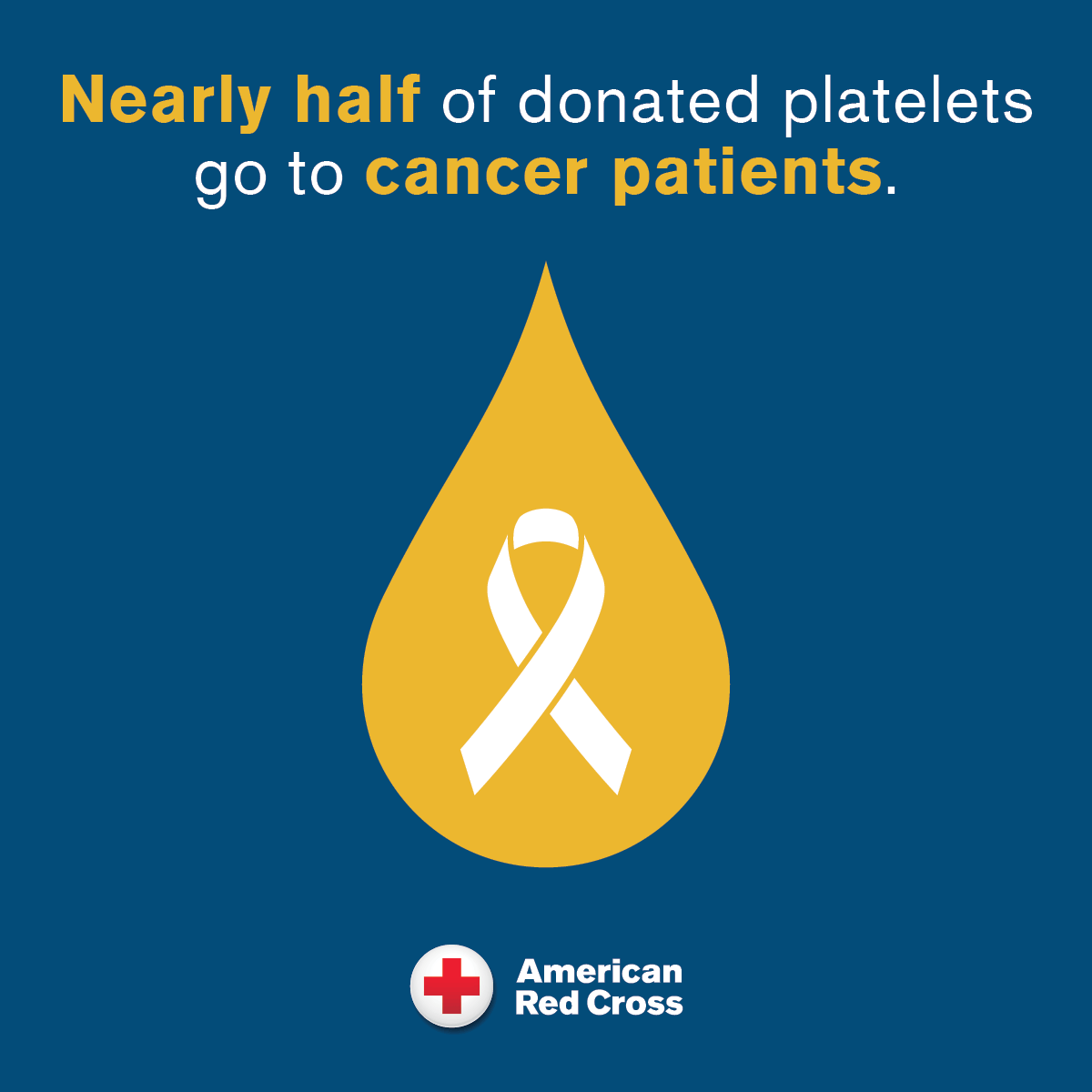
    Red Cross graphic: Nearly half of all platelet donations go to cancer patients.

    Another way you can aid the movement is by donating blood or platelets. Fifty percent of all platelet donations, in particular, are transfused to cancer patients. Platelets stop bleeding in the body by attaching to the linings of blood vessels. Thus, platelets are an important contributor to damage-repair within the body; this is especially true for those suffering from cancer, as the disease is known to reduce platelet levels in the blood of patients (a condition called thrombocytopenia). Platelets also bolster the general production of healthy blood cells.

    Platelet donations are in constant need because they have a shelf life of only 5 days. Individuals with all blood types (except for O negative and B negative – those donors can make the most impact by giving whole blood or Power Red donations) are encouraged to give platelet donation a try. Visit RedCrossBlood.org to schedule a donation appointment.

    Looking ahead, the “Close the Care Gap” focus for 2024 will be “together, we challenge those in power.”  Here, we’ll promote the widespread availability of health services through forging connections with community leaders and political figures. The overall purpose of this three-year campaign is to eventually create a cancer-free world for all.

    To conclude, it is crucial that cancer care inequity is wholly eliminated so that everyone in need can receive proper treatment and further medical attention. This year, make sure to do your absolute best in spreading awareness pertaining to the “Close the Care Gap” initiative!

  • National Blood Donor Month: Local Red Cross volunteer overcomes fears to help save lives

    By Ava Arteaga

    American Red Cross volunteer and first-time blood donor Ava Arteaga. Submitted photo

    My name is Ava; I’m twenty-two years old, and I am a recent first-time blood donor thanks to the American Red Cross and its incredible volunteers.

    Shortly after joining the Red Cross as a volunteer, I realized I had never donated blood myself. I knew blood donations had decreased since the start of the pandemic and decided this would be a great way to begin my volunteer-journey and contribute to those in need of lifesaving blood.

    I began this process by booking an appointment online at RedCrossBlood.org. I scheduled an appointment and decided to complete my RapidPass® next— this way I could save time on the day of the blood donation. When the day eventually arrived, I got dropped off at the blood drive by my brother and planned to have a friend pick me up. My mother is a nurse and insisted I not drive myself home.

    Once inside, I was greeted by a nice Red Cross volunteer. He could tell I was feeling a bit anxious and chatted with me for a minute. He answered my questions, told me what to expect, and offered positive encouragement. I was directed to another volunteer who greeted me, took down some of my information, and recorded my blood pressure.

    Within a few minutes, I was being walked over to the center of the building where several tables were spread out – some of which people were laying on. I was somewhat thrown off by this and asked what that was all about. The volunteer explained that I would be laying down during the blood donation portion to make sure I would be safe and secure in case I suddenly felt faint.

    At this point my anxiety heightened a bit more. My biggest fear going into this process was that I’d faint during the donation. I sat down on the table and started imagining how I could politely say that I didn’t think this through; however, the idea of walking out gave me more anxiety than the idea of donating. So, I stayed put. I also started to quietly cry.

    Laying back and staring at the blurry ceiling, I heard footsteps approaching me until I saw a figure in my peripheral vision. It was a nurse I hadn’t met yet. She started talking to me with a big smile and empathetic eyes. She assured me that I would be alright and tried to rid my nerves with jokes and laughter.

    Pretty quickly, it worked. She had a nurse’s touch! She told me that she’d be keeping an eye on me and that she would let the phlebotomist know to do the same. The phlebotomist, who was just as comforting and uplifting, performed the blood extraction in no time. Within 10 minutes, I was enjoying snacks and refreshments. I even hopped on my computer and started working while I waited for my ride to arrive.

    My anxiety had absolutely transformed into relief and joy. With the help of the American Red Cross volunteers and staff, I successfully donated blood for the first time. My worst fears never came to fruition. After it was all said and done, I felt fine. Besides feeling a little tired and weak, all 115 pounds of me was in top notch shape. The entire process lasted only an hour, and I was able to continue my day normally. I am already looking forward to my next blood donation!

    If fear or anxiety is holding you back from donating blood, my advice is to let the staff and volunteers of the American Red Cross take care of you so that you can take care of a patient in need. Thank you, Red Cross! This month, I hope you resist those worries and make an appointment to donate blood.

  • National Blood Donor Month: Blood donation is no laughing matter for comedian Mary Frances Connelly

    By Jackie Faiman

    Mary Frances Connelly. Submitted photo.

    Mary Frances Connelly is a mother, a grandmother and a native Philadelphian. She is a standup comedian who has been refining and earning a living from her act for 37 years. She first got into standup to support herself and her daughter, though she admits that it sounds crazy to enter show business for the money. She figured out she was funny early on when she had the boys on her bus ride to school laughing so hard they cried.

    “I could make girls laugh, but it’s rare that a female comic can make men laugh.”

    She is also a regular blood donor for the Red Cross.

    She remembers the event that moved her to become a donor. It was 1982 and she had just given birth to her daughter. During the difficult delivery, she received two units of blood which, she says, saved her life. Now she wants to pay forward the gratitude she felt for that gift.

    She has her regular blood donation down to a science. She schedules it for a Friday evening. After a meal at a local diner, she visits a donation site at a church in Downingtown. Afterward she stops at her daughter’s home to care for her grandson.

    “He wants to know all about that red bandage.”

    And she plans to keep donating for as long as she can.

    “You just feel so good when you’re doing it, and you know that you’re making a difference in someone else’s life.”

    Like many donors, Mary Frances uses and loves the Red Cross Blood Donor App.

    “The App keeps you apprised of your donation. It tells you when they are vetting it and which hospital it goes to. My first one last year went to CHOP (Children’s Hospital of Philadelphia). I told my grandson…and he got very excited knowing that my blood was helping little kids.”

    When asked why she gravitated to the Red Cross, Mary Frances points out that the organization steps in at a critical point in peoples’ lives, whether providing a blood donation or relief after a flood or a hurricane.

    “They let you know that there will be a new kind of normal. When you see the Red Cross, you know that things are going to be OK.”

  • National Blood Donor Month: Q & A with writer and 3-gallon blood donor Shawn Proctor

    By Sanaya SinhaRoy

    Frequent Red Cross blood donor Shawn Proctor with his son, Colin, a new donor and senior at Villanova University. Submitted photo.

    “Great things are done by a series of small things put together.” These wise words by Vincent Van Gough can be shown through the act of donating blood. The importance of donating blood is vital. If just one person takes the time to sit down and donate, it can save the lives of up to 3 people. Middle-grade fiction writer Shawn Proctor knows this and has donated 3 gallons of blood so far.

    Shawn has been published in many different literary journals and was nominated for Best New American Voices. He works at Villanova University, where he was first exposed to the idea of donating blood. Here is what he says about his work as a writer as well as his experience of being a regular blood donor.

    Q: When did you make the decision to start donating blood and why?

    A: I work at Villanova University and noticed the College of Nursing was hosting a blood drive. I was a bit afraid of needles at the time, but my mother is a respiratory therapist, and I knew the importance of donating blood. I decided to give it a try on my lunch break. 

    Q: How did you feel after you donated blood for the first time?

    A: So happy. So many of my co-workers were at the drive. I loved seeing a community of students, staff, and faculty come together for the common good, and I was thrilled to contribute my small part to that collective effort. 

    Q:  What gave you the motivation to start donating blood regularly? 

    A: At first, the convenience. The Blood Donor App makes it SO easy to find and schedule a donation. Then I learned at a Red Cross drive that my blood is particularly ideal for babies in neonatal intensive care units. My wife works with very young babies at a school. Knowing that my blood can save someone’s small child, to give them a chance to grow up – that’s all the motivation I could ever need.  

    Q: Having donated 3 gallons of blood already, what would you say to others that are a hesitant of donating for the first time?

    A: Download the Blood Donor app and give donating whole blood a try. The donation process is usually fairly short, but it might take a few times before you get really comfortable. And that’s OK. I listen to audio books or music while donating. Additionally, before you leave, they give you yummy snacks and, sometimes, fun freebies, like a shirt. The Shark Week shirt this year was (*blows chef’s kiss*) amazing. 

    Q: As a middle-grade fiction writer, how many different stories have you written in your career?

    A: In the beginning of my career, I focused mainly on short fiction, so there are several hundred stories in my back catalog –25 have been published in places like Daily Science Fiction, Galaxy’s Edge, and Flash Fiction Online. More and more, I am working on novels for children and have been pitching literary agents in the hopes publishing those longer tales too. 

    Q: What is the hardest part of being a writer in today’s world?

    A: Finding an audience. Your stories compete with an ocean of entertainment media, not to mention the constant social media fads and distractions of cell phones. Stories have to be captivating or you risk … um … opps, sorry! I just heard a notification on Twitter about something a celebrity said on Instagram. Or was it TikTok?

    Anyway, where was I? 

    Q: Have you ever thought of using your creative writing skills to inspire others to donate blood? 

    A: I typically bring in elements of things that are important to me in my stories. For example, I wrote about the horses on Assateague Island in one novel and the importance of the arts in schools in another. Donating blood to the Red Cross is similarly vital, and I know it will find a place in a story someday soon.

    Q: Is there any additional information you would like to share?

    A: During the pandemic, I felt like there was so much division in our country. People were isolated. I resumed donating blood as soon as the Red Cross indicated it was safe to do so, because I knew this was one small way to help out during a very difficult time for many people. 

    Now that restrictions have eased, my children are getting involved donating as well, as they are old enough and motivated to help out others.