Red Cross Collections team member Shannon Cobo (right) with her children Riley and Alex. Submitted photo.
When the COVID-19 pandemic paused her career in home health care, Shannon Cobo brought her 20 years of phlebotomy experience to the American Red Cross. The move exceeded her wildest expectations.
“This job is the best I have ever had,” she said. “It’s so rewarding.”
Shannon likes the ability to go to different places and meet new people every day. But it’s the Red Cross mission that she finds most meaningful.
“It’s sometimes easy to get caught up in our daily tasks and forget why we’re there, but then you have these meaningful moments talking with the donors, and it’s nice knowing you’re making a difference,” she said.
She tells people everywhere she goes how much she loves her job. And when Shannon meets someone looking for a job, she encourages them to apply to the Red Cross.
“I love my job that much that I want others to have that experience.”
Editor’s Note: National #BloodCollectorsWeek is Sept. 3-9, 2023. Celebrate those who ensure donors have great experiences and patients get the blood they need. Schedule an appointment to donate blood!
Red Cross Collections team member Kristin Mindock. Submitted photo
September marks Kristin Mindock’s one-year anniversary working with the American Red Cross as a phlebotomist. And while collecting blood is a big change from her previous career in the restaurant industry, she enjoys the challenge.
“Every vein is different. Some are more challenging than others,” she said.
The Red Cross offers six weeks of paid, comprehensive training for phlebotomists at all levels, including those like Kristin who have no prior experience in the field.
“I look back a year ago, how I was asking everyone for help [and] now I can solve those problems on my own,” she said. “I give myself a little high five when that happens.”
In fact, it’s Kristin who now provides that help for members of her team. Thanks in part to her managerial experience, she became a collections specialist II, also called a “charge” in December. That promotion means she’s the team’s designated problem solver on assigned blood drives.
But Kristin is quick to point out that she’s still “a worker” and enjoys interacting with blood donors – a highlight of her job.
“I like meeting new people every day,” she said.
Editor’s Note: National #BloodCollectorsWeek is Sept. 3-9, 2023. Celebrate those who ensure donors have great experiences and patients get the blood they need. Schedule an appointment to donate blood!
Red Cross Collections team member Sarah Levetter. Photo by Jenny Farley/American Red Cross.
Sarah Levetter has one trait that might make you wonder at first why she chose phlebotomy as her profession.
“I’m terrified of needles,” she said. But that fear is her secret weapon to help people who want to donate blood.
“Some people come in – they look terrified. So I manage to relax them.” She explains her fear to donors and says, “I got you. We’re gonna get through this.”
Sarah said she “fell in love” with phlebotomy after starting the job for the Red Cross as a temp. Temporary became permanent after realizing she loved everything about the process, especially meeting new people at blood drives.
“One of the volunteers calls me the happy dancing phlebotomist. I’m always smiling.” Sarah likes putting new donors, especially high schoolers, at ease.
She remembered one donor who seemed nervous at first but after she helped him through the process she got the best news possible.
“He said he is now a lifetime donor because his first experience went so well.”
Sarah is thinking of becoming a nurse so she can know more about the medical issues that some donors have. In the meantime, she has a message for anyone who wants to give blood but might be afraid.
“Let’s have some fun. We’re doing a good thing.”
Editor’s Note: National #BloodCollectorsWeek is Sept. 3-9, 2023. Celebrate those who ensure donors have great experiences and patients get the blood they need. Schedule an appointment to donate blood!
Leghend, with a name as unique as he is, just started first grade and told his mom he had a great first day. He also told her to remove some of the games from his phone because he wanted more educational apps for the school year. He’s six years old.
Kieshia Martin describes her son as smart and curious. “He’s at that age where he questions everything,” she said.
Leghend is tech savvy and enjoys things other kids love like basketball, swimming and Boy Scouts. He also deals with something they don’t have to. He has sickle cell disease.
Kieshia learned her son had the genetic blood disorder just a couple of days after he was born when the hospital ran routine blood tests.
“I was devastated. It was like a punch in the gut.”
People with sickle cell disease have red blood cells that are hard, in the shape of a crescent, instead of being soft and round. That makes it hard for blood to carry oxygen throughout the body. They need blood transfusions to manage health complications like anemia, organ damage and terrible pain.
Kieshia says sometimes it’s hard to tell if Leghend is hurting. “He’s a jokester.” She said he does have pain in his stomach and legs and can’t go long periods of time in activities that involve running or jumping.
“He gets winded.”
Last Fourth of July, Leghend ended up in the hospital with an enlarged spleen and got pneumonia while he was there. “It’s hard to see your kid like that.” He needed his first two blood transfusions. “If there wasn’t a donor I don’t know what could have happened.”
Having to rely on the kindness of strangers to save your son can be overwhelming.
Kieshia says donating blood is about “people willing to help someone they don’t know.”
One in 3 African American blood donors will be a match for patients who have sickle cell disease. She would donate her own blood to her son but “I’m not a match,” she said.
The Red Cross is working to increase the number of blood donors who are Black to make sure patients with sickle cell disease get the blood they need to thrive and survive.
On September 14th, a blood drive will be held in Leghend’s honor from 2-7 p.m. at the Ricketts Center at 658 Beech St. in Pottstown. Donors are needed. Schedule an appointment here.
Kieshia wants for Leghend what all parents want for their kids. “I never want him to struggle.”
She has dedicated her life to seeking out the best medical care, no matter how far she has to drive to get it. She’s also searching for a “forever blood donor,” someone who is the perfect match for her son and can donate throughout his life.
Kieshia plans to go to nursing school to learn more about how she can help Leghend and communicate more effectively with his many specialists.
For now, she tells him what he needs to know by sharing “little books and pamphlets” about sickle cell disease that a six year old can understand. She never wants him to feel like a victim. “I want him to be as normal as possible,” and she said, “I try to make each moment count.”
September is Sickle Cell Awareness month. To schedule an appointment to donate blood, download our free Red Cross Blood Donor App, visit RedCrossBlood.org or call 1-800-REDCROSS.
Adam Joseph holds a first-time blood donor sign after giving blood at Saint Luke Lutheran Church in Devon on Aug., 7, 2023. Photo by Konrad Jones/American Red Cross
Action News (6abc) meteorologist Adam Joseph gave blood for the first time, on the first day he was eligible, Monday morning, Aug. 7 – the day the American Red Cross implemented new FDA guidelines that eliminate broad, time-based deferrals based on sexual orientation.
As a long-time advocate for this change, Adam described the milestone as “a day I have been waiting for my entire life.”
“Honestly, I don’t even feel like blood is coming out of me right now!” he joked in a Facebook video recorded from the donation table. “I can’t believe this day is here and that you guys are with me. Love you all!”
Action News reporter TaRhonda Thomas covered Adam’s historic donation, which he made at a Saint Luke Lutheran Church blood drive in Devon.
Watch: 6abc’s Adam Joseph Donates Blood For the First Time.
“It took over 40 years for someone like me to be able to give blood, and it took me 4 minutes and 33 seconds to give the gift of life,” he said following his donation.
Adam described the day and donation process as “exhilarating,” and promised he would be back to donate again in 56 days, as soon as he is eligible.
“Not to be a weather pun, but I’m actually on cloud 9 that my blood is going somewhere and is going to help someone and save a life. That’s what we’re about here today is saving a life,” he said. “We’re allowing people who have never ever been able to give blood, maybe their entire adult life like myself, the opportunity to walk in the door and do this.”
Adam is among the new donors welcomed into the lifesaving mission of the Red Cross Monday. Under the new FDA donor screening process, all donors answer the same eligibility questions regardless of gender or sexual orientation and are assessed for blood donation based on individual risk factors, not on sexual orientation. This change eliminates the FDA’s previous policy that deferred men who have sex with men from giving blood.
“The Red Cross celebrates this historic move as significant progress and remains committed to achieving an inclusive blood donation process that treats all potential donors with equality and respect while maintaining the safety of the blood supply,” explained Stefanie Arcangelo, interim CEO, Red Cross Southeastern Pennsylvania Region. “The Red Cross is committed to achieving further progress and will continue to provide data to the FDA in support of making blood donation even more inclusive.”
Years of data have demonstrated that this new eligibility screening process ensures a safe blood supply patients can feel confident in. For years, the Red Cross has worked to change the deferral policy concerning men who have sex with men – this work included decades of data collection and assessment to improve transfusion safety, ongoing advocacy to eliminate donor questions based on sexual orientation, and our recent role as a leading contributor in the FDA-funded ADVANCE Study.
The Red Cross welcomes everyone who wishes to be part of our humanitarian mission. You can learn more about these updates as part of our Eligibility FAQs. There is also information specific to the LGBTQ+ community on our LGBTQ+ Donors page.
Mary Noll receives the American Red Cross Bob Hasmiller Award from Cliff Holtz, chief operating officer, and Gail McGovern, president and CEO, on April 26, 2023 in Washington, D.C. Photo by Dermot Tatlow/American Red Cross
For the past 18 years, Mary Noll has volunteered for the Red Cross. She has deployed at least 30 times, helping out after disasters at home and throughout the country. Now, her service and dedication have been nationally recognized with the prestigious Bob Hasmiller Award as the disaster services volunteer of the year. She received the honor at a ceremony in Washington, D.C.
Mary said she felt humbled by the award and shared the credit with her fellow volunteers. “I owe a lot of the award that I got to the people that I work with. I’ve had a lot of good people that have taught me and as a result I’ve turned around and tried to teach others what I’ve learned.”
In 2022, Mary volunteered 3,800 hours. “That’s almost two full time jobs,” she said. Mary has several roles with the Red Cross including instructor, mass care and many logistical jobs that help keep the Red Cross Emergency Response Vehicles (ERV) on the road during a disaster.
She is a Red Cross fleet and facilities volunteer partner, transportation lead, a National Fleet Operations (NFO) administrator and the specialty vehicle operator lead for the Southeastern Pennsylvania Region.
“When I go out on national responses, I go out as an admin so I assist the mechanics in inspecting and repairing and servicing anything that is on the disaster relief operation.
So we keep as many vehicles as possible functional.”
Those vehicles are critical to providing people with the help they need to recover from a disaster, like the one that inspired Mary to begin volunteering.
“I’m a Katrina baby,” she said. During Hurricane Katrina, Mary said she was sitting on a couch in Atlanta, on her birthday, watching the devastation and misery of the storm on the news. What she did next changed her life.
“I just said, what am I doing sitting here when I should be there?” She signed up to volunteer with the Red Cross and was immediately deployed to the Lower 9th Ward in New Orleans. “Basically, Ground Zero,” she said.
Mary fed people out of the back of an ERV for nearly a month and spent Thanksgiving with grateful residents in an empty lot in the middle of the Lower 9th Ward. “They said,
‘You’re part of our family and we need you to sit down and have dinner with us.’ So it was the most meaningful Thanksgiving I’ve ever had. Even to this day it makes me cry.”
Helping people survive after one of the deadliest hurricanes in U.S. history, taught Mary how important it is to cherish what you have because “you never know how much you have to lose until you lose it.”
Mary Noll donates blood at the 6abc blood drive on March 29, 2023. Photo by Alana Mauger / American Red Cross
Mary coped with her own immense loss when she kept volunteering with the Red Cross during the pandemic. “The Red Cross was there for me when my husband was diagnosed with a blood cancer,” she said.
After years of donating blood themselves, Mary and her husband Peter suddenly needed blood for Peter to fight cancer.
“Toward the end, he was getting 10 units of one type of blood product or another a week. If it hadn’t been for that, he wouldn’t have been around, as long as he had.”
Peter died of his rare cancer after a lifetime together and nearly 47 years of marriage. Mary credits blood donations with helping him live longer, giving them more time. Peter had a volunteer spirit too. The week before he died he helped move donated mattresses into the Red Cross House in Philadelphia.
The Red Cross House is the only one of its kind in the country. It’s a place for people who have lost everything in a fire or other disaster like a building collapse, to temporarily live while they rebuild their lives. Mary has volunteered there helping guests at the front desk when they first arrive.
If you are interested in volunteering for the Red Cross, Mary has some advice. “You get more out of it than you can ever put into it. People are so grateful that you’re there in their darkest hour.”
Mary plans to keep volunteering and sharing the Red Cross mission, with the memories of Hurricane Katrina and other disasters she has deployed to, never forgotten.
“That’s why I’m still here. I go out and I take care of people. People say why do you do it? And I say because if something like that happened to my family, I’d want somebody to do it for them.”
To learn more about how to become a Red Cross volunteer like Mary, or to donate blood, visit redcross.org.
Mascots Cuppy and Buddy helped kick off the partnership between the American Red Cross and Dunkin’ Greater Philadelphia. Pictured (from left) Jessica Weissman, senior field marketing manager, Dunkin; Stefanie Arcangelo, interim CEO, Red Cross Southeastern Pennsylvania; and Annette Tucci-Jenkins, district manager, Red Cross Penn Jersey Blood Service Region. Photo by Konrad Jones / American Red Cross.
Local blood donors are in for a treat this August. Dunkin’ of Greater Philadelphia is once again teaming up with the American Red Cross to provide 25,000 vouchers to American Red Cross blood donors in the region during August.
To thank donors who help refuel the blood supply throughout August, presenting donors will receive a Dunkin’ voucher for a free Medium Hot or Iced Beverage* and a free Egg & Cheese Wake-Up Wrap**, redeemable at participating Dunkin’ restaurants in the Greater Philadelphia area, while supplies last. Vouchers are not redeemable for cash. Dunkin’ and the American Red Cross celebrated the partnership today with a special media event at the American Red Cross Blood Donation Center. The Dunkin’ Community Cruiser was on-site, handing out free samples of Iced Coffee to celebrate the partnership kickoff.
“We are thrilled to continue our partnership with Dunkin’ and encourage donors to give to help prevent a summer blood shortage,” said Helen Munizza, Regional Donor Services Executive, American Red Cross Blood Services. “As you finalize your plans for the end of summer, make a blood or platelet donation appointment part of them and receive this special gift from Dunkin’.”
Donors who give now will help stock the shelves for the rest of the summer season. Schedule an appointment to give blood or platelets by using the Red Cross Blood Donor App, visiting RedCrossBlood.org, or calling 1-800-RED CROSS (1-800-733-2767).
“Dunkin’ is excited to once again team up with the American Red Cross and reward deserving blood donors this August,” said Jessica Weissman, Senior Field Marketing Manager, Dunkin’. “We hope that by offering donors a free Medium Hot or Iced Beverage and Egg & Cheese Wake-Up Wrap, Dunkin’ will help encourage the Philadelphia community to stop by a local blood drive or donation center and donate blood this summer.”
*NO PURCHASE NECESSARY. OFFER NOT VALID ON MOBILE APP ORDERS. Dairy alternatives, flavors, cold foam and espresso shots may be an additional charge. Limit one per customer per visit. Shop must retain coupon. May not be combined with other offers or promotions. No substitutions. Consumer must pay applicable tax. Void if copied, transferred or sold and where prohibited or restricted by law. Cash Value 1/20 of 1 cent. Terms apply. Good at participating Dunkin’ locations in Kent and New Castle Counties, DE; Atlantic, Burlington, Camden, Cape May, Cumberland, Gloucester, Mercer, and Salem Counties, NJ; Berks, Bucks, Chester, Delaware, Lehigh, Montgomery, Northampton and Philadelphia Counties, PA. EXP: 9/10/23.
The luckiest among us have a once in a lifetime friendship. For Dominic Chilberti, that friend was Chris. “Chris was everybody’s best friend. He was loved by everyone,” said Dominic.
They met at four years old and what began as children turned into decades of joy and camaraderie. Kindergarten, eight years of Catholic school, some high school and then as often happens in life, a separation of physical distance when they both moved out of their hometown.
In the 1980s, before smartphones offered Facetime and texting, Dominic and Chris managed to stay in contact the old fashioned way, “over the phone.”
For years, those phone calls ranged from 10 minutes to two hours. The talks cemented a friendship that ushered both men through the triumphs and failures of life, with a lot of laughter.
“Chris didn’t laugh at many of my jokes but when he did he had the best uncontrollable laugh and it would make my day.”
Then came news neither was expecting. Doctors told Chris he had brain cancer. Chris began a fight to live that led to treatment, surgery and a critical need for blood transfusions.
Throughout his illness, Dominic described Chris as the man everyone wanted to help. “Chris was the type of person that had so many friends it was actually hard getting a chance to help him.”
Chris fought hard for nearly three years but died in March of 2022. Mired in grief, Dominic wanted to do something and remembered what Chris had told him.
“Chris and I talked about how I wished I could do more and he mentioned donating blood. They were always telling him they needed blood donors.” So, in memory of his friend, Dominic began to give.
“I remember being so frustrated that all I could do is sit by and watch my friend wither away. After his passing this frustration grew. This gave me some purpose in helping in his memory.”
Dominic didn’t stop after donating once. In 2022, he donated at least 27 units. He started with whole blood and then moved on to platelets. He said he donates “as often as the requirements allow me. I continue to do this in the hopes that anyone in treatment or surgery in need of blood never goes without.”
Some people may be hesitant to give a lifesaving blood donation, but Dominic offered reassurance.
“For most people it is fear of the unknown. It can be intimidating before you actually do it, but once you have you will laugh at yourself for waiting so long. If you can survive a blood test, you can donate blood. It really isn’t that different and it doesn’t take much time.”
Dominic wants to recruit others to donate blood. He also plans to keep donating himself and when he does he will always think of Chris.
“I was very lucky to have had him in my life.”
For more information on how to donate blood and to schedule an appointment, visit RedCrossBlood.org.
Red Cross graphic: Based on your blood type & patient needs, there is a “right” type donation for you. Learn more at RedCrossBlood.org.
Have you ever thought about what blood is and why it’s so important? We all know we can’t live without it. Blood is a fluid in our bodies that has several important jobs. Blood transports oxygen and nutrients to our cells and also helps get rid of waste. Blood is made up of different components: plasma, red blood cells, white blood cells and platelets.
Every two seconds, someone in the United States needs blood. If you are ever in need of a transfusion, it’s important you get the blood type that’s right for you. There are eight primary types of blood, though there can be variations. I have type AB-,which is considered rare. Less than one percent of people in the United States have it. The other seven most common types are A+, A-, B+, B-, AB+, O+ and O-.
So how is blood type determined? It all comes down to genetics. What type of blood your parents have contributes to what type you have. In people, blood type can be determined by the presence of specific antigens on the surface of a person’s blood cells. There are two types of antigens: A and B. The AB blood type results from both A and B antigens being present on a person’s blood cells. If someone has red blood cells that don’t inherit either antigen, that’s represented by the letter O.
Bags of donated O- blood at an American Red Cross donation center.
There are two main blood groups: ABO and Rhesus (Rh). The ABO group provides the letter of the blood type. The Rh group determines the sign, plus or minus, of the blood type. Rh is a protein that can be found on the surface of blood cells. If this protein is detected, the person is said to be Rh+. If it’s not detected, the person is Rh-.
When designating a blood type, the Rh does not have to be included; only the positive and negative signs need to be conveyed, along with the antigen-designated letters.
There is no substitute for blood. It can’t be artificially produced. That’s why donors are so critical. It’s a known fact that blood transfusions help save lives. The transfusion of blood from a donor to a patient in need can provide the recipient with a multitude of benefits depending upon their circumstance and condition. But a transfusion can only be completed if the donor has a compatible blood type with the recipient.
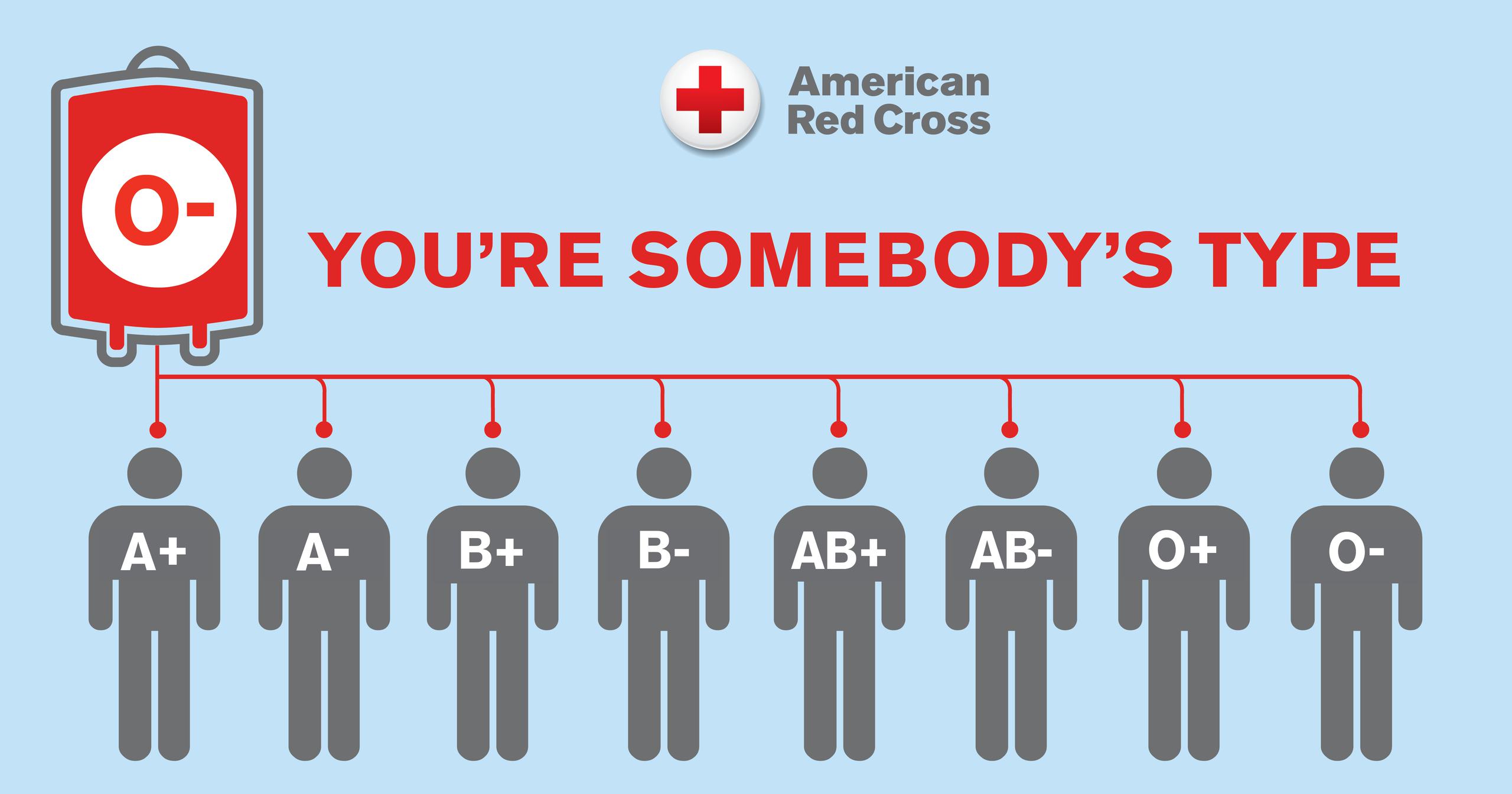
Red Cross graphic: Type O- can be transfused to people of all blood types: A+, A-, B+, B-, AB+, AB-, O+ and O-.
Blood types are compatible if the donor’s blood antigens do not have corresponding antibodies in the recipient’s blood. For example, if the donor’s blood is type A, the recipient can not have anti-A antibodies. Type O+ is the most common blood type, and more than 80% of individuals can receive O+ blood.
Type O- is labeled as the “universal donor,” as it can be provided to any other blood type. Only 7% of people in the U.S. have type O-. Type AB+ is labeled as the “universal recipient,” as it can receive any other blood type. The same principles that apply to the transfusion of red blood cells also apply to the process of donating platelets and plasma. The universal plasma type is AB.
The Red Cross maintains 40% of the nation’s blood supply, and the demand for blood is great. You don’t need to know your blood type to donate, but you will learn your type as part of the donation process. If you are interested in donating blood, you can learn more online at RedCrossBlood.org.
Blood donor arm while giving. Photo by Michelle Frankfurter/American Red Cross
It’s a great feeling to get the notice that you’ve saved lives just by sitting in a chair for a couple of hours and donating platelets. I’ve been donating platelets for a year and it’s been the most rewarding experience I’ve ever had. Just knowing that my donation has helped children who are fighting cancer and people who have suffered trauma makes that two hours go by quickly. I keep a map where I can mark off each state where a donation has gone. It’s so much fun to see how far donations go and to find out what hospital is using them. So far my donations have made it to New Jersey, Philadelphia, West Virginia and Maryland.
I especially love when my platelets go to CHOP (Children’s Hospital of Philadelphia) because I know they are helping a child who is fighting cancer. We all know someone who has had cancer. If you’ve ever wondered what you can do to help, donate platelets. It’s very gratifying to be able to make a difference for a family that is living with so much pain.
What are platelets?
Platelets are a component of blood that assists with blood clotting. They are essential for people who are dealing with cancer, chronic diseases and traumatic injuries.
Every fifteen seconds someone needs platelets. Donors are needed every day because of this need and due to the short shelf life of platelets. They can only be stored for five days.
What is a donation like?
The whole process takes about two hours. First, a phlebotomist takes your vitals to make sure you can donate that day. Then you are shown to a very comfortable chair where you will sit for the duration of the donation. You have to sit still for the donation, but don’t worry! The Red Cross provides Netflix so you can relax and stream a movie you’ve been waiting to see. Or catch up on that series you’ve wanted to binge.
The phlebotomist will insert two needles, one in each arm, and hook that up to an apheresis machine. This machine filters out the platelets from your blood and then returns your blood to you in your return arm. Some donation centers can do a one arm donation where they stick your arm in two different places so you can give blood from one needle and receive the return in the second needle. However, most centers use both arms. You must keep your arms still during the donation so you won’t be able to read a book or use your cell phone.
Tips for donating
You might get a little chilly because the blood being returned to you is a lower temperature. The center can provide a warm blanket for you to keep you warm during your donation.
Sometimes I feel a little tingling in my mouth or upper lip. This is because of the citrate included in the return arm. This helps your blood to clot. If this happens, let your phlebotomist know right away and they can adjust the amount of citrate and give you Tums, which will alleviate the tingling.
You can donate up to 24 times a year. Watch out, it becomes addictive once you donate. You will want to keep helping people and doing something that makes a huge difference in someone else’s life.
Get a good night’s sleep and make sure to keep yourself hydrated a couple of days before you donate.
Tell the staff if you feel any discomfort at all. There is usually a work around for whatever you are feeling.
Keep thinking about all the lives you are saving!
Join the online support group
One of the best parts of donating is joining the online American Red Cross Platelet Donors Group on Facebook. There are so many supportive people out there who love donating as much as you will. They can give you great advice and encouragement to keep going. With over nine thousand members, they cheer each other on, give advice and it’s moderated by great volunteers who can answer any question you might have.
Platelet donation is a great way to give back. It really does help a lot of people in need. It’s a fun experience and you will find great support to keep doing it. So don’t wait! Download the Red Cross Blood Donor App today and make an appointment. You’ll be happy you did, and so will someone else!