By Bill Thawley
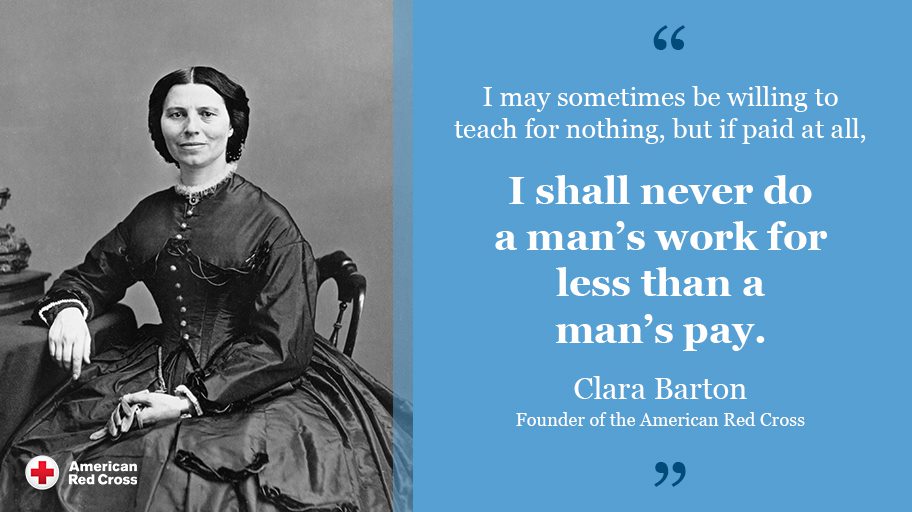
The second part of Clara Barton’s story begins in 1854 with her arrival in Washington, D.C., to work in the U.S. Patent Office. As a recording clerk, she earned $1,400 a year. But the following year, the Pierce Administration demoted her to copyist and reduced her salary to 10 cents per 100 words copied. Very few women worked for the federal government at the time, and the few who did were simply not paid the same as men. Barton demanded equal pay and was rejected. Eventually the Buchanan Administration eliminated her position.
She left D.C and moved to her home in Massachusetts, living with relatives and friends during this time. She also taught school in the Worcester area. But in 1860 she returned to Washington to serve as a copyist in the Lincoln Administration. This move foreshadowed her future role in the Civil War.
When the 6th Massachusetts Infantry arrived in Baltimore in 1861, the men had to change trains and march to the next station to get to Washington. They were among the first regiments to arrive at the start of the war. As they marched, they were attacked by a large crowd; many were injured. But Barton was on hand to meet them when they finally got to Washington. She recognized many of them, as they were from the area where she taught in Massachusetts.
Barton immediately sought to help the soldiers. She appealed to friends and family members in her home state for donations. She later located the soldiers and began to source supplies to help feed and care for them. She left the patent office and helped the soldiers from her home. Her appeals for help were eventually quite successful. The city really had not been prepared.
After the battle of Bull Run in July 1861, Barton continued to tend to wounded soldiers as they arrived back in Washington. She eventually established a distribution agency to provide supplies and medicines for the soldiers. Her appeals for funds and supplies continued to yield donations and she rented warehouses to store the supplies.
In March 1862 Barton’s father passed away. He’d been a captain in the War of 1812, and he encouraged her from his deathbed to continue in her endeavors to support the soldiers. Later that year, she gained permission to bring supplies to battlefields.
After the Battle of Antietam, Maryland, Barton showed up with a wagonload of supplies and met Dr. James Dunn of Connaught, Pennsylvania. If heaven ever sent out an angel, Dr. Dunn thought, Clara Barton would be the one. He was so impressed that he wrote a letter to his hometown newspaper, calling her “the Angel of the Battlefield.” The letter was printed in many newspapers in the North, and the name stuck. Throughout 1862 and 1863 she followed the Army of the Potomac and cared for the wounded. In April 1863 she met and befriended Colonel John J. Elwell, a physician and attorney from Ohio. They exchanged letters for many years; she kept a photo of him on her desk.
During this period, Barton did nonstop nursing and helped feed soldiers at the sites of several Civil War skirmishes. She also stayed dedicated to the cause of equal rights for women and African Americans and trained many formerly enslaved people to be nurses. After a brief hiatus in D.C. to rest and collect supplies, Barton was placed in charge of diet and nursing for a Union Army corps hospital that served the wounded from the almost daily fighting outside Petersburg, Virginia.
In early 1865, Barton again returned home, this time to care for her dying brother. Later that year she received approval from President Lincoln to address the problem of the large numbers of missing soldiers. The creation of the “Office of Correspondence with Friends of the Missing Soldiers of the United States Army” ushered in her four-year search for missing men. At Andersonville, Georgia, where a prisoner of war camp held Union soldiers during the final 14 months of the Civil War, she assisted in the marking of 13,000 graves.
For three years after the war’s end, Barton gave many lectures to support the Office of Correspondence. She shared podiums with such luminaries as Ralph Waldo Emerson, Mark Twain, and Frederick Douglass. She also met Elizabeth Cady Stanton and Susan B. Anthony; those friendships aligned Barton with the suffrage movement. Douglass and Barton remained friends for years, and he would later sign the original Articles of Incorporation for the American Red Cross.
In 1869 Barton closed the Office of Correspondence; it had received more than 63,000 letters and identified 22,000 missing men. Fast-forward to the 1990s: The building that housed this office was slated to be torn down—but in a lucky twist of fate, an inspector just happened to find the office, exactly as it’d been left in 1869. The treasure trove of letters, clothing, and more is now housed in a downtown D.C. location run by the National Museum of Civil War Medicine.
In September 1869, Barton traveled to Europe on the advice of her doctor. There she met Dr. Louis Appia and for the first time learned of the International Committee of the Red Cross (ICRC). From 1870 to 1871 she did relief work in Europe during the Franco-Prussian War, after which she suffered from “nervous exhaustion” and temporarily lost her eyesight. She traveled to England in an attempt to recuperate, and then returned to the U.S. in 1873.
The ICRC had asked Barton to establish a Red Cross in her country, and she proceeded to petition President Rutherford Hayes to do just that. The prevailing wisdom among leaders at the time was that there would never again be a crisis like the Civil War—and hence an American Red Cross would be unnecessary. Finally in 1881 she convinced President Chester Arthur that the Red Cross would be valuable in disasters other than war. With federal funding, Barton established the first office of the American Red Cross in her apartment in Washington. The date was May 21, 1881, and this year is the 140th anniversary of the American Red Cross.

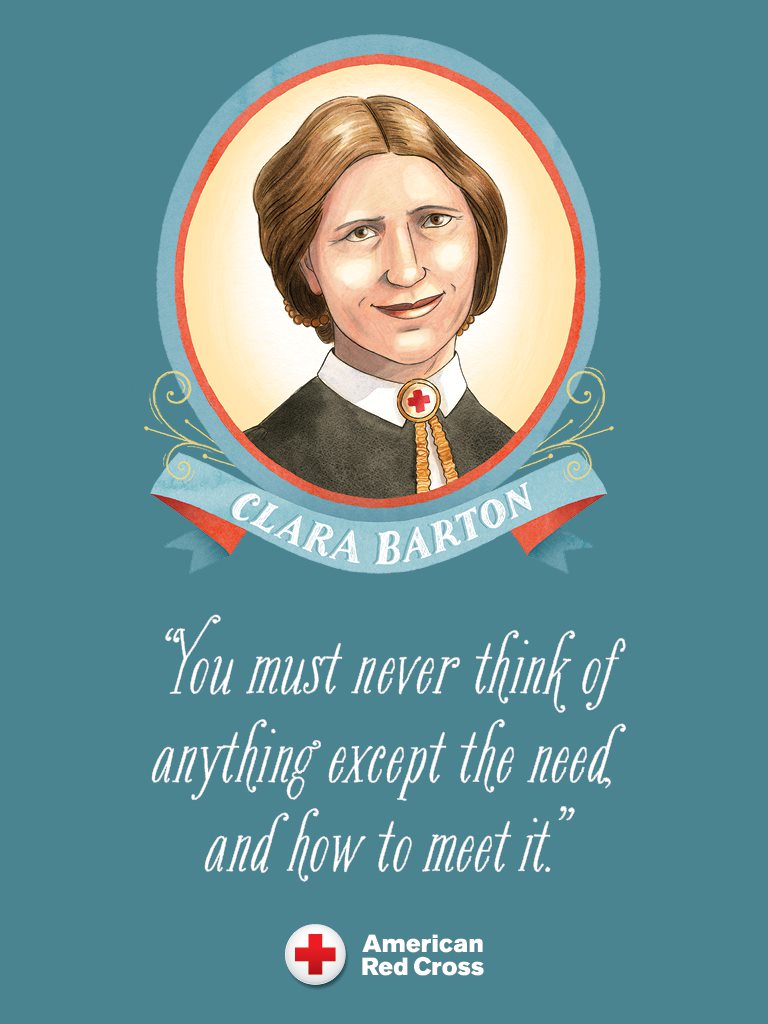
In Barton’s own words, “You must never so much as think whether you like it or not, whether it is bearable or not; you must never think of anything except the need, and how to meet it.” She was a remarkable woman ahead of her time. She was a champion for the equal rights of women and embraced the humanitarian principles of diversity, inclusion, and equal rights. She advocated for the expansion of rights for African Americans. She was one of the first women to work for the federal government, and vowed that she would never do a man’s work for less pay.
Many of Clara Barton’s life experiences reflect what the Red Cross does today: nursing, education, training, reconnection, logistics, and equal opportunity. The organization’s mission statement says it all: “The American Red Cross prevents and alleviates human suffering in the face of emergencies by mobilizing the power of volunteers and generosity of donors.” This mission embodies the very causes that Barton fought for during the Civil War and continued in her years as president of the American Red Cross.


