Category: Historical

  • International Nurses Day: Thank you Red Cross nurses!

    By Rob Wilder

    May 12, the anniversary of the 1820 birth of pioneer nurse Florence Nightingale, is International Nurses Day honoring the dedicated work by nurses worldwide. In 1887, Clara Barton followed in her footsteps to found the American Red Cross. Today more than 20,000 volunteer and employee Red Cross nurses and other related health professionals help alleviate suffering, provide humanitarian aid, and promote healthy living throughout the United States.

    The Red Cross has a long history of involving nurses in its mission, both in disaster relief and community service. Red Cross nurses have worked in various capacities, including disaster relief after floods, hurricanes, and other emergencies, and have also taught courses in home nursing and nutrition. Additionally, they have played a crucial role in blood donation drives and other health-related activities.

    Red Cross graphic – Thank you, nurses!

    The Red Cross nurses of today

    Current initiatives of the American Red Cross Nursing Committee include work on the elimination of measles and rubella. In conjunction with community partners, Red Cross nurses work to vaccinate children and educate families on the critical importance of immunization to eliminate the dangers of these diseases to children and pregnant women. They also work in preventive care by addressing the widespread risks of diabetes and hypertension in the community.

    Strategies of the Red Cross Nursing Committee are developed for the entire country. However, alleviation of hunger, more equitable access to healthcare and remedies for unfair housing policies are applied with local community partners.

    Red Cross Chief Nurse: Urgent need for healthcare professionals

    Linda Fahey is the Chief Nurse for the American Red Cross and Program Director for Nursing and Health. She leads nursing and health practices across the organization, focusing on recruiting and engaging health professionals to support the Red Cross mission. As a Disaster Health Supervisor, Linda provides care and leadership during disasters. She began her career as a Navy nurse and has since held academic and hospital roles, expanding to executive positions while maintaining adjunct faculty status to support nursing education.

    The need for nurses nationwide continues to grow with the number and intensity of disasters increasing each year. Just this year nurses and other health professionals responded to help individuals and families address their health needs after losing homes in the fires that swept Southern California in January. During the month of April, the call went out again as storms hit Kentucky, Missouri, Arkansas, Tennessee, Mississippi, and Illinois.

    For each of these locations, nurses and their colleagues in other health professions volunteered to serve, making a difference in the lives of people who have lost so much. I recently responded to Tennessee as a disaster health services nurse and saw the devastation of tornadoes and flooding first-hand as I worked with a team of nurses who were on the ground supporting families who had lost everything.

    We worked to address health care needs caused by the storms and went home knowing that our care made a difference. I urge those who are able to join the long line of Red Cross nurses who have served in the past. Please consider completing the training for Disaster Health Services so you are ready to respond in your community, in your region, and possibly even deploy nationally to help with this growing need.

    Join us!

    Many volunteer nurses and other healthcare professionals are now urgently needed because of so many recent disasters. If you are interested becoming a Red Cross nurse, click here.

    Visit our website to learn more about the Red Cross Nursing Network.
  • Throw Back Thursday: March is Women’s History Month

    By Anne Arnold

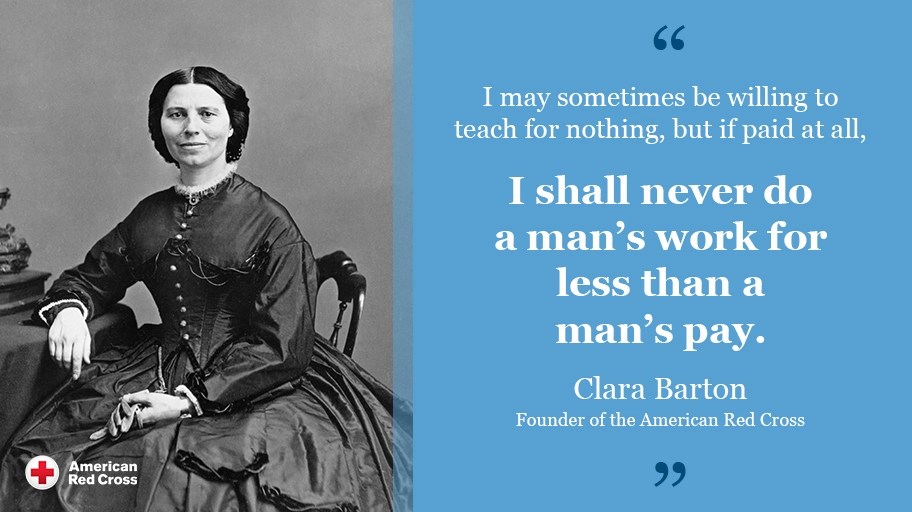
    Red Cross graphic – “I may sometimes be willing to teach for nothing, but if paid at all, I shall never do a man’s work for less than a man’s pay.” – Clara Barton, Founder of the American Red Cross.

    Every year, March is designated Women’s History Month by presidential proclamation. The month is set aside to honor women’s contributions in American history.

    Women’s History Month started as Women’s History Week

    Women’s History Month began as a local celebration in Santa Rosa, California. The Education Task Force of the Sonoma County Commission on the Status of Women planned and executed a “Women’s History Week” celebration in 1978. The organizers selected the week of March 8 to correspond with International Women’s Day. The movement spread across the country as other communities initiated their own Women’s History Week celebrations the following year.

    In 1980, a consortium of women’s groups and historians, led by the National Women’s History Project (now the National Women’s History Alliance), successfully lobbied for national recognition. In February 1980, President Jimmy Carter issued the first Presidential Proclamation declaring the Week of March 8th 1980 as National Women’s History Week. Discover more about Women’s History Month and its importance here.

    Women’s History Month and the Red Cross: Honoring Unsung Heroic Women Who Served in Wartime

    Women have played an important role in fulfilling the lifesaving American Red Cross mission since Clara Barton founded the organization more than 140 years ago. Known as the “Angel of the Battlefield,” Clara had cared for wounded soldiers during the Civil War before establishing the Red Cross in the U.S., where she was a visionary leader in serving those in need.

    This March — which is recognized as both Red Cross Month and Women’s History Month — we take a look at some of the Red Cross women who stepped up to help throughout history, exemplifying Clara’s humanitarian spirit and courageously supporting U.S. service members in wartime. To read more about some of the heroic women in our Red Cross history, click here. You can also get to know our modern-day women leaders by checking out our #LeadLikeClara blog series, which started in March 2022.

  • Red Cross celebrates opening of renovated Spring Garden Campus in Philadelphia

    By Alana Mauger

    A new feature of the Red Cross Spring Garden Campus is an historical timeline from 1916 to present day that spans the curved hallway connecting the main entrance to the atrium. Photo by Katerina Luchinina / American Red Cross

    The American Red Cross Southeastern Pennsylvania Region officially opened its new headquarters with a two-part celebration and ribbon cutting on March 5, 2025.

    Already home to Biomedical Services for more than 30 years, the newly renovated Spring Garden Campus now incorporates Red Cross Humanitarian Services work – Disaster Cycle Services, Training Services, Service to the Armed Forces and International Services – under one roof at 700 Spring Garden St. in Philadelphia.

    “Right from this building, we lead with heart and hope,” Red Cross Regional CEO Jennifer Graham shared during the ceremony. “Our commitment is community and presence is our promise.”

    That commitment was on display Wednesday when partners from across the region joined local and Northeast division Red Crossers to commemorate the opening.

    Community partners join American Red Cross officials to cut the ribbon during the evening program at the Spring Garden Campus grand opening on March 5, 2025. Photo by Konrad Jones / American Red Cross

    Representing the City of Philadelphia, Dominick Morales, director of the Philadelphia Office of Emergency Management (OEM), said the Red Cross is not only a partner, but a “physical pillar” in the city.

    “This new space embodies your commitment by providing a base of operations for safety training to respond to disasters and catastrophes and for blood donation. And unfortunately, Philadelphia and Southeastern Pennsylvania are no stranger to needing those services daily,” he said.

    Morales added that the campus “stands as a symbol that service and volunteerism are important because in times of need, we truly need one another.”

    Left: Director of the Philadelphia Office of Emergency Management Dominick Morales; Right: Philadelphia Fire Department,Deputy Commissioner Gustav Bauman. Photos by Konrad Jones / American Red Cross

    Representing the Philadelphia Fire Department, Deputy Commissioner Gustav Bauman recalled being in an older iteration of the very same Red Cross building 30 years ago on his first day as a firefighter.

    “In this building, you’ve provided decades of partnership and service to our whole community,” he said. “Through the application of science, compassion and action, you have exemplified what is success in a community.”

    Wrapping up his remarks, Bauman thanked the Red Cross.

    “I know that I speak on behalf of the almost 3,700 hearts that make up the Philadelphia Fire Department that we can’t do this – could never have done this – without you.”

    Red Cross Blood Services labs are on the second floor overlooking the atrium at the Spring Garden Campus in Philadelphia. Photo by Donn Greenberg / American Red Cross

    While much Red Cross disaster work happens outside of the building, Biomedical Services has been serving the Greater Philadelphia community and beyond from Spring Garden Street for more than 30 years.

    Several national Red Cross laboratories are unique to Philadelphia and highlight the facility’s state-of-the-art technology. Here, scientists and technicians solve complex immunohematology and platelet transfusion cases; help hospital partners find lifesaving rare blood through the American Rare Donor Program; use molecular testing to match blood at a genetic level; and perform specialized testing for transplants.

    Director of Red Cross National Laboratories Dr. Margaret Keller offers guests a behind-the-scenes look at the labs on the second floor of the Spring Garden Campus. Photo by Konrad Jones / American Red Cross

    The Spring Garden Campus also includes a new, larger blood donation center with private health history rooms and improved reception and recovery areas. And thanks to evolving technology, the building now has two specialized donation centers that support clinical apheresis and cellular therapy treatments for seriously ill patients.

    “Our new donor centers ensure that every blood and platelet donor who walks through our doors has a welcoming, positive experience,” said Dr. Shraddha Babariya, executive director of Red Cross Laboratory Services. “A positive donor experience means donors come back, and repeat donations save more lives.”

    Expanded Blood Donation Center at the Spring Garden Campus in Philadelphia. Photo by Dave Skutnik / American Red Cross

    Representatives from Red Cross corporate partners West Pharmaceutical Services and Cencora rounded out the evening’s speakers.

    “What a fantastic facility! You can feel the passion towards helping the local communities, not just here in Philadelphia, but beyond,” said Eric Green, CEO of West Pharmaceutical Services, which hosts blood drives across the U.S. and supports local disaster responses and the Red Cross sickle cell initiative.

    “We’re honored to have our name in the lobby, which is so close to where we started 100 years ago just several blocks from here. But more importantly, our purpose at West is to improve patient lives, and our partnership with American Red Cross is simply a partnership of common purpose,” he shared.

    Left: West Pharmaceutical Services CEO Eric Green; Right: Cencora Director of Community Impact and Cencora Impact Foundation Program Director Nicole Gordon. Photos by Konrad Jones / American Red Cross

    Like Green, Nicole Gordon, director of community impact for Cencora and program director for the Cencora Impact Foundation, said her organization’s work with the Red Cross “is grounded in our purpose.” Cencora sponsored the new Revolution Conference Room by supporting Red Cross International Services, as well as hosting blood drives and facilitating a Service to the Armed Forces kit build.

    “We’re united in our responsibility to create healthier futures, and for us, I couldn’t think of a better way to do that than to partner with the Red Cross,” she said.

    Visit our website to learn more about the Spring Garden Campus renovation along with building campaign and recognition opportunities. Visit our Flickr albums for photos from the day and evening events.

    Watch media coverage of the American Red Cross Spring Garden Campus Grand Opening celebration on March 5, 2025 in Philadelphia as seen on Fox 29, NBC 10 and Telemundo 62.
  • Throw Back Thursday: From its inception, the American Red Cross moved forward with teamwork

    By Bill Thawley

    Many of us know that Henri Dunant founded the International Red Cross and Clara Barton founded the American National Red Cross. However, forward progress required more than just individual effort for both founders. They both realized that to bring their concept to fruition, they needed the help of others. As they became successful, they found that teamwork wins.

    Henry Dunant (1828–1910), Swiss philanthropist and co-founder of the International Committee of the Red Cross; Nobel Peace Prize laureate 1901. Published under PD-US-expired.

    Dunant Engages Public Health Allies

    Henri Dunant was witness to the carnage of the battlefield of Sofrino with more than 40,000 dead and wounded. He organized the local population to care for the wounded. As a result, Dunant wrote a book on this experience and his ideas for change. The book was brought to the attention of the Geneva Society for Public Welfare. A sub-committee was formed which included Henri Dunant and four others. Members were Guillaume-Henri Dufour a famous Swiss army general, Gustav Moynier a lawyer and chair of the Geneva Society of Public Welfare, Louis Appia a physician and field surgeon, and Theodur Maunoir of the Geneva Hygiene and Health Commission. This group decided to form a society to accomplish Dunant’s goals.

    American Red Cross founder Clara Barton (1821-1912). Published under PD-US-expired.

    The Red Cross Comes to the US

    Following the foundation of the international society, Clara Barton met with Dr. Louis Appia in the early 1870s on her visit to Europe. He persuaded her to go back to America and start a society there. She did not accomplish this alone. She lit fires under many famous and not- so-famous people of her time. Her group consisted of Congressmen, Senators, and the American President. One of her supporters was Walter Polk Phillips, a very well-known newsman of the time, later an officer of the Red Cross. He created the Phillips System. Another co-founder of the American Red Cross is Adolphus S. Solomons. He was a strong supporter with numerous contacts in the Federal Government. Many of the early meetings were held in his parlor in Washington, D.C.

    Clara Barton also had a group of friends in Dansville, New York, who gave her support. Physicians from both sides of the Civil War also helped. Many newspapermen and telegraphers endorsed the new organization. It is interesting to note that Stephen Barton, her nephew, was a telegrapher.

    Fifty-one people signed the Red Cross Constitution. Supporters who did not sign were Susan B.Anthony (a best friend of Clara), Senator Henry Congers (Ohio, a firm advocate in the Senate), and Frederick Douglass. However, the civil rights pioneer was a good friend, who signed the Articles of Incorporation of the American Red Cross.

    Clara Barton Red Cross historical marker at Saint Mary of Sorrows Church (Fairfax Station, Virginia). Published under CC BY-SA 4.0

    Our Heritage, Our Engagement

    Today, American Red Cross consists of many specialized teams. We are all part of those teams and contribute in various ways. No matter what skill or how much time we contribute, it all adds up to delivery of our Red Cross mission.

    Along with your actual service, please do not forget to add 15 minutes for reading an email, putting in your time for an event, or any other task. Our donors see this information in annual reports. Of course, we cannot deliver our mission without their monetary support.

    Whether we are volunteers, employees, supporters, or donors we all work together to accomplish the mission as part of the overall Team. Together, we must all be in sync to support our organization. Now more than ever, the Red Cross continues to move forward in our challenging times. So let us engage with the team and advance for humanity’s benefit. It is part of our organization’s DNA.

  • Throw Back Thursday: Red Cross introduced Christmas Seals to the U.S.

    By Bill Thawley

    The first Christmas seals from 1907 and 1908. Public domain photo

    At the beginning of the twentieth century, tuberculosis was a feared disease, and its harmful effects on children were particularly devastating. Because it was highly contagious, patients with tuberculosis were treated in special hospitals called sanatoriums. The operational costs of the sanatoriums were great, and many could not afford treatment.

    In 1904, Einar Holbøll, a Danish postal clerk, developed the idea of adding an extra charitable stamp on mailed holiday greetings during Christmas. The money raised would be used to help children sick with tuberculosis. Over 4 million “Christmas Seals” were sold in the first year and within six years, enough money was raised to build the Christmas Seal Sanatorium in Denmark.

    Emily Bissell, Secretary of the American Red Cross, buys the first Christmas Seal sold in the U.S. from Red Cross worker Lillie Ray at the Wilmington, Delaware post office in 1907. Photo from American Red Cross Historical Photos Collection 1898-1919.

    This sparked Jacob Riis, a Danish-American social worker, journalist and friend of Theodore Roosevelt, to write an editorial advocating the sale of Christmas Seals in America. Inspired by Riis, American Red Cross leader Emily Bissell designed the first Red Cross Christmas Seal in 1907. Bissell hoped the stamps could be sold to raise funds for an experimental tuberculosis hospital in Wilmington, Delaware. Sold at post offices for a penny each, the sale of Christmas Seals generated $250,000 by 1909.

    It became obvious to the Red Cross that this campaign should be continued. The director of the American Red Cross at the time, Ernest Percy Bicknell, was a member of the Board of Directors of the National Tuberculosis Association. Bicknell and Dr. Livingston Farrand, a member of the faculty of Columbia University, arranged a partnership in the sale of the Seals with the Red Cross. The American Red Cross and the National Association for the Study and Prevention of Tuberculosis were partners in this endeavor, and they split the proceeds equally. The Christmas Seal at this time featured both the Red Cross emblem and the double-barred cross of Lorraine emblem for the National Tuberculosis Association.

    Issued in 1919, this is the only seal to depict both the Red Cross and the doubled-bar cross of the National Tuberculosis Association. Public domain photo

    By 1920, the Red Cross withdrew from the arrangement and the program was taken over by the National Tuberculosis Association. The National Tuberculosis Association became the American Lung Association in 1973 and continues the proud tradition of Christmas Seals today. The program’s revenue is vital source for the organization’s work against lung diseases.

  • The archives project: Stepping back into American Red Cross history

    By Judith Weeks

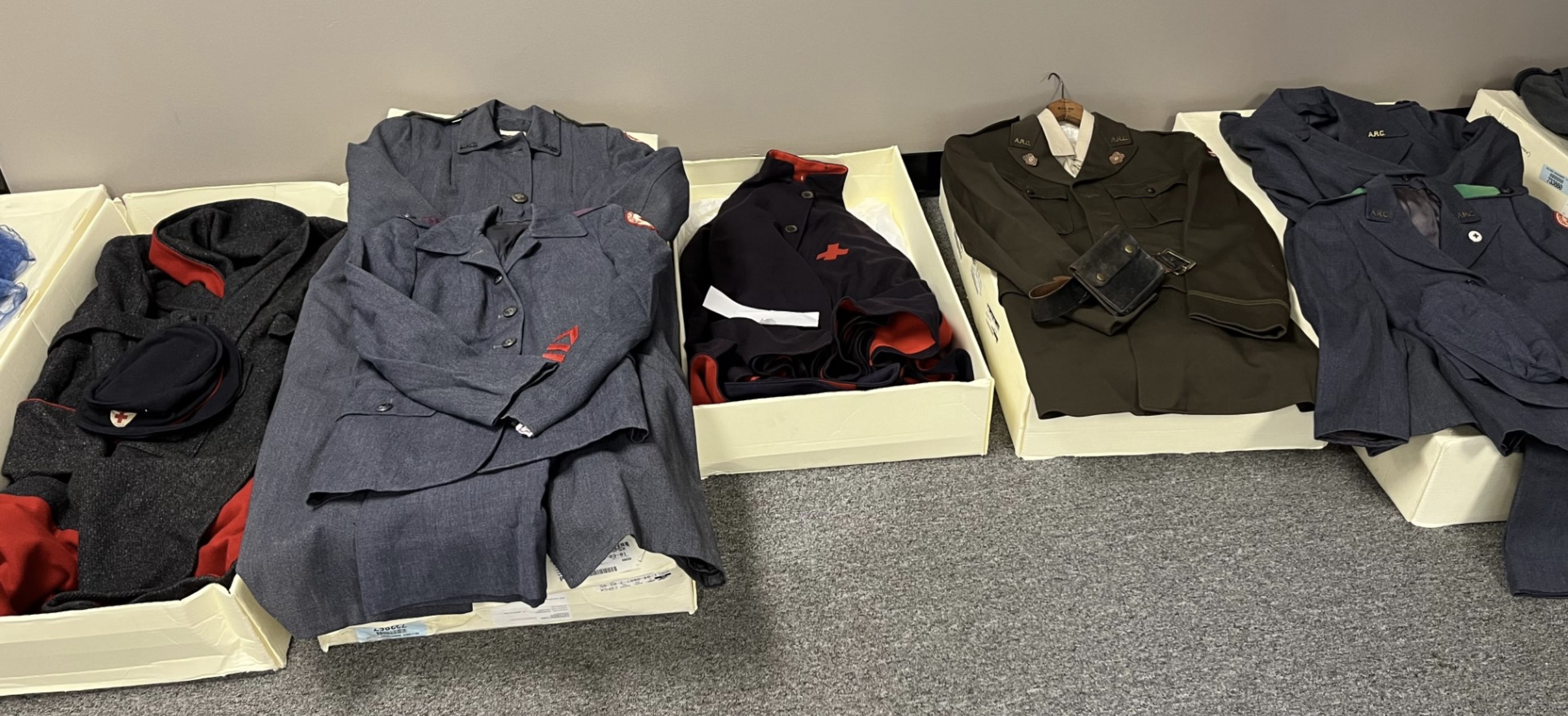
    Nursing Service Cape, Ambulance Corps uniforms from WWI and WWII. Photos are by Nancy Tobin / American Red Cross unless otherwise noted.

    The American Red Cross Southeastern Pennsylvania Region (SEPA) has moved from its Chestnut Street office to a newly-renovated campus on Spring Garden Street. In the process of closing the building, closets were emptied and boxes in an offsite storage facility were returned to Chestnut Street. The contents accumulated over many years from closing branch offices and chapters throughout the region.

    All the boxes filled a room to the ceiling containing clothing, books, scrapbooks, and memorabilia dated from the early 1900s, through WWI, WWII, into the mid twentieth century. How would the enormous task of separating and identifying all this material be accomplished? Nancy Tobin was given the job. It was like sorting through Grandma’s attic looking for precious family heirlooms, only on a much larger scale. Nancy immediately tackled the job. Emily Schricker, a Red Cross volunteer, experienced in cataloging and preserving artifacts, jumped in to help.

    It took two years with the help of volunteers to organize and catalog everything. Volunteers organized clothing, manuals, books, volunteer uniforms, coats and hats, scrapbooks, photos, newspaper articles, pins and patches, memorabilia and even dolls. When completed, Nancy reached out to organizations who were interested in some for their collections.

    Many items have a story!

    American National Red Cross in Washington D.C.

    Archivist and Manager of Historical Programs and Collections Susan Robbins Watson, came to  Chestnut Street. She gathered vintage clothing, books, and memorabilia, taking these items to the Red Cross Museum in Washington D.C. for display and restoration.

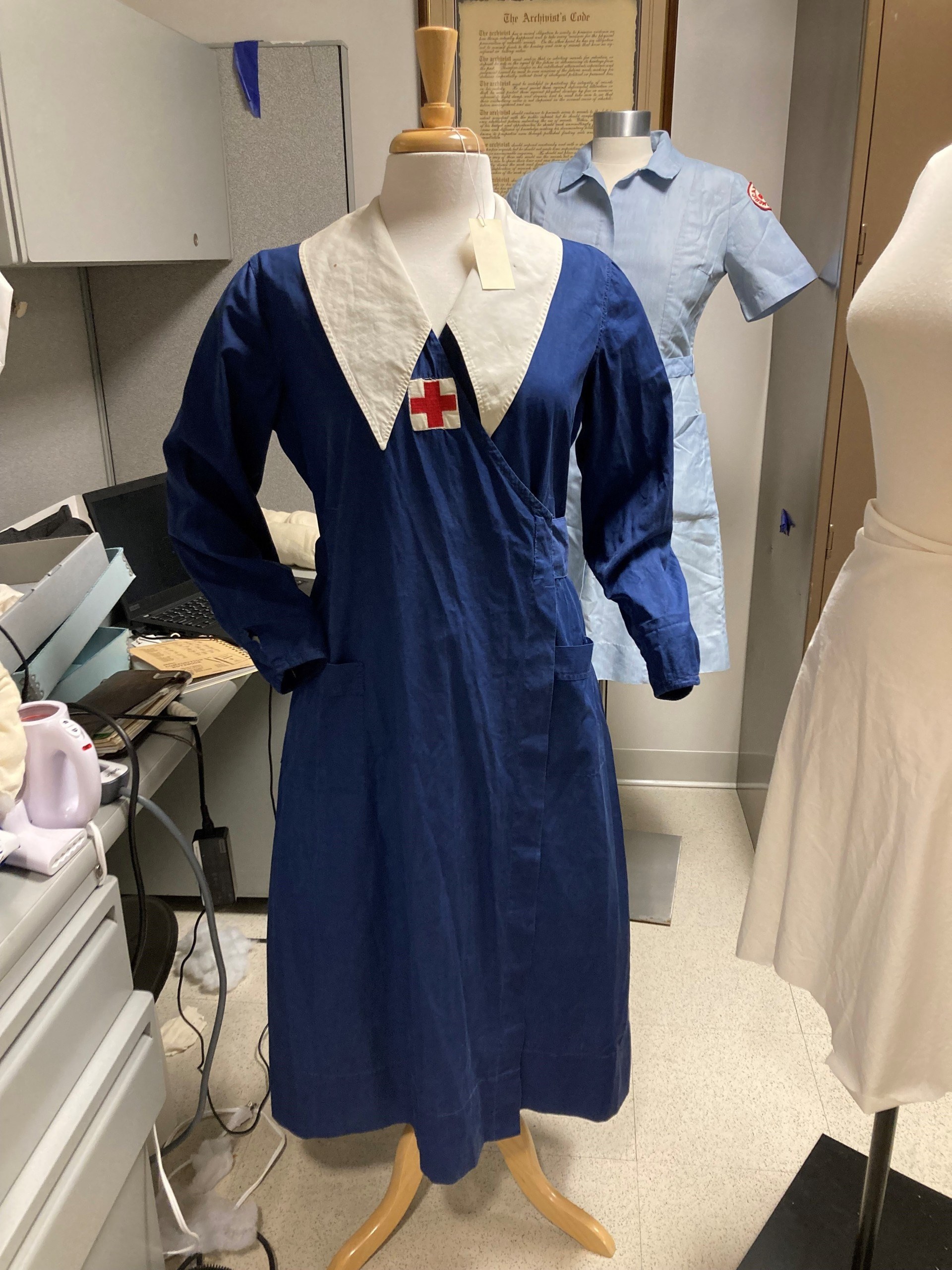
    Susan restored this blue uniform worn by a volunteer for the Braille Corps or the Arts and Skill Corp. During WWII, volunteers used a stamp and board to manually translate literature. The Arts and Skills Corp employed creative arts programs in rehabilitation centers and hospitals for wounded veterans.

    A woolen woman’s bathing suit from the 1930’s, was worn by a volunteer from the Red Cross Lifesaving Service. It was hot and heavy on a summer day!

    This WWII Canteen Service winter coat and hat was worn by a volunteer distributing baskets filled with food and drinks from a Canteen Truck to soldiers traveling across the country.

    DREXEL UNIVERSITY
    College of Media Arts and Design, The Robert and Penny Fox Historic Costume Collection

    Monica Stevens Smyth, Collection Manager and Adjunct Instructor for this world class collection of historic costumes, carefully studied all the uniforms. She was interested in the unusual collection of stained surgical dressing gowns, aprons, veils, and caps from WWI, worn by volunteers when helping nurses. She wanted her students to study these textiles.

    HISTORICAL SOCIETY OF PENNSYLVANIA

    Photo by Judith Weeks

    Emily reached out to Cary Hutto, Archive Director of the Pennsylvania Historical Society. She gathered scrapbooks with fragile newspaper clippings and books including the first edition of a book written by Clara Barton. Titled “A History of This Remarkable International Movement in The Interest of Humanity” this book was published in 2014.

    Photo by Judith Weeks

    UNIVERSITY OF PENNSYLVANIA
    Barbara Bates Center for the Study of the History of Nursing

    Jessica Martucci, Curator and Jessica Clark, Archivist, were interested in first aid and home nursing manuals including the collection of dolls dressed in Red Cross uniforms. Interestingly a first aid book, specifically for Bell Telephone, was included.

    WWII MUSEUM IN GETTYSBURG

    Red Cross canteen truck at WWII Museum in Gettysburg. Submitted photo

    Richard D’Ambrisi, volunteer Docent and Archivist, for the WWII museum at Gettysburg, was interested in items worn by volunteers who worked for Red Cross canteens. The last Red Cross canteen truck is in this museum. During WWII, canteen trucks were located at train stations where Red Cross Volunteers distributed baskets of snacks and drinks to soldiers coming and going.

    WWII MUSEUM IN GERMANTOWN

    Dr. A. V. Hankins with Mary Harper at the ACES Veterans Museum. Submitted photo

    Mary Harper, Service to Armed Forces volunteer, discovered a doctor’s office on Germantown Avenue with a museum of WWII memorabilia on the second floor. She gathered WWII Red Cross uniforms for display.

    Thank you to the committed team for saving these historical materials: Nancy Tobin, Emily Schricker, Anne Arnold, Tina Harris and Gracie Claude.

    Left photo: National Red Cross Archivist and Manager of Historical Programs and Collections Susan Robbins Watson with Red Cross volunteers Tina Harris and Gracie Claude and Executive Coordinator Nancy Tobin. Right photo: National Red Cross Archivist and Manager of Historical Programs and Collections Susan Robbins Watson with Red Cross volunteers Emily Schricker and Anne Arnold and Executive Coordinator Nancy Tobin.

  • #ThrowBackThursday – The Junior Red Cross

    By Bill Thawley

    July 1948. Camp Bynden Wood, Pennsylvania. To train for leadership in Junior Red Cross, 160 teen-agers met during July at Camp Bynden Wood, Penn. In this photo, Fronia Davidson of the Red Cross Eastern Area discusses the use of posters and pictorial exhibits in publicizing activities of the Junior Red Crossers. Boys and girls attending the camp came from Canada, Pennsylvania, Ohio, Maryland, Virginia, West Virginia, Kentucky, Indiana, and the District of Columbia. American Red Cross photo by Clifford Veich.

    The Junior Red Cross started in September 1917. Initiated by Woodrow Wilson and under the direction of Henry Pomeroy Davison, chairman of the Red Cross war council, the Junior Red Cross was created after realizing the invaluable contributions children could make to support the relief efforts during WWI. Knitting wristlets and sweaters, alongside their mothers, youngsters found unique opportunities to help.

    The zeal and patriotism of the children knew no bounds. They joined the Junior Red Cross as a school program and part of their local Red Cross chapter. Club dues of 25 cents per member contributed to their school fund, which was used to help finance their humanitarian efforts. The children’s creativity on how to raise additional funds took hold. During the rainy season in Minnesota, a youngster stood on the street corner with an umbrella, offering to take people home for five cents. Children throughout the country held bazaars, grew gardens and sold produce, collected discarded items and sold them for recycling, harvested castor oil beans from vacant lots, and collected wool from the trees and fences of the sheep ranges, among other resourceful efforts.

    1947. Louisville, Kentucky. Steady! A young Junior Red Cross member at the McFerran School in Louisville, Kentucky concentrates on threading a needle to be used in making stuffed toys for children overseas. Rag dolls and stuffed toys of all shapes, sizes and varieties are made by Louisville Junior Red Cross members. Photo by American Red Cross

    While appearing minimal, these grassroots fundraisers yielded thousands of dollars. The money raised was used to help those in need. Wooden toys, sweaters, socks, mittens, and other pieces of clothing were purchased or made and sent overseas to Serbia, Italy, Russia, Romania, France, and Belgium. There were many refugees in Europe and the Middle East, all received aid with great joy. Within four months of being established, the Junior Red Cross was responsible for delivering 250,000 refugee garments to the afflicted in the war-torn countries.

    The school program was administered in about 60,000 schools, no small task yet managed admirably by the Red Cross. There were children of many nationalities in the school clubs, and they all wore their Red Cross buttons proudly. Almost 11 million children participated in the Junior Red Cross during World War I.

    Today, our Red Cross Clubs carry on supporting those in need, with clubs existing in middle schools, high schools, and colleges. They may not hold umbrellas or knit garments, but they still raise money, sponsor blood drives, and perform other tasks to help deliver our humanitarian efforts worldwide.

  • Red Cross Southeastern PA HQ moves to renovated Spring Garden Campus in Philadelphia

    Pictured: (top from left) A farewell note to the Chestnut Street building from one of our volunteers; outside of the Spring Garden Center; (center from left) Spring Garden Center atrium; Clifton Salas, Heidi Dampman, Evan Pratt and Mary Noll helped lead the building transition; new Humanitarian Services and Biomedical Donor Services office space; (bottom from left) new Spring Garden Center lobby; leaving the Chestnut Street building.

    By Dave Skutnik

    This week we have started to say goodbye to our Chestnut Street headquarters in Philadelphia, which has been home to the American Red Cross in Philadelphia for more than 50 years.

    We’re moving our Philadelphia operations back under one roof – which is how it was prior to the mid-1990s. All services will be delivered from a larger and more efficient location at 700 Spring Garden Street.

    The existing Red Cross building at 700 Spring Garden Street is already home to Red Cross Blood Services, including high-tech laboratory spaces and the Philadelphia Blood Donation Center. The building has been renovated to also house Red Cross Humanitarian Services, which includes Disaster Relief, Service to the Armed Forces, Training Services and International Services, as well as Training Services.

    The 700 Spring Garden campus offers much more flexibility, including a large parking lot to accommodate staff, volunteers, donors and community partners. This move does not affect the Red Cross House in University City nor the Northeast Philadelphia Blood Donation Center, and also does not affect other offices and blood donation centers in the suburbs.

    The move aligns with our continuous efforts to streamline all Red Cross operations to provide the best possible working environment for our employees and volunteers, to ensure the best use of donor dollars, to reduce costs and to allow us to put more money back into mission delivery.

    We’re excited to have all Red Cross services in Philadelphia back together under one roof — like it was decades ago. While the new building features the latest technology, it will also serve as a nod to our history in the Philadelphia area.

    Since 1972, the building at 23rd and Chestnut Streets has been home to the Humanitarian and Training Services arms of the Red Cross. From 1972 to 1994, American Red Cross Blood Services was also housed at this location and another annex building at 23rd & Ranstead. Blood Services moved to its current location on Spring Garden Street in 1994.

    Prior to the 23rd & Chestnut Street location, the Red Cross operated out of 1710 Spruce Street from 1956 until 1972. Before that, Red Cross headquarters was at multiple locations along North Broad Street dating back to World War I.

    While it’s hard to say goodbye to a place that’s been home for more than 50 years, we think this note from one of our amazing volunteers sums it up perfectly.

    We’d like to give a big shoutout to our relocation team of Clifton, Evan, Heidi and Mary – who have worked tirelessly to make this transition a smooth one. Thank you for everything! 

    To read more about our new location, click here.

  • #ThrowBackThursday – Ships that have flown the Red Cross flag

    By Bill Thawley

    USNS Mercy, one of two current hospital ships used by the U.S. Navy. Photo published under Creative Commons Attribution-Share Alike 4.0 International license.

    In response to the Mississippi River floods of 1882-1884, the “John V. Troop” was the first ship to fly the Red Cross flag. Clara Barton used the ship to deliver relief supplies, including animals, down the Mississippi from Cairo, Illinois. The ship was not owned by the Red Cross but chartered for sixty dollars per day.

    The “USS Solace” was the second ship to fly the Red Cross flag. She was built in 1896-1897 by the Newport News Shipbuilding and Drydock Co, in Newport News, Virginia. Initially, she was operated as the “SS Creole” by the Cromwell Steamship Lines. The ship was acquired by the United States Navy on April 7, 1898, renamed the “Solace”, and converted into a hospital ship. She was officially commissioned by the Navy on April 14, 1898. She served in Cuba during the Spanish-American War and made many trips to the United States mainland with wounded and malarial- stricken American forces.

    USS Solace off of Mare Island Navy Yard on July 1, 1899. Photo is public domain.

    On September 12, 1914, the Red Cross “Mercy Ship” sailed to Europe with medical staff and supplies following the outbreak of World War I. Jane Delano, who founded the Red Cross Nursing Service, helped staff the ship with nurses. Although the ship was officially named the “SS Red Cross,” it was better known as “The Mercy Ship.” It carried 170 surgeons and nurses who were sent to Europe to provide medical relief to combat casualties on both sides of the war.

    SS Red Cross circa 1914. Photo is public domain.

    The Second Geneva Convention of 1949 regulated what hospital ships should look like and the flags they should display. Hospital ships must be painted white. Military ships must have a green band, and those operated by approved relief societies must have a red band.

    Ships functioning as hospitals must fly a national flag and a Red Cross flag. Relief or humanitarian mission ships may not be used for any military purpose nor interfere with or hamper enemy combatant vessels. They must give medical assistance to wounded personnel of all nationalities. Belligerent vessels, as designated by the Hague Convention, can search any hospital ship to investigate violations of the international restrictions.

    The current hospital ships of the United States Navy are the “USNS Comfort” and “USNS Mercy.” They have been used for aid missions around the world.

    USNS Comfort approaching Pier 90 in New York City on March 30, 2020. Photo is published under Creative Commons Attribution-Share Alike 4.0 International license.
  • Throw Back Thursday: Museum at American Red Cross National Headquarters

    By Bill Thawley

    Arriving at the American Red Cross building at 431 18th St NW, Washington, D.C., you are presented with a building of stone, faced with white marble from Vermont. Going through the main bronze doorways, you are led into a large central marble entrance hall, with a broad stairway to the second floor. There are various displays, some of which are rotated periodically, throughout both floors. Note: It is a common practice to rotate exhibits and artifacts in museums to reduce light damage and overall wear on historical items.

    “Charity” by Hiram Powers. Photo by Brian MacDonald/American Red Cross

    The Board of Governors Room contains the three Favrile windows by Louis Comfort Tiffany (featured last month on this blog). Niches in the Hall are filled with sculpture depictions of “Faith,” “Hope” and “Charity,” executed by Hiram Powers, a neoclassical sculptor.

    Clara Barton’s dress, both front and back views, worn throughout the 1860s, was donated by Susan H. Stafford, Clara’s great, great, great niece. Funding for the conservation and exhibition was donated by Barbara Bovender. The dress was worn for special occasions and speaking engagements. Check out the video about Clara’s dress below.

    A remarkable piece of Clara’s history, a dress which actually belonged to her, is now on display at Red Cross headquarters in Washington, D.C. 

    There is a bust of Jean Henri Dunant, one of the founders of the International Red Cross movement in 1863, as well as a painting of the Geneva Treaty Convention in 1864 by Charles Edouard Armand-Dumaresq (a French painter, who specialized in military subjects). The Geneva Convention was ratified in 1882; Clara Barton and Adolphus Solomons represented the United States at the Convention.There is a display case containing some personal items of Clara’s, including her diary of 1904 and her sewing kit used after the hurricane of 1893 on the Sea Islands, near Savannah, Georgia.

    Since some of the paintings and photographs may be rotated, you may see different works of art displayed at different times. For example, a panel by Cameron Burnside, a modernist painter, known for his wartime paintings, shows Red Cross workers meeting a troop train during World War I and serving refreshments to soldiers. Another panel depicts the Junior Red Cross, which was started in World War I, making bandages and clothing. By the end of the war, there were 11 million members in the Junior Red Cross. There’s also a photo commemorating the Gray Ladies, who volunteered in hospitals, helping the patients by running errands, bringing books, etc. during World War I.

    “The Red Cross Spirit” by Felix de Weldon. Photo by Brian MacDonald/American Red Cross

    There is a memorial garden outside of the buildings, with a sculpture by Felix de Weldon, the sculptor of the famous World War II Marine Memorial of Iwo Jima. It depicts Red Cross workers helping fallen soldiers. This was commissioned by the American Red Cross Overseas Association, honoring all of those who gave their lives in service to the Red Cross. There is also a sculpture of Jane Delano, the founder of the Red Cross Nursing Service in 1909, by Robert Tait McKenzie, a physician and sculptor.

    On the grounds of the Red Cross Square, there is a sculpture by Frederic Sogoyan, given by the Armenian people in 1991 for the Red Cross’ help during the 1988 Spitak earthquake. Also on the square is the Red Cross emblem by Larry Kirkland, abstract sculptor, dedicated to volunteerism and the volunteer spirit of the Red Cross. The sculpture features a red cross, in the center of a wall of white marble, with the center open to display the red cross.

    Red Cross Square. Photo by Jose Sarmiento/American Red Cross

    Be sure to add a visit to Red Cross HQ during your next visit to Washington, D.C.!