Category: Red Cross Month

  • Help Can’t Wait: Pennsylvania Red Crossers highlight community impact in Harrisburg

    By Jenny Farley

    Dozens of Red Cross volunteers and staff stand on the steps of the Capitol Rotunda in Harrisburg holding signs that read "Proud Volunteer" and "Help Can't Wait During Emergencies."
    Pennsylvania Red Crossers hold a press conference in the Capitol Rotunda in Harrisburg on March 24, 2026 for Red Cross Advocacy Day. Photo by Alana Mauger / American Red Cross

    On March 26, volunteers and staff traveled to the state capitol in Harrisburg to attend American Red Cross Pennsylvania Advocacy Day during Red Cross Month.

    Standing side by side with prominent Pennsylvania lawmakers on the Capitol Rotunda steps, Jennifer Graham, the CEO for the Red Cross Southeastern Pennsylvania Region (SEPA), told the crowd, “Help can’t wait” in an emergency – the theme of the day.

    She thanked the 7,000 volunteers across the state who respond when disaster strikes.

    “Their dedication is extraordinary. Without them, the Red Cross mission would not be possible,” she said.

    Red Cross Greater Pennsylvania Region CEO Jorge Martinez and Southeastern Pennsylvania CEO Jennifer Graham hold a proclamation from Governor Josh Shapiro recognizing March as Red Cross Month in the Commonwealth. Photo by Alana Mauger / American Red Cross

    Representative Joe Webster spent two decades working in the Pentagon and was there when terrorists attacked on 9/11 and the hijacked Flight 77 crashed into the building. He marveled at how fast the Red Cross arrived to help on that horrific day.

    “When I got to the parking lot of the Pentagon the Red Cross was already there and I give credit to the volunteers for the immediate response.”

    Representative Webster expressed confidence that whatever national incident or weather event may happen, he believed Red Cross volunteers would step up to help.

    He said, “Volunteers, you’ve been honored this morning but you honor us by being here.”

    Jennifer Strayer is a blood donor and nurse from the Central Pennsylvania Chapter who has volunteered for the Red Cross as a board member for more than a year. She loves history and appreciates the beauty of the capitol building. Hearing lawmakers speaking about their own experiences with the Red Cross meant a lot to her.

    “It touches you as a volunteer, as a board member, to know that we’re doing great work and our lawmakers see it. They’re advocating for us,” she said.

    Jennifer Strayer is a nurse and Red Cross regional board member who attended the Red Cross Pennsylvania Advocacy Day at the capitol. She said, “It’s very emotional to hear our lawmakers talk about their own personal connection to the Red Cross in times of need. Between the military, blood donation and fires — they hit on a lot of the great work that our volunteers do every day.” Photo by Jenny Farley / American Red Cross

    Representative Lisa Borowoski, Representative Mark Gillen and Senator Doug Mastriano addressed the crowd, along with Jorge Martinez, the CEO of the American Red Cross Greater Pennsylvania Region.

    CEO Martinez explained why Red Cross programs like Sound the Alarm are so important.

    “More people died in home fires in Pennsylvania last year than in any other state. 152 lives lost,” he said.

    During a Sound the Alarm event, Red Crossers go door to door installing free smoke alarms in homes and walking through fire escape plans so families will learn how to get out during a fire.

    “Our free smoke alarm program saves lives and it’s only possible through generous support from donors and the volunteers you see standing behind me,” he said.

    After leaving the capitol, many Red Crossers traveled by bus to the Pennsylvania Emergency Management Agency (PEMA) to tour the building and learn more about the essential cooperation between the Red Cross and emergency management.

    Jeffrey Pioszak is a mass care coordinator at PEMA in the Bureau of Administrative Services Division of Emergency Planning and Response. He spoke to the group about how disasters “begin and end locally.”

    He said, “We depend on what the American Red Cross does. We only get better when we all work together.”

    Pennsylvania Red Crossers sit in the Emergency Operations Center at PEMA headquarters in Harrisburg. Photo by Alana Mauger / American Red Cross

    Katrina Mulherin is a community disaster program specialist for the Delaware Valley Chapter of the Red Cross who will celebrate her one-year anniversary at the Red Cross in May.

    She traveled to PEMA and the capitol from West Chester with Lynn Cohen, the executive director for the Delaware Valley Chapter, Heather Gale, SEPA’s regional mass care manager, and Lisa McGee, SEPA’s regional disaster services officer.

    Katrina made the trip “to learn more about the work the Red Cross does at the governmental level to advocate for important issues.”

    She said meeting lawmakers and learning more about PEMA was a great learning opportunity and “It really paints a clearer picture of how all these different aspects work together to support the Red Cross.”

    Pictured left to right: Red Cross workers Katrina Mulherin and Heather Gale drove to Harrisburg from West Chester to attend the Red Cross Advocacy Day during Red Cross month. Photo by Jenny Farley/American Red Cross. 

    The Red Cross responds to about 65,000 disasters every year and provides 40% of the nation’s blood supply. To learn more, go to redcross.org.

  • #LeadLikeClara: Donna Zacker powers compassion through steady leadership behind the scenes

    Editor’s Note: In commemoration of Red Cross Month and Women’s History Month, we are publishing a series of #LeadLikeClara profiles featuring local women volunteer leaders who emulate the leadership characteristics of Red Cross founder Clara Barton.

    Photo of American Red Cross volunteers Bob and Donna Zacker standing in front of a gray wall with the Red Cross logo.
    Donna Zacker pictured with her husband Bob, also a volunteer at the Disaster Action Team Summit in February. Photo by Alana Mauger / American Red Cross

    By Terri Seydel

    Every disaster response has two stories.

    One is the story we see—volunteers arriving, shelters opening, families receiving help in their most difficult moments.

    The other story unfolds quietly behind the scenes. Systems must work. Information must flow. Caseworkers must have the right tools at the exact moment someone needs help rebuilding their life.

    This year, the American Red Cross Southeastern Pennsylvania Region celebrates Donna Zacker, a dedicated volunteer leader who “Leads Like Clara,” a phrase inspired by the humanitarian legacy of Clara Barton, founder of the American Red Cross and a pioneer of compassionate service.

    And if you ask anyone on the disaster team, they will tell you: Donna leads exactly like Clara—quietly, skillfully, and with relentless dedication to helping people.

    A Volunteer Who Chose Service

    When Donna moved to the Philadelphia area in 2012, she made a decision that would shape the next chapter of her life.

    Instead of pursuing a traditional full-time job, she looked for meaningful ways to give back. She found that opportunity with the Red Cross, becoming a disaster caseworker, a role that places volunteers directly on the front lines of helping individuals and families recover after fires, storms, and other emergencies.

    Caseworkers are often the lifeline for people navigating the immediate aftermath of disaster. They connect clients with resources, help them understand next steps, and ensure no one has to face recovery alone.

    But Donna didn’t stop there.

    The Power Behind the Platform

    In 2020, the Red Cross introduced RC Care, a software platform designed to support disaster casework by organizing client information, resources, and response coordination in one centralized system.

    Donna quickly became one of the region’s most important leaders behind the platform.

    RC Care allows case workers to:

    • Manage disaster client cases through an integrated console
    • Access dashboards and reporting tools that help teams make informed decisions
    • Connect clients with expanded community resources through Findhelp (findhelp.org), a national resource database
    • Share data that supports large-scale planning with agencies such as Federal Emergency Management Agency (FEMA)

    Donna played a key role in launching the system locally and coordinating training for the volunteers who depend on it every day.

    For many disaster caseworkers, RC Care is the tool that helps them focus less on logistics and more on what matters most…helping people.

    Donna ensures that tool keeps getting better by continuing to help manage updates and enhancements that expand the system’s capabilities, allowing the Red Cross to respond more efficiently and support clients more effectively after disasters.

    Expanding Impact for Large-Scale Response

    Donna’s work with RC Care is now expanding to support one of the Red Cross’s newer services: Shelter Resident Transition, which assists people staying in shelters during large-scale disaster events as they move toward longer-term recovery.

    This service becomes especially critical during major incidents, when shelters must support many residents simultaneously.

    Through Donna’s leadership, RC Care now helps teams coordinate this work more effectively, ensuring people leaving emergency shelter have clear pathways to the next stage of support.

    In other words, the technology helps volunteers do what they do best: care for people.

    A Leader Who Still Serves on the Front Lines

    What makes Donna’s contribution even more remarkable is that she continues to serve as a disaster caseworker herself.

    While helping maintain and improve the system used across the region, she remains directly involved in assisting clients and supporting fellow volunteers.

    Colleagues often describe Donna as someone who genuinely enjoys helping others succeed. She is known for mentoring volunteers, answering questions, and encouraging new team members as they learn the complex but deeply rewarding work of disaster case management.

    Simply put: she builds systems—but she builds people, too.

    Leading Like Clara

    Lead Like Clara profiles recognize women whose leadership reflects the spirit of Clara Barton: courage, service, and a steadfast commitment to helping others during their most vulnerable moments.

    Donna Zacker embodies that spirit.

    Through her work with RC Care, her dedication as a disaster case worker, and her passion for supporting fellow volunteers, she has strengthened the Red Cross mission in ways that often go unseen, but never unfelt.

    Because when disaster strikes, families need help quickly.

    And thanks to Donna’s leadership behind the scenes, the people who answer that call are better equipped than ever to respond.

    Congratulations to Donna Zacker as a Lead Like Clara honoree and a true champion of the Red Cross mission.

    Her work ensures that when communities face their hardest days, compassion, coordination, and care are already in place.

  • #LeadLikeClara: Kate Byrnes brings nursing expertise and steady leadership to disaster health services

    Editor’s Note: In commemoration of Red Cross Month and Women’s History Month, we are publishing a series of #LeadLikeClara profiles featuring local women volunteer leaders who emulate the leadership characteristics of Red Cross founder Clara Barton.

    Red Cross volunteer Kate Byrnes wearing a Red Cross disaster vest over a black T-shirt and sunglasses.
    Kate Byrnes deployed to the wildfires in Maui in 2023. She said one of the things that helps Red Cross volunteers cope with difficult disasters is the people. She said, “They’re just always saying, ‘thank you so much for coming here to help us.’”Submitted Photo.

    By Jenny Farley

    Kate Byrnes decided to volunteer for the American Red Cross after the attacks on America on 9/11.

    “You just felt like you wanted to be able to do something to help,” she said.

    She has been helping ever since.

    “I joined the Red Cross to deploy to disasters and to staff the shelters.”

    Kate volunteers in Disaster Health Services where she is the regional lead in two primary roles: assisting clients who are affected by a disaster and protecting the health and safety of staff and volunteers who respond to them.

    Kate has been a nurse since 1982, a nurse practitioner and a professor who taught nursing at Immaculata University for 20 years.

    In shelters Kate works at a health station to help clients replace medications, manage chronic medical conditions like diabetes and treat minor injuries.

    She has deployed to regions hit hard by hurricanes and tornadoes, but the disaster that stays with her the most was the Maui wildfires in 2023 that killed more than 100 people and burned thousands of homes.

    “It’s always hard to go through a disaster and there’s always a long rebuilding process, but this one was hard because it seemed like a lot of them were going to have to give up the idea that they would ever be able to go back to life the way it had been, because that community was forever changed.”

    During large scale disasters seeing so much suffering can be difficult for staff and volunteers. But the resilience of the people in Maui left an unforgettable impression on Kate.

    “One of the things that’s rewarding about being in the Red Cross is people are always so grateful for your help.” She said, “It’s always rewarding to be able to be there and be part of the helping process and help them rebuild. Whatever small contribution you can make.”

    Kate’s lead role in managing the health of staff and volunteers is also vitally important to ensuring clients get what they need when they need it the most.

    She helps people who deploy to a disaster know what they are getting into and have the tools and support to deal with whatever challenge may happen.

    Then, before the deployment she calls to explain the conditions they will face and makes sure that their health can handle it. She also encourages staff and volunteers on a deployment to take care of themselves and not be afraid to take a break.

    “Nobody’s going to be critical if they say, ‘I need to step back today’ or ‘I need a day off.’ It’s perfectly understandable because it can get pretty intense.”

    For Kate, the intensity is worth it.

    “Volunteering has really been good for me. It gives you a sense of purpose.”

    If Kate’s story inspires you to volunteer for the Red Cross, find out how at redcross.org/volunteertoday.

  • Mother and daughter team up to support blood donors

    By Maureen C. Zug

    Mother and daughter Red Cross volunteers Jane and Juniper sit at a table with blood donation chairs visible behind them.
    Mother-daughter blood donor ambassador duo Jane and Juniper during a shift at the Red Cross Blood Donation Center in West Chester. Submitted photo

    On a recent snowy Saturday afternoon, I had the  pleasure  to video call with the mother-daughter team of Juniper Mui and her mother Jane Chan. Although we have a number of husband and wife teams throughout the Red Cross organization, this is the first mother-daughter pair I have met personally.

    Getting Started As Volunteers

    Motivated by a desire to volunteer in 2023, Juniper and Jane looked for opportunities at a number of different organizations.  The American Red Cross was the only possibility for Juniper, since  she was underage at the time.  Originally, the duo intended to volunteer for the summer as blood donor ambassadors, but they enjoyed their volunteer roles so much that they decided to continue year ‘round. 

    Juniper and Jane belong to the Delaware Valley Chapter.  They serve at Red Cross Blood Donation Centers in West Chester and Horsham. Jane is a financial analyst; daughter Juniper is a high school student. Despite their busy schedules, they truly enjoy their time together greeting, registering, orienting, and guiding blood donors toward post-donation drinks and snacks.  They are a reassuring presence for novice donors.

    As blood  donor ambassadors,  they are the welcoming faces at the blood donation centers.  They answer questions or contact Red Cross collections team professionals onsite to get quick answers. Juniper  recalled a time when another mother-daughter pair tried to donate blood together, but the daughter was underage.  The young women was gracefully declined, but was assured that she would be able to donate blood in the future.  During our chat, I could not help but notice that Juniper and Jane are so in tune with each other, in a very natural way, that they finish each other’s sentences.

    What Motivates Juniper and Jane to Continue Volunteering

    In any conversation among Red Cross volunteers, the question eventually comes up—‘Why do you volunteer?” Both mother and daughter answered the question clearly:

    • They want to give back to the community with a sense of gratitude.
    • Volunteering makes them feel good.
    • The Red Cross community of volunteers is generous and welcoming.
    • Community engagement is important during a time of economic and political uncertainty.

    As a parent, Jane says that “Volunteering helps me see my daughter differently”and “Understand her personality from a different perspective.” Juniper sees her volunteer role as “A learning experience opportunity to care for others.” She is focused on “Staying in the moment” for a most fulfilling time spent as a blood donor ambassador.  Also she likes working in tandem with her mother to pass the time and  the benefit of knowing her  personality.

    An Active Family Life

    Jane and Juniper have the active support of a loving husband and father who helps with cooking and other household chores. “We try to balance everyone’s needs in the family,” Jane said, which also includes a younger daughter.  It may seem like a juggling act sometimes, but Jane says this sense of balance works well for her family.  Add in the three family tabby cats—Boots, Pluto, and Benedict—and you get a good picture of a happy and active family life.  In fact, Pluto quietly attended our video call while snuggling in Juniper’s arms, and graciously accepted pets from Jane during our conversation.

    Future Plans

    As champions for volunteering with the Red Cross,  Juniper and Jane say they will continue to serve as blood donor ambassadors, helping in whatever way that they can. Juniper intends to recruit her little sister as a volunteer as she becomes older. At this point, Juniper has expressed an interest in engineering classes.  However, she is still considering options for college and majors. Jane is proud of her family and will continue to encourage her daughters’ ongoing  community engagement.

    Thank you, Juniper and Jane, for sharing your Red Cross story!  Your support of the blood donor community is highly inspirational, especially during a time of critical need for blood, platelets and plasma.

  • Celebrating a multigenerational legacy of service this Red Cross Month

    By Alana Mauger

    For over half of our country’s 250-year history, the American Red Cross has cared for our communities. This Red Cross Month, we’re honoring the evolution of how our volunteers deliver support when help can’t wait.

    Red Cross Month began during World War II, when President Franklin D. Roosevelt called on individuals to address growing humanitarian needs. What started as a national call to action has become a community tradition—reaffirming the power of compassion and the impact we can make together.

    Square light blue graphic with dark blue words I'm a proud humanitarian in the center. A red heart sits above the words.
    Red Cross graphic – I’m a proud Humanitarian.

    A Multigenerational Portrait

    We’re digging into data that paints a multigenerational portrait of our Southeastern Pennsylvania (SEPA) volunteers.  From Gen Z to the Silent Generation, people of all ages comprise our region’s nearly 3,300 active volunteers.  Our demographics reveal some surprising insights:

    • Gen Z (ages 13-28) is the fastest-growing and largest group of volunteers at 48%, driven largely by growth in student-led Red Cross clubs.
    • The next largest cohort at 19% is the Baby Boomers (ages 61-79), followed closely by Millennials (ages 29-44) at 17%.
    • While fewer in number, Gen X (ages 45-60) comprises about 7.5% of volunteers who often anchor core mission roles.
    • The Silent Generation (ages 81+) is the smallest cohort at 1% but contributes a legacy of service that often spans multiple decades.

    “Generation after generation, our volunteers demonstrate that compassion is one of our greatest strengths,” said CEO Jennifer Graham. “In moments when help can’t wait, Red Cross volunteers of all ages and backgrounds come together to offer care, comfort and hope. Your commitment reflects a shared humanitarian spirit that connects us across time and continues to make a meaningful difference through our lifesaving mission.”

    Square graphic with 25 smaller pictures of people wearing Red Cross clothing. In the center are white words on a purple background: Volunteers are heroes.
    Red Cross graphic – Volunteers are heroes.

    Gen Z Leads the Way

    Gen Z is the fastest growing and largest Red Cross cohort, representing nearly half of all active SEPA volunteers. This surge reflects our strong youth and young adult programming, including 28 student-led Red Cross clubs across local high schools and colleges. Nearly 900 students participate in these clubs, collectively contributing more than 1,500 service hours so far this academic year.

    But Red Cross clubs are only part of the story. Many youth and young adult volunteers engage directly in the broader Red Cross mission. During this fiscal year, Gen Z volunteers have already contributed more than 8,000 service hours across all lines of service.

    SEPA’s Youth in Action

    Some youth volunteers take on an exceptional range of responsibilities.

    Unionville High School senior Anika Harris co-founded her school’s Red Cross Club two years ago. As president of the roughly 120-member club, she’s strengthening her leadership skills by organizing blood drives and fundraisers, coordinating CPR and International Humanitarian Law trainings and helping educate students on preparedness topics such as smoke alarms and flooding. Anika also serves as a blood donor ambassador at the West Chester Blood Donation Center, greeting, checking in and thanking donors to ensure they have a positive experience. Additionally, she represents SEPA as a youth and young adult ambassador with the American Red Cross National Youth Council.

    Anika says the Red Cross encourages young people and provides the tools they need to turn their ideas into action. “The emphasis on youth involvement has really been surprising and heartwarming,” she shared. “I appreciate the way the Red Cross cares about youth and their perspective on things.”

    Anika Harris stands in a gymnasium with a blood drive going on in the background.
    Anika Harris at Unionville High School’s blood drive in February. Submitted photo

    Like Anika, Harriton High School junior Zain Ahmad founded and now leads his school’s Red Cross Club—but his involvement began even earlier. At age 13, Zain joined his mom at a local Sound the Alarm event. Inspired, he began volunteering with the Home Fire Campaign and youth preparedness team. The following year, Zain joined the regional communications team and has since written more than two dozen blog stories. He also serves on the region’s Green Team, helping guide the implementation of local sustainability initiatives.

    Zain says he started a Red Cross club at his school to help students see how “accessible and impactful volunteering could be.” He added, “Many of my peers assumed the Red Cross was only about blood drives, but I wanted to show them the breadth of opportunities that make it possible for anyone to contribute, in ways both big and small.”

    In the fall, Zain was recognized nationally as a nominee for the Red Cross Navin Narayan Award for Excellence in Youth Leaders.

    Zain Ahmad holds a certificate and Red Cross backpack. Jennifer Graham is pictured giving a thumbs up on his left and Red Cross mascot (person inside large dog costume wearing a Red Cross vest) is on his left.
    Red Cross SEPA CEO Jennifer Graham and Fred Cross presents Zain Ahmad with a certificate recognizing his nomination for the national Navin Narayan Award for Excellence in Youth Leaders before the MLK Day of Service Sound the Alarm event in Norristown on Jan. 19, 2026. Photo by Alana Mauger / American Red Cross

    Join the movement

    This Red Cross Month, we’re honoring how people today deliver support when help can’t wait. Every contribution matters — visit redcross.org to get involved by volunteering, making a financial donation, giving blood or taking a class in lifesaving skills.

  • Red Cross Month shines a spotlight on A1C and community health

    By Alana Mauger

    Red Cross graphic – 1 in 5: Red Cross donors who had their A!C tested when they gave in March 2025 had levels in the prediabetic or diabetic range.

    This March, the American Red Cross is performing A1C testing on all successful blood, platelet and plasma donations (one result per calendar year). The offering comes as new data reveals that one in five blood donors has elevated A1C levels—a sign that prediabetes and diabetes are prevalent among adults in generally good health. These findings come from the first year of free A1C screenings offered by the Red Cross across three testing periods in 2025. Click here to dive into the data

    “Too many people still face gaps in access to preventive care, and the Red Cross is proud to help close them by giving our 2.5 million blood and platelet donors easy access to essential health information, like their blood sugar levels,” said Dr. Courtney Lawrence, Red Cross medical director. By giving blood and downloading our Blood Donor App, individuals can be informed and empowered to better manage and advocate for their health.”

    Dr. Courtney Lawrence, Red Cross medical director, explains A1C results. Watch it on You-Tube.

    Among donors with elevated A1C levels, 80% had readings indicating prediabetes — a condition that is often reversible through healthy lifestyle changes, such as a balanced diet and regular exercise.

    The A1C test does not require fasting and provides an average blood sugar level over the past three months. Visit RedCrossBlood.org, to schedule your March donation appointment.All who come out to give blood, platelets or plasma March 1-31, 2026, will also receive a $15 Amazon Gift Card by email. See RedCrossBlood.org/March for details. 

    In addition to periodic A1C screening, the Red Cross continues to help bridge health care gaps by providing donors with valuable health insights, including blood pressure, hemoglobin, pulse and body temperature — all of which can be tracked in the Blood Donor App. Download the app from Apple or Google Play.

    Donating blood in March is part of Red Cross Month, a national campaign that encourages people to deliver support when help can’t wait — whether by giving blood, making a financial donation, volunteering or taking a lifesaving skills class.

  • Red Cross Giving Day rallies supporters to deliver aid when help can’t wait after disasters

    By Alana Mauger

    Red Cross graphic – American Red Cross Giving Day is March 26.

    The American Red Cross Southeastern Pennsylvania Region is issuing a call to help ensure no one faces a disaster alone by donating on Red Cross Giving Day, March 26.

    During the first 50 days of 2025, Red Cross volunteers responded to more big disasters in the U.S. than days — including the tragic Northeast Philadelphia plane crash that impacted more than 200 people. And that’s on top of everyday crises like home fires that have upended lives here in Southeastern Pennsylvania. Meanwhile, more Red Cross blood donations have gone uncollected so far this year due to weather than throughout all of 2024.

    “This year’s disasters have set a whirlwind pace, displacing thousands of people from their homes across the country and disrupting the nation’s blood supply for patients,” said Jennifer Graham, CEO, Red Cross Southeastern Pennsylvania Region. “As we enter spring disaster season, families are relying on us to come together as a community and support them when help can’t wait during future crises. Join us today by making a financial donation or giving blood or platelets.”

    Visit redcross.org today to make a financial donation or schedule an appointment to give blood or platelets in March:

    MAKE A FINANCIAL DONATION

    Donations will be part of Red Cross Giving Day, which aims to rally 30,000 individuals to help people affected by disasters big and small. A gift of any size makes a difference. For example, a donation of $3 can provide a comfort kit with supplies like a toothbrush, comb and shampoo, and a gift of $11 can provide a nutritious meal, snack and drink.

    For those who are able, any donor who gives $140 or more in March will receive a choice of a Red Cross monopack or a pair of socks as a thank-you for supporting our mission. Donors can make their gift and claim their thank-you by visiting redcross.org any time during March.

    GIVE BLOOD OR PLATELETS

    To help overcome the significant weather impact on blood donations, the Red Cross also urges the public to give lifesaving blood or platelets by making an appointment today at RedCrossBlood.org, on the Red Cross Blood Donor App or by calling 1-800-RED CROSS. People of all blood types are needed now to help avoid further strain to the blood supply.

    The Red Cross is expanding its health offerings by performing free A1C testing (commonly used to screen for prediabetes and diabetes) on successful blood, platelet and plasma donations in March. Additionally, all who come to give blood, platelets or plasma March 1-31 will receive a $10 Amazon.com Gift Card by email. See RedCrossBlood.org/March for details on both offers.  

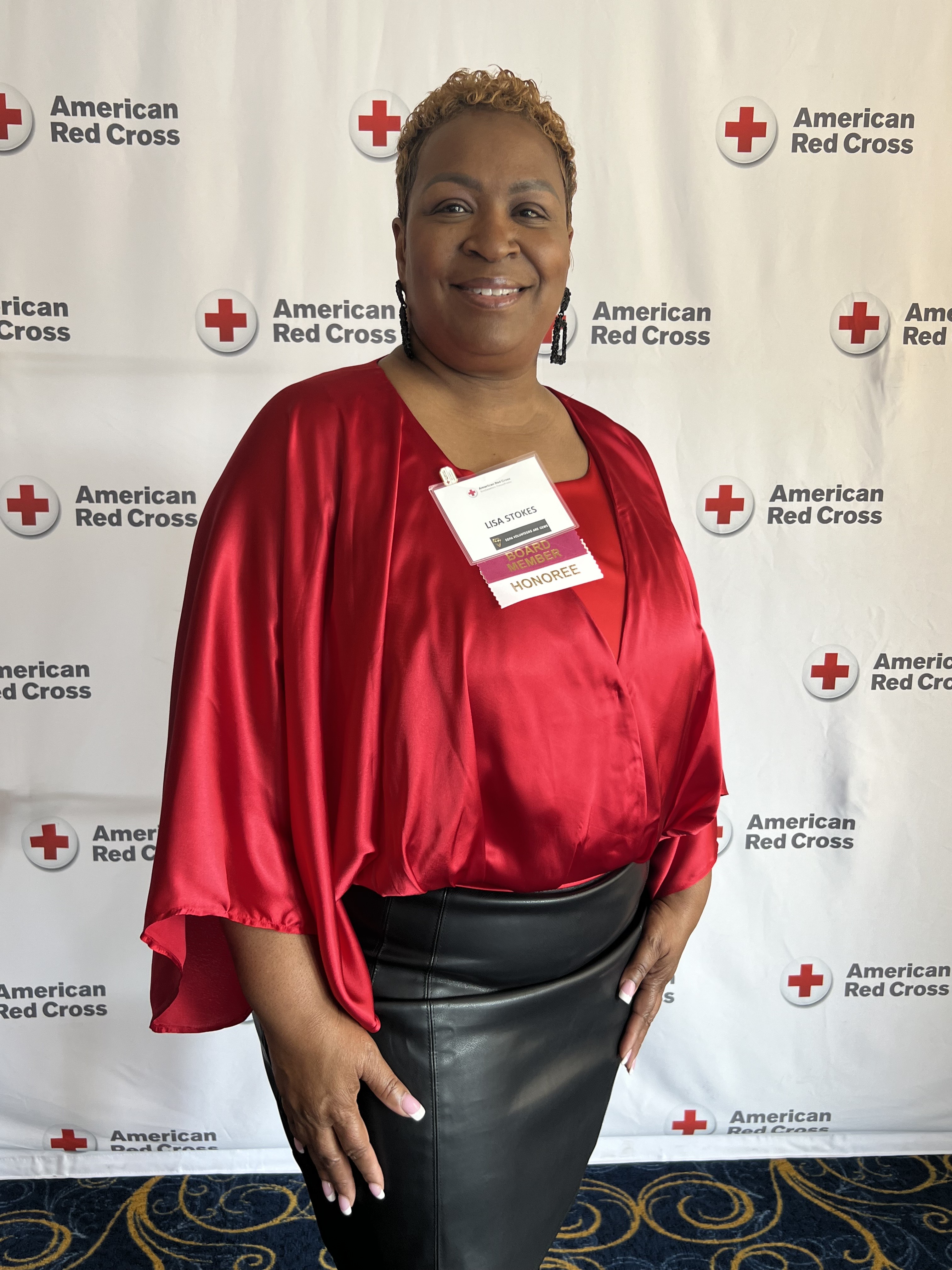
  • #LeadLikeClara: Humanitarian Lisa Stokes leads by example

    By Jenny Farley

    Red Cross board member Lisa Stokes makes a point of thanking volunteers. She said, “If all I can do is meet them, or see them somewhere and say ‘thank you,’ you can rest assured I’m there.” Photo by Jenny Farley / American Red Cross

    To understand what the Red Cross means to Lisa Stokes, you have to go back in time to when her love for the organization first blossomed.

    “My relationship began with the Red Cross back in 1997 because my daughter was a one-pound preemie,” she said.

    Doctors gave Lisa’s daughter, Mariah, 72 hours to live.

    “She was born at 25 weeks, and she needed blood transfusions that came from the Red Cross.”

    Blood helped save her.

    “Those blood transfusions were made possible through the donations from total strangers to keep my daughter alive, to give her a chance to live.”

    Mariah was medically fragile with respiratory issues that required round-the-clock nursing care. Lisa became her protector and the coordinator of a lot of moving parts to make sure Mariah was safe and well cared for. Mariah depended on medical equipment to help keep her stable.

    In 2013, a fire broke out next door. When flames crept up the walls, they ruined everything, filling that life-sustaining medical equipment with soot and destroying everything but a few clothes.

    By then, Lisa had two other children, her daughter Maiya and Chantel, a niece/daughter she adopted as a toddler.

    The fire left Lisa and her family with nowhere to go.

    “I ended up standing in front of the Red Cross House just looking up like I cannot believe that I’m here.”

    There is only one Red Cross House in the United States, and it’s in Philadelphia. Last year, staff at the Red Cross House helped more than 500 families recover from a disaster by providing a free place to stay and regular meals.

    When Lisa and her girls arrived in 2013, the Red Cross House had to adapt to Mariah’s medical needs. With Lisa’s help, the staff learned how to support a new type of guest.

    Lisa said staying there was, “The best decision I ever made.” She said, “They were able to give me and my daughters a place to not only lay our heads, not only provide three meals a day for us, but they allowed a safe space for me to understand everything that happened to us and then begin to rebuild.”

    When her stay ended and her family could finally return home, she vowed to come back. She kept her promise. That began an odyssey of more than a decade of volunteering for the Red Cross.

    “When people understand that there’s people out here willing to help you, it changes your perspective, and so, Red Cross is it for me.”

    Lisa became a Red Cross board member who recently won the Anita Lockwood Award, given to a leadership volunteer with years of dedicated service to the Red Cross in several areas.

    “From Sound the Alarms, to setting up and packing survival and disaster kits, if they call on me and I’m available, I go.”

    At the award ceremony, Red Cross Regional CEO Jennifer Graham said, “Lisa’s enthusiasm is infectious, and her passion for our mission shines brightly.” She thanked Lisa for her “exceptional leadership and enduring presence.”

    During this Women’s History Month, Lisa has a message for future female leaders interested in humanitarian work like the Red Cross.

    “Be bold and show up. As an African American woman, a person of color, representation means a lot.” She said, “Being bold and stepping up, maybe even out of your comfort zone, is what we have to do in an unapologetic way. I’m here. I’m here to help.”

    Lisa balances a full-time job as a Community Health worker at the University of Pennsylvania Hospital with her extensive commitment to volunteering for the Red Cross. Like most women, she’s used to handling multiple things at once. So, what advice does she have for other women to avoid burnout?

    “I pace myself. ‘No’ is a complete sentence with a period. With no explanation.” She said, “I tell women when I speak to them, don’t forget to take some time for yourself. Self-care is not selfish.”

    As for dealing with the hardships of surviving a disaster like a fire, she said, “The sun is going to come out. You may not see it right now, but the sun is going to shine again.”

    Through everything she has survived and accomplished, Lisa encourages others to get involved, donate blood and especially follow her example and volunteer for the Red Cross.

    “Volunteering for the Red Cross will fill the void you didn’t know that you had.”

  • Throw Back Thursday: March is Women’s History Month

    By Anne Arnold

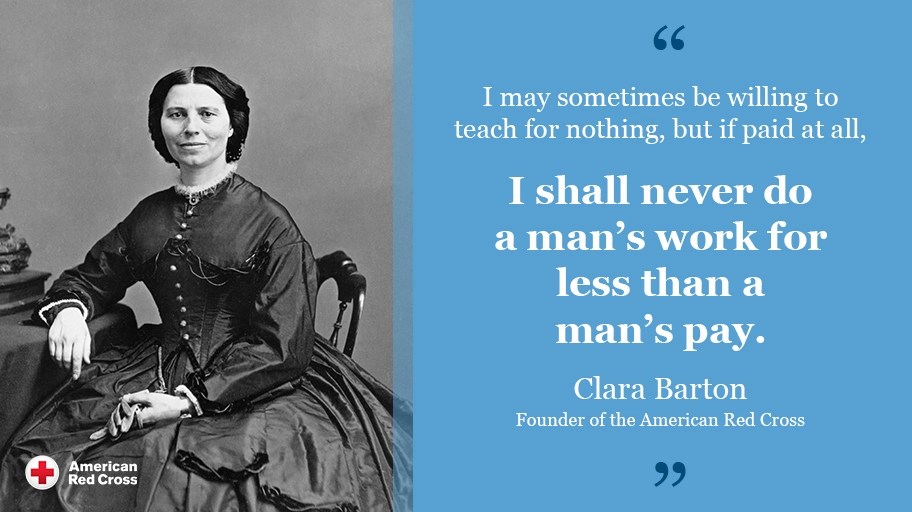
    Red Cross graphic – “I may sometimes be willing to teach for nothing, but if paid at all, I shall never do a man’s work for less than a man’s pay.” – Clara Barton, Founder of the American Red Cross.

    Every year, March is designated Women’s History Month by presidential proclamation. The month is set aside to honor women’s contributions in American history.

    Women’s History Month started as Women’s History Week

    Women’s History Month began as a local celebration in Santa Rosa, California. The Education Task Force of the Sonoma County Commission on the Status of Women planned and executed a “Women’s History Week” celebration in 1978. The organizers selected the week of March 8 to correspond with International Women’s Day. The movement spread across the country as other communities initiated their own Women’s History Week celebrations the following year.

    In 1980, a consortium of women’s groups and historians, led by the National Women’s History Project (now the National Women’s History Alliance), successfully lobbied for national recognition. In February 1980, President Jimmy Carter issued the first Presidential Proclamation declaring the Week of March 8th 1980 as National Women’s History Week. Discover more about Women’s History Month and its importance here.

    Women’s History Month and the Red Cross: Honoring Unsung Heroic Women Who Served in Wartime

    Women have played an important role in fulfilling the lifesaving American Red Cross mission since Clara Barton founded the organization more than 140 years ago. Known as the “Angel of the Battlefield,” Clara had cared for wounded soldiers during the Civil War before establishing the Red Cross in the U.S., where she was a visionary leader in serving those in need.

    This March — which is recognized as both Red Cross Month and Women’s History Month — we take a look at some of the Red Cross women who stepped up to help throughout history, exemplifying Clara’s humanitarian spirit and courageously supporting U.S. service members in wartime. To read more about some of the heroic women in our Red Cross history, click here. You can also get to know our modern-day women leaders by checking out our #LeadLikeClara blog series, which started in March 2022.

  • #LeadLikeClara: Mary Hughes helps volunteers deploy to disasters

    Editor’s Note: In commemoration of Red Cross Month and Women’s History Month, we are publishing a series of #LeadLikeClara profiles featuring local women volunteer leaders who emulate the leadership characteristics of Red Cross founder Clara Barton.

    Regional Deployment Lead Mary Hughes. Photo by Konrad Jones/American Red Cross

    By Jenny Farley

    Before a Red Cross volunteer can deploy to a disaster, there’s a lot of work behind the scenes. The mission is to get people to the right place and make sure they are taken care of so they can do their number one job – helping people recover and rebuild their lives.

    One of the volunteers who makes that happen is Mary Hughes. She has volunteered for the Red Cross since 2013, and now works as a regional deployment lead in our Southeastern Pennsylvania region.

    Mary helps volunteers get ready to deploy by ensuring they “know what to bring, that they are prepared, and that they know how to assess the situation.”

    She tells them what to pack and reminds them that on a deployment the minimum time commitment is two weeks away from home, and may be longer. She also advises them of hazards or severe weather conditions they may face so they can stay safe.

    As the world’s largest humanitarian network, the Red Cross responds to about 65,000 disasters a year, most of them home fires. Mary has deployed several times herself.

    “Where I send people out on deployment I could also deploy and I’ll be on the other end as staffing, receiving people.”

    Throughout her years of volunteering, there is one family Mary can’t forget. A father had gone to work while his son attended school. During the day, a fire killed the man’s wife, who was the boy’s mother.

    The Red Cross helped the man afford to get his wife’s ashes back to their home country and coordinate with the foreign embassy to make the arrangements.

    “It all changed in an instant for them and hopefully the Red Cross, their help in some way, was a positive for him, even though it was a very unfortunate circumstance.”

      Each disaster is unique but there is a common thread that ties them together.

    “The clientele are all different, but they all have the same need and desire – to kind of get back to normal.”

    Mary first volunteered for the Red Cross in high school as a switchboard operator. She temporarily stopped volunteering after she said she may have cut off one too many callers.

    The desire to help people never left, and when she retired from her work as a civilian employee for the Navy and the Air Force, she drove by a Red Cross office and her life changed.

    “It didn’t take long for me to figure I was not going to sit home and watch TV.”

    Mary said her favorite part about volunteering for the Red Cross is “even though I’m an introvert, it’s the people interaction and assisting people.”

    The Red Cross responds to a disaster every 8 minutes, and that couldn’t happen without volunteers like Mary, who often work out of public view.

    “I think it’s pretty important because if there aren’t any behind the scenes people then it’s hard to get the volunteers out there, especially with all of the things that they have to consider when they’re deploying.”

    Mary’s service has even inspired her husband to volunteer, after he overheard her coordinating for the Red Cross on a call.

    “I was on the phone with somebody and all of a sudden he was a man possessed. He took all the classes, and now he seems to enjoy volunteering himself. There’s something for everybody.”

    Mary Hughes certainly leads like Clara Barton. If she makes you want to become a Red Cross volunteer, visit redcross.org/volunteertoday.