Category: mental health

  • New Year’s resolutions: Small goals, big impact

    By Monica Weikel

    Photo of an open spiral-bound notebook open to a page with the words New Year's Resolutions handwritten at the top.
    New Year’s Resolutions. Public domain photo by Polina.

    I’ve always loved New Year’s resolutions. There’s something comforting and hopeful about starting a new year with intention. Every year, I take time to reflect on what worked, what didn’t, and what I want my life to feel like moving forward. For me, resolutions aren’t about reinventing myself overnight—they’re about gentle, realistic growth.

    This year, my goals are simple but meaningful: limiting social media to one hour a day, making homemade dinners at least three times a week instead of eating out, and going on a walk every day. They’re small goals, but they make a big difference in how I feel, and more importantly, they’re changes I can realistically keep up with. Research shows that people are more likely to stick with resolutions when they’re specific, realistic, and built into daily routines —and looking back on my own years of setting goals, breaking things down and building habits into my day have made all the difference.

    One of the most important tips for making healthy New Year’s resolutions is to keep them within reach. It’s easy to get caught up in big, dramatic goals, but setting yourself up for success matters more. If you can’t currently run a mile, saying you’ll run a marathon this year might only lead to frustration. A more realistic goal—like training for a 5K—still challenges you while giving you room to grow. Small wins build confidence, and confidence builds consistency.

    Over time, I’ve realized how important it is to have goals that touch more than just one part of life. Instead of focusing on just one thing, try setting goals for your health, finances, career, mental health, and social life. A health goal might be walking daily; a financial goal could be saving a specific amount each month; a career goal could mean learning a new skill; and a mental health goal could be journaling. Social goals—like being more present with friends or making time for loved ones—are just as important. When your goals are balanced, growth feels more fulfilling and less overwhelming.

    One fun and motivating idea is to create a mood board or goal board. This can include photos from the internet or pictures you’ve taken that visually represent what you want to achieve this year. Whether that’s healthier habits, peaceful routines, travel, or personal growth—seeing a visual reminder of your goals can be incredibly motivating, especially on days when your motivation dips.

    Finally, don’t be afraid to talk to others about their resolutions. Ask what’s worked for them and what hasn’t and share your own goals if you feel comfortable. At the end of the day, New Year’s resolutions aren’t about perfection—they’re about intention, self-compassion, and taking small steps toward the life you want.

  • Stress Awareness Month: 5 simple techniques to find calm in chaos

    By Kalagi Panchal

    Sign with the words “Good Morning…Let the stress begin……. Published under CC0 Public Domain license. Image source

    April is Stress Awareness Month, a time to recognize the impact of stress and explore healthy ways to manage it. With busy schedules, constant notifications, and daily pressures, stress can easily build up—but small, intentional practices can make a big difference.

    Here are five simple yet powerful techniques to help you reset and recharge:

    1. The 4-7-8 Breathing Method

    One of the fastest ways to calm your nervous system is through controlled breathing. Try the 4-7-8 technique:

    • Inhale deeply for 4 seconds
    • Hold your breath for 7 seconds
    • Exhale slowly for 8 seconds
      Repeat 3-4 times.

    This method signals your body to relax, reducing anxiety almost instantly.

    2. The 5-4-3-2-1 Grounding Exercise

    When stress feels overwhelming, grounding techniques bring you back to the present. Use your senses:

    • Name 5 things you can see
    • Touch 4 objects around you
    • Identify 3 sounds you hear
    • Notice 2 smells nearby
    • Name 1 thing you can taste
      This exercise shifts focus away from racing thoughts.

    3. Cold Water Splash (or Ice Cube Hold)

    A quick cold water splash on your face triggers the dive reflex, slowing your heart rate and easing tension. No sink nearby? Hold an ice cube in your hand until it melts—focusing on the sensation helps break stress spirals.

    4. Two-Minute Mindful Pause

    Instead of pushing through stress, pause for two minutes:

    • Close your eyes
    • Notice your breath
    • Observe any tension (without judgment)
    • Let your shoulders drop
      This mini-meditation creates space before reacting to stressors.

    5. Laughter Therapy

    Laughter literally reduces stress hormones. Watch a funny clip, call a friend who makes you laugh, or recall a hilarious memory—even forced laughter can trick your brain into feeling lighter.

    Final Thought: Small Shifts Add Up

    You don’t need hours of free time to combat stress. Even 30 seconds of deep breathing or a mindful pause can reset your mood. This month, experiment with what works for you—and remember, stress is manageable one small step at a time.

  • Diary of a Nurse: Take care of your mental health along with your physical body

    By Haley Heisley

    “Hi I am Haley and I will be your Nurse today.” This is way I begin every shift with each of my patients and also how I begin every article for you. I do this in hopes that I can share health promotion, prevention and awareness with you through your phone or laptop screen instead of in a hospital room. 

    I have noticed that people do not focus on their mental health as much as on their physical body. Many times I see a patient or their family members upset, stressed, overwhelmed or scared. They worry about hospital bills, insurance and childcare, affording medications, seeing a family member suffer, missing days of work, laying in pain and anything else you can think of in a healthcare setting. Never hesitate to ask for help. Stress and feeling down are not good for the healing process and motivation it takes to achieve optimal health. I often see family members and friends step up and help out their mom, dad, grandmother or neighbor while in the hospital. I see spiritual care and psychology experts come into patients’ room and get to know how they are feeling and be there to support them mentally, too. 

    According to the National Library of Medicine, depression is common in about one-third of medical inpatients and persisted for at least 30 days in up to half of those patients after discharge. The study found “strong evidence of an association between depressive symptoms and poor short‐term prognosis after discharge from the hospital; a 73% increased risk of readmission and a two‐fold risk of death within 30 days compared to patients without depressive symptoms with similar results at 90 days.” This goes to show that your mental health is EXTREMELY important. Just like the statistics and lab results the doctors present to you in the hospital, mental health is something that is measured in regards to better outcomes in patients. 

    An article posted by Jefferson Health finds that hospital stays can be very stressful for many people, regardless of age, “whether it’s about the fear and uncertainty about one’s health condition or the confusion and isolation of the hospital setting.” For seniors, the stress of hospitalization can be even more damaging to mental health. Citing a study from the American Academy of Neurology, “cognitive decline more than doubles after a hospital stay for elderly patients, negatively affecting their cognitive and mental health.” 

    Red Cross graphic – Your mental health matters.

    Mental Health is just as important as physical health; in fact they work together hand in hand. Poor mental health can lead to prolonged healing processes and even new diagnoses if not treated. When caring for your physical health, signs of depression and anxiety are common in patients, making it so important to notice these signs in yourself, your loved ones, and in your patients. As a healthcare worker, I am constantly reminded to take care of myself in order to take care of others. The things healthcare workers witness can be traumatic, and it is important to do a mental inventory check with yourself and know that you have support. You do not have to be a patient or a healthcare worker to feel these ways because no one is immune to these illnesses. 

    Different resources vary by community, hospital, school, city and state – just know you are never alone. 

  • It’s World Kindness Day: Be kind today and every day

    By Samantha Munro

    World Kindness Day graphic – The world is full of kind people. If you can’t find one, be one.

    World Kindness Day is celebrated globally on November 13 each year. It promotes the importance of being kind to each other, to yourself, and the world.

    One may wonder why is there so much importance placed on it, as it should be fairly easy to do! However, this isn’t always so in a world that is filled with unfortunate events happening every day — whether it is due to the climate crisis or social and civil injustices. Seeing these things play out on a global or personal stage in our lives makes it hard to put on a smile! 

    The truth is that we must make a conscious effort every day to maintain a positive mindset to show positivity to others. The world being in a sometimes chaotic state should be the reason that we rise every day with the intent to be that ray of light in someone’s day.

    Whether it be opening the door for someone, keeping the elevator door open for that person in a hurry, or offering up your seat on the bus or train to for an elderly person, it is not hard to see so many opportunities to show kindness throughout the day. These small yet profound acts show that there is still goodness in the world through moments of darkness.

    This is what the American Red Cross is all about, acts of kindness given day by day.

    Standing true to its mission and vision, the American Red Cross prevents and alleviates human suffering in the face of emergencies through its strong network of volunteers, donors, and partners, aspiring to turn compassion into action!

    Will you heed the call today? Turn your compassion into action by becoming a Red Cross volunteer or by scheduling an appointment to donate blood or platelets. These small acts of kindness make a big difference!

  • World Mental Health Day: Prioritizing mental health in the workplace

    By Haley Heisey

    World Federation for Metal Health video – About world Mental Health Day.

    “Mental health problems don’t define who you are. They are something you experience. You walk in the rain and feel the rain, but you are not the rain.” -Matt Haig, Author

    According to the Center for Disease Control (CDC), more than 1 in 5 U.S. adults live with a mental illness and over 1 in 5 youth (ages 13-18) either currently or at some point during their life have had a seriously debilitating mental illness. When you think about those statistics, it’s as small as 1 person in a group of friends or 1 person in each family having a mental illness. On a larger scale, think of the hundreds of people you pass everyday struggling with mental illness in their lives and we have no idea. It is time to treat mental illness as important as physical diagnosis and mental health as important as our physical body’s health. 

     World Mental Health Day this year is on October 24, 2024. The history behind this important day began in 1948, and ever since then has been working to grow into a global organization. The theme this year is, “It is time to prioritize mental health in the workplace.” We remind ourselves to seek alone time at home and enjoy our days off, but who says we can’t prioritize ourselves too while we are at work? If you do not take care of you, how will you ever be able to take care of anyone or anything else? Working in healthcare, there are many moments of high stress, and afterwards I need to take a step aside and collect myself before taking on another strenuous task so that I know I will show up as my best self. I once heard something along the lines of, “instead of giving it your all, give it your best, because if you give your all you are left with nothing.”

    What can you and I do? If you are struggling with mental illness or know someone who is, seek help from a doctor or even from someone close to you in life. Remind yourself that it is okay to feel this way, but you should not have to feel it anymore. When it comes to the topics of anxiety and depression, these affect many people on many different scales. You never know what’s on someone’s mind or what’s going on in someone’s life, so always be the person that isn’t part of the problem of  the increase in mental illness and be a part of the awareness. In your home, your school, your community, your workplace and in the world. 

    Mental Health Resources:

  • National Suicide Prevention Week: #BeThe1To

    By Samantha Munro

    Bringing our attention to this subject matter is never easy, but necessary! Suicide is the second leading cause of death among people ages 10-14 and the third leading cause of death among people ages 15-24 in the U.S. It is also the 12th leading cause of death overall in the U.S.

    Understanding the issues concerning suicide and mental health is an important way to take part in suicide prevention, helping others in crisis, and changing the conversation around suicide. Thus, the month of September is National Suicide Prevention Month with National Suicide Prevention Week being from September 8th-14th and National Suicide Prevention Day being September 10th — all bringing awareness to this very important topic.

    One may ask, why would the American Red Cross be interested in this topic? It goes into alignment with our mission statement, “prevents and alleviates human suffering in the face of emergencies.” As a humanitarian organization, we respond to an average of more than 60,000 disasters every year.

    Experiencing a natural disaster or other emergencies can be intensely stressful. This stress is not only experienced by those who have lost, but also by those who are there to help, as 90% of our disaster relief workers are volunteers, and they may be going through the same thing while also being there as a support for others during their moment of crisis.

    The impact can still be felt even when the immediate danger has passed. People may feel grief or anger over the damage or loss, fear or hopelessness when thinking about rebuilding their lives, and not knowing where or how to begin.

    The Red Cross offers Disaster Mental Health support provided by licensed professionals who volunteer their time and talent when disaster strikes. It is crucial for people to know that there is help available to them after experiencing a disaster. Knowing that you are not alone, that there are people who are available to assist you with getting your life back on track one day at a time, can help prevent further tragedies such as the ending of this life!

    If you or someone you know is struggling or in crisis, help is available. Call or text 988 or chat at 988lifeline.org to reach the 988 Suicide & Crisis Lifeline. Below are a list of resources for you, your loved ones or someone in need of them. Also, if you feel as though you can be that resource in someone else’s life, please consider becoming a Disaster Mental Health volunteer.

    Resources

  • Mental Health Awareness Month – ‘Where to Start: Mental Health in a Changing World’

    By Samantha Munro

    Mental Health America graphic – May is Mental Health Month. Want to improve your mental health but don’t know where to start? Get information and resources at MHANATIONAL.ORG/MAY

    This year’s Mental Health Awareness Month theme, “Where to Start: Mental Health in a Changing World,” is very fitting in today’s society. When you think you may have a basic understanding and things “seem” to be going well, we are hit with more truths whether it be about ourselves or the world at large.

    During this time period, we reset ourselves in a way to tackle all of the information coming our way — filtering the noise and narrowing down on “What can I do about this situation and how can it help me and those to come?”.

    As we focus on mental health, it is important to know that it is an ongoing journey to strengthen the mind, to embrace the good and not to let the bad knock us down. Though we may feel like we are falling, the understanding of how your mind works, your fears, weakness and strengths can help you get the help you need that caters to your mind’s improvement.

    Mental health awareness is something that everyone should keep in mind of because we will all need it at one point or another, whether dealing with unfair treatment at the workplace, discord between family or friends, or frustration at the ongoing injustices in our world.

    To tie this into the American Red Cross, when it comes to disasters, people may feel grief or anger over the damage or loss, fear or hopelessness when thinking about rebuilding their lives, and not knowing where or how to begin.

    This is why the Red Cross offers Disaster Mental Health Team provides support by licensed professionals who volunteer their time and talent when disaster strikes. It is crucial for people to know that there is help available to them after experiencing a disaster. Knowing that you are not alone, that there are people who are available to assist you with getting your life back on track one day at a time can give you hope and a peace of mind!

    In the end, no matter where you are on this journey, call life, always know where to go and who to turn to whenever you feel lost. You can start with the resources provided below. Also, if you feel as though you can be that resource in someone else’s life and you have the credentials, please consider becoming a Red Cross Disaster Mental Health volunteer.

    Mental Health Resources:

  • Check Your Stress: April is National Stress Awareness Month

    By Samantha Munro

    Red Cross graphic – Find a small way every day to cope with stress.

    April is recognized as National Stress Awareness Month to bring attention to the negative impact of stress. Managing stress is an essential component of a healthy lifestyle. Knowing how to manage stress can improve mental and physical well-being as well as minimize severity of health-related issues.

    The origins of National Stress Awareness Month can be traced back to 1992 when the Health Resource Network (HRN), a non-profit health education organization, launched a campaign to encourage people to learn about the effects of stress and to provide information on how to manage it.

    As a humanitarian organization, The American Red Cross responds to an average of more than 60,000 disasters every year. Even when the immediate danger has. People may feel grief or anger over the damage or loss, fear or hopelessness when thinking about rebuilding their lives, and not knowing where or how to begin.

    The Red Cross offers Disaster Mental Health services provided by licensed professionals who volunteer their time and talent when disaster strikes. It is crucial for people to know that there is help available to them after experiencing a disaster. Knowing that you are not alone, that there are people who are available to assist you with getting your life back on track one day at a time.

    Keeping a balanced life and limiting the amount of stress is very important. Here are some resources that can be of great benefit to anyone seeking additional information:

  • Random Acts of Kindness Week: Be the Light

    By Susan West

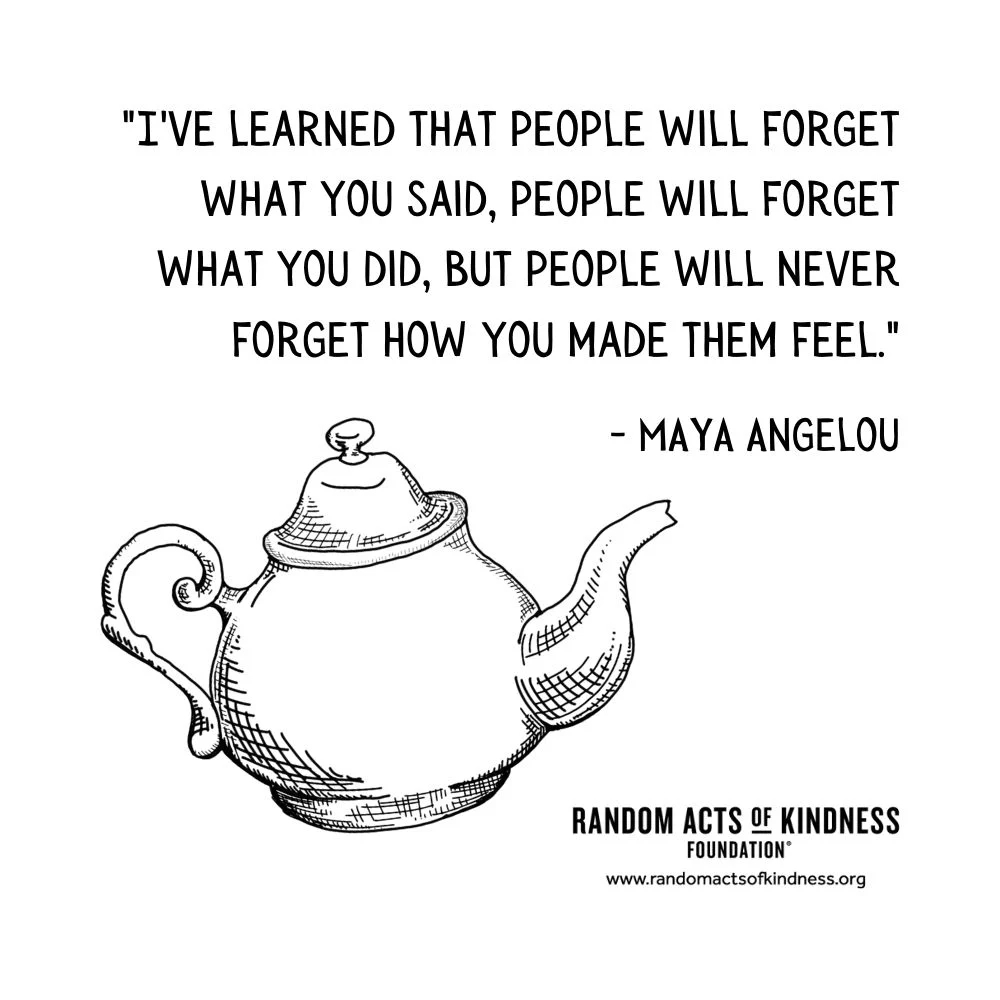
    Random Acts of Kindness Foundation graphic – “People will forget what you said, people will forget what you did, but people will never forget how you made them feel.” ~ Maya Angelou

    As someone reading this Red Cross blog, you’re probably already a very nice person, so don’t take this with a “duh.” But for the next several days, and especially on Saturday, February 17—Random Acts of Kindness Day—we’re inviting you to kick your kindness up a notch.

    Everyone knows that doing good makes us feel good; the smallest favors can yield huge mood boosts. But do you know just how big of an impact a small act can make? In a series of experiments described in Scientific American, social psychologists Amit Kumar and Nicholas Epley came to a striking conclusion: We sell ourselves short. People who perform random acts of kindness tend to underestimate how much the recipients value the gesture.

    This was true of kindnesses done for familiar people as well as complete strangers. For example, people who gave out free cocoa on a cold day saw the favor as “relatively inconsequential,” while it really mattered to the recipients, the researchers found.

    And kindness can be contagious, leading to a verified “pay it forward” effect. Here are some (mostly free) ideas:

    • Be nice, not just neutral. Smile at everyone. (Fake it if you have to.)
    • In the store, look your cashier in the eye and thank them.
    • Let the other car merge first. Always. (Unless your passenger is in labor.)
    • Be fully engaged in your interactions; one of the greatest gifts you can give someone is your undivided attention.
    • Thank a teacher.
    • Pay for the person behind you.
    • Bring muffins to work.
    • Walk the neighbor’s dog.
    • What the heck, write a check.

    In troubled times, simple kindness is a light that shines on us all. The truest altruism is anonymous; the kindest kindness is selfless. Your act in and of itself will bring you joy. Don’t self-congratulate on social media; instead, sit with your satisfaction and bask in the glow of your helper’s high. Some stranger somewhere will remember, because you were kind to them when nobody else was.

  • World Mental Health Day 2023

    By Samantha Munro

    World Health Organization (WHO) graphic: Our Minds, Our Rights, Our World Mental Health Day, 10 October 2023.

    World Mental Health Day 2023 is an opportunity for people and communities to unite behind the concept that “mental health is a universal human right” to improve knowledge, raise awareness and drive actions that promote and protect everyone’s mental health.

    The day provides an opportunity for all stakeholders working on mental health issues to talk about their work, and what more needs to be done to make mental health care a reality for people worldwide.

    Good mental health is vital to our overall health and well-being. Yet one in eight people globally are living with mental health conditions that can impact their physical health, their well-being, how they connect with others, and their livelihoods.

     One may ask, why would the American Red Cross be interested in this topic? It goes into alignment with our mission statement, to prevent and alleviate human suffering in the face of emergencies. As a humanitarian organization, we respond to an average of more than 60,000 disasters every year.

    Experiencing a natural disaster or other emergencies can be intensely stressful. This stress is not only experienced by those who have lost, but also by those who are there to help, as 90% of our disaster relief workers are volunteers — who have or also may be going through the same thing while also being there as a support for others during their moment of crisis.

    The impact can still be felt even when the immediate danger has passed. People may feel grief or anger over the damage or loss, fear or hopelessness when thinking about rebuilding their lives, and not knowing where or how to begin.

    This is why the American Red Cross offers Disaster Mental Health support provided by licensed professionals who volunteer their time and talent when disaster strikes. It is crucial for people to know that there is help available to them after experiencing a disaster. Knowing that you are not alone, that there are people who are available to assist you with getting your life back on track one day at a time, can give you hope and a peace of mind!

    Last year, Red Cross Disaster Mental Health volunteers nationally made over 23,500 contacts following medium to large disasters, and 548 Disaster Mental Health volunteers deployed outside of their regions, including several from Southeastern Pennsylvania.

    More of these critical volunteers are needed. If you’re a mental health professional with a current license or certification in any U.S. state or territory, your skills are needed to help people facing the stress and trauma of disaster or to facilitate skills workshops for service members, veterans and their families. Learn more about these opportunities by visiting redcross.org/voluneertoday.