Category: Community Partnerships

  • Preparedness is not a moment, it’s a commitment

    The city’s most important infrastructure isn’t always visible. This summer, volunteers, emergency managers and community partners helped strengthen the systems that keep Philadelphia prepared.

    By Jennifer Graham, CEO, American Red Cross Southeastern Pennsylvania

    Back in June, I arrived at the American Red Cross Southeastern Pennsylvania headquarters at Seventh and Spring Garden streets before dawn. It was 5:30 a.m., and dozens of volunteers were already preparing for a long day ahead.

    Some were serving breakfast and packing lunches. Others were charging emergency communications radios, organizing supplies, reviewing assignments and preparing transportation for teams headed across Philadelphia. The city was preparing to welcome tens of thousands of visitors for a series of major events, from international soccer matches and fan fests to celebrations connected to America’s 250th anniversary.

    As I walked through the building, I met volunteers from every walk of life. Retirees. Working professionals. Students. Neighbors. Some had adjusted work schedules. Others had given up weekends with family. None of them expected recognition. Most people attending the events that day would never know they were there. Yet their work was helping support the city.

    American Red Cross volunteers wearing red shirts are seated and gathered in a bright room for a briefing at the Spring Garden campus, with flags and an American Red Cross logo displayed in the background.
    American Red Cross volunteers get briefed on the day’s assignments heading out into the field.

    When we talk about infrastructure, we often think about roads, bridges, transit systems, utilities and public buildings. Those investments are essential. They allow a city to move people, goods and services safely and efficiently.

    But after spending this summer working alongside the Philadelphia Office of Emergency Management and many local, state and federal partners, I was reminded that cities depend on another form of infrastructure as well: people.

    The networks of trained volunteers, emergency managers, nonprofit organizations, public servants and community partners who stand ready to support one another are every bit as important to a city’s resilience as the physical systems we can see. This summer offered a powerful example.

    For 45 consecutive days, American Red Cross volunteers supported preparedness and coordination efforts tied to some of the region’s largest events. Volunteers filled hundreds of shifts and contributed nearly 10,000 hours. Behind the scenes, they supported stand-by evacuation centers and shelters, feeding operations, emergency communications, transportation logistics and volunteer coordination—ready to assist should conditions change unexpectedly.

    Red Cross teams maintained a presence in emergency coordination efforts, working alongside city agencies and partner organizations to help ensure information and resources could be shared quickly and effectively.

    Top: Government Operations volunteers Bruce Swift and Sandy Capoferri at the Philadelphia Emergency Operations Center (EOC) on June 19. Submitted photo. Bottom: Disaster Action Team Responder LeRoy Whitehead inside the mobile emergency operations center (EOC) at Lemon Hill on June 14. Photo by Aurora Reardanz / American Red Cross

    At the same time, the Red Cross continued its everyday mission across Southeastern Pennsylvania. While supporting major events, we responded to home fires and local disasters, provided emergency assistance to families in crisis, collected lifesaving blood donations, trained the community in lifesaving skills like CPR and first aid and supported military service members, veterans and their families.

    Much of that work happened quietly. And that is exactly how successful preparedness should look.

    The best emergency management efforts are often the ones people never notice. Visitors arrive safely. Events run smoothly. Communities gather and celebrate. Potential challenges are anticipated before they become problems.

    But those outcomes do not happen by accident. They are the result of months, and sometimes years, of planning, relationship-building and coordination. Organizations learn how to work together long before they need to. Trust is established before challenges arise. Communication systems are tested. Volunteers are trained. Responsibilities are defined.

    By the time crowds fill stadiums and public spaces, an enormous amount of unseen work has already taken place. Building resilience before emergencies occur strengthens communities and reduces vulnerabilities when unexpected events happen. In that way, preparedness is fundamentally an infrastructure investment. Not an investment in concrete or steel, but an investment in human capacity.

    Three American Red Cross volunteers wearing red shirts labeled "RED CROSS VOLUNTEER" stand looking out toward a glowing city skyline at night with illuminated colorful buildings in the distance.
    Red Cross volunteers at a stand-by family reception center on July 4, 2026. Photo courtesy of Philadelphia Office of Emergency Management.

    For me, one of the most inspiring examples from comes from two volunteers who spent much of their summer coordinating our volunteer workforce. Together, they recruited volunteers, managed schedules, organized assignments and helped ensure teams had the information and support needed to be successful. Over the course of the summer, they coordinated 325 volunteer shifts.

    Most people attending events throughout Philadelphia never met them. But their impact was everywhere. Their dedication underscores an important truth about cities: the people who make communities function are not always the people in the spotlight. They are often the people working behind the scenes, solving problems, building connections and helping systems operate effectively.

    Philadelphia has always been shaped by civic participation. Long before terms like “resilience” and “preparedness” became part of public policy discussions, neighbors here were organizing block by block, supporting one another and stepping forward when their communities needed help. That spirit remains one of the city’s greatest strengths.

    The biggest lesson I took away from this summer is that preparedness is not a moment. It is a continuous commitment: a commitment to planning before problems occur, investing in partnerships before they are tested and maintaining readiness even when the spotlight is elsewhere.

    It is also a commitment to recognizing that a city’s greatest asset is not its infrastructure alone, but the people who make that infrastructure work. Most will never receive public recognition for their contributions, but they demonstrated something worth remembering: behind every resilient city is a community of people showing up every day to make it stronger.

    We invite you to put on a red vest and join us. Visit redcross.org/volunteer to find out how you can support our community.

  • When all else fails: Red Cross amateur radio volunteers stand ready for Philadelphia’s biggest summer events

    Two male Red Cross volunteers in red t-shirts sit at a workspace desk; one types on a laptop while the other operates a handheld amateur radio.
    Amateur radio operators (from left) Lee Erickson and Delancey Cheeks are pictured during their first Red Cross summer events shift on June 14 at the Spring Garden Campus. Photo by Debbie Tevlin / American Red Cross

    By Jenny Farley and Alana Mauger

    As Philadelphia hosts a summer filled with major sports events, festivals and large public gatherings, American Red Cross volunteers are preparing for something they hope never happens: a communications emergency.

    Across the city, teams of volunteers are standing by to assist community partners if an emergency occurs during these historic events. Among those volunteers are members of the Red Cross Disaster Services Technology (DST) team, many of whom are licensed amateur (ham) radio operators.

    On June 22, as thousands of soccer fans gathered for a match between Iraq and France, Red Cross DST Lead Cliff Hotchkiss and his team assembled at the Spring Garden Campus to prepare for the evening ahead. Their mission was simple but important: ensure reliable communications remained available if emergency responders and Red Cross teams needed them.

    Amateur (Ham) Radios as a Communication Backup

    While cell phones and internet-based systems handle most day-to-day communications, amateur radio provides a critical backup when traditional networks become overloaded, damaged or are unavailable.

    “With the amount of crowds that we have in the city, it is not unlikely that the cell phone systems would get overloaded, and there might be interruption in cellular communication,” Hotchkiss said.

    He said if cell phones went down, radios could be used to link the Red Cross groups around the city, including those at pre-staged family resource centers, the Spring Garden Campus, the Philadelphia Emergency Operations Center (EOC) as well as the Red Cross warehouse in Norristown if supplies were needed.

    Hotchkiss shepherded his team through testing their radios, listening to a briefing, and going through a logistical run-through of the likely night ahead. He also had another role.

    Five smiling American Red Cross volunteers stand side-by-side in a brightly lit building atrium with large green plants in the background. They are wearing Red Cross t-shirts, credentials around their necks, and portable amateur radios clipped to their belts or held in hand.
    Shown from left to right are amateur radio operators and Red Cross volunteers Tom Barrett, Mark Pricskett, Richard Van Sleet, Cliff Hotchkiss and Aaron Bradshaw. The group is prepared to help with emergency communications during the summer events in Philadelphia. Photo by: Jenny Farley/American Red Cross.

    “Net Control” Serves as the Host of the Night

    On nights like this, think of Hotchkiss as the air traffic controller. When people are communicating on a radio, you don’t want everyone talking at once because it can get confusing. That’s where Hotchkiss comes in, operating in a position called “net control,” something he can do on his radio from home.

    He said, “It’s kind of like, for lack of a better description, the host of the communication.”

    Everyone reports to “net control” so that a bunch of people aren’t talking over one another.

    “Acting as net control can be a real challenge. It takes a lot of practice and a lot of precision to do that,” he said.

    Volunteers on Hotchkiss’ team of highly skilled amateur radio operators briefly sat at tables set up in the atrium at the Spring Garden Campus on June 22nd. Many of them were meeting each other for the first time.

    All of them were working their first Red Cross event. Like Hotchkiss, they shared an appreciation for amateur radio and had earned the license required to operate them.

    A close-up photograph of a bald man with a beard and glasses, wearing a pink Sriracha t-shirt and an ID badge, speaking into a handheld amateur radio.
    Amateur radio operator Sam Rausch checks in to Net Control from Central Parkway Library during his first Red Cross summer events shift on June 14. Photo by Eileen Raul / American Red Cross

    Blood Donor Uses His Ham Radio Skills to Help the Red Cross

    Volunteer Tom Barrett used to regularly donate blood until he had colon cancer and had to stop donating because of his medications. When he was a kid he wanted to be a paramedic, inspired by the 1970’s TV show “Emergency.”

    He ended up in the music industry, teaching music theory and working for two publishers.

    He also trained with the Delaware County Medical Reserve Corps and took first aid classes offered by the Red Cross.

    Barrett got into amateur radio about 9 years ago and was ready to use his talents for the Red Cross.

    “I already had the skills. This was an opportunity that came up and I’m happy to help,” he said.

    A close-up photograph of a smiling, middle-aged man with glasses and long grey hair, wearing a red American Red Cross "America 250" t-shirt. He has an official volunteer credential lanyard around his neck, a speaker microphone clipped near his collar, and is holding a handheld amateur (ham) radio with a long antenna in his left hand while seated indoors.
    Tom Barrett started volunteering for the Red Cross when he heard from the Amateur Radio Emergency Service (ARES) that there was a need. “They came to us asking if we had volunteers willing to help so some of us did,” he said. Photo by: Jenny Farley/American Red Cross.

    Paramedic Learned About Amateur Radio from His Dad’s Military Service

    Aaron Bradshaw works as an emergency room tech and paramedic whose father was a radio operator in the military.

    “Ever since then I just started picking it up and getting into it,” he said. Bradshaw met Hotchkiss through the Philadelphia Amateur Radio Emergency Service (ARES) group.

    “He started mentioning stuff about the Red Cross and then I started looking into it and I was like ‘oh that will be interesting. I’ll give it a try.’ And here I am.”

    Barrett and Bradshaw tested their radios out to make sure they were working before they headed to the shuttle that took them to their assigned location at South Philadelphia High School.

    A close-up photograph of a man with short dark hair, glasses, and arm tattoos, wearing a red American Red Cross "America 250" t-shirt and a black backpack strap over his shoulder.
    Red Cross volunteer Aaron Bradshaw is carrying his amateur radio equipment which could be used to communicate in an emergency. Bradshaw said, “When I got my amateur license about two years ago I wanted to get more involved in radio-like communication activities.” Photo by: Jenny Farley/American Red Cross

    Self-Described “Tech Person” Puts His Radio to Work

    Mark Pricskett and Richard Van Sleet stayed behind with their radios in a room at the Spring Garden Campus to provide communications support from there.

    Pricskett had “always wanted to volunteer for the Red Cross and thought ham radio would be a good fit because of the technology.” He said, “I’m a tech person and I thought that’s where I could do my best stuff.”

    One of the things he finds most intriguing about radio is that it is constantly evolving. He said, “Radio is no longer just on the radio anymore. It involves communication with the computer. There’s all kinds of different devices to communicate with that come under the radio heading, so it’s always changing.”

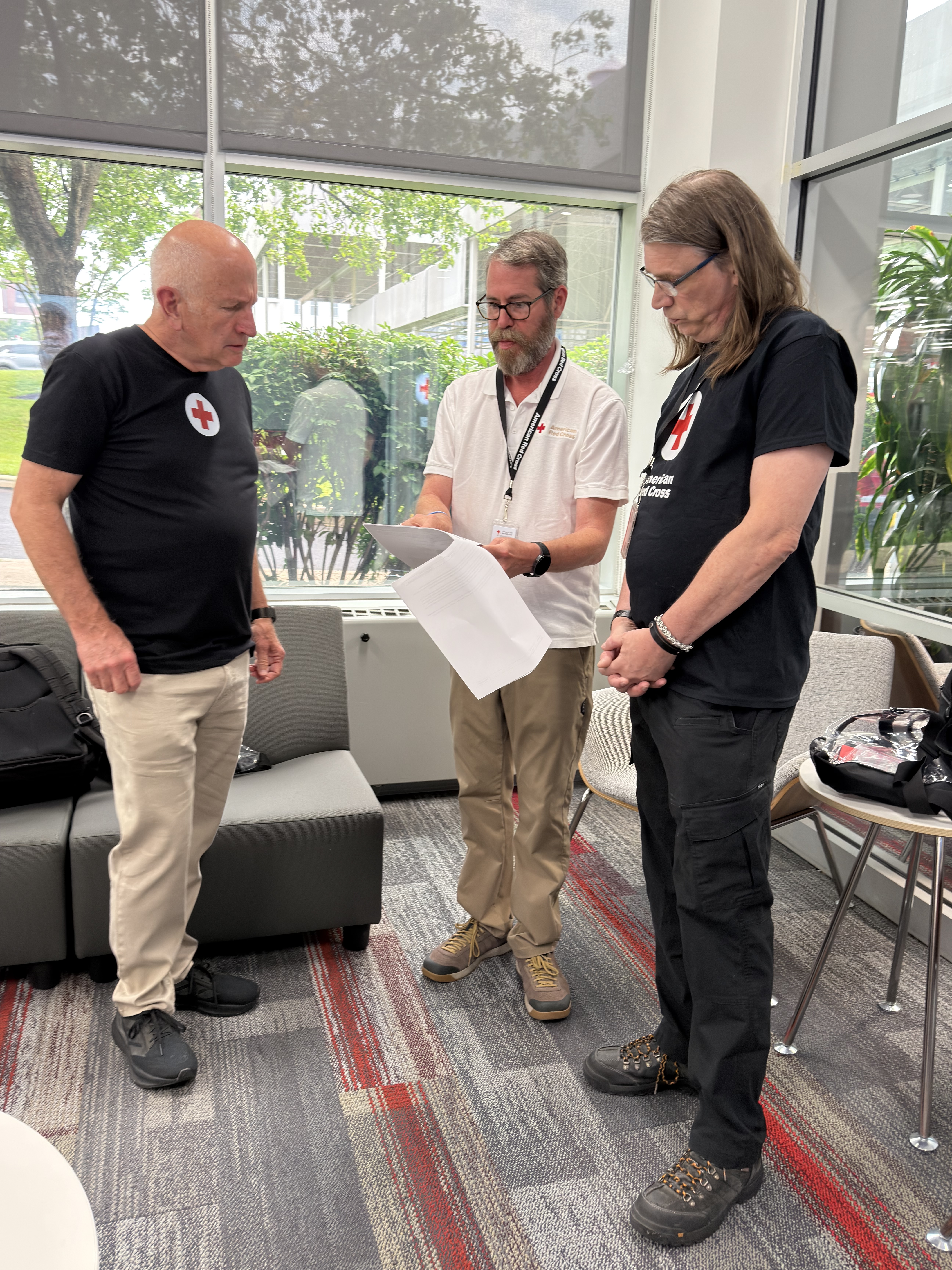
    Three men stand indoors in a workspace reviewing a document together. Two of them wear black t-shirts with a red cross logo, and the middle man wears a white polo shirt with a lanyard.
    Shown from left to right: Richard Van Sleet, Cliff Hotchkiss and Mark Pricskett go over the communication plan at Red Cross headquarters at the Spring Garden Campus in Philadelphia. All three volunteers are licensed amateur radio operators. Photo by: Jenny Farley/American Red Cross.

    Radio to the Rescue

    So, what does an amateur radio operator do during an emergency?

    Hotchkiss said, “One of the mottos of ARES is when all else fails, there is amateur radio.”

    Radio can be used to communicate when phones aren’t an option.

    Hotchkiss described an example of radio communication saving lives during Hurricane Helene in western North Carolina in September 2024.

    He knew an amateur radio operator who lived in a neighborhood that became unreachable in the storm when the bridge to the community was destroyed.

    “They were completely isolated. There was no way you could get to them,” he said. “Amateur radio played a really major part because all of the cell phones were wiped out for weeks.”

    The radio operator was able to relay messages that led to his elderly neighbors getting the help and medical supplies they needed.

    A close-up photograph of a smiling, middle-aged man with grey hair and a red American Red Cross t-shirt, carrying a black backpack and a large black gear bag filled with cables and equipment.
    Amateur radio operator Alex Haddad prepares to leave the Spring Garden Campus for his field assignment at South Philly High School on June 25. Photo by Debbie Tevlin / American Red Cross

    Emergency Preparedness Goes Hand-in-Hand with Radio

    Richard Van Sleet just started volunteering for the Red Cross two months ago and was on his first assignment. After he retired he got interested in emergency preparedness and radio seemed like a natural fit.

    “It’s kind of like the ultimate. If everything else goes bust ham radio will work. That’s how I got interested in it as an emergency communication.”

    In his job as “net control,” Hotchkiss is required to keep a record of all radio messages so that in a post-emergency review, people can study what becomes the public record of what happened.

    Except for the stormy weather, the night went relatively “smoothly” according to Barrett. He said they checked in with the team at the Spring Garden Campus every 30 minutes and fortunately “nothing happened.”

    Being on standby to act in case of emergency is something Red Crossers know how to do well.

    Van Sleet shared a sentiment that most in Hotchkiss’ group of radio warriors may have been thinking.

    “You prepare for these things but you actually hope nothing will happen. If that’s not the case, I think we’re ready,” he said.

    A close-up photograph of a smiling man with a black American Red Cross polo shirt and an ID badge, speaking into a handheld amateur radio with a red wall in the background.
    Amateur radio operator Chris Kelleher checks in to Net Control during his shift at South Philly High School on June 27. Photo by Sean Snyder / American Red Cross


  • Red Cross volunteers mobilize across Philadelphia to support summer of historic events and celebrations

    By Alana Mauger

    Hundreds of American Red Cross volunteers from Southeastern Pennsylvania are stepping up this summer as Philadelphia welcomes visitors from around the world for a season of major events, matches and celebrations. From June 14 to July 14, 2026, up to 60 volunteers will be on the ground each day to support 13 large-scale events across the city.

    “Our goal is to strengthen community safety and resilience while making sure the Red Cross is ready to respond if large-scale support is needed,” said Jennifer Graham, CEO, American Red Cross Southeastern Pennsylvania. “We’re working closely with our partners to anticipate and prepare for whatever needs emerge.”

    To do that, Red Cross volunteer teams are strategically positioned throughout the city on key event days, ready to jump into action if needed.

    Positioned for Rapid Response

    During soccer matches, volunteers are staffing family resource centers at South Philadelphia High School and Parkway Central Library alongside the Office of Emergency Management (OEM) and other city agencies. These volunteer teams bring expertise in sheltering and client care. An amateur radio (ham) operator is also embedded with each team to support emergency communications.

    Four smiling Red Cross volunteers sit behind a long white folding table indoors. From left to right, a man in a red Red Cross T-shirt sits next to a cooler, a man in a black Red Cross T-shirt wearing a baseball cap sits with his hands clasped, a woman in a red Red Cross T-shirt rests her hands on the table, and a woman in a red Red Cross T-shirt sits on the far right. Closed lockers and double doors are visible in the background.
    Family resource center volunteers on standby at South Philly High School on June 14. Pictured (from left) Sheltering Supervisor Hal Cohen, Amateur Radio Operator Alex Haddad, Disaster Spiritual Care Service Associate Sharon White and Sheltering Service Associate Valarie Kania. Submitted photo

    With teams and resources already in place before they’re needed, the centers can open in mere moments and serve as places of refuge for people evacuating.

     “If something were to happen, our teams are prepositioned to receive people, begin gathering their contact info and take inventory of their immediate needs,” explained volunteer Debbie Tevlin, who is heading up the Red Cross operations team for the event series.

    And because government operations volunteers maintain a presence in the city’s Emergency Operations Center on key days, the Red Cross can quickly spring into action. These volunteers are part of the external relations team and serve as liaisons between Red Cross and city leadership.

    Two smiling Red Cross volunteers sit side-by-side at a desk indoors. On the left, Bruce Swift wears a grey polo shirt with a Red Cross logo, and on the right, Sandy Capoferri wears a red Red Cross lanyard over a white zip-up sweater. A laptop and a small desk sign reading "OIA Office of Immigrant Affairs" sit in front of them. In the background, a large wall is filled with multiple massive television screens showing traffic and surveillance feeds, with an "EOC" sign visible on a desk to the left.
    Government Operations volunteers Bruce Swift and Sandy Capoferri at the Philadelphia Emergency Operations Center (EOC) on June 19. Submitted photo

    In addition to the resource centers and city EOC, volunteer teams are stationed inside a mobile EOC near fan events at Lemon Hill to help law enforcement with family reunification on match days. They’re also serving in that capacity during several large Wawa Welcome America events around the city.

    Disaster Action Team responder LeRoy Whitehead was part of the first Red Cross team to staff the mobile EOC at Lemon Hill on June 14th. He was impressed by what he saw.

    “We were in a massive trailer with multiple rooms, and there were 15 gigantic screens showing feeds from cameras everywhere. Every part of the part of the fan fest grounds was covered,” he shared.

    LeRoy and his teammate Aurora Reardanz were given space directly behind officers from the Philadelphia Police Department so they could readily assist with family reunification.

    “We were called into action for a brief moment,” he said, but thankfully police officers quickly located the missing child’s family. “It was nice to be ready, to be there right in the mix. It made me proud to be part of the Red Cross.”

    LeRoy said he was most impressed by the way representatives from the different regional and national agencies worked collaboratively together, especially when they had to shut down the festivities early because of impending storms.

    “People put their egos aside to protect and serve the community,” he said.

    Disaster Action Team Responder LeRoy Whitehead stands smiling inside a long, narrow mobile emergency operations center (EOC) trailer. He wears a red American Red Cross polo shirt, a black baseball cap, khaki pants, and a volunteer badge around his neck. A bright red "RED CROSS" sign is mounted on the wall to his left, and further down the hallway, yellow and blue signs mark "FAA" and "FBI" stations above long rows of desks and equipment.
    Disaster Action Team Responder LeRoy Whitehead inside the mobile emergency operations center (EOC) at Lemon Hill on June 14. Photo by Aurora Reardanz / American Red Cross

    Behind the Scenes Support

    The Spring Garden Campus serves as the home base for Red Cross summer event operations. From here, a dedicated group of volunteers and staff coordinate logistics, transportation, technology, meals, emergency communications and other key support functions.

    Disaster Action Team specialist Terri Whiteford worked the first summer events ambassador shift on June 14th. As an ambassador, she delivered a warm welcome, distributed swag – including a T-shirt, sunglasses and a personal care kit with sunscreen, bug spray and hand sanitizer – provided directions and made sure everyone knew their assignments.

    “We’ve got a lot of guests in Philadelphia right now, and I’m really pleased the city reached out to the Red Cross because we’re really good at this,” she said.

    Indoors at a white round table, Ambassador Terri Whiteford, wearing a purple shirt, smiles as she hands a clear plastic swag bag filled with items to shuttle driver John Timalonis. John stands smiling on the left, wearing a red American Red Cross volunteer vest over a white t-shirt, a baseball cap, and glasses. A sign-in sheet and a pen sit on the table between them.
    Ambassador Terri Whiteford (right) gives shuttle driver John Timalonis (left) a swag bag before his shift on June 14 at the Spring Garden Campus. Photo by Alana Mauger / American Red Cross

    As a huge soccer fan, Disaster Action Team responder Bonnie Baker couldn’t wait for her first of many shifts as ambassador lead on June 25th. She played soccer in college, coached her daughter’s club team and is even a certified referee! Bonnie said she was compelled to get involved with the summer events in some way, and the ambassador lead role seemed like a good fit.

    “I really love the opportunity to meet other volunteers at the Red Cross, and everyone has been so welcoming,” she said.

    Field teams start and end their shifts at the Spring Garden Campus without the hassle of parking thanks to volunteer drivers who shuttle the teams to and from their assigned locations across the city.

    But before they leave, mass care volunteers provide meals and pack coolers with food and drinks for the day and evening shifts ahead. Feeding team member Mike Kucenic said it’s their job to “bring smiles.”

    Three smiling mass care feeding team volunteers stand behind a long table covered in a red tablecloth indoors. On the right, Karen Westermann wears a blue Red Cross polo shirt, a khaki visor, and blue medical gloves as she carefully slices a decorated sheet cake. To her left, Mike Kucenic wears a red Red Cross "America 250" t-shirt and a red baseball cap, while Kevin Savage stands smiling in the background. Packages of black paper plates, napkins, and other food service items are laid out on the table.
    Mass care feeding team volunteers (from left) Mike Kucenic, Kevin Savage and Karen Westermann prepare to feed field volunteers before their shift. Photo by Alana Mauger / American Red Cross

    Roles like shuttle driver and ambassador open opportunities to volunteers who don’t typically work in disaster services. For example, several blood transportation specialists have picked up shuttle shifts, and volunteers across the organization are welcoming and onboarding field workers as ambassadors.

    That’s what led Kim Majczan to sign up for an ambassador shift on June 25th. She usually volunteers as an ambassador of a different kind – one that helps ensure blood donors have a positive experience at mobile blood drives.

    “I wanted to meet volunteers from other areas. I also wanted to see this building,” she said, referring to the Spring Garden Campus.

    Inside a modern office space, five Red Cross volunteers gather around a small white table for a briefing. On the left, Assistant Director of Operations Debbie Tevlin stands wearing a red shirt and black pants, gesturing with her hand as she speaks. Seated around the table are regional mass care manager Heather Gale, deputy job director Marty Westermann, and ambassadors Kim Majczan and Bonnie Baker. In the background, a flat-screen TV mounted on the wall displays a commemorative "20 Years of Service" graphic.
    Assistant director of operations Debbie Tevlin briefs ambassadors Kim Majczan (left) and Bonnie Baker (right) at the start of their shifts onJune 25. Regional mass care manager Healther Gale and deputy job director Marty Westermann are also pictured. Photos by Alana Mauger / American Red Cross

    In addition to serving as the base of operation, the Spring Garden Campus is a backup Red Cross shelter location in the event that disaster workers need to be brought in from outside the Philadelphia area. Local volunteers and staff are covering on-call shelter shifts through July 22nd to ensure everything is ready if needed.

    Volunteers Power the Mission

    Volunteers are the backbone of the American Red Cross and make up 90% of the organization’s humanitarian workforce. They carry out direct service roles, like responding to disasters, helping at blood drives, providing services to military families and teaching community preparedness.  They also support the Red Cross internally in functional areas like operations, communications and financial development.

    Together, this wide range of volunteer contributions enables the Red Cross to reach more people and provide timely, compassionate care when it matters most. Visit our website to learn about the many volunteer opportunities in Southeastern Pennsylvania.

  • More than a blood drive: ‘I Bleed for Preston & Steve’ delivers heart, hype and hope

    Members of 93.3 WMMR's Preston & Steve Morning Show are pictured with officials from the American Red Cross Southeastern Pennsylvania Region.
    American Red Cross Southeastern Pennsylvania Regional CEO Jennifer Graham and Red Cross Regional Donor Services Executive Helen Munizza grab a photo with the Preston & Steve Morning Show crew after their broadcast on June 19th from the Greater Philadelphia Expo Center in Oaks. Pictured (from left) are Ryan Shuttleworth, Casey Fosbenner, Helen Munizza, Steve Morrison, Jennifer Graham, Preston Elliot and Marissa Magnatta. Photo by Donn Greenberg / American Red Cross

    By Jenny Farley and Alana Mauger

    Missy Hinspeter doesn’t like needles. But on June 19th, the sixth-grade science teacher rolled up her sleeve anyway. Her A negative blood type is rare, found in only about 1 in 16 people.

    “It’s good that I can give,” she said. It was her third time donating at the “I Bleed for Preston & Steve” Blood Drive, and as a big fan of the show, she was happy to see them again in person – even if the needle stick made her nervous.

    Across the room, fellow Preston & Steve fan Bill Paoletti had a different reason for being there. After losing a leg in a motorcycle accident 8 years ago, he said that wearing a helmet and days of blood transfusions helped save his life.

    Nearby, Erin Crew donated blood on her schedule of every 56 days. She’s been giving blood for years, starting after her father survived leukemia, relying on transfusions along the way.

    “I was his life donor, so he’s gone through a lot of blood,” she said. “We figure as long as I’m able to keep donating, I’ll give as much as I can, because we know firsthand how important it is.”

    3 photos side by side of blood donors Missy Hinspeter, Bill Paoletti and Erin Crew.
    Left: Missy Hinspeter donated blood even though she “hates needles.” She tries to donate at least once a year. Center: Bill Paoletti lost a leg in a motorcycle accident. Blood transfusions helped save his life. He said, “Knowing people care enough to donate got me to where I am today.” Right: Longtime blood donor Erin Crew was asked what she’d tell someone thinking of donating blood that hasn’t done it yet. She said, “It’s so easy. It’s fast and you get snacks.” Photos by Jenny Farley / American Red Cross

    Stories like these filled the Greater Philadelphia Expo Center in Oaks as more than a thousand blood donors, volunteers and fans came together for the 21st annual 93.3 WMMR “I Bleed for Preston & Steve” Blood Drive — held in one location for the first time since the COVID-19 pandemic.

    By the end of the day, the American Red Cross collected 1,048 units of blood, retaining its distinction as one of the largest, single-day blood drives in the country.

    “People were heeding the call,” Steve Morrison said during the show’s June 23rd broadcast as he and co-host Preston Elliott announced the totals.  

    Preston reflected on the sheer number of donations. “A lot of blood drives, you’ll hear tens, maybe a hundred, couple hundred, but very rarely do you get in the 1,000 mark,” he said. “You just knocked it out of the park. You saved a lot of lives.”

    Giving Back and Raising Awareness

    This year’s blood drive took place on Juneteenth, a federal holiday that commemorates the end of slavery in the United States. It also coincides with World Sickle Cell Day, adding a deeper layer of meaning and opportunity for education.

    “Juneteenth is a holiday we are proud to be a part of and recognize, as well as World Sickle Cell Day. We’re making sure we’ve got a space for our blood donors to come in to be able to donate, help our diverse communities and have a little fun while they’re at it,” said Jennifer Graham, CEO, Red Cross Southeastern Pennsylvania Region.

    She described the long-running event as “an amazing legacy” that serves as the Red Cross “unofficial official kickoff to summer.”

    Jennifer Graham, CEO of the American Red Cross Southeastern Pennsylvania Region, wears a black blazer with a Red Cross logo over a white shirt and headphones. She sits at a broadcast table with microphones, gesturing with her hands while speaking on-air. In front of her are several signs featuring the "93.3 WMMR ROCKS!" logo.
    Jennifer Graham, CEO, American Red Cross Southeastern Pennsylvania Region, talks on-air with the Preston & Steve Morning Show on June 19th. Photo by Alana Mauger / American Red Cross

    The day provided a bit of education in addition to the opportunity to have fun and give back. Throughout the drive, 93.3 WMMR DJs shared information about sickle cell disease and encouraged their listeners to step up to help ensure the Red Cross maintains a diverse blood supply.

    Preston recalled a character from season one of the TV show “The Pitt” who was admitted to the hospital during a sickle cell crisis.

    “She was in excruciating pain and came very, very close to dying until they diagnosed it and got her a transfusion,” he shared during the broadcast.  

    Because they may receive frequent transfusions, people living with sickle cell disease may develop an immune response to blood that is not closely matched to their own. A patient in need is more likely to find a compatible blood match from a donor of the same race or a similar ethnicity, which is why the Red Cross is committed to maintaining a diverse blood supply at all times.

    Blood Collections Supervisor Ashley Barrett, wearing a dark Red Cross uniform shirt and a headset mic, checks host Preston Elliot's arm to locate his veins. Preston, wearing a red t-shirt, baseball cap, and headphones, looks on while morning show producer Casey Boy stands nearby holding a handheld microphone during the live broadcast. Multiple signs featuring the "93.3 WMMR ROCKS!" logo are visible at the front of the broadcast table.
    Blood Collections Supervisor Ashley Barrett helps host Preston Elliot locate his veins while producer Casey Boy holds the mic during the live broadcast of the Preston & Steve Morning Show on June 19th. Photo by Alana Mauger / American Red Cross

    Collections supervisor Ashley Barrett talked listeners through the blood donation process and helped Preston identify which of his veins would work best for drawing blood. The Morning Show also tackled how seasonal challenges and a packed calendar of major events compete for people’s time.

    “We are certainly in a spot where the number of people scheduling donations has dropped by about 20%,” Graham said during her live radio interview.

    Preston issued a call to action for everyone listening, “If you can’t make this blood drive, go to RedCrossBlood.org to find out where you can find one in your general area. But donate this summer, for sure, and every 56 days.”

    Powering a Life-Saving Effort

    A blood drive of this magnitude wouldn’t be possible without dedicated Red Cross volunteers and staff.

    Maureen O’Connell spent the first official day of her retirement volunteering as a Red Cross blood donor ambassador. She just retired after 41 years as a nurse, and you could tell she was still thinking of her patients.

    “I worked in the hematology/oncology unit, so often I would just hang units and units of blood and platelets, and I always said I want to give back some day,” she shared.

    A headshot of Maureen O'Connell, a smiling woman with short, curly blonde hair and blue eyes, wearing a white blazer over a red shirt. She is wearing a Red Cross pin on her lapel and a handwritten nametag that reads "Maureen."
    Maureen O’Connell is a newly retired nurse who volunteered for the Red Cross as a blood donor ambassador at the drive. She said, “I just love the donors. They’re so joyful!” Photo by Jenny Farley/American Red Cross.

    Preston and Steve praised the dedication of Red Cross staff who showed up and put in long hours to make the day a success.

    “Everybody is in such a great mood,” Preston observed. “Every time we do this, they love it.”

    Steve gave a special shout-out to the Red Cross collections team. He said they “just really take great care of you, and the end result is, you know, again, you’re seeing a lot of smiling people.”

    Preston and Steve, who both donated blood at the event along with producer Ryan Shuttleworth, are already gearing up for next year’s drive.

    “So the question is, we’re back up into stellar numbers – should we make a real concerted effort next year to break that record?” Steve asked, referring to the 2019 drive, which collected more than 1,400 donations.

    “For real, I think we could do it,” Preston responded. “After this many years of doing it, I thought maybe you’d see things wane a little bit; not even close.”

    Two stacked, horizontal photos showing radio hosts donating blood. In the top photo, Steve Morrison lies on a padded table in a yellow shirt and jeans, making an enthusiastic rock-on hand gesture and a funny face. In the bottom photo, Preston Elliot lies on a separate table in a maroon t-shirt, looking directly at the camera with a smile and giving a thumbs-up while blood is collected from his arm.
    Preston Elliott (top) and Steve Morrison (bottom) donate blood at the 21st annual “I Bleed for Preston & Steve” Blood Drive. Photos by Donn Greenberg / American Red Cross

    Celebrating a Movement

    In front of an audience of excited blood donors and their friends and families, 93.3 WMMR hosts broadcast their shows live from Oaks for a full 12-hours. That included the drive’s namesake Preston & Steve Morning Show, followed by Jacky Bam Bam in for Matt Cord in the afternoon and Brent Porche who was on the air until the last blood donation appointment at 7 p.m.

    Two horizontal photos side-by-side honoring the late radio host Pierre Robert. In the left photo, a blood donor in a blue shirt presents a framed black-and-white portrait of a smiling Pierre Robert to radio host Jacky Bam Bam, who is wearing a cowboy hat, sunglasses, and a black "Pumpkin" T-shirt. In the right photo, radio host Brent Porche smiles and flashes a peace sign alongside Pierre's nephew, Brett Robert. Both men are wearing commemorative graphic T-shirts honoring Pierre.
    Throughout the day, radio hosts, blood donors and Red Crossers celebrated the life and legacy of beloved 93.3 WMMR DJ Pierre Robert, who died on Oct. 29, 2025. Pierre broadcast his afternoon show live from the blood drive every year for the past decade. Pictured left: A blood donor presents radio host Jacky Bam Bam with a portrait of Pierre. Photo by Donn Greenberg / American Red Cross
    Pictured right: Radio host Brent Porche hangs out with Pierre’s nephew Brett Robert during his live broadcast between 3-7 p.m. Both are wearing Pierre-themed T-shirts. Brett read a proclamation for Pierre earlier in the day during Jacky’s show. Photo by Alana Mauger / American Red Cross

    The hosts and producers mingled with fans, launched boomerangs and even broke into an impromptu roller-skating party at one point. They patiently signed autographs and posed for hundreds of photos with thrilled blood donors who walked away with a limited-edition Preston & Steve T-shirt, along with other goodies.

    With music blaring and crowds moving through the space, the event felt like part celebration, part mission-driven movement. It’s rooted in the megafans – like Tom VanDuyne and Craig Powell – who return year after year and in the 89 new donors who gave blood for the first time.

    “It feels good that I’m able to do this and that Preston and Steve and the Red Cross have been doing this now for 21 years and it has kept going,” Powell said. “I hope that it continues on for many more years.”

    Two horizontal photos side-by-side featuring morning show super-fans. In the left photo, Tom VanDuyne sits indoors wearing a black baseball cap and a black graphic T-shirt with the "Dharma Initiative" logo from the TV show LOST. In the right photo, Craig Powell stands smiling with his hand in his pocket, wearing a navy blue T-shirt that reads "Pinball Gallery, Malvern, PA." Both men are wearing red bands on their arms from their blood donations.
    Morning Show super-fans Tom VanDuyne (left) and Craig Powell (right) have come out to donate blood at all 21 “I Bleed for Preston & Steve” Blood Drives! Tom said donating is a “piece of cake.” Photos by Jenny Farley / American Red Cross

    CEO Jennifer Graham summarized the event best.

    “You come for the party. You come for the experience. You come for the people. You leave helping save lives, and there’s nothing more impactful than that.”

    Paying it Foreward

    As seasonal challenges grow, the Red Cross has an urgent need for blood and platelet donors to give now to help ensure hospitals stay ready to help patients without delay. Book a time to donate blood or platelets by visiting RedCrossBlood.org, downloading the Red Cross Blood Donor App or calling 1-800-RED CROSS.

    Above: American Red Cross photos from the 21st annual “I Bleed for Preston & Steve Blood Drive on June 19th at the Greater Philadelphia Expo Center in Oaks. Photos taken by Donn Greenberg, Jenny Farley, Kai Kwong and Alana Mauger. Check out our Flickr album for more!

  • Red Cross and Montgomery County Multi-Faith Coalition unite faith leaders to strengthen disaster-ready communities

    By Jenny Farley

    Photo of the 6 panelists and moderators from the Faith Responds event.
    The American Red Cross and the Montgomery County Multi-Faith Coalition partnered to present “Faith Responds: Building Resilient Communities.” Shown from left to right: Panel moderator Kayleigh Tizzard, Panelists Sam Applefield, Reverend John Folk, Akshara Vivekananthan, Red Cross Spiritual Care Lead Charline Scott and Red Cross Delaware Valley Executive Director Lynn Cohen. Photo by: Jenny Farley/American Red Cross.

    The American Red Cross partnered with the Montgomery County Multi-Faith Coalition to bring faith and community leaders together for an event at the Church of the Redeemer in Bryn Mawr on April 22, 2026.

    Faith Responds: Building Resilient Communities

    The theme of the event was “Faith Responds: Building Resilient Communities.”

    The common goal? Assembling the tools needed to help people prepare for and recover from a disaster, while helping participants foster lasting connections and cooperation with one another and the Red Cross.

    A Fire Never Forgotten

    Lynn Cohen is the executive director for the American Red Cross Delaware Valley Chapter. Her home burned when she was just seven years old. The feeling of losing all of her belongings, including beloved toys, stuck with her well into adulthood and contributed to her desire to work for the Red Cross.

    Cohen told the crowd that during disasters like home fires, faith communities are often “at the very heart of the response.”

    She explained, “You are trusted like the Red Cross. You are present like the Red Cross and long after the headlines fade, you’re still working alongside people as they recover and rebuild, as is the Red Cross.”

    A Lifetime of Ministry Leads to the Red Cross

    Charline Scott has been in ministry nearly 40 years, and has volunteered for the Red Cross for more than a decade. She started out as a member of the Disaster Action Team (DAT) and is currently a Spiritual Care Lead.

    As one of four featured panelists, Scott described her experiences administering spiritual care with the Red Cross.

    “Most of the clients that I support are clients that all of a sudden have a home and become homeless. Our goal with disaster spiritual care is – and I’m very sincere about this – to offer hope in a time of hopelessness.”

    Scott is an ordained elder with Churches United Through Christ and said she has been a Christian all her life.

    Photo of American Red Cross volunteer Charline Scott.
    Spiritual Care Lead Charline Scott has been volunteering for the Red Cross since 2014. She said, “The Red Cross gives me the
    ability through disaster spiritual care to be able to teach people how to support themselves after an event has taken place.” Photo by: Jenny Farley/American Red Cross.

    Answering God’s Call

    Scott said, “It’s that strength, my faith in God that says, ‘He’s called me to do this work.’ He didn’t define what the work was. He just says, ‘Do the work,’ which means you have to be willing to set yourself aside and just do what you’re called to do.”

    She emphasized that when she provides spiritual care she’s often ministering to people who don’t go to church, or who have a different faith than she does.

    Providing comfort is about meeting people where they are and doing something to support them at their “most challenging time.”

    Multi-faith Event Co-Host Moderates Panel

    Kayleigh Tizzard is an Intersect project director and multi-faith coordinator for the Montgomery County Multi-Faith Coalition. Intersect is a program offered by Access Services.

    Tizzard co-hosted the event and moderated the panel.

    Photo of Kayleigh Tizzard of the Montgomery County Multi-Faith Coalition and Katrina Mulherin, Red Cross community disaster program specialist having a discussion.
    Kayleigh Tizzard of the Montgomery County Multi-Faith Coalition, shown on the left, speaks with Katrina Mulherin, a community disaster program specialist for the Delaware Valley Chapter of the Red Cross. The two are pictured at the Church of the Redeemer in Bryn Mawr, Pennsylvania on April 22, 2026. Photo by: Jenny Farley/American Red Cross.

    Panel of Faith Leaders Talk Comfort & Coping

    The panel also featured Akshara Vivekananthan, a program officer at HealthSpark Foundation, Sam Applefield, a Montgomery County food policy and program coordinator, and Reverend John Folk, who pastors Trinity Reformed United Church of Christ in Pottstown.

    Reverend Opens His Church to Shelter His Community

    Reverend Folk’s church became a Reception Center and shelter for the community after a fire in Pottstown in November 2025. When he got the call about the large fire, Folk was told his own church was burning. It turned out to be a vacant church across the street near neighborhood homes that lost power as a result of the fire.

    “I realized pretty quickly that there was a good chance that we were going to need to open our doors,” he said.

    Red Cross Response Praised by Pastor

    Reverend Folk said when the Pottstown fire happened the Red Cross showed up quickly and “showed up in a way that they were able to organize and mobilize absolutely everything that was needed.”

    He said, “It’s a very special blessing to welcome people that are equipped to be able to handle the moment and the Red Cross truly was.”

    Photo of rows of Faith in Action participants seated.
    Participants of the faith event at the Church of the Redeemer in Bryn Mawr made connections that will help their communities cope with a disaster and learn about services the Red Cross provides, including spiritual care. Photo by: Jenny Farley/American Red Cross.

    What is a Red Cross Reception Center?

    A Reception Center provides a safe place for people affected by a disaster to meet with responders from the Red Cross so they can assess immediate needs. It usually stays open for 1-12 hours, but shelters can be open for days.

    When facilities lend their space as a Reception Center, they are supporting their neighbors and making sure people who need assistance get immediate help after a disaster.

    How You Can Help

    If you have a space you would like to be used as a Reception Center, contact Katrina Mulherin at katrina.mulherin@redcross.org.

    Mulherin is a community disaster program specialist for the Delaware Valley Chapter of the Red Cross.

    She described the importance of the faith-based event, which she said came about as an effort between the Red Cross and the Montgomery County Multi-Faith Coalition “to bring resources to the people who are on the front lines, responding to disasters and working in the human services space.”

    She said, “We wanted to bring people together to learn more about what one another does so that we can work together and collaborate.”

    Volunteers Make a Difference

    Volunteers make up 90% of the American Red Cross workforce and events like the one at Church of the Redeemer would not be possible without them.

    As part of the Red Cross volunteer community engagement team, Le Roy Whitehead and Valarie Kania greeted guests and then helped volunteer Melanie Boerner feed the group lunch from Wawa.

    Boerner has a special connection to the church. She married there 35 years ago.

    Photo of American Red Cross volunteers Red Cross volunteers Melanie Boerner, Le Roy Whitehead and Valarie Kania.
    Shown from left to right are Red Cross volunteers Melanie Boerner, Le Roy Whitehead and Valarie Kania. Photo by JennyFarley/American Red Cross.
  • Hundreds donate during expanded 6abc Philly Red Cross Month Blood Drive

    By Jenny Farley and Alana Mauger

    In its sixth year, 6abc Philly continued its tradition of sponsoring a Red Cross Month Blood Drive on the last Wednesday in March. This year’s drive—held on March 25, which was also Red Cross Giving Day—expanded to five locations in Southeastern Pennsylvania and Southern New Jersey and collected 517 units of blood.

    Watch 6abc coverage of the blood drive below.

    VIDEO: Hundreds turn out for 6th annual 6abc Philly Red Cross Month Blood Drive. Watch it on You-Tube

    According to Jennifer Graham, CEO, Red Cross Southeastern Pennsylvania Region, the drive comes at a critical time of year.

    “Severe winter weather across the country has caused thousands of blood donations to go uncollected over the past several months,” she said. “At the same time, we’re preparing for summer when donations decrease because of school breaks and vacations.”

    Graham says that donors of all blood types are needed now to help ensure patient care is not disrupted and the blood supply is stable heading into spring.

    Since 2021, the 6abc Philly Blood Drive has collected 1,614 donations.

    Photo of Janelle Cheeseborough in the canteen area of a blood drive.
    Janelle Cheeseborough donated blood for the first time after seeing the need in a news story on 6abc. She said her first experience donating “was great.” Photo by: Jenny Farley/American Red Cross.

    Some donors, like Janelle Cheeseborough, came out to give for the first time. 6abc aired several news stories about the importance of donating blood in the days leading up to the drive that caught her attention.

    “I saw it pop up on Channel 6 and I thought, you know I’ve never done it before. So, I thought, ‘why not?’”

    Janelle wasn’t nervous because she said, “I felt welcome as soon as I came in. Like I’ve already been here before. I felt welcome.” She plans to donate again and is going to bring her sister to donate too.

    One of those recipient stories on 6abc featured Red Cross communications volunteer Jenny Farley, who received 5 blood transfusions following surgical complications in November.

    She has written dozens of stories about people who have needed blood, never imagining she would be one of them.

    “It changes everything because I think until your own life is at stake, you can’t really get it,” she told 6abc anchor Gray Hall during the interview, which you can watch below.

    VIDEO: Red Cross volunteer saved by blood donors shares her own story. Watch it on You-Tube

    Some people that came out to donate on Wednesday were seasoned blood donors.

    Deborah Johnson-Jennings is 70 years old and has been donating blood for 45 years! She started giving when she worked for a school district and now tries to donate at least once a year. So, what did it mean to her to donate at the 6abc drive?

    “It means a lot because I know it’s well needed. It’s just one way you can give back,” she said.

    Deborah Johnson-Jennings is 70 years old and started donating at age 25. She donated blood at the American Red Cross 6abc blood drive on March 25. Photo by: Jenny Farley/American Red Cross.

    Jennifer and Kevin Lewis both celebrate March birthdays. They came to the drive together to donate blood as a birthday gift to themselves and others.

    Jennifer is a Philadelphia police officer who has donated for more than 25 years.

    “I used to donate almost every 56 days if I could. So, I just kept up the tradition and now I try to do it at least two, three times a year,” she said.

    Kevin worked at the Children’s Hospital of Philadelphia (CHOP) for 27 years as a respiratory therapist and sleep technologist. It was his first time donating blood at the 6abc drive. He was especially moved to learn that because he is African American his blood may be used for sickle cell patients.

    “I have family members that have sickle cell. So, just to hear that, I got choked up. In addition to getting choked up, it was like, ‘Wow, I need to do this more often,’” he said.

    Jennifer & Kevin Lewis celebrated their March birthdays early at the 6abc blood drive. Kevin encouraged others to donate. He said, “Do it for the children who have sickle cell. African American men, African American women — come on out and definitely give blood, because giving blood does save lives.” Photo by Jenny Farley / American Red Cross

    Volunteers who serve as blood donor ambassadors help blood drives run smoothly by caring for the donors who come out to give.

    Welcoming donors is blood donor ambassador D’LaVale Anderson-Reeves’ specialty. She is a breast cancer survivor who has volunteered for the Red Cross for more than 20 years and works as part of the community outreach team too.

    Her favorite part is “meeting a lot of people.” She also enjoys recruiting new Red Cross volunteers and making donors feel better if it turns out they aren’t able to donate for health reasons.

    “Some people get upset because they’re not able to give, so you’re trying to make them feel better and that makes me feel good. What I always say is, ‘well, you can’t give blood – you can always come and reschedule another time – but you know we can use some volunteers when you come and join us.’”

    Left: Red Cross volunteer D’LaVale Anderson-Reeves will celebrate her 70th birthday and 18 years as a breast cancer survivor this October. She worked as a blood donor ambassador at the 6abc blood drive where she tried to recruit donors. She said, “I try to talk them into volunteering for the Red Cross.” Right: Blood donor ambassador Susan Brereton is a new Red Cross volunteer who worked at the 6abc blood drive. She said, “I was looking for volunteer work because I’m retired and I wanted something that was very connected to the community–which the Red Cross is.” Photos by Jenny Farley/American Red Cross.

    Susan Brereton is a new Red Cross volunteer who has been doing it for about a month. The 6abc blood drive was her second shift as a blood donor ambassador.

    “I’m still learning the ropes but this is a really exciting event here because so many people are coming.” She said, “So far, so good. Everybody’s lovely.”

    In addition to the location in Philadelphia at the Courtyard by Marriott City Avenue, 6abc drives were held at the Spring Valley YMCA in Royersford and Sellersville Fire Department in Southeastern Pennsylvania. In South Jersey,  locations included the Collingswood Grand Ballroom and the Forum Wedding and Catering Hall in Blackwood.

  • Students gain life skills through prom dress fundraiser benefiting the Red Cross

    By Jenny Farley

    Red Crossers pose for a photo with Hill Top Preparatory School students, faculty and staff on May 29, 2025. Photo by Donn Greenberg / American Red Cross

    At Hill Top Preparatory School in Bryn Mawr, the American Red Cross honored students and educators whose class project to sell prom dresses resulted in a generous donation.

    Delaware Valley Chapter Executive Director Lynn Cohen spoke to the group at a check presentation ceremony last May in the room nicknamed “The Nest.” That’s where the dress sale was held at the Hill Top Preparatory School campus over four days beginning Feb. 28. Lynn handed out certificates and thanked each student individually for their hard work.

    “Thank you all so much for your time, your effort, your energy,” she said.

    Before the sale, students researched charities and did presentations to convince their classmates that their charity was the best choice to receive the prom dress proceeds. Then, they voted on which one to pick.

    Junior Laura Dourte did a slideshow on the Red Cross because the organization’s mission resonated with her.

    “I have that same exact goal to alleviate human suffering,” she said.

    Red Cross Delaware Valley Chapter Executive Director Lynn Cohen presents a certificate to junior Laura Dourte, whose presentation led students to choose the Red Cross as the beneficiary of their fundraiser. Photo by Donn Greenberg / American Red Cross

    Kat Phillips came up with the idea for students to sell prom dresses. Kat is an Employability and Transition (ET) teacher at the school who heads the department.

    She called Laura’s presentation “fabulous” and praised the students who did so much to make the prom dress sale a huge success.

    “As we know, thanks to Laura, this is a very important organization that does a lot of good for a lot of people, so I hope you feel really good about the hard work that you did and the proceeds that are going to be going to the Red Cross.”

    Hill Top Preparatory School specializes in teaching children from 5th to 12th grade who are neurodiverse. Students may have “executive function challenges, traditional learning disabilities, autism, or attention-deficit/hyperactivity disorder (ADHD),” according to Kevin Mayne, the Head of School.

    “Being here and seeing our students engaging with the American Red Cross made me so incredibly proud of the work that they’ve done and also of the partnership that we’ve developed with the American Red Cross. I think it’s the beginning of a beautiful relationship,” he said.

    Kevin first learned about the Red Cross as a child when he heard family stories about Red Crossers helping his grandmother recover from a devastating flood. She lost most of her belongings and Kevin said, “The Red Cross was there to help her from day one.”

    Hill Top Preparatory School collected and sold prom dresses to benefit the Red Cross. Submitted photo by Kat Phillips

    Kara Broadhurst is an ET teacher who also works as a job coach at Hill Top Preparatory School. She was especially proud of how students did everything for the prom dress sale from “start to finish.”

    She said, “They steam the dresses, they mend, they learn to stitch little parts of the dresses if something was ripped.” They also assembled the racks the dresses hung on and handled payments during the sale. Seeing the Red Cross honor everyone thrilled her.

    “It’s wonderful! It’s such a full circle moment when they are proud of what they’ve done and they realize the work was all worth it.”

    Michelle Trusty is also an ET teacher and occupational therapist at the school. She explained that short prom dresses sold for $10 and long ones for $20, which made them affordable for students who shopped for their own prom at the sale and anyone else who wanted to buy one.

    “We had many more community members coming this year than ever before. Our students did beautifully!”

    The generosity of Hill Top Preparatory School students helping the Red Cross extended beyond the prom dress project.

    Ryan Gaul, a Red Cross Disaster Preparedness Manager for Southeastern Pennsylvania, came to the school to thank students for helping assemble educational kits in April to be handed out at Sound the Alarm events. The kits help teach people about fire safety and the importance of smoke alarms in saving lives.

    “You guys really made a big difference so thank you. Certainly, we’ll keep in touch and keep working together,” he said.

    Hilltop Preparatory School Employability and Transition (ET) teachers (from left) Michelle Trusty, Kara Broadhurst and Kat Phillips and Head of School Kevin Mayne present a check for $2,500 to American Red Cross Delaware Valley Chapter Executive Director Lynn Cohen and Red Cross Preparedness Manager Ryan Gaul. Photo by Jenny Farley / American Red Cross

    Kat presented a check for $2,500 to the Red Cross. She was grateful to Ryan and Lynn for making sure the Hill Top Preparatory School students knew how much their work on the prom dress project mattered.

    “I just so appreciate that you all took the time to give them that moment and to show the appreciation. This is something they’re never going to forget.”

    Lynn told students how much the Red Cross appreciates them and that when they see the Red Cross on the news after a home fire, “You can say, ‘I helped with that mission. I’m a part of that mission.’ So, thank you so much for everything you’ve done and for choosing the Red Cross.”

  • Red Cross celebrates opening of renovated Spring Garden Campus in Philadelphia

    By Alana Mauger

    A new feature of the Red Cross Spring Garden Campus is an historical timeline from 1916 to present day that spans the curved hallway connecting the main entrance to the atrium. Photo by Katerina Luchinina / American Red Cross

    The American Red Cross Southeastern Pennsylvania Region officially opened its new headquarters with a two-part celebration and ribbon cutting on March 5, 2025.

    Already home to Biomedical Services for more than 30 years, the newly renovated Spring Garden Campus now incorporates Red Cross Humanitarian Services work – Disaster Cycle Services, Training Services, Service to the Armed Forces and International Services – under one roof at 700 Spring Garden St. in Philadelphia.

    “Right from this building, we lead with heart and hope,” Red Cross Regional CEO Jennifer Graham shared during the ceremony. “Our commitment is community and presence is our promise.”

    That commitment was on display Wednesday when partners from across the region joined local and Northeast division Red Crossers to commemorate the opening.

    Community partners join American Red Cross officials to cut the ribbon during the evening program at the Spring Garden Campus grand opening on March 5, 2025. Photo by Konrad Jones / American Red Cross

    Representing the City of Philadelphia, Dominick Morales, director of the Philadelphia Office of Emergency Management (OEM), said the Red Cross is not only a partner, but a “physical pillar” in the city.

    “This new space embodies your commitment by providing a base of operations for safety training to respond to disasters and catastrophes and for blood donation. And unfortunately, Philadelphia and Southeastern Pennsylvania are no stranger to needing those services daily,” he said.

    Morales added that the campus “stands as a symbol that service and volunteerism are important because in times of need, we truly need one another.”

    Left: Director of the Philadelphia Office of Emergency Management Dominick Morales; Right: Philadelphia Fire Department,Deputy Commissioner Gustav Bauman. Photos by Konrad Jones / American Red Cross

    Representing the Philadelphia Fire Department, Deputy Commissioner Gustav Bauman recalled being in an older iteration of the very same Red Cross building 30 years ago on his first day as a firefighter.

    “In this building, you’ve provided decades of partnership and service to our whole community,” he said. “Through the application of science, compassion and action, you have exemplified what is success in a community.”

    Wrapping up his remarks, Bauman thanked the Red Cross.

    “I know that I speak on behalf of the almost 3,700 hearts that make up the Philadelphia Fire Department that we can’t do this – could never have done this – without you.”

    Red Cross Blood Services labs are on the second floor overlooking the atrium at the Spring Garden Campus in Philadelphia. Photo by Donn Greenberg / American Red Cross

    While much Red Cross disaster work happens outside of the building, Biomedical Services has been serving the Greater Philadelphia community and beyond from Spring Garden Street for more than 30 years.

    Several national Red Cross laboratories are unique to Philadelphia and highlight the facility’s state-of-the-art technology. Here, scientists and technicians solve complex immunohematology and platelet transfusion cases; help hospital partners find lifesaving rare blood through the American Rare Donor Program; use molecular testing to match blood at a genetic level; and perform specialized testing for transplants.

    Director of Red Cross National Laboratories Dr. Margaret Keller offers guests a behind-the-scenes look at the labs on the second floor of the Spring Garden Campus. Photo by Konrad Jones / American Red Cross

    The Spring Garden Campus also includes a new, larger blood donation center with private health history rooms and improved reception and recovery areas. And thanks to evolving technology, the building now has two specialized donation centers that support clinical apheresis and cellular therapy treatments for seriously ill patients.

    “Our new donor centers ensure that every blood and platelet donor who walks through our doors has a welcoming, positive experience,” said Dr. Shraddha Babariya, executive director of Red Cross Laboratory Services. “A positive donor experience means donors come back, and repeat donations save more lives.”

    Expanded Blood Donation Center at the Spring Garden Campus in Philadelphia. Photo by Dave Skutnik / American Red Cross

    Representatives from Red Cross corporate partners West Pharmaceutical Services and Cencora rounded out the evening’s speakers.

    “What a fantastic facility! You can feel the passion towards helping the local communities, not just here in Philadelphia, but beyond,” said Eric Green, CEO of West Pharmaceutical Services, which hosts blood drives across the U.S. and supports local disaster responses and the Red Cross sickle cell initiative.

    “We’re honored to have our name in the lobby, which is so close to where we started 100 years ago just several blocks from here. But more importantly, our purpose at West is to improve patient lives, and our partnership with American Red Cross is simply a partnership of common purpose,” he shared.

    Left: West Pharmaceutical Services CEO Eric Green; Right: Cencora Director of Community Impact and Cencora Impact Foundation Program Director Nicole Gordon. Photos by Konrad Jones / American Red Cross

    Like Green, Nicole Gordon, director of community impact for Cencora and program director for the Cencora Impact Foundation, said her organization’s work with the Red Cross “is grounded in our purpose.” Cencora sponsored the new Revolution Conference Room by supporting Red Cross International Services, as well as hosting blood drives and facilitating a Service to the Armed Forces kit build.

    “We’re united in our responsibility to create healthier futures, and for us, I couldn’t think of a better way to do that than to partner with the Red Cross,” she said.

    Visit our website to learn more about the Spring Garden Campus renovation along with building campaign and recognition opportunities. Visit our Flickr albums for photos from the day and evening events.

    Watch media coverage of the American Red Cross Spring Garden Campus Grand Opening celebration on March 5, 2025 in Philadelphia as seen on Fox 29, NBC 10 and Telemundo 62.
  • Red Cross, Mural Arts partner to educate Philadelphia community about sickle cell disease

    By Alana Mauger

    Press conference participants kick off Mural Arts Month with confetti cannons on Sept. 17th in Love Park. Photo by Alana Mauger / American Red Cross

    For the second year, Mural Arts Philadelphia (Mural Arts) invited the American Red Cross to partner with its Mural Arts Month activities to raise awareness about sickle cell disease. Sickle cell is the most common genetic blood disorder in the U.S., impacting more than 100,000 people across the country and affecting one out of every 365 African American births.

    Mural Arts kicked off its celebration with a press conference on Sept. 17th in Love Park. The timing aligns with Sickle Cell Awareness Month in September and the Red Cross campaign “Joined by Blood,” which continues through October.

    Red Cross Emerging Markets Account Manager Jamie Lane tied the work of the two organizations together at the press conference.

    “Joined by Blood marks a special time when the Red Cross teams up with community organizations – like Mural Arts – to host blood drives and provide public health education to support those living with sickle cell disease,” he shared.

    Red Cross Emerging Markets Account Manager Jamie Lane speaks at the Mural Arts Month press conference. Photo by Alana Mauger / American Red Cross

    The focus of the “Joined By Blood” campaign is simple: partner with members of the Black community to grow the number of Black blood donors. Why? Regular blood transfusions are often needed to manage the extreme pain and life-threatening complications of sickle cell disease.

    For sickle cell warriors, repeated transfusions may cause an immune response to blood from donors that is not closely matched to their own. However, because most individuals who are Black have unique structures on their red blood cells that are not often found in other donor populations, 1 in 3 Black blood donors is a match for someone living with sickle cell disease.   

    The 2024 Mural Arts Month theme “Roots & Reimagination” strikes a chord with the work of the Red Cross, as the scientific community is working to reimagine the way it treats sickle cell. For the first time, groundbreaking gene therapies are a treatment option for sickle cell warriors. But the role of blood remains vital.

    “Donated blood remains a critical part of those medical procedures,” said Lane. “Some patients may need up to 50 units of blood and 25 units of platelets as they go through treatment.”

    Lane concluded his remarks by encouraging all donors – regardless of their blood type or background – to schedule an appointment to donate blood or platelets.

    “There’s no substitute for generously donated blood,” he said.

    Red Cross Volunteer Kathleen Dykers and Senior Volunteer Recruitment Specialist Ned Bloom staff an information table in Love Park on Sept. 18th. Submitted photo

    October marks the 26th annual Mural Arts Month in the City of Brotherly Love and the 40th anniversary of the mural arts program, which began in 1984 as the Anti-Graffiti Network. With more than 4,300 murals across the city, Philadelphia is known as the “Mural Capital of the World” and boasts the nation’s largest public art program.

    Red Cross volunteers will provide information about sickle cell disease and more during Mural Arts Fest on Sept. 28th from 1-6 p.m. in Love Park. The event is free but RSVPs are encouraged. Visit the Mural Arts website for a full list of events.

  • 6abc hosts fourth annual blood drive on Red Cross Giving Day

    By Alana Mauger

    A record number of donors came out to give blood at the fourth annual 6abc Red Cross Month blood drive in Philadelphia and South Jersey. Photo by Konrad Jones/American Red Cross

    The American Red Cross and 6abc held their fourth annual Red Cross Month blood drive on March 27 in Philadelphia and South Jersey, collecting 238 units of blood to help patients in the Delaware Valley and beyond.

    A steady stream of people – including 67 first-time donors – came out to give blood throughout the day at Courtyard by Marriott in the Wynnefield section of Philadelphia and at the Collingswood Grant Ballroom and Scottish Rite Auditorium in New Jersey.

    “To make sure we have a safe and stable blood supply is really critical,” said Red Cross Southeastern Pennsylvania CEO Jennifer Graham, who was on hand to thank donors in Philadelphia throughout the day. “The blood on the shelves today helps those who need it tomorrow.”

    Watch reporter Caroline Goggin’s live afternoon coverage from the 6abc blood drive on March 27.

    President and General Manager Bernie Prezenika was among the many 6abc employees who made time to donate.

    “It’s a privilege to be able to donate and maybe help someone else who is in need,” said Prazenica. “We have a big metropolitan area with a lot of folks who have health issues. And I just think it’s important that we all do our part to try to help our neighbor.”

    Since 2021, the annual drive has collected 734 units of blood.

    “Donors look forward to this drive every year,” said Graham regarding the drive’s popularity. “They mark it on the calendars and come back year after year specifically for this event.”

    6abc covered several stories leading up March 27 to help promote blood drive appointments.

    One of those followed meteorologist Adam Joseph as he donated blood at Villanova University on March 12. It was the second time Joseph donated since the FDA updated its blood donor eligibility guidelines in 2023. 6abc covered Joseph’s first donation back on Aug. 7, 2023.

    Watch 6abc meteorologist Adam Joseph’s blood donation at Villanova University.

    For another story, Bucks County couple Sue Lowenstein and John “Fish” Fisher shared how blood donations saved Fish’s life after he suffered a medical emergency while on vacation in Colorado in 2016.

    Watch as Sue Lowenstein and John “Fish” Fisher share their story with 6abc.

    Every two seconds someone in the U.S. needs blood. It is essential for surgeries, cancer treatment, chronic illnesses, and traumatic injuries. Whether a patient receives whole blood, red cells, platelets or plasma, this lifesaving care starts with one person making a generous donation. Schedule a blood donation appointment at RedCrossBlood.org.