Submitted by Debbie Tevlin, SEPA Disaster Action Team Regional Program Lead
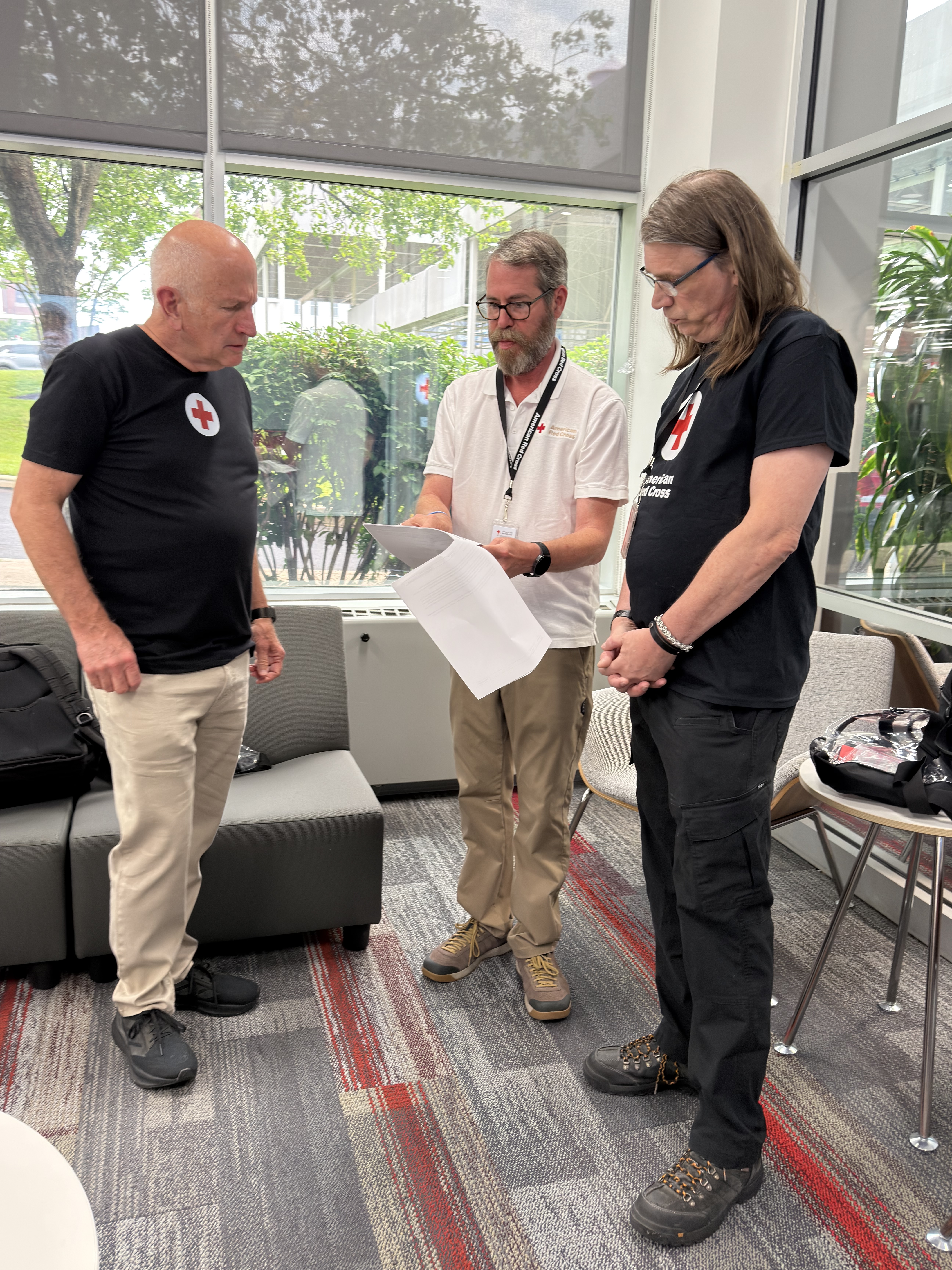
American Red Cross volunteers Griff Schrack and Linda Szypula served on a microburst storm response team. Photo by Debbie Tevlin / American Red Cross
As the July microburst storm operation comes to a close, we want to take a moment to reflect on the impact made by our Disaster Action Team (DAT) volunteers.
From the earliest days of the response through the recovery operation, DAT duty officers and responders played a critical role in helping the affected communities. The team responded to disaster calls, conducted damage assessments, completed intake activities, coordinated resources and staffed Multi-Agency Resource Centers (MARCs). At every stage of the response, DAT teammates consistently stepped up.
During the operation, the American Red Cross served 134 people (39 families comprised of 78 adults and 56 children). DAT volunteers provided immediate emergency assistance that may include financial assistance, health and emotional care, referrals to community resources and ongoing recovery support. In partnership with the Philadelphia Office of Emergency Management, Red Cross teams staffed three MARCs, where they engaged with more than 300 residents and distributed 327 cleanup kits.
Red Cross volunteers Barbara McGarvey and Dinae Norris distribute cleanup kits at the Wynnfield Library on July 20th. Submitted photo
The response was strengthened by collaboration across Disaster Cycle Services: information and planning, detailed damage assessment, intake, financial and statistical Information, staffing, mass care, external relations and leadership. This collaboration ensured that duty officers and responders had the resources and support needed to serve clients effectively.
The numbers tell only part of the story. Behind every case opened, every cleanup kit distributed and every resource provided were DAT volunteers who answered the call when their communities needed them most.
To those who answered the call, THANK YOU! Your efforts reflect the strength of the Red Cross mission in action and the vital role DAT volunteers play in helping communities prepare for, respond to and recover from disasters.
About the Storm
On July 11, 2026, a series of severe microbursts moved through Philadelphia, producing straight-line winds of up to 70 mph and causing significant damage across West and South Philadelphia. The storms downed trees and power lines, flooded streets and homes, damaged vehicles and buildings and left thousands without power. The widespread impacts prompted a city disaster emergency declaration and a coordinated recovery response involving local, state, federal and nonprofit partners, including the American Red Cross.
Amateur radio operators (from left) Lee Erickson and Delancey Cheeks are pictured during their first Red Cross summer events shift on June 14 at the Spring Garden Campus. Photo by Debbie Tevlin / American Red Cross
By Jenny Farley and Alana Mauger
As Philadelphia hosts a summer filled with major sports events, festivals and large public gatherings, American Red Cross volunteers are preparing for something they hope never happens: a communications emergency.
Across the city, teams of volunteers are standing by to assist community partners if an emergency occurs during these historic events. Among those volunteers are members of the Red Cross Disaster Services Technology (DST) team, many of whom are licensed amateur (ham) radio operators.
On June 22, as thousands of soccer fans gathered for a match between Iraq and France, Red Cross DST Lead Cliff Hotchkiss and his team assembled at the Spring Garden Campus to prepare for the evening ahead. Their mission was simple but important: ensure reliable communications remained available if emergency responders and Red Cross teams needed them.
Amateur (Ham) Radios as a Communication Backup
While cell phones and internet-based systems handle most day-to-day communications, amateur radio provides a critical backup when traditional networks become overloaded, damaged or are unavailable.
“With the amount of crowds that we have in the city, it is not unlikely that the cell phone systems would get overloaded, and there might be interruption in cellular communication,” Hotchkiss said.
He said if cell phones went down, radios could be used to link the Red Cross groups around the city, including those at pre-staged family resource centers, the Spring Garden Campus, the Philadelphia Emergency Operations Center (EOC) as well as the Red Cross warehouse in Norristown if supplies were needed.
Hotchkiss shepherded his team through testing their radios, listening to a briefing, and going through a logistical run-through of the likely night ahead. He also had another role.
Shown from left to right are amateur radio operators and Red Cross volunteers Tom Barrett, Mark Pricskett, Richard Van Sleet, Cliff Hotchkiss and Aaron Bradshaw. The group is prepared to help with emergency communications during the summer events in Philadelphia. Photo by: Jenny Farley/American Red Cross.
“Net Control” Serves as the Host of the Night
On nights like this, think of Hotchkiss as the air traffic controller. When people are communicating on a radio, you don’t want everyone talking at once because it can get confusing. That’s where Hotchkiss comes in, operating in a position called “net control,” something he can do on his radio from home.
He said, “It’s kind of like, for lack of a better description, the host of the communication.”
Everyone reports to “net control” so that a bunch of people aren’t talking over one another.
“Acting as net control can be a real challenge. It takes a lot of practice and a lot of precision to do that,” he said.
Volunteers on Hotchkiss’ team of highly skilled amateur radio operators briefly sat at tables set up in the atrium at the Spring Garden Campus on June 22nd. Many of them were meeting each other for the first time.
All of them were working their first Red Cross event. Like Hotchkiss, they shared an appreciation for amateur radio and had earned the license required to operate them.
Amateur radio operator Sam Rausch checks in to Net Control from Central Parkway Library during his first Red Cross summer events shift on June 14. Photo by Eileen Raul / American Red Cross
Blood Donor Uses His Ham Radio Skills to Help the Red Cross
Volunteer Tom Barrett used to regularly donate blood until he had colon cancer and had to stop donating because of his medications. When he was a kid he wanted to be a paramedic, inspired by the 1970’s TV show “Emergency.”
He ended up in the music industry, teaching music theory and working for two publishers.
He also trained with the Delaware County Medical Reserve Corps and took first aid classes offered by the Red Cross.
Barrett got into amateur radio about 9 years ago and was ready to use his talents for the Red Cross.
“I already had the skills. This was an opportunity that came up and I’m happy to help,” he said.
Tom Barrett started volunteering for the Red Cross when he heard from the Amateur Radio Emergency Service (ARES) that there was a need. “They came to us asking if we had volunteers willing to help so some of us did,” he said. Photo by: Jenny Farley/American Red Cross.
Paramedic Learned About Amateur Radio from His Dad’s Military Service
Aaron Bradshaw works as an emergency room tech and paramedic whose father was a radio operator in the military.
“Ever since then I just started picking it up and getting into it,” he said. Bradshaw met Hotchkiss through the Philadelphia Amateur Radio Emergency Service (ARES) group.
“He started mentioning stuff about the Red Cross and then I started looking into it and I was like ‘oh that will be interesting. I’ll give it a try.’ And here I am.”
Barrett and Bradshaw tested their radios out to make sure they were working before they headed to the shuttle that took them to their assigned location at South Philadelphia High School.
Red Cross volunteer Aaron Bradshaw is carrying his amateur radio equipment which could be used to communicate in an emergency. Bradshaw said, “When I got my amateur license about two years ago I wanted to get more involved in radio-like communication activities.” Photo by: Jenny Farley/American Red Cross
Self-Described “Tech Person” Puts His Radio to Work
Mark Pricskett and Richard Van Sleet stayed behind with their radios in a room at the Spring Garden Campus to provide communications support from there.
Pricskett had “always wanted to volunteer for the Red Cross and thought ham radio would be a good fit because of the technology.” He said, “I’m a tech person and I thought that’s where I could do my best stuff.”
One of the things he finds most intriguing about radio is that it is constantly evolving. He said, “Radio is no longer just on the radio anymore. It involves communication with the computer. There’s all kinds of different devices to communicate with that come under the radio heading, so it’s always changing.”
Shown from left to right: Richard Van Sleet, Cliff Hotchkiss and Mark Pricskett go over the communication plan at Red Cross headquarters at the Spring Garden Campus in Philadelphia. All three volunteers are licensed amateur radio operators. Photo by: Jenny Farley/American Red Cross.
Radio to the Rescue
So, what does an amateur radio operator do during an emergency?
Hotchkiss said, “One of the mottos of ARES is when all else fails, there is amateur radio.”
Radio can be used to communicate when phones aren’t an option.
Hotchkiss described an example of radio communication saving lives during Hurricane Helene in western North Carolina in September 2024.
He knew an amateur radio operator who lived in a neighborhood that became unreachable in the storm when the bridge to the community was destroyed.
“They were completely isolated. There was no way you could get to them,” he said. “Amateur radio played a really major part because all of the cell phones were wiped out for weeks.”
The radio operator was able to relay messages that led to his elderly neighbors getting the help and medical supplies they needed.
Amateur radio operator Alex Haddad prepares to leave the Spring Garden Campus for his field assignment at South Philly High School on June 25. Photo by Debbie Tevlin / American Red Cross
Emergency Preparedness Goes Hand-in-Hand with Radio
Richard Van Sleet just started volunteering for the Red Cross two months ago and was on his first assignment. After he retired he got interested in emergency preparedness and radio seemed like a natural fit.
“It’s kind of like the ultimate. If everything else goes bust ham radio will work. That’s how I got interested in it as an emergency communication.”
In his job as “net control,” Hotchkiss is required to keep a record of all radio messages so that in a post-emergency review, people can study what becomes the public record of what happened.
Except for the stormy weather, the night went relatively “smoothly” according to Barrett. He said they checked in with the team at the Spring Garden Campus every 30 minutes and fortunately “nothing happened.”
Being on standby to act in case of emergency is something Red Crossers know how to do well.
Van Sleet shared a sentiment that most in Hotchkiss’ group of radio warriors may have been thinking.
“You prepare for these things but you actually hope nothing will happen. If that’s not the case, I think we’re ready,” he said.
Amateur radio operator Chris Kelleher checks in to Net Control during his shift at South Philly High School on June 27. Photo by Sean Snyder / American Red Cross
In celebration of Black History Month, we invited colleagues to share their thoughts and stories as proud Red Crossers that make up our inclusive team in Southeastern Pennsylvania. Please note, the views expressed in this post are of the author and not necessarily those of the American Red Cross. Learn more about our culture of mission, impact and inclusion.
By Christal Harte
Christal Harte is a volunteer writer with Red Cross Southeastern Pennsylvania’s communications team. Submitted photo
Since I was a child, it was always impressed upon me how important it is to serve. I can’t pinpoint exactly when it began, but I can look back and see clear threads in my life pointing toward service. In fifth grade, I volunteered to help kindergarteners learn to read. In junior high, I spent my free periods supporting the dean with various activities. In high school, I volunteered with the I Have a Dream Foundation in New York City, working with elementary-aged children to support their math and literacy skills.
I walk through life acutely aware that we render service to one another no matter our occupation or education, and that everyone deserves dignity and respect. Even in college, I chose a path of service, majoring in InternationalService with dreams of going abroad to serve others in different cultures and communities and to extend the right hand of friendship that America had to offer. I spent time in the Peace Corps before eventually making my way back stateside.
After the housing market crash and financial crisis of 2008, I worked a string of jobs—each fun in its own way. In February 2017, I was let go from a startup due to lack of continued funding. I’m a pragmatic optimist, and I saw that moment as an opportunity to rediscover myself and spend time serving. I went straight to the Red Cross website to look for roles where help was needed.
I started as a volunteer on the Disaster Action Team, which has a training program that prepares you to respond to local crises, with opportunities to support nationally when the need arises. From there, I supported several initiatives under Lisa McGee, then the Workforce Engagement Manager for the State of New Jersey. I did administrative work and helped deploy disaster teams to local fires, providing ground support to people in need.
Later, I came across a posting to write blogs for the Red Cross. By then, my life had changed—I was married and had two children (now three). Even as life grew busier and I served in my church and community, I didn’t want to let go of my Red Cross work. Writing allowed me to stay connected, learn more about the organization and its people, and share their stories.
I’ve always loved to write—from poetry to songs to stories. Being part of the Red Cross and contributing in a way others can learn from is deeply satisfying. It brings me joy to serve while maintaining a busy home and work life.
In high school, an actor named Henry Winkler—best known as “The Fonz” from Happy Days—came to speak to our class about one way he served: donating blood. He shared why he donates and why others should too, simply saying, “You donate blood, you save a life.” That stayed with me. He found a way to serve, and over time, I have found mine.
There’s a movie called Pay It Forward about a young boy who starts a simple idea: do something kind for three people and ask them to “pay it forward” to three more. The story shows how small, ordinary acts of service can ripple outward and change lives in ways we may never fully see. That’s what volunteering with the Red Cross feels like to me. You may not always witness the long-term impact of what you do, but every shift, every hour, every act of care matters to someone.
If you’ve ever felt a quiet nudge to give back, I encourage you to listen to it. Find a place to plug in—whether it’s the Red Cross or another organization close to your heart. Your way of serving may look different from mine, but it is no less meaningful. Sometimes all it takes is one step, one yes, and one small act to begin a journey of service that can bless both others and yourself.
The American Red Cross Southeastern Pennsylvania Region responded to more than 594 local disasters in 2025, helping nearly 3,000 disaster survivors with shelter, food, clothing, emotional support and much more. Here is what they had to say about the Red Cross and its volunteers.
Disaster survivors in their own words 2025. Watch on You-Tube. Video by Alana Mauger / American Red Cross
Southeastern Pennsylvania Regional Disaster Officer Lisa McGee surveys damage as part of a Red Cross reconnaissance team in remote western Alaskan villages. Photo courtesy of Lisa McGee.
Hundreds of American Red Cross disaster volunteers have mobilized to support communities in western Alaska devastated by the remnants of Typhoon Halong. Among them is Southeastern Pennsylvania’s Regional Disaster Officer Lisa McGee, who departed Philadelphia last Friday to serve as a zone coordinator for at least three weeks.
Approximately 1,500 Alaskans were evacuated from remote villages that are only accessible by boat or plane. These include the villages of Kipnuk and Kwigillingok where the most severe damage occurred. Evacuees were flown first to Bethel, then to Anchorage—nearly 500 miles from their homes. In Anchorage, the Red Cross and its partners are providing safe shelter, food, emergency supplies, emotional support and health services.
Culturally informed care
Lisa is staying in Bethel, a “hub town” serving approximately 48 villages, many with distinct customs and languages. She starts each day at Bethel’s modest airport – described by Red Crosser Alli Katterheinrich of the Northwest Ohio Region as “just one small building with a luggage conveyor and security.” From here, Lisa travels by small plane and all-terrain vehicle (ATV) to remote villages as part of a two-person Red Cross reconnaissance team. The teams meet tribal and government leaders to assess needs and provide culturally respectful support.
Lisa McGee travels by ATV to an Alaskan village with her driver Joseph. Photo courtesy of Lisa McGee.
So far, Lisa’s team has visited the villages of Quinhagak, Chevak and Akiachak. She was also en route to the village of Eek in a four-passenger plane before hazardous snow conditions forced them to turn around. Despite the challenges, she said the tribal leaders have been “very warm and welcoming,” even arranging transportation from the airport to the villages for Red Cross workers.
Discussions with local leaders have focused on infrastructure damage, including roads, power lines, homes, public buildings and utilities. Across the villages, the team has observed widespread destruction of boats, fish and smoke houses, fish camps and fishing equipment.
“These losses are critical since fishing is their subsistence. They enjoy their fishing culture, which has been handed down over centuries from their ancestors,” Lisa shared via email. “During my Red Cross brief, the facilitator shared that these native people have been living on this land for centuries.”
Additional Red Cross teams are deploying by boat and plane to deliver relief supplies, including non-traditional items such as freezers and bleach, as well as building materials like tin and plywood to support urgent repairs.
The airport in Chevak, Alaska. Photo courtesy of Lisa McGee
Red Crossers prepare to board a plane that will take them to a remote village. Photo courtesy of Lisa McGee.
View of Alaskan tundra from the plane. Photo courtesy of Lisa McGee.
A fishing boat damaged by Typhoon Halong. Photo courtesy of Lisa McGee.
Long road to recovery
Back in Anchorage, several hundred evacuees are staying in shelters, while others are staying with friends and relatives or have made other arrangements. Anyone affected is welcome to stop by a Red Cross emergency shelter for a place to rest, a hot meal, to charge their phone or get other support.
As winter approaches, many homes across the region are uninhabitable—some swept from their foundations and carried out to sea. Utility poles are down, boardwalks (which serve as roads and sidewalks) are destroyed, and residents are without power or running water. Food stores are ruined, and heating stoves are damaged.
Emergency responders warn that some villages may need to be completely rebuilt. Recovery could take up to 18 months, and delivering building materials is increasingly difficult as winter ice halts barge deliveries.
Red Crosser Dale Kunce talks to residents at a local school in the heavily-damaged village of Kipnuk, Alaska on Oct. 19, 2025. Photo by Scott Marder/American Red Cross.
How to help
Help people affected by disasters like floods, fires and countless other crises by making a gift to American Red Cross Disaster Relief. Your gift enables the Red Cross to prepare for, respond to and help people recover from disasters big and small, whenever and wherever they occur across the country. Visit redcross.org.
CBS 3 reporter Ray Strickland talks with Lisa McGee at Philadelphia International Airport before her deployment to Alaska on Oct. 17, 2025. Watch it on You-Tube.
Disaster Mental Health Lead Randy Miller (far left) with Disaster Health Services Volunteer Nina Carroll (center) and Disaster Spiritual Care Lead Charline Scott (right) at a reception center in Bucks County in 2023. The three volunteers are also members of Incident Care and Condolence Team. Photo by Alana Mauger / American Red Cross
From a single-family home fire to widespread destruction caused by a natural disaster, American Red Cross volunteers are there when families need them most. But holistic disaster recovery is more than blankets, cots and meals.
“The thing that is often most helpful is just being present, being a good listener and allowing people to share their story,” said Randy Miller, Disaster Mental Health lead for the Red Cross Southeastern Pennsylvania Region.
That presence can be a powerful first step in helping someone begin to heal after a traumatic event.
“When we are present for someone in the immediate period after a disaster, we’re offering relief and release. People can talk about what happened and start to process it and think about their priorities and first steps,” she explained.
Randy is a retired psychiatric nurse and a certified grief and loss educator. Like her, all members of her team are licensed professionals. But their role with the Red Cross is to provide support strategies, not therapy.
“We talk about resilience, and if they’re still struggling after those few initial calls, we will refer them to support in their community,” she said.
Building toward recovery often starts with a simple but powerful tool: psychological first aid.
“It’s all about the first 24 to 48 hours after a disaster,” she said.
According to the the Psychological First Aid Field Operations Guide, the approach reduces the initial distress caused by traumatic events and fosters both short- and long-term coping strategies. Ready.org summarizes its core principles as “listen, protect and connect,” focusing on establishing safety and comfort, making human connections, providing calm and hope and enhancing self-efficacy.
Every Red Cross disaster responder is required to complete a four-hour Psychological First Aid course, for which Randy is one of the instructors.
She stressed that being a good listener in the immediate aftermath of a disaster is an important first step in connecting someone with the right resources and helping them build strategies.
“It’s asking someone, ‘what is the most important thing to them today?’ Because we might think it’s one thing when it’s totally something else,” she said.
For those who survive a disaster, Randy shares this advice: identify people in your life who can be present for you.
“A lot of times, people are afraid to ask for help. It can really be a challenge, but it’s a big thing to be able to ask for help and know that people and organizations will be there for you,” she said.
Randy encourages everyone to check out FindHelp.org, a free tool that her team uses to connect survivors with community resources. You can filter resources by distance, insurance, language and more.
Every day, Red Cross volunteers like Randy bring comfort, hope and healing to people facing their darkest moments. If you’re looking for a meaningful way to give back, consider joining the Red Cross as a volunteer. No matter your background or experience, there’s a place for you on our team. Get started at redcross.org/volunteer.
World Mental Health Day
October 10th is World Mental Health Day – a powerful reminder that there is no health without mental health. This year’s theme, “Access to services: Mental health in catastrophes and emergencies,” focuses on the urgent need to support the mental health of people affected by humanitarian emergencies. The theme reflects the heart of the Red Cross mission.
According to the World Health Organization, crises such as natural disasters, conflicts and public health emergencies can cause significant emotional distress—leading one in five survivors to experience a mental health condition. Supporting the mental well-being of those affected by humanitarian emergencies isn’t just important—it can save lives. It gives people the strength to cope, the space to heal and the foundation to recover and rebuild their communities.Visit wmhdofficial.com to learn more.
It’s one of the hottest days of the summer and your 25-story apartment building just lost power. A firefighter knocks on your door, telling you to evacuate. But how are you going to get your wheelchair down from the 11th floor? Oh, that’s right – the firefighters have a stair chair. It’s a little scary at first – being carried down in what amounts to a seated dolly, but unfortunately, you’ve done this before. You remind the firefighter that your insulin needs to stay refrigerated, and you worry about who will care for your cat.
Red Cross volunteer Richard Strayves guides a Courtyard Apartments resident to a SEPTA bus as she prepares to leave the shelter. Photo by Alana Mauger / American Red Cross
For residents of Courtyard Apartments at Riverview in South Philadelphia, the scene is eerily familiar. For the second time in just over a month, a small electrical fire led to the building’s evacuation. Those who couldn’t stay with friends or family were bussed to Kensington High School for the Creative and Performing Arts (Kensington CAPA), where the American Red Cross and Philadelphia Office of Emergency Management (OEM) set up an emergency shelter.
Red Cross disaster workers operated the first shelter for 11 days, starting overnight June 23rd through July 2nd. Just a few weeks later, many of those same workers were greeted like old friends by many of the same apartment residents as they arrived at Kensington CAPA overnight July 29th.
“Here we are again,” one of the residents sighed, greeting a Red Cross volunteer he recognized from his earlier stay. Overall, the sentiment, “I can’t believe this is happening again,” was palpable.
On a positive note, Red Cross and OEM disaster workers learned a few lessons between shelter operations and already anticipated many of the residents’ needs. From day one, Cantonese and Vietnamese interpreters, licensed practical nurses and fire department EMTs were stationed at the shelter, and vegetarian meal options and SNAP food replacement forms were available.
Left: Red Cross volunteers Rahel Pachter and Roy Landes interact with apartment resident Ann Cope and her cat, Nala, at the Kensington CAPA shelter. Right: Ann’s cat Nala hangs out in her pet crate. Photos by Alana Mauger / American Red Cross
Red Cross volunteer pet liaison lead Rahel Pachter led the charge to retrieve residents’ pets from their apartments and transport them to the shelter, where OEM and Animal Care and Control (ACCT) Philly provided crates and supplies.
“I could just kiss you!” apartment resident Ann Cope told Rahel when she was reunited with her beloved cat, Nala.
Ann was devastated to leave Nala behind during her first shelter stay. At that time, OEM and the apartment management coordinated with ACCT to care for residents’ pets inside their apartments.
With her wheelchair in front of Nala’s crate on Wednesday, Ann said, “I was sitting right there last night,” pointing across the gymnasium to her cot, “and I watched every move she made.”
Like Ann, Margaret Alston was happy to have her cat, Oreo, alongside her this time around. Looking for the positive in their situation, she said that being around a lot of people might make Oreo more social.
“I made new friends – people who live in my building that I didn’t know before staying here the first time,” she said, sitting on the gym floor in front of Oreo’s crate Friday. “Maybe Oreo will become more social, too.” She even ordered him a leash so he can take walks with her around the building when they return.
Left: Margaret Alston cuddles with her cat, Oreo, outside of his pet crate at the Kensington CAPA shelter. Photo by Alana Mauger / American Red Cross.. Right: Red Cross Pet Liaison Lead Rahel Pachter climbed all 25 floors with a Philadelphia firefighter to retrieve pets from their apartments during the recent building evacuation. Submitted photo.
Along with resident Howard Bussey, Margaret presented Red Cross disaster workers with a giant ‘Thank You’ card near the end of their first shelter stay.
“It was Howard’s idea, but I bought the card, and we got everyone to sign it,” she said. “We’re just so grateful for everything the Red Cross has done – BOTH times now.”
Thankfully, their second stay was shorter than their first one. After four days, apartment management moved residents to a nearby hotel, where they will stay until repairs are completed.
Together, the two operations supported 673 overnight shelter stays, 3,375 meals and 1,910 snacks. Operation partners included the Philadelphia School District, Philadelphia Fire Department, Philadelphia Department of Public Health, Philadelphia Department of Behavioral Health and Intellectual disAbility Services (DBHIDS), Philadelphia Office of Homeless Services, SEPTA, Salvation Army and Animal Care and Control (ACCT) Philly.
Hugs and handshakes were exchanged Friday, Aug. 1st as residents boarded SEPTA buses for their next destination. “Hopefully we won’t need you again,” one resident said jokingly as he left the shelter.
Hopefully not – but if they do, the Red Cross will be there.
A resident from Courtyard Apartments sits next to her cot in the Red Cross/Philadelphia OEM shelter. Photo by Alana Mauger / American Red Cross
Sometimes, a small fire can have a big impact. When an electrical box fire broke out at Courtyard Apartments at Riverview in South Philadelphia on June 23rd, the building’s fire suppression system did its job, and the flames were extinguished quickly.
But for the approximately 200 residents who call the building home, the situation was anything but easy. Utilities were cut, people were evacuated and those not staying with family or friends were bussed to Kensington Creative and Performing Arts (CAPA) High School a few miles north.
The high school gymnasium became home for 11 days as a shelter operated by the American Red Cross Southeastern Pennsylvania Region and the Philadelphia Office of Emergency Management. Red Cross disaster workers, mostly volunteers, staffed the shelter 24 hours/day.
Weary but resilient, 88 residents were shuttled to the shelter the first night. Most were older adults. Many were medically fragile and required help moving around. Some spoke little or no English. Several required culturally specific food. And despite the extreme heat advisory in effect for our region, almost all were too cold.
Red Cross disaster workers serve three meals per day plus snacks at the shelter. Pictured left are Ken and Molly Soondar and right is Jannette Labron. Photos by Debbie Tevlin and Alana Mauger / American Red Cross
Several warm blankets and slices of pizza later, residents began to settle in. By night two, half found other accommodations, leaving the shelter population to hover in the mid-40s for the remaining 10 days.
With the help of community partners, the shelter supported a total of 501 overnight stays, served 2,625 meals and provided approximately 1,650 snacks. In addition to these, residents had access to support services like interpretation, clothing, personal hygiene and comfort items, blankets, health services, spiritual care, emotional support and community referrals.
Red Cross individual disaster care volunteers were crucial to ensuring the wellbeing of the vulnerable shelter population. Soon the work of our disaster health, mental health and spiritual care teams was supplemented by community LPNs, EMTs and social workers. Interpreters who spoke Cantonese and Vietnamese ensured residents understood the information being provided.
Operation partners included Philadelphia School District, Philadelphia Fire Department, Philadelphia Department of Public Health, Philadelphia Department of Behavioral Health and Intellectual disAbility Services (DBHIDS), Philadelphia Office of Homeless Services, SEPTA, Salvation Army and Animal Care and Control (ACCT) Philly.
Left: Kensington Creative and Performing Arts High School Principal Patricia McDermott colors with shelter residents. Right: faculty member Shango-Jamal Lewis sings one evening at the shelter. Photos by Alana Mauger and Maureen Streeter / American Red Cross
The entire Kensington CAPA High School community went above and beyond just providing a physical space. The custodial and school safety staffs were attentive and helpful. Principal Patricia McDermott provided hooded sweatshirts, books, games and art supplies, and on several days, she personally worked on crafts with the residents. One evening, faculty member Shango-Jamal Lewis gave an impromptu vocal concert after dinner, including a rousing rendition of “Happy Birthday” for one of the volunteers.
Nine days into the operation, residents Margaret Alston and Howard Bussy presented Red Cross disaster workers with a giant card signed by everyone, thanking them for their care and compassion. The next day, letters written by local elementary-aged students were delivered and hung on the wall.
Top: Margaret Alston and Howard Bussy (third and fourth from right) present a thank you card to Red Cross disaster workers Maureen Streeter, Ed Robold, Sandy Capoferri, Melanie Boerner, Danelle Stoppel and Karen Nielsen. Bottom left: Card signed by Courtyard Apartments at Riverview residents. Bottom right: Residents read letters written to them by elementary age students. Photos by Owen Pendergast and Alana Mauger / American Red Cross
Just before dinner on July 3rd, residents got some great news; power and utilities were restored to the apartment building, and they could return to their homes! Hugs were given and a few tears were shed as volunteers helped residents pack up their belongings and board the busses that would drive them home.
The Red Cross is grateful to everyone who came together to care for our new friends during their time of need.
Red Crossers gathered at the Spring Garden Campus in Philadelphia to be recognized for their out-of-region deployments in 2024-25. Photo by Konrad Jones / American Red Cross
The American Red Cross Disaster Workforce Team hosted a Deployment Appreciation event on May 28th in Philadelphia for local volunteers and staff who deployed outside of the Southeastern Pennsylvania (SEPA) Region over the past year. Honorees enjoyed dinner and received certificates acknowledging their deployments.
Seventy volunteers and staff – representing 22% of SEPA’s deployable workforce – served during 121 deployments to assist with Red Cross disaster relief operations between January 2024 and March 2025.
Regional CEO Jennifer Graham thanked Red Crossers in attendance for taking time out of their busy schedules to support communities impacted by disasters and provide them with a pathway to recovery.
“It takes a village, and this is an amazing village, an amazing family here in SEPA,” she said. “I’m so proud to be able to work alongside every single one of you and am thankful for all that you did over the past year.”
Among their deployments, an astounding 64 volunteers and staff assisted people impacted by Hurricane Helene across North Carolina, Florida and Georgia, and 14 spent time in California helping those affected by wildfires. Twenty-two Red Crossers deployed two or more times, and eight deployed four or more times.
Volunteer Joe Hughes shares stories from his first-ever deployment last year in Northeastern Iowa. Photo by Konrad Jones / American Red Cross
Volunteer Joe Hughes was one of four local Red Crossers who deployed to flooded communities in Northeastern Iowa. It was his very first out-of-region deployment.
Sharing his experience as a member of the Mass Care Feeding Team, Joe stressed the importance of being flexible – like the cartoon character Gumby, he said – because deployment situations can change quickly and often. Despite the uncertainty, he enjoyed the service opportunity and said the most rewarding part was “staying in touch with the people.”
“Your training is your training, right? But the tools that you’ll use – your handshake, your hugs, your smiles and your reassuring tone of voice – that’s what connects more with these people,” he said. “I loved it. I’ll do it again. I encourage others to do the same.”
Before certificates were distributed, Director of Workforce Engagement Patrick Kobol surprised the group with a special video message from actor and comedian Richard Kind, who is a Bucks County native. Watch Richard’s video
Below, those who attended the Deployment Recognition Event on May 28th received certificates from Regional CEO Jennifer Graham and Regional Disaster Services Officer Lisa McGee. Photos by Konrad Jones / American Red Cross
Crucial need for disaster support
Volunteers are more critical now than ever as the Red Cross responds to a new major disaster about every two weeks. These massive events, like storms and wildfires, are on top of the home fires which occur multiple times every day across the country. To make sure no one faces an emergency alone, the Red Cross has a crucial need for disaster volunteers and is actively recruiting to be ready for disasters of all sizes.
Just like the people served, the Red Cross is proud that its volunteers represent a wide array of cultures, backgrounds, ages, lifestyles and beliefs. Everyone is welcome at the Red Cross. While volunteers of all types are needed, there is a strong need for people to support disaster operations.
Rahel Pachter is pet liaison lead for Red Cross Southeastern PA Region. Photo by Dianne Heard / American Red Cross
Much like Clara Barton, the founder of the American Red Cross, Rahel Pachter has dedicated herself to serving those in need with unwavering determination. Barton, known as the “Angel of the Battlefield,” fearlessly stepped into crisis zones to aid soldiers and civilians alike. Rahel embodies this same spirit of compassion and resilience, bringing comfort to both people and their beloved pets during disasters.
Rahel’s journey with the Red Cross began in 2019 as a blood donor ambassador, but her passion quickly expanded into disaster response and pet welfare. Witnessing the struggles of pet owners during emergencies, she took the initiative to become a pet liaison, ensuring that animals are not forgotten in times of crisis. Attending a Shelter Training Institute in California solidified her commitment, leading her to launch the pet liaison program in SEPA independently.
Rahel’s leadership shines through in her ability to make people feel safe and supported, even in the most trying circumstances. She has worked tirelessly to develop necessary forms and procedures for the Disaster Pet Liaison program. Rahel provides a valuable service to vulnerable pet owners. One of her memorable experiences involved helping an elderly woman who needed constant supervision. Recognizing the unique challenges in such situations, she plans to order essential supplies like slip leashes to assist responders in handling pets more effectively.
Like Barton, who built the Red Cross on the foundation of human connection and service, Rahel believes in the power of personal touch. She offers strong therapeutic hugs and brings hope to those she meets, ensuring that even in the darkest moments, no one feels alone.
As a Red Cross responder in Marion, near the Philadelphia line, she and her husband enter neighborhoods others might avoid, driven by faith and a deep sense of duty. As a Disaster Action Team supervisor, she mentors new trainees, witnessing firsthand the heartbreaking realities of those affected by disasters. Frustrated with the system’s temporary solutions, she dreams of creating a truly impactful organization to support people in need—just as Barton did when she revolutionized emergency relief.
One of Rahel’s biggest concerns is the lack of affordable, temporary housing for pets during disasters. The cost of accommodating animals in hotels is high, and she envisions a mobile spay-neuter unit to provide essential care on the go. By addressing these issues, she hopes to bridge the gap in disaster relief services for both people and their beloved pets.
For those who love heartwarming stories about pets overcoming adversity, “Homeward Bound: The Incredible Journey” (1993) is a must-watch. The film follows two dogs and a cat as they embark on a perilous journey across the wilderness to reunite with their family. Filled with adventure, resilience, and deep bonds between pets and humans, it’s a perfect companion to Rahel’s mission—showing just how much animals mean to the people who love them, especially in times of crisis.
Like Clara Barton, Rahel is driven by a deep sense of duty to serve others, always willing to step into disaster zones and fight for those who need help the most—whether they have two legs or four.
Editor’s Note: In commemoration of Red Cross Month and Women’s History Month, we are publishing a series of #LeadLikeClara profiles featuring local women volunteer leaders who emulate the leadership characteristics of Red Cross founder Clara Barton.