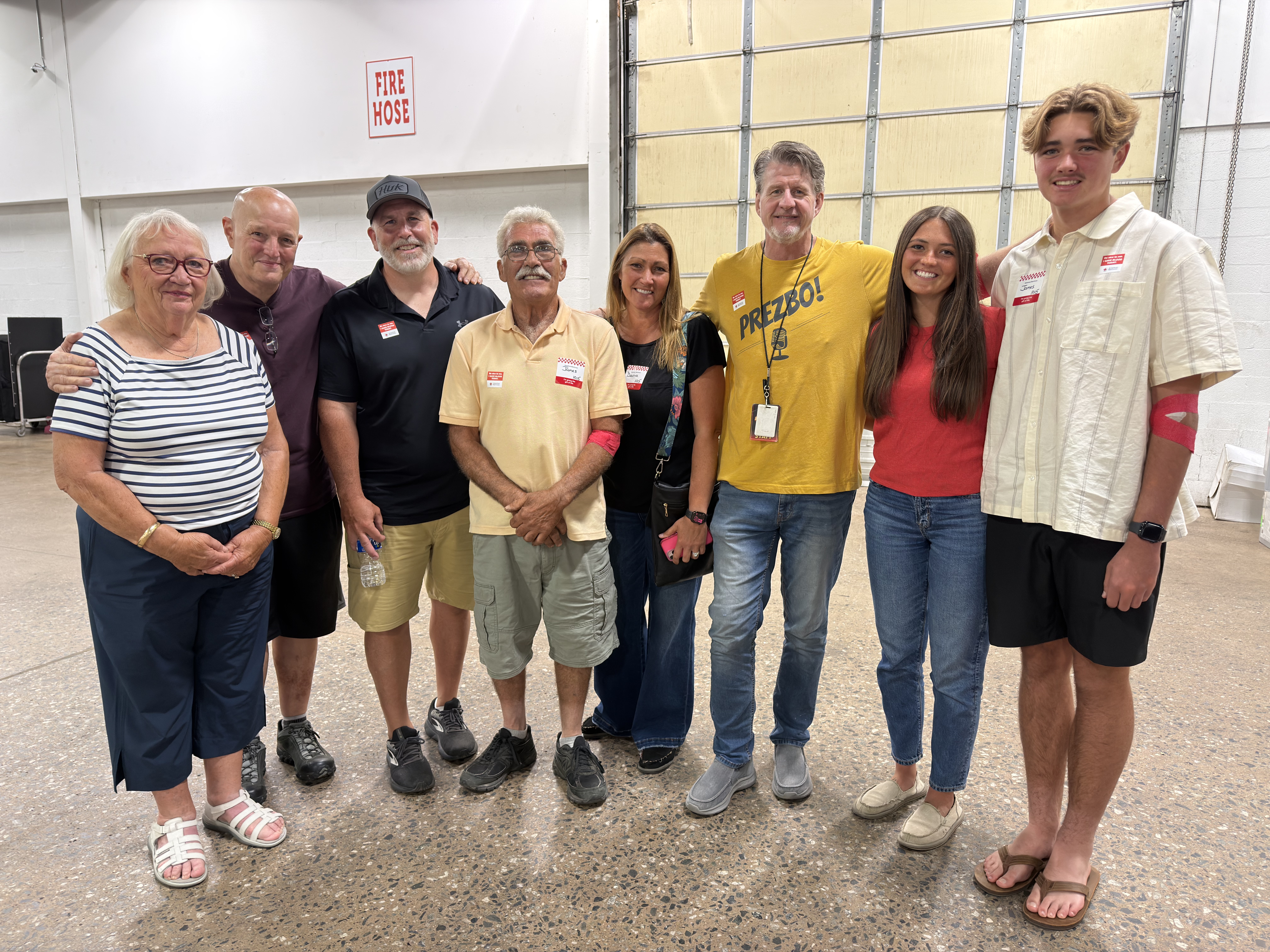
A family of blood donors came out to donate at the Red Cross “I Bleed for Preston and Steve” blood drive on June 19, 2026. That’s the day of longtime donor James Guarrera’s 73rd birthday. Shown from left to right are: Donna Guarrera, Preston & SteveMorning Show co-host Steve Morrison, Frank Kreider, James Guarrera, Danine Guarrera, Preston & SteveMorning Show co-host Preston Elliot, Taylor Sparks and James Sparks. Photo by JennyFarley/American Red Cross.
James Guarrera turned 73 on June 19, the day of the Red Cross “I Bleed for Preston and Steve” blood drive. He heard about it on his favorite radio station 93.3 WMMR, the station that broadcasts the Preston & Steve Morning Show.
The one gift he most wanted for his birthday was for his family to donate blood together. So, he brought them with him. You are about to meet a whole family of blood donors.
Giving a gift on your own birthday
Guarrera started donating blood years ago when his dad was in a construction accident.
“I’ve been giving for a few years now. I’m up to 87 units,” he said. He donates platelets, plasma and whole blood, which he donated at the drive.
“It’s a good thing for people to give. It doesn’t take you that long. It’s not painful and you’re helping somebody. So, this is my way today, on my birthday, to give a gift to somebody.”
Granddaughter builds up her iron to donate
Guarrera’s granddaughter Taylor Sparks, who turned 20 the week after the blood drive, first donated in high school but had to wait a year before giving again because her iron was too low. That didn’t discourage her.
She increased the amount of red meat in her diet and took daily iron supplements – all so she could donate blood whenever possible. On the day of the blood drive, she wasn’t feeling well and couldn’t give.
A shared blood type means two family members are universal donors
“I wasn’t eligible today, but it’s my grandfather’s birthday, and he donates blood all the time. He’s very passionate about giving his blood,” she said.
Taylor and her grandfather both have an O negative blood type. “We like to give our blood. It’s universal,” she said.
O negative blood is considered the universal donor blood type because it can be transfused into any patient. In an emergency, when doctors don’t have time to figure out what type of blood a patient has, they use universal type O blood.
Daughter donates for the first time and son-in-law is a longtime donor
Taylor’s stepdad Frank Kreider has donated blood many times this year already, including three platelet donations.
“It’s just an easy thing that we can do to help people,” he said.
Taylor’s blood drive appointment went to her mom Danine, Guarrera’s daughter who stepped in to donate for the first time.
“It’s great to give, and I felt good. I was a little nervous, but I’m okay,” she said.
Teen grandson’s donation is a way of saying ‘Happy Birthday‘
The blood donations didn’t stop there. Taylor’s brother James Sparks is a rising high school junior. He wanted to do his part to honor his grandfather too.
“It’s my grandpop’s birthday, and I’ve never given before.” He said, “It was a little birthday present for him.”
What’s a Power Red donation?
For his first time giving blood, James chose a Power Red donation, which the American Red Cross says has “twice the lifesaving power,” because it allows people to safely donate nearly double the amount of red blood cells.
A special machine is used so plasma and platelets get returned to you during the donation.
Coming from a family of blood donors, James was happy to celebrate his grandfather on his special day. He felt like it was his duty to “give a little bit of blood back to people who need it.”
Guarrera’s family planned to take him out to lunch after the blood drive, but he may have felt like he already unwrapped his present.
“It’s my birthday gift to get everybody to come,” he said.
Blood supply recovering, but vulnerable
Thanks to the generosity of thousands of people who rolled up a sleeve this summer, the blood supply continues to recover from critically low levels. As we enter September, the blood supply remains vulnerable — especially as we approach new seasonal challenges such as back-to-school activities that can cause donors to be less available to give, and the ongoing potential for tropical systems in the Atlantic, which can further threaten the blood supply by disrupting blood drives.
By making and keeping appointments now, donors can help the Red Cross ensure lifesaving blood products are on hand wherever they are needed, including communities where donations may not be possible due to severe summer weather and natural disasters.
If you’ve been thinking about donating but haven’t made your appointment yet, consider what first-time blood donor Danine said, “Give, because people need it. You never know who you’re going to help.”
To learn more about donating blood or to find a blood drive near you, go to RedCrossBlood.org.
Maddie Mafodda (right) holds her mom Allison’s hand as she gives blood for the first time. Submitted photo
Hi! I am Maddie Mafodda, and I’m soon ready to start my senior year at Academy of Notre Dame de Namur. This past April, I donated blood at my schools’ NHS Blood Drive for the very first time! Let’s talk about it!
I signed up to donate blood super spontaneously. I remember being in my Anatomy class, and deciding to sign up, because I was already so involved with the Red Cross. At that moment, I actually regretted signing up, but now, I don’t regret a thing!
On the actual day of the drive, I showed up to my school’s gym, where the blood drive was being held, and signed in. I highly recommend filling out your RapidPass to make the check in process much easier. Then, I sat and waited for my turn to be called up. I got to talk with my friends, classmates, teachers, and blood donor ambassadors about their experiences donating blood. Personally, I was super worried about the needle (I am NOT a fan of needles), so I talked these worries out with the people who had donated blood many times before that day. It was super comforting!
Then, I got called up. I had to get my basic vitals taken as well as confirm some information about myself and my health, which was super quick because I had filled out my RapidPass. Then, I waited there for a table to open up and it was my turn to lay down and give blood.
I was so nervous! I thought I had talked out all of my nerves, but walking to my table brought all of my nerves back. Looking back, I have no idea what I was so nervous about. I laid comfortably on my table, while the phlebotomist cleaned my arm and found the vein she was going to use. She was super nice and reassuring, since she knew it was my first time donating blood. Then, she slipped the needle into my arm, and let it sit for about 5 minutes before my bag was full and she removed it. Honestly, it wasn’t as bad as I thought it would be! I was expecting to be in excruciating pain for the time that the needle was in my arm, and it just ended up feeling like a very hard pinch, followed by some moderate discomfort, which was relieving.
During my 5 minutes, I squeezed my fist together to make the blood pump faster, and I think that helped a lot! I am also not afraid to admit that I squeezed my mom’s hand, because it was still my first time!
Once it was all over, I walked right over to a large mat our school had set out for us. I sat there and rehydrated with juice and ate pretzels and cookies to refuel. I needed it! When you donate blood, you give about 1 pint of blood, which is a lot! Initially, I felt super faint, but after a short amount of time (and lots of snacks), I felt ready to get back to the rest of my day! I felt like myself again by the next morning when I woke up.
Overall, giving blood was a nerve-racking experience, but it is so rewarding! I got an email telling me exactly what hospital my blood went to, which was so cool to hear! I loved getting that follow up knowing that my donation truly saved lives.
I would TOTALLY recommend giving blood to anyone on the fence about it. Plus, you can tell all of your friends about the cool thing you did!
A few tips: Make sure you eat lots of food and drink plenty of water (+ electrolytes!). I honestly think this is what helped me feel better so soon after donating; it is very important! Make sure you get a good night’s rest! Donating blood while tired seems AWFUL; imagine already being tired and becoming more tired by donating blood! Yikes! And lastly, I skipped my track practice after school that day to rest and relax, which I highly recommend you do as well. Maybe have a nice self care night! You deserve it!
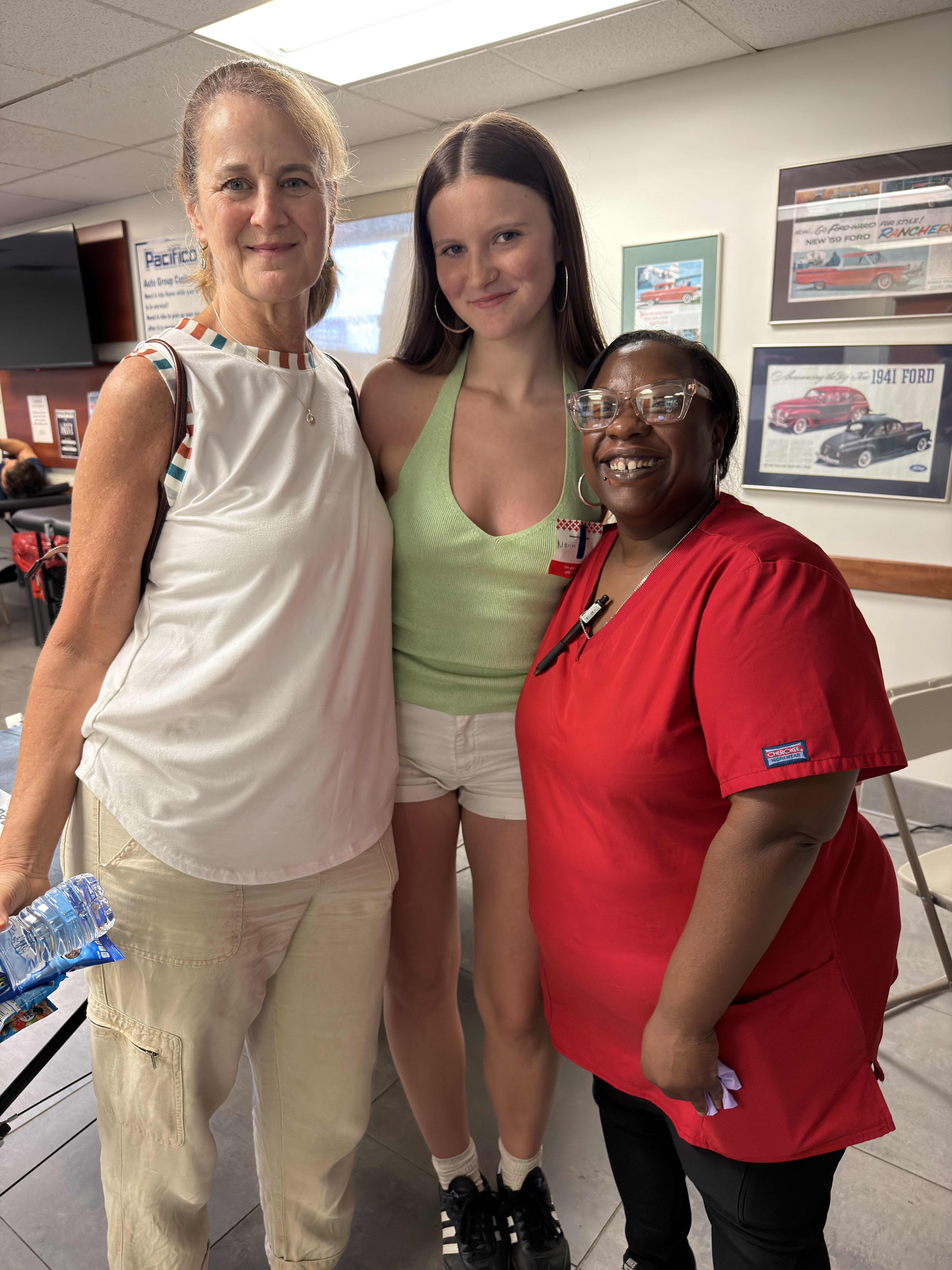
Maria Shankin is shown with her daughter Marin Shankin and phlebotomist Ikea Smith at the Red Cross blood drive at Pacifico Ford on July 13, 2026 in Philadelphia. Marin donated blood for the first time one day before her 21st birthday. Ikea Smith is used to helping first time blood donors. She said, “I just try to walk them through the process and just make them feel comfortable and let them know that everything’s going to be okay.” Photo by Jenny Farley/American Red Cross.
Marin Shankin and her mother Maria are big fans of “Breaking Bad,” the hit TV show that starred actor Bryan Cranston.
When Cranston posted that he would be at a Red Cross blood drive at Pacifico Ford on July 13th, both knew they had to make the trip to see him in person.
“I saw on Instagram that my good friend Walter White was going to be here,” Marin said.
Walter White is the fictional character Cranston played.
One day before Marin would celebrate her 21st birthday, she and her mother headed to the blood drive.
“I was like, ‘oh, maybe it’ll be fun if I donate my blood with Bryan,’” she said.
Marin said even though blood drives happen at schools and other places, normally it might not be the type of event she found herself attending until now.
“I’ve just never done it before.”
Marin had been studying abroad in Italy before coming home for the summer. She and her mom have been re-watching “Breaking Bad” all the way through for the second time.
“We’re right in the middle of it and we’re huge fans the first time around. We love it even more this time,” Maria said. “We jumped in the car and came down.”
Cranston donated blood at the drive and inspired many other people like Marin to donate too. The mom and daughter duo said it probably won’t be the last time Marin donates.
Maria said, “You need somebody to get you started and if it’s Bryan Cranston, then so be it, right?”
According to Maria, over a period of 20 years, Marin’s dad had a “very bad heart problem” and received several transfusions.
“He had two open heart surgeries, and he needed blood many times.So, it’s a good thing she’s doing,” Maria said.
Ikea Smith is a phlebotomist who has worked for the Red Cross for 8 years. She befriended the pair at the blood drive and talked to Marin as she checked on her during her donation.
“I tried to make her feel a little more comfortable.” She said, “I just kind of talked to her, just to get to know her a little bit, found out that tomorrow’s her birthday, her 21st birthday, so she was really nice.”
Ikea said it made her feel good to see a first-time blood donor and she told Marin something she’s witnessed before, “Once you start donating, you’ll want to continue to donate.”
Marin agreed. She said donating blood might become a new birthday tradition.
“It’s a good thing. She’ll never forget it,” Maria said.
Marin has something to say to other young people who are thinking of donating but haven’t done so yet.
“You should do it. It’s not bad. It’s not hard and I feel like you’re young and healthy and able and can help other people.”
Right now, for only the second time ever, the American Red Cross has declared a national blood crisis. All blood types are needed but especially type O.
Nearly half of the people who live in the United States have type O positive blood and O negative is what doctors use first in an emergency when there isn’t time to figure out a patient’s blood type.
If just three more people donate at each blood drive this summer, the Red Cross says the blood supply will stabilize. If it doesn’t, doctors may have to make decisions about patient care based on whether or not they have available blood on the shelves. Some surgeries could be delayed.
If you would like to make an appointment to donate, you can get more info at RedCrossBlood.org.
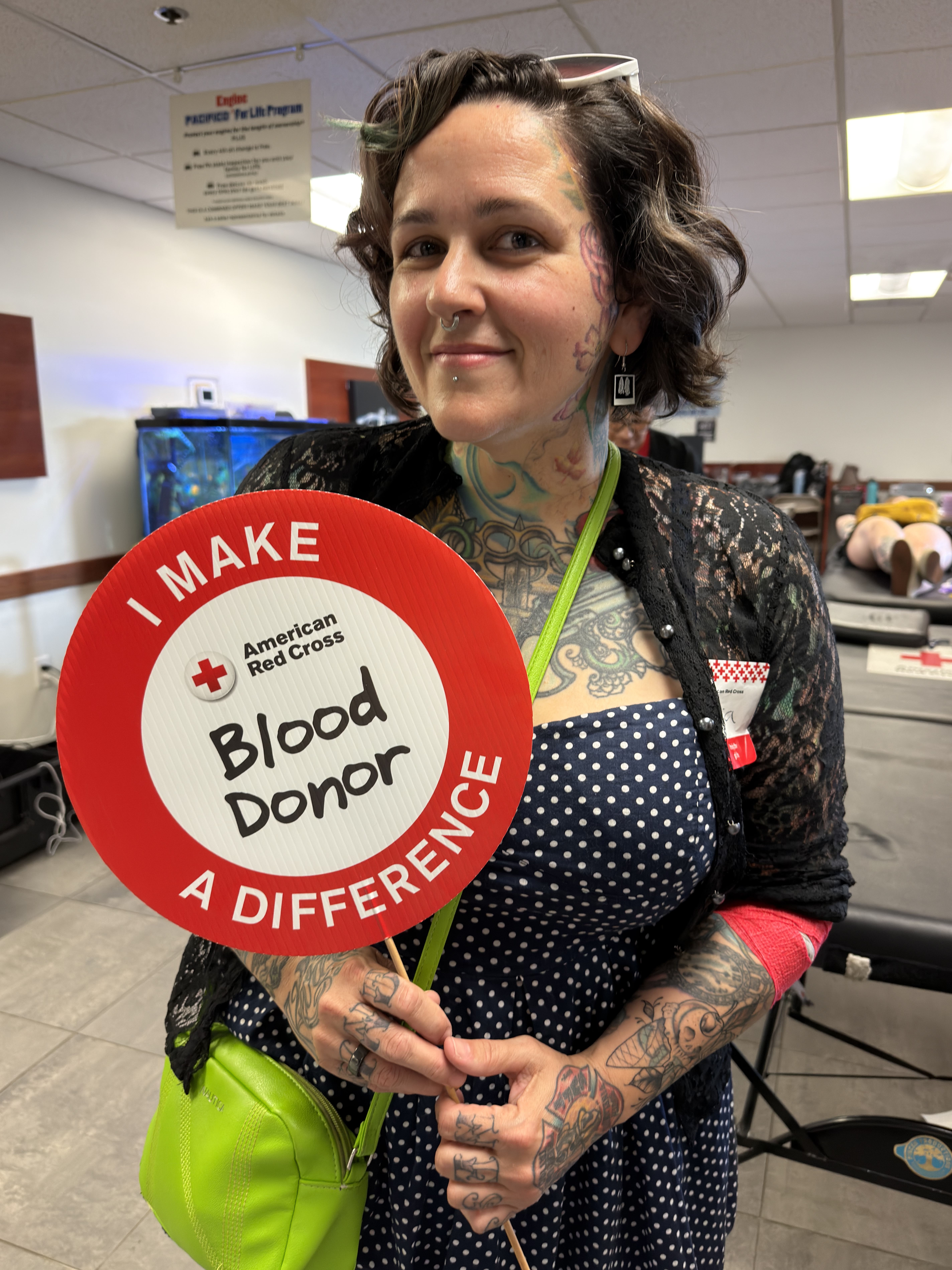
Marcy Letizia’s life was saved by platelet transfusions years ago when she nearly died after giving birth. She said back then when her family was in the hospital waiting room “hoping that I was gonna make it” they all donated blood. When she recovered she did too. She said, “Every time I would get a chance, I would try to donate.” Photo by: Jenny Farley/American Red Cross
It had been about ten years since Marcy Letizia donated blood, so when her friend Mary texted that they should do it she thought, “I’ve been trying to do new things and trying to have a new chapter of life a little bit so, I figured I might as well.”
Letizia showed up to donate at an American Red Cross blood drive hosted by Pacifico Ford in Southwest Philadelphia, held in cooperation with the Ford Building Together initiative and Major League Baseball.
When she was checking in, someone mentioned to her that there was a celebrity there that day.
“Who?” she asked.
Bryan Cranston, she was told. Letizia couldn’t believe it. “I didn’t think she was correct. I was like, ‘No, no’!”
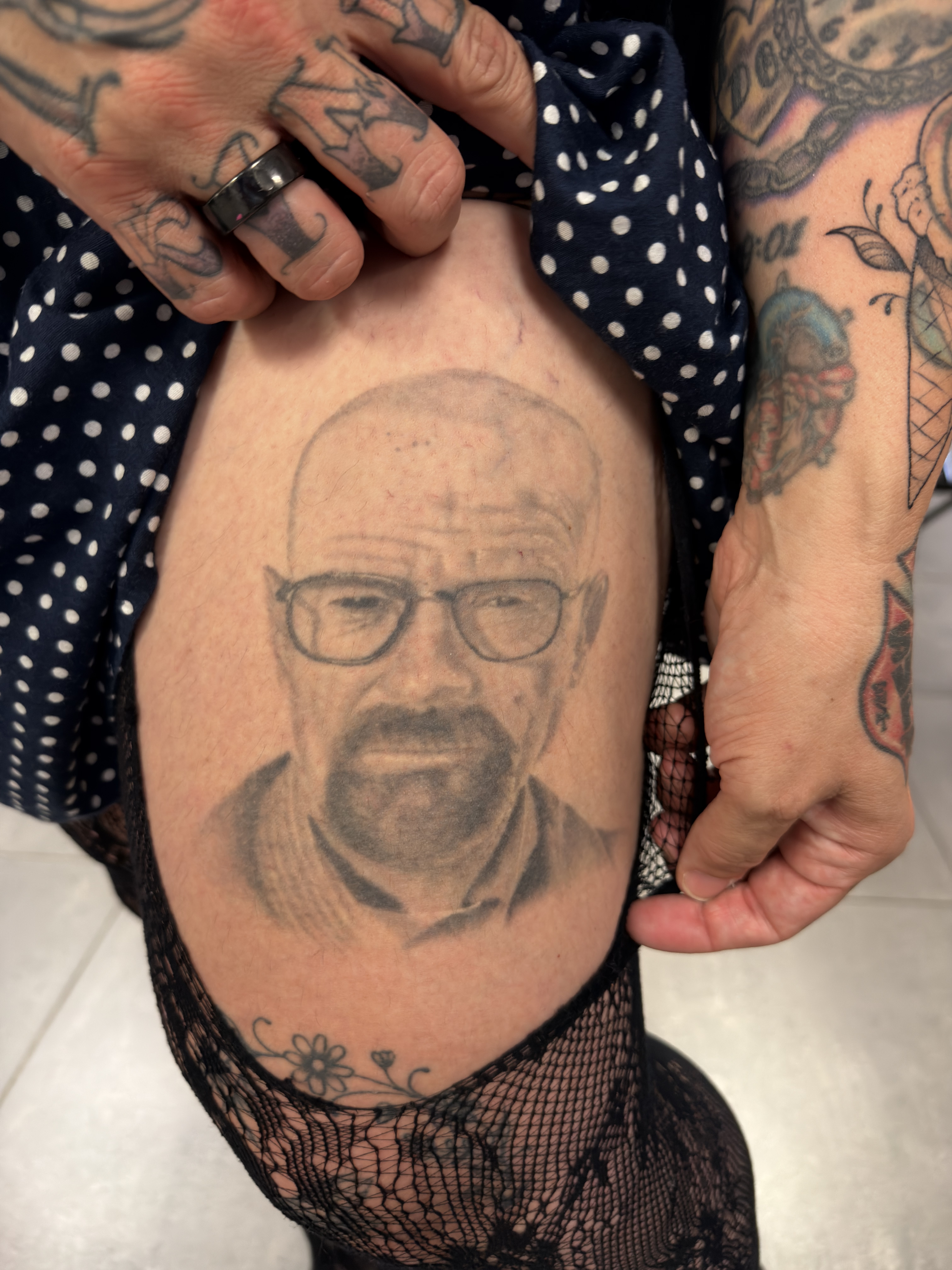
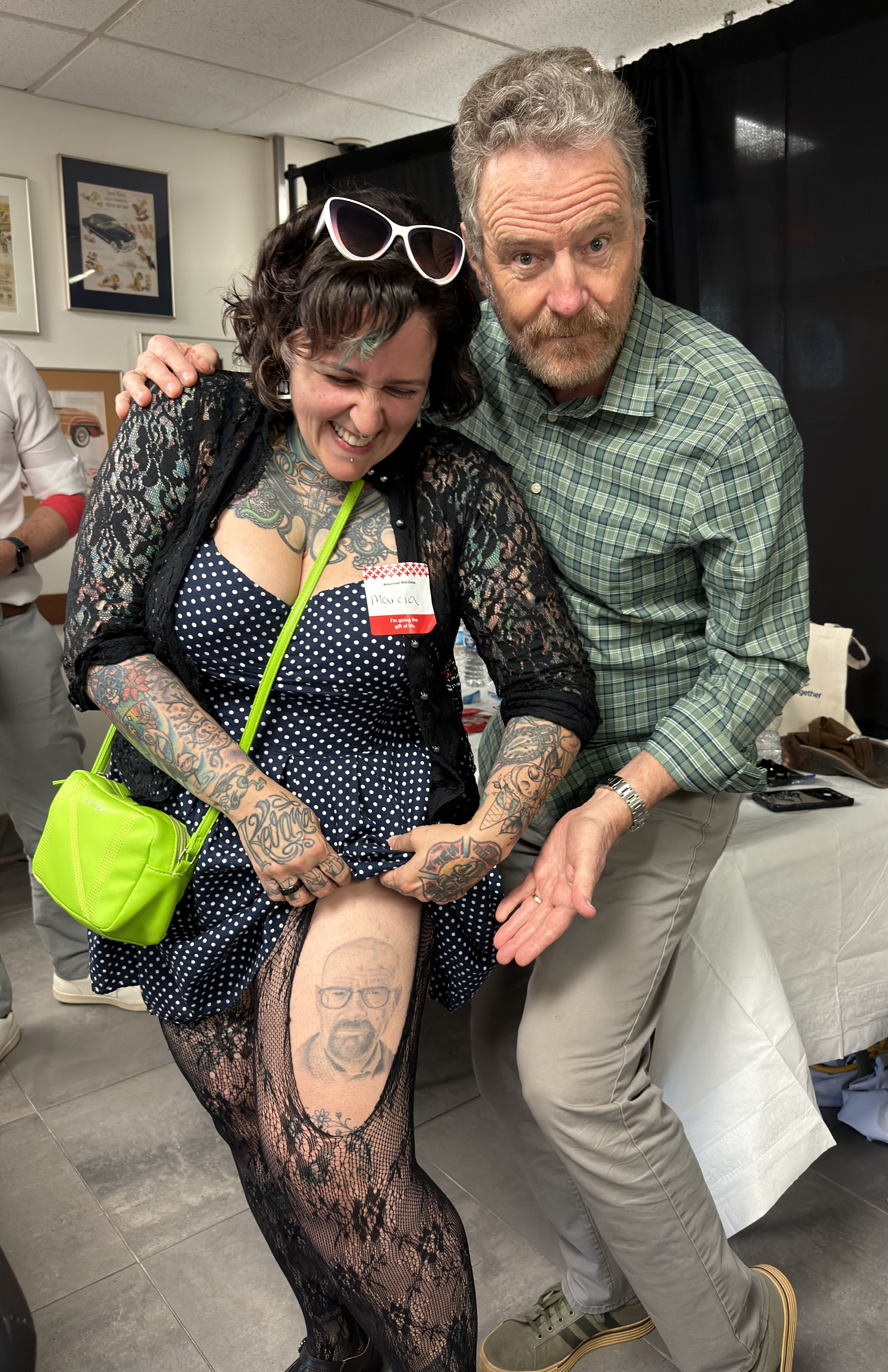
Letizia and her husband own a tattoo shop in New Jersey. Her husband is the artist who tattooed, what is arguably the most famous TV character Cranston has ever played, on Letizia’s thigh about 13 years ago.
“Breaking Bad’s” Walter White. “We’re kind of super fans.”
She said, “I had no idea he was here. I just came to the blood drive.”
Marcy Letizia owns a tattoo shop in Vineland, New Jersey with her husband, the tattoo artist who did this tattoo of Bryan Cranston’s famous fictional character Walter White from “Breaking Bad.” Photo by JennyFarley/American Red Cross
Cranston has won so many awards it’s hard to list them all. He’s been nominated for an Oscar. He’s won multiple Emmys, a Golden Globe and two Tony awards and many more.
He’s an actor, producer and director. He’s the voice of Ford Motor Company and has done commercials for Ford for nearly ten years. He’s supported numerous causes and has a long history of philanthropy on his own and with Ford Philanthropy.
He’s also a blood donor.
Before he arrived at Pacifico Ford, Cranston promoted the drive from Center City on his Instagram.
He talked about being in town for Major League Baseball’s All-Star Game and mentioned the Red Cross, and two organizations that help feed hungry people in need – World Central Kitchen and Sharing Excess.
“What I’m here for is to bring awareness to these three great organizations that help our communities,” he said.
He urged people to come say hello to him and said, “I’m going to be giving blood.”
Many people caught that post and came to Pacifico Ford to see him, but stayed to donate blood, just like Cranston.
He felt strongly that in his case, to inspire people to donate, he wanted to do it himself or else his words would be “hollow,” he said.
And that’s how one of Cranston’s biggest fans got introduced to the only celebrity she’s ever wanted to meet.
Marcy Letizia came to give blood at the Red Cross drive at Pacifico Ford and had no idea she would get to meet Bryan Cranston after he donated blood too. She said, “He’s the one celebrity that I’ve always, always, always adored. He’s fantastic in everything that he’s been in. So, the stars aligning and just making it so I came here for a blood drive with my friend was just crazy.” Photo by Jenny Farley/American Red Cross
Letizia has two kids, who are 17 and 24. She said they watched Cranston’s hit series “Malcolm in the Middle” from the time they were little.
“It’s strange that everything aligned, that I actually got the meeting. It was crazy cool.”
She was wearing black stockings, but she ripped them just enough to show Cranston the tattoo of his face.
He joked, “I’ve got a tattoo of you!” And they both laughed.
Letizia won’t forget it. He was “so down to earth and normal and nice,” she said.
Nearly 25 years ago, Letizia nearly died when she lost too much blood giving birth to her daughter.
Platelet transfusions helped saved her. As soon as she recovered, she became a blood donor.
The American Red Cross is facing an emergency blood shortage as the blood supply fell nearly 25% in June. There is also an emergency need for platelets. Donors are urgently needed to give now to help ensure patients receive lifesaving medical care without delay. The shortage is especially serious for types O positive and B negative blood. Visit RedCrossBlood.org to schedule an appointment to donate.
Isabella Rosa hates running. That didn’t stop her from running ten miles in the Broad Street Run in Philadelphia. Broad Street is lined with lampposts. Each time she ran past one she told herself, “Just get to the next lamppost.”
She thought getting to the next lamppost was a good metaphor for life, so she knew what one of her nine tattoos was going to be.
“I got myself a little lamppost,” she said.
For Isabella Rosa, life is all about getting to the next lamppost so she had one tattooed on her arm. She also has two cross-stitch needles, a floral design and a heart tattoo with a crying face, which is one of her favorites. When she donated blood at the Staff Donor Day drive on July 9, she said, “If I could help anybody who needs blood, I really would love to.” Photos by Jenny Farley/American Red Cross
Jessica Kohn is a big “Game of Thrones” fan. When she had a bone tumor removed from her ankle, she waited for the scar to heal and knew what would make the perfect tattoo.
“Like they say in the show, ‘What do we say, to the god of death?’ And she says, ‘Not Today.’ So, that was a very meaningful tattoo.”
Kohn said the tattoo reminds her that she came out on the other side of an ordeal.
Now, Kohn donates blood to “pay it forward.” She said, “I’ve had so many people help me with my illnesses and injuries, surgeries that I’ve had.”
Jessica Kohn got her octopus tattoo in Sedona, Arizona, and her “Not Today” tattoo after she recovered from having a bone tumor removed. She got a raccoon tattoo because she volunteers at a wildlife center helping to rehab orphaned and injured animals and return them to the wild. She said, “Raccoons are my favorite animal that I work with.” Photos by Jenny Farley/American Red Cross
For Laura Hash, tattoos can have meaning or just be beautiful to look at. She has a palm tree tattoo to commemorate a 50th birthday trip she took with her friends, and she’s drawn to tattoos of music notes and flowers.
“They’re very vivid. I love them. The tattoo artist did great,” she said. Hash also has tattoos on her hip and thigh.
Laura Hash donated blood at the Red Cross “I Bleed for Preston and Steve” blood drive on June 19. She has musical and floral tattoos and also has one of a palm tree to commemorate the trip she took with her friends to celebrate turning 50. Her friends got a matching tattoo. Photos by Jenny Farley/American Red Cross
The Lifesaving Connection
Rosa, Kohn and Hash all love tattoos and they are all blood donors. Rosa works in the National Molecular Lab as a genetic analyst at the American Red Cross Spring Garden Campus. She analyzes DNA sequences to “help type people’s blood” so that recipients who may need more specialized blood than traditional blood types can get what they need.
She donated blood at the Staff Donor Day blood drive on July 9. “The more that I work here, the more that I realize that it really is a need for a lot of folks, and if it’s something that I can help with, by giving 7 minutes of my time, I’m happy to do that,” she said.
Hash and Kohn donated blood at the “I Bleed for Preston and Steve” Red Cross blood drive on June 19.
Kohn said she likes donating blood to help others.
“My favorite part is getting the email to tell me where my blood’s going.” She said, “It’s nice to know oh, it went here to the kids’ hospital, it went here to this place, and so that’s a pretty cool part of it.”
Kohn is an animal lover who has volunteered at a wildlife center for 10 years. Many of her tattoos are of animals and some are dedicated to the memory of beloved pet cats that have died.
Having tattoos won’t stop you from donating blood. On National Tattoo Day, we are reminding you of what you need to know:
Red Cross graphic: Got Ink? What you need to know about tattoos and blood donation.
Have a Tattoo? Here’s What You Need to Know to Donate Blood
Pennsylvania is one of seven states and the District of Columbia that don’t have regulations for tattoo businesses, so you must wait three months after getting a tattoo before you can donate blood.
Those states include: New York, Maryland, Massachusetts, New Hampshire, Idaho and Wyoming.
The delay is because of concerns about hepatitis. The Red Cross tests blood donations for hepatitis B and hepatitis C, but it takes time to detect the virus. If you have hepatitis, don’t donate blood.
In states that regulate tattoo facilities, there is no delay before donating blood, as long as the tattoo business uses fresh ink and sterile needles.
If you apply your own tattoos or get tattoos in states with regulations but from unregulated businesses or artists, you will still have to wait three months between getting your tattoo and donating blood.
If you have questions about donating blood with tattoos or piercings, learn more at RedCrossBlood.org.
American Red Cross Southeastern Pennsylvania Regional CEO Jennifer Graham and Red Cross Regional Donor Services Executive Helen Munizza grab a photo with the Preston & Steve Morning Show crew after their broadcast on June 19th from the Greater Philadelphia Expo Center in Oaks. Pictured (from left) are Ryan Shuttleworth, Casey Fosbenner, Helen Munizza, Steve Morrison, Jennifer Graham, Preston Elliot and Marissa Magnatta. Photo by Donn Greenberg / American Red Cross
By Jenny Farley and Alana Mauger
Missy Hinspeter doesn’t like needles. But on June 19th, the sixth-grade science teacher rolled up her sleeve anyway. Her A negative blood type is rare, found in only about 1 in 16 people.
“It’s good that I can give,” she said. It was her third time donating at the “I Bleed for Preston & Steve” Blood Drive, and as a big fan of the show, she was happy to see them again in person – even if the needle stick made her nervous.
Across the room, fellow Preston & Steve fan Bill Paoletti had a different reason for being there. After losing a leg in a motorcycle accident 8 years ago, he said that wearing a helmet and days of blood transfusions helped save his life.
Nearby, Erin Crew donated blood on her schedule of every 56 days. She’s been giving blood for years, starting after her father survived leukemia, relying on transfusions along the way.
“I was his life donor, so he’s gone through a lot of blood,” she said. “We figure as long as I’m able to keep donating, I’ll give as much as I can, because we know firsthand how important it is.”
Left: Missy Hinspeter donated blood even though she “hates needles.” She tries to donate at least once a year. Center: Bill Paoletti lost a leg in a motorcycle accident. Blood transfusions helped save his life. He said, “Knowing people care enough to donate got me to where I am today.” Right: Longtime blood donor Erin Crew was asked what she’d tell someone thinking of donating blood that hasn’t done it yet. She said, “It’s so easy. It’s fast and you get snacks.” Photos by Jenny Farley / American Red Cross
Stories like these filled the Greater Philadelphia Expo Center in Oaks as more than a thousand blood donors, volunteers and fans came together for the 21st annual 93.3 WMMR “I Bleed for Preston & Steve” Blood Drive — held in one location for the first time since the COVID-19 pandemic.
By the end of the day, the American Red Cross collected 1,048 units of blood, retaining its distinction as one of the largest, single-day blood drives in the country.
“People were heeding the call,” Steve Morrison said during the show’s June 23rd broadcast as he and co-host Preston Elliott announced the totals.
Preston reflected on the sheer number of donations. “A lot of blood drives, you’ll hear tens, maybe a hundred, couple hundred, but very rarely do you get in the 1,000 mark,” he said. “You just knocked it out of the park. You saved a lot of lives.”
Giving Back and Raising Awareness
This year’s blood drive took place on Juneteenth, a federal holiday that commemorates the end of slavery in the United States. It also coincides with World Sickle Cell Day, adding a deeper layer of meaning and opportunity for education.
“Juneteenth is a holiday we are proud to be a part of and recognize, as well as World Sickle Cell Day. We’re making sure we’ve got a space for our blood donors to come in to be able to donate, help our diverse communities and have a little fun while they’re at it,” said Jennifer Graham, CEO, Red Cross Southeastern Pennsylvania Region.
She described the long-running event as “an amazing legacy” that serves as the Red Cross “unofficial official kickoff to summer.”
Jennifer Graham, CEO, American Red Cross Southeastern Pennsylvania Region, talks on-air with the Preston & Steve Morning Show on June 19th. Photo by Alana Mauger / American Red Cross
The day provided a bit of education in addition to the opportunity to have fun and give back. Throughout the drive, 93.3 WMMR DJs shared information about sickle cell disease and encouraged their listeners to step up to help ensure the Red Cross maintains a diverse blood supply.
Preston recalled a character from season one of the TV show “The Pitt” who was admitted to the hospital during a sickle cell crisis.
“She was in excruciating pain and came very, very close to dying until they diagnosed it and got her a transfusion,” he shared during the broadcast.
Because they may receive frequent transfusions, people living with sickle cell disease may develop an immune response to blood that is not closely matched to their own. A patient in need is more likely to find a compatible blood match from a donor of the same race or a similar ethnicity, which is why the Red Cross is committed to maintaining a diverse blood supply at all times.
Blood Collections Supervisor Ashley Barrett helps host Preston Elliot locate his veins while producer Casey Boy holds the mic during the live broadcast of the Preston & Steve Morning Show on June 19th. Photo by Alana Mauger / American Red Cross
Collections supervisor Ashley Barrett talked listeners through the blood donation process and helped Preston identify which of his veins would work best for drawing blood. The Morning Show also tackled how seasonal challenges and a packed calendar of major events compete for people’s time.
“We are certainly in a spot where the number of people scheduling donations has dropped by about 20%,” Graham said during her live radio interview.
Preston issued a call to action for everyone listening, “If you can’t make this blood drive, go to RedCrossBlood.org to find out where you can find one in your general area. But donate this summer, for sure, and every 56 days.”
Powering a Life-Saving Effort
A blood drive of this magnitude wouldn’t be possible without dedicated Red Cross volunteers and staff.
Maureen O’Connell spent the first official day of her retirement volunteering as a Red Cross blood donor ambassador. She just retired after 41 years as a nurse, and you could tell she was still thinking of her patients.
“I worked in the hematology/oncology unit, so often I would just hang units and units of blood and platelets, and I always said I want to give back some day,” she shared.
Maureen O’Connell is a newly retired nurse who volunteered for the Red Cross as a blood donor ambassador at the drive. She said, “I just love the donors. They’re so joyful!” Photo by Jenny Farley/American Red Cross.
Preston and Steve praised the dedication of Red Cross staff who showed up and put in long hours to make the day a success.
“Everybody is in such a great mood,” Preston observed. “Every time we do this, they love it.”
Steve gave a special shout-out to the Red Cross collections team. He said they “just really take great care of you, and the end result is, you know, again, you’re seeing a lot of smiling people.”
Preston and Steve, who both donated blood at the event along with producer Ryan Shuttleworth, are already gearing up for next year’s drive.
“So the question is, we’re back up into stellar numbers – should we make a real concerted effort next year to break that record?” Steve asked, referring to the 2019 drive, which collected more than 1,400 donations.
“For real, I think we could do it,” Preston responded. “After this many years of doing it, I thought maybe you’d see things wane a little bit; not even close.”
Preston Elliott (top) and Steve Morrison (bottom) donate blood at the 21st annual “I Bleed for Preston & Steve” Blood Drive. Photos by Donn Greenberg / American Red Cross
Celebrating a Movement
In front of an audience of excited blood donors and their friends and families, 93.3 WMMR hosts broadcast their shows live from Oaks for a full 12-hours. That included the drive’s namesake Preston & Steve Morning Show, followed by Jacky Bam Bam in for Matt Cord in the afternoon and Brent Porche who was on the air until the last blood donation appointment at 7 p.m.
Throughout the day, radio hosts, blood donors and Red Crossers celebrated the life and legacy of beloved 93.3 WMMR DJ Pierre Robert, who died on Oct. 29, 2025. Pierre broadcast his afternoon show live from the blood drive every year for the past decade. Pictured left: A blood donor presents radio host Jacky Bam Bam with a portrait of Pierre. Photo by Donn Greenberg / American Red Cross Pictured right: Radio host Brent Porche hangs out with Pierre’s nephew Brett Robert during his live broadcast between 3-7 p.m. Both are wearing Pierre-themed T-shirts. Brett read a proclamation for Pierre earlier in the day during Jacky’s show. Photo by Alana Mauger / American Red Cross
The hosts and producers mingled with fans, launched boomerangs and even broke into an impromptu roller-skating party at one point. They patiently signed autographs and posed for hundreds of photos with thrilled blood donors who walked away with a limited-edition Preston & Steve T-shirt, along with other goodies.
With music blaring and crowds moving through the space, the event felt like part celebration, part mission-driven movement. It’s rooted in the megafans – like Tom VanDuyne and Craig Powell – who return year after year and in the 89 new donors who gave blood for the first time.
“It feels good that I’m able to do this and that Preston and Steve and the Red Cross have been doing this now for 21 years and it has kept going,” Powell said. “I hope that it continues on for many more years.”
Morning Show super-fans Tom VanDuyne (left) and Craig Powell (right) have come out to donate blood at all 21 “I Bleed for Preston & Steve” Blood Drives! Tom said donating is a “piece of cake.” Photos by Jenny Farley / American Red Cross
CEO Jennifer Graham summarized the event best.
“You come for the party. You come for the experience. You come for the people. You leave helping save lives, and there’s nothing more impactful than that.”
Paying it Foreward
As seasonal challenges grow, the Red Cross has an urgent need for blood and platelet donors to give now to help ensure hospitals stay ready to help patients without delay. Book a time to donate blood or platelets by visiting RedCrossBlood.org, downloading the Red Cross Blood Donor App or calling 1-800-RED CROSS.
Above: American Red Cross photos from the 21st annual “I Bleed for Preston & Steve Blood Drive on June 19th at the Greater Philadelphia Expo Center in Oaks. Photos taken by Donn Greenberg, Jenny Farley, Kai Kwong and Alana Mauger. Check out our Flickr album for more!
Editor’s Note: In commemoration of Red Cross Month and Women’s History Month, we are publishing a series of #LeadLikeClara profiles featuring local women volunteer leaders who emulate the leadership characteristics of Red Cross founder Clara Barton.
Longtime American Red Cross volunteer Carla Venditti talked about the importance of blood donor ambassadors. She said, “You are the firstperson they see in a blood drive and you have to make them feel so welcome. It’s a great feeling. You’re looking at people you’ve seen in the past and they keep coming back and you’re so thankful that they’re there giving blood.”
By Jenny Farley
Carla Venditti first volunteered for the American Red Cross at the age of 18 when she became a water safety instructor and taught little kids how to swim during her off hours as a receptionist at the YWCA.
After retiring from 25 years in the tech industry she returned to volunteering for the Red Cross.
“You can’t sit still when you retire,” she said.
After donating blood one day she sat down at the blood drive and asked someone there a simple question, “You need help?” That was in 2004 and she’s been a volunteer ever since.
Carla donates blood every 56 days and will soon have donated a staggering 23 gallons. She knows how the blood donation process works as a donor, and in her volunteer role she works as a blood donor ambassador and the scheduler of volunteers for blood drives in Bucks County.
She makes herself available “24/7 – because they call me all hours of the day, emails all hours – every day of the week – to say whether they’re canceling out of a blood drive or they want to sign up for a blood drive.”
Blood drives need volunteers to successfully operate and Carla takes pride in making sure the volunteers get to staff their favorite drives.
“I plug their names in. Even when they don’t see it – their names are going into blood drives because it’s their favorite one and they want to go back. The donors love seeing the same volunteers, because they remember their names.”
There’s an art and finesse to coordinating so many different schedules and she’s dedicated to keeping her team happy and successful.
“They’re all really good people that work for the Red Cross.” She said, “I really love my team. They know I look after them.”
She also makes sure volunteers know how important being a blood donor ambassador really is. Blood donor ambassadors greet donors, make sure they are properly registered and keep the refreshments stocked.
“You’re greeting people and making them feel like they’re a million bucks for doing what they’re doing. That’s important because nobody has to give blood. You can’t reproduce blood. They’ve tried. You cannot create blood. So, we are all needed to help other people.”
If you are thinking of volunteering for the Red Cross, Carla wants you to know, “It’s an enjoyable experience. You get to meet a lot of people, and you get to learn a lot of stuff. You learn so much from being a volunteer.”
Rachel Noethen is a Red Cross volunteer duty officer and blood and platelet donor. Submitted photo
American Red Cross volunteer Rachel Noethen wants you to know it’s never too late to give blood for the first time – or in her case, to get back into the habit of donating.
Rachel has donated blood in the past, then paused as life got busy.
“I don’t even know why I stopped doing it,” she shared.
Seeing natural disasters and severe weather strain the national blood supply inspired her to roll up her sleeve again.
“I kept seeing it pop up on Red Cross social media pages, so I got back into it,” she said.
Rachel gave blood at the Horsham Blood Donation Center in the fall, then she made her very first platelet donation on New Year’s Day.
Giving blood and platelets is just the latest way Rachel supports the Red Cross. She also serves as a volunteer duty officer on the Disaster Action Team (DAT). In this role, she volunteers from home, taking requests from local authorities and dispatching Red Cross teams to help families affected by home fires and other emergencies.
Rachel typically volunteers two to four times per week, often covering the early morning 4–8 a.m. shifts that are notoriously difficult to fill.
“It’s such a great team, very welcoming” she shared. “The support of everybody is what keeps me super motivated.”
She also recently joined a Sound the Alarm smoke alarm installation event in Bucks County, giving her the chance to “put some faces and names together” since her duty officer work is virtual.
Beyond her Red Cross service, Rachel volunteers with the Philadelphia Folk Festival and Hemlock Edge Rescue.
Severe Blood Shortage
The Red Cross is facing a severe blood shortage and urges people to take action now to help offset the impact of recent winter storms. To schedule an appointment to donate blood or platelets, visit RedCrossBlood.org.
Tracy Hampton doesn’t just donate blood—she champions it. As a self-described sickle cell fighter, she has turned her personal commitment into a movement, inspiring others to see blood donation not as a chore, but as a powerful act of solidarity. For Tracy, every pint of blood is a promise: a promise to ease someone’s suffering, to stand with sickle cell patients, and to fight for a healthier future.
Tracy’s blood donor journey began when she was 18, inspired by her mother, who worked at the Children’s Hospital of Philadelphia and donated regularly. Her commitment followed her through college and military service with the U.S. Air Force, but gained a deeper meaning when the Red Cross alerted her that she is a Rare Donor Type with blood factors most beneficial to sickle cell patients.
Now a Pharmacist at Temple University Hospital, she began learning more about the impact of sickle cell when a work colleague shared his own sickle cell patient journey. His story and the red cross commitment to helping sickle cell patients, coupled with her unique ability to donate this specific blood type, made her own commitment grow deeper and even more meaningful.
Tracy Hampton champions blood donations for sickle cell warriors. Submitted photo
Why Tracy’s Activism Matters
Sickle cell disease is the most common inherited blood disorder in the U.S., affecting about 100,000 people, primarily of African descent. The disease causes red blood cells to become rigid and crescent-shaped, leading to painful blockages, anemia, and organ damage. Symptoms can begin as early as infancy, and for many patients, blood transfusions are the only way to manage these complications.
The challenge is that sickle cell patients often need very closely matched blood, and those matches are most likely to come from donors of similar backgrounds. Because of this, the supply isn’t always as diverse as the need. Tracy’s activism helps bridge that gap. By donating herself and inspiring others to join in, she’s strengthening the blood supply and making it more inclusive for everyone who depends on it.
The Red Cross Connection
The American Red Cross has recognized the urgent need for specialized blood donations for sickle cell patients. Their initiatives include:
Targeted blood drives that encourage donors from communities most affected by sickle cell disease.
Sickle cell trait screening for donors offers valuable health insights while identifying the best matches for patients.
Awareness campaigns that highlight the importance of diverse blood donations and their lifesaving impact.
A Personal Connection to the Cause
For Tracy, donating blood is more than a routine; it’s deeply personal. Each time she gives, her blood is marked with a distinctive blue tag, ensuring it is set aside specifically for sickle cell patients who need closely matched transfusions. Through the Red Cross Blood Donor App, she follows the journey of her donation, seeing where it travels and knowing it has reached someone whose name she may never know but whose life she has touched. That connection fuels her commitment.
Her dedication has already earned her 30 Red Cross donor badges, a milestone she wears with pride as a symbol of the impact one person can make on the larger community. But Tracy’s vision extends beyond her own contributions. She wants people to learn more about sickle cell disease and understand how profoundly it shapes the lives of patients and families. With greater awareness, she believes, comes greater compassion and a stronger collective commitment to help.
At home, Tracy is raising two boys, ages 4 and 13, and hopes her example shows them that they are empowered to help others and give back to their community. For her, blood donation is not just about saving lives today; it’s about continuing a legacy of service and compassion passed down through generations of her family.
Tracy’s story embodies the mission of these programs. She is living proof that one donor can spark change, and that activism can be as simple and as powerful as giving blood.
Her activism reminds us that the fight against sickle cell disease isn’t fought in isolation. It’s fought in community, in compassion, and in the quiet courage of donors who choose to give. By following her lead, we can ensure that hope flows as surely as life itself.
When most of us think about donating blood, we picture a quick visit, a tiny needle, and a pint that disappears into the system. What we rarely see is the story behind that pint—the life it touches, the family it helps, and the hope it brings.
Debbie’s story is one of those reminders.
Debbie with her husband, who received 5 units of blood during his battle with esophageal cancer. Submitted photo
A Night That Changed Everything
Debbie’s husband was diagnosed with Stage 4 esophageal cancer—a diagnosis that instantly changed the rhythm of their lives. During his treatment, while recovering at his second rehabilitation facility, he suddenly experienced a dangerous drop in blood pressure. He was rushed to the ER, where doctors acted fast and gave him five pints of blood.
Those five pints—donated by strangers who had no idea who they would help—gave Debbie’s husband strength and stability at a critical moment.
“I try not to think about what we would have done if that blood wasn’t available,” Debbie said. “That was the moment I realized how important donating blood really is.”
For Debbie, it wasn’t just a medical procedure. It was a gift of time, comfort, and connection when she needed it most.
Finding Strength as a Partner and Caregiver
Supporting a loved one through cancer feels like walking a tightrope—balancing fear, hope, and responsibility every single day. Debbie describes the emotional weight of being strong for her husband while carrying her own grief in silence.
Honoring his wish to keep the diagnosis private meant she bore much of the burden alone. When she finally reached out to her mother, she realized how much she had been holding inside. Looking back, she wishes she had asked for help sooner—a reminder that caregivers need care too.
A Love That Did Not Change—Even as Life Did
Debbie’s love for her husband never wavered; if anything, it deepened. The hardest part, she recalls, was watching him change physically and emotionally while facing an uncertain future.
After he passed away in early 2025, Debbie struggled to return to the plans they once made together. The silence in their home—where laughter once filled the rooms—made her grief even heavier.
“I realized how precious time is and not to take it for granted,” she said. “I just feel very sad he’s not here to share our lives and grow old together.”
Her words echo a universal truth: time with loved ones is irreplaceable. Often, it’s the smallest shared moments that mean the most.
Transforming Grief into Purpose
Debbie often thinks back to that night in the ER—the moment when donated blood gave her husband strength and stability. She wonders how different things might have been if that blood hadn’t been there.
That question guides her today.
In honor of her husband, she now donates blood every year on their wedding anniversary.
“I realized how important blood donations are,” she said. “I wonder what would have happened if the ER didn’t have those five pints my husband needed.”
For Debbie, donating blood is both a personal act of remembrance and a way to help families facing their own emergencies.
Why Blood Donation Matters
Debbie wants people to understand one simple truth: “Without donations, there is little hope for people in need. With donations, there is.”
Blood donations help in ways we rarely see—during surgeries, emergencies, cancer treatments, and more. They stabilize crises and give families something priceless: more time together.
For someone navigating a life-changing diagnosis, each transfusion can mean another conversation, another shared moment, another chance to hold on—even briefly—to hope.
A Message of Support for Others
Debbie also wants caregivers and families facing similar challenges to know they are not alone.
“Reach out and talk to people,” she said. “Don’t keep it to yourself. Seek any emotional support you can.”
Her words remind us that care isn’t just medical—it’s emotional, too. And just like blood donors, communities can make all the difference.
A Call to Give Hope
Debbie’s story reminds us that every blood donation matters. Her husband’s extra time wasn’t measured in years, but in moments—moments that were only possible because donors chose to give.
To schedule an appointment to donate blood or platelets, visit RedCrossBlood.org.